


Early intervention focuses on provision of specialised support and services for infants and young children who present with disability and may be at risk for ongoing developmental and speech and language delays. Our speech team at AC believe that by providing families of these children with the necessary information and support to monitor and intervene proactively will allow their child to benefit from early childhood intervention and reduce further difficulties in their communication, speech, language and interaction with others.. Between birth and age five, a child’s brain is highly flexible and receptive to learning, a period known as neuroplasticity. Addressing language difficulties during this critical window can significantly improve long-term outcomes including language understanding and expression, literacy, social confidence, and academic achievement.
Children understand before they speak/communicate. Delaying support for language understanding affects expression i.e. how and what a child communicates. It also makes it harder for the child to catch up to their peers and can lead to frustration, lower self-esteem, and challenges making friends. Timely speech therapy for a child at risk for delays in their development can reduce minor delays from becoming major obstacles your child continue to experience a fulfilling relationship with others and supports their learning, understanding and expression of needs, wants, and choices.
Common Signs of Language Delays
Parents are ideally placed to first notice when their child’s language may not be similar to other children their age. Here are key language milestones and warning signs to watch for (Adapted from Speech and Language Development Chart (2nd Ed.) by Addy Gard, Leslea Gilman, and Jim Gorman, Pro-Ed):
Age | Receptive language (Understanding) | Expressive language (Talking) |
0-3 months | – startles to loud sounds – tracks visually and eyes move toward sound – turns head toward voice – mouths some objects | – cries, coos, gurgles – begins blowing bubbles |
3-6 months | – anticipates feeding when sees bottle – smiles at face – recognises spoon/bottle – laughs when playing with objects | – babbling begins (to others/self/objects) – vocalises pleasure/displeasure – stops vocalising when adult enters – self-initiated vocal play |
6-9 months | – looks at common objects when names are said – Understands “no” and stops – searches for partially hidden objects – bangs objects together | – uses wide variety of sound combinations – reduplicative babbling “bababa” |
9-12 months | – begins to relate symbol and object – will give toy/object on request – responds with searching movements to simple questions – turns head immediately to own name – indicates displeasure when object is removed | – can name or look for subject out of sight – first true word – gestures &/or vocalises to indicate wants/needs |
1 – 1 ½ years | – follow simple 1-step commands – points to recognised object – points to wanted object – begins to claim certain objects (emerging possession) – points to 1-3 body parts on command – identifies 2-3 objects/pictures from a group – perceives others’ emotions | – uses 3-20 words – vocalises with gestures – says “all gone” – answers question “what’s this?” – asks for “more) |
1 ½ – 2 years | – understands approx. 300 words – listens as pictures are names – listens to simple stories – points to 5 body parts Responds appropriately to yes/no questions (head shake) | – uses approximately 50 recognisable words – uses names of most familiar objects – says own name on request – refers to self with name – verbalises “no” – combines 2 words into phrases (2 years) |
2 – 2 ½ years | – understands approx. 500 words – listens to 5-10 min story – carries out series of 2 related commands – identifies action in pictures | – increasing vocab up to 200 words – names 6 objects by use – repeats 2 numbers correctly – starts to answer “where/What…doing” questions |
2 ½ – 3 years | – understands approx. 900 words – points to 10 object pics described by their use – matches colours
| – increase in number of words used – answers simple “who, why. Where, how many” questions (3yrs) – can ask simple question “what’s that” – yes/no questions emerging |
3 – 3 ½ years | – responds to commands involving two actions – responds to commands involving 2 objects
| – responds appropriately to simple “how” question – beginning of question-asking stage – names 8-10 pictures – states action – supplies last word of line “the apple is on the…” – counts 3 objects pointing to each |
3 ½ – 4 years | – knows back and front of clothes Responds to commands involving 3 actions – recognises one colour | – tells 2 events in order of sequence – long, detailed conversations – repeats 12-13 syllable sentences (one of three trials) Can do simple verbal analogies “daddy is a man, mummy is a “ |
4 – 4 ½ years | – understands concept of the number (give me three) – names one colour – can recognise 2-3 primary colours | – counts four objects – rote counts 1-10 – responds appropriately – not necessarily correctly to “how far” questions |
4 ½ – 5 years | – expanding vocabulary up to 2800 words – completes 3 commands in sequence – able to classify according to form, colour or use | – uses 1500-2000 words – answers simple “when” questions “when do you sleep” – asks meaning of words – tells long stories accurately – counts 10 objects – repeats days of week in sequence – identifies missing object from group of 3 |
If you are concerned that your child is not understanding or speaking as per their age level, don’t wait… speak to your doctor or get a speech therapist to assess and provide you with guidance. At Accessible Care, we believe that it is important to seek advice and guidance early. The speech therapy team at Accessible Care can assist.
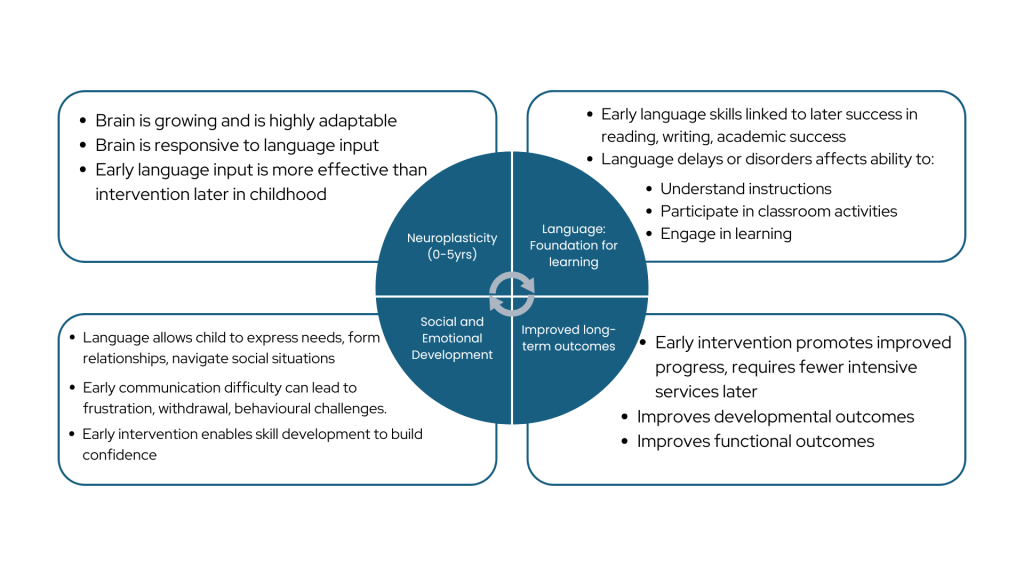
Why the Accessible Care team believe that intervening early in Language Development is Important
Ready to take the next step?
Start your child’s personalised Speech Therapy journey at Accessible Care . We are located in Coburg, Victoria and can accommodate you in-clinic, at your home/in community, at your child’s kinder/school. We have the experience and expertise to provide you with tailored support. Your voice matters and we are here to listen to your concerns about your child’s language development.

