


As a parent, you know your child best. So when a quiet worry about their development begins to surface, it’s natural to feel unsure of where to turn. The world of therapies and the NDIS can seem overwhelming, and you might wonder if seeking support through early childhood intervention will lead to your child being ‘labelled’. We want you to know that these concerns are completely valid, and you are not alone in feeling this way.
But what if seeking support was simply about giving your child the best possible start? In this gentle guide, we’re here to bring clarity and reassurance. We will walk you through what early intervention truly means, why it’s so important for building a strong foundation, and how it can help your child develop the skills and confidence to shine. Consider this your first step toward feeling empowered and confident in the path ahead for your family.
Key Takeaways
- Understand how specialised support can help your child develop essential life skills and build confidence for a bright future.
- Learn to recognise key developmental signs while also trusting your own parental instincts when you feel something isn’t quite right.
- Discover how a dedicated team of professionals delivers early childhood intervention and how a ‘key worker’ can become your main point of contact.
- Get a clear, step-by-step guide to accessing support in Australia, including how the NDIS Early Childhood Approach works for children under 9.
What is Early Childhood Intervention (ECI)? A Foundation for a Bright Future
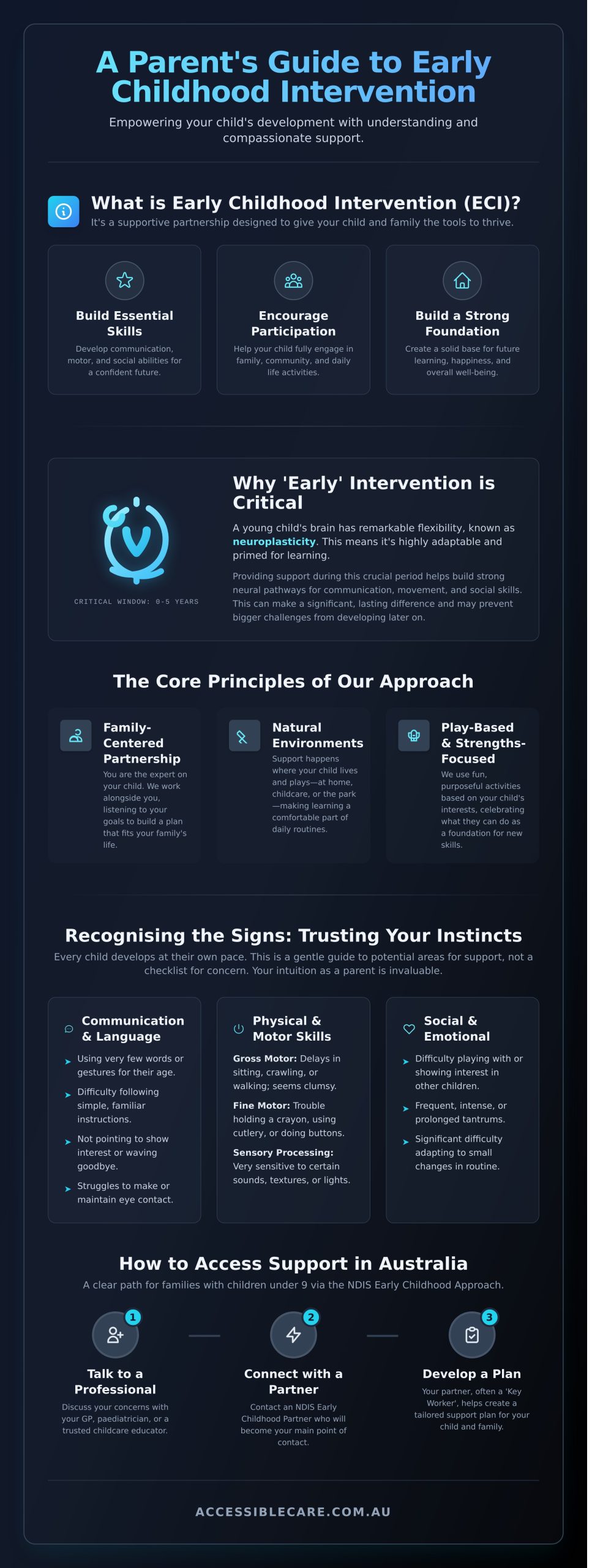
At its heart, early childhood intervention (ECI) is a system of specialised, supportive services for infants and young children with developmental delays or disabilities. But more than that, it’s a partnership designed to give your child and your family the tools to thrive. The goal is not to ‘fix’ a problem, but to empower your child to develop essential skills, participate fully in family and community life, and build a strong foundation for their future learning and happiness.
This approach is deeply personal and tailored to your child’s unique strengths and needs. It’s about understanding what Early Childhood Intervention is in the context of your family, celebrating every milestone, and providing compassionate support every step of the way. It’s a journey we take together, ensuring you feel confident and capable in supporting your child’s growth.
The ‘Early’ in Intervention: Why Timing is So Important
The first few years of a child’s life are a time of incredible brain development. A young child’s brain has remarkable flexibility, often called neuroplasticity, which means it is highly adaptable and ready to learn. Providing support during this critical window can make a significant and lasting difference. Early support helps build strong neural pathways for communication, movement, and social skills, which can prevent bigger challenges from developing later on.
A Partnership with Your Family
We believe that you are the true expert on your child. Our ECI professionals work alongside you, listening to your goals and concerns to build a plan that fits your family’s life. This family-centred approach focuses on building your skills and confidence. Support often happens in the natural environments where your child lives and plays-like your home, childcare, or the local park-making learning a comfortable and integrated part of your daily routine.
The Core Principles: Play-Based and Strengths-Focused
Effective early childhood intervention feels less like therapy and more like play. Our approach is built on fun, engaging, and purposeful activities that motivate your child to learn and explore. We start by identifying and celebrating what your child can already do, using their unique interests and strengths as the building blocks for new skills. This positive, child-led process ensures that your child feels successful, happy, and understood.
Recognising the Signs: Does My Child Need Early Intervention?
Every child is unique, and they all develop at their own pace. This guide is here to offer gentle support, not to cause alarm. As a parent, you know your child best. If you have a persistent feeling that something isn’t quite right, trusting your instincts is the first and most important step. Looking for patterns, rather than focusing on a single missed milestone, can help you understand your child’s journey.
You may hear the term ‘developmental delay’. This simply means a child is taking a little longer to reach certain developmental milestones compared to their peers. It is not a diagnosis, but an indication that your child might benefit from extra support to build their skills and confidence. This is where early childhood intervention provides a caring and effective pathway forward.
Communication and Language Milestones
Communication is more than just talking; it’s about understanding, connecting, and expressing needs. It involves both speech (making sounds) and language (understanding and using words). Signs that your child may need support in this area include:
- Using very few words or gestures for their age.
- Difficulty following simple, familiar instructions.
- Not pointing at objects to show interest or waving goodbye.
- Struggling to make or maintain eye contact with others.
Physical and Motor Skill Development
This area covers how your child uses their body, from big movements to small, detailed actions. You might observe challenges with:
- Gross motor skills: Delays in sitting up, crawling, or walking; seeming particularly clumsy or uncoordinated.
- Fine motor skills: Trouble holding a crayon, using cutlery, or doing up buttons.
- Sensory processing: Being very sensitive to or avoiding certain sounds, textures, or lights.
Social, Emotional, and Behavioural Signs
Learning to navigate emotions and social situations is a vital part of development. Support may be helpful if your child often has:
- Difficulty playing with or showing interest in other children.
- Frequent, intense, or prolonged tantrums that are hard to manage.
- Significant difficulty adapting to small changes in their routine.
These challenges are a key area where Positive Behaviour Support strategies can be introduced to help your child thrive in their environment.
If any of these signs resonate with you, remember that seeking advice is a positive and proactive step. The goal of quality early childhood intervention, as guided by Australia’s National Best Practice Framework, is to work in partnership with your family, building on your child’s strengths and empowering them to reach their full potential.
What to Expect: Your ECI Team and Therapy Types
Starting your journey with early childhood intervention can feel overwhelming, but you are not alone. You will be supported by a dedicated team of professionals who are here to listen and partner with you every step of the way. Often, you will have a ‘key worker’-one consistent person who becomes your main point of contact, helping to coordinate all aspects of your child’s care and support.
The first step is a gentle assessment, which is simply a conversation to understand your child’s unique strengths, needs, and your family’s goals. Together, we create a tailored support plan that feels right for you. This collaborative process is at the heart of the NDIS early childhood approach, ensuring your priorities guide the support. This plan is a living document; it’s flexible and designed to evolve as your child learns and grows.
Meet Your Multidisciplinary Support Team
Your child’s team may include a range of skilled and compassionate allied health professionals, such as:
- Speech Pathologists: Helping with all aspects of communication, from understanding and using language to social skills and safe feeding.
- Occupational Therapists: Supporting participation in daily life by building skills for play, self-care (like dressing), and managing sensory needs.
- Behaviour Support Practitioners: Working with your family to understand the reasons behind challenging behaviours and develop positive, supportive strategies.
- Physiotherapists: Assisting with physical development, including movement, balance, coordination, and strength.
Finding the right combination of professionals is a key part of the journey. While this guide focuses on the Australian context, the challenge of locating trusted providers is universal. Online directories can be an invaluable resource in this search. For those in the UK, for example, platforms like Guide2Care offer a comprehensive directory of care providers, simplifying the process of building a support team.
Common Therapies Explained Simply
Therapy is designed to be engaging and fun, focusing on building skills through activities your child enjoys.
- Speech Therapy: Often looks like play, using games, books, and songs to build vocabulary, sentence structure, and social communication skills.
- Occupational Therapy: Involves fun and practical activities to improve things like handwriting, using cutlery, or developing routines for getting ready.
- Positive Behaviour Support: Focuses on creating predictable routines and calm environments to reduce anxiety and support positive behaviour.
Where Support Happens: Therapy in Your Everyday Life
Effective early childhood intervention happens where life happens. Rather than taking place only in a clinic, our team provides support in the environments where your child lives, learns, and plays. This can be:
- At home, integrating strategies into your family’s daily routines.
- At childcare or kinder, helping your child participate and connect with their peers.
- In the community, building skills at the local park, library, or shops.
Ensuring these environments, especially the home, are safe and conducive to learning is a foundational step. A calm, healthy space free from the stress and distraction of common household pests can make a significant difference. For families in the area, ABC Pest Control Sydney provides professional services to help maintain a secure and comfortable setting for your child’s growth and therapy.
This approach helps your child learn and practice new skills in real-world situations, making a meaningful difference in their everyday life. Meet our compassionate team of paediatric therapists.
How to Access Early Childhood Intervention in Australia
Navigating the path to support for your child can feel overwhelming, but Australia’s system is designed to provide help as early as possible. The National Disability Insurance Scheme (NDIS) uses an ‘Early Childhood Approach’ for children younger than 9. This approach focuses on getting your child the support they need quickly, often without a formal diagnosis. Here is a simple, step-by-step guide to accessing these vital services.
Step 1: Talk to a Professional
Your journey begins with a conversation. The best first step is to speak with a trusted health professional who knows your child, such as your GP, a paediatrician, or a local child and family health nurse. They listen to your concerns with care and respect. To make the most of this appointment, it helps to bring:
- A list of your specific concerns or observations.
- Any notes about your child’s development or behaviour.
- Reports from childcare, kindergarten, or school, if you have them.
This professional can offer initial advice and provide referrals to get you connected with the right support services.
Step 2: Connecting with an NDIS Early Childhood Partner
In Australia, NDIS Early Childhood Partners are the main point of contact for families seeking early childhood intervention. These are local organisations with teams of experienced professionals who understand child development. Their role is to support you and your family by listening to your needs, providing information, and connecting you with the best community or NDIS supports. This service is free and available to any family with concerns about their child’s development.
Step 3: Creating a Support Plan
After you connect with an Early Childhood Partner, they will work alongside you to create a tailored plan. They are dedicated to empowering you with choice and control over your child’s journey. Depending on your child’s needs, they may help you access community-based supports like playgroups or they may assist you in applying for an NDIS plan to fund more specialised therapies. You are not alone in this process; they will guide you with compassion every step of the way.
The system can seem complex, but having a supportive partner makes all the difference. Need help navigating the NDIS? We can support you.
Take the Next Gentle Step on Your Child’s Journey
Navigating your child’s development can feel overwhelming, but remember you are not alone. The most powerful takeaway is that identifying the need for support early is the first, most compassionate step you can take. This proactive approach lays a strong foundation, giving your child the best possible start and empowering them to reach their unique potential.
At Accessible Care, we are here to walk this journey with you. As a registered NDIS provider with a dedicated team of experienced paediatric Speech and Occupational Therapists serving families in Melbourne and Adelaide, we offer a truly person-centred approach. We understand that effective early childhood intervention is about listening to your family and creating a tailored plan that nurtures your child’s growth and confidence.
Talk to our caring team about your child’s needs today.
Remember, you are your child’s greatest advocate. Taking this step is a sign of your incredible love and commitment to their bright future.
Frequently Asked Questions About Early Childhood Intervention
Do we need a formal diagnosis before we can start early intervention?
No, you do not need a formal diagnosis to begin the process. If you have any concerns about your child’s development, that is enough to seek a referral or an initial consultation. The focus is on providing support as early as possible. Acting on your concerns is the most important first step, and our compassionate team can help guide you through an assessment to understand your child’s unique needs and strengths, ensuring they get the right support from day one.
How is early childhood intervention funded? Is it covered by the NDIS?
Yes, early childhood intervention can be funded through the National Disability Insurance Scheme (NDIS). If your child is under 9 with a developmental delay or disability, they may be eligible for support through the NDIS Early Childhood Approach. This approach helps connect you with the right services. Other funding options can include private health insurance or paying privately. We can help you understand and navigate your funding options to ensure you receive the support you’re entitled to.
What is my role as a parent in my child’s therapy sessions?
Your role as a parent is vital-you are your child’s first teacher and our most important partner. You are an active participant in the therapy process. We empower you by sharing strategies and activities that you can integrate into your daily routines at home. Your insights into your child’s personality, strengths, and challenges are essential for creating a support plan that truly works for your family. Your involvement ensures progress continues long after a session ends.
How is ECI different from what my child gets at daycare or kindergarten?
While daycare and kindergarten focus on general learning and socialisation for all children in a group setting, ECI is different. Unlike the group setting of daycare, early childhood intervention provides tailored, one-on-one support that is specifically designed to meet your child’s individual developmental goals. Our therapists work with you and your child on specific skills, using evidence-based strategies to help them build confidence and thrive in all environments, including at kindergarten.
How long will my child need to be in an early intervention program?
The duration of early intervention is unique to every child and family. It depends entirely on your child’s individual needs and the goals you set together with your therapy team. Some children may need short-term support to overcome a specific challenge, while others may benefit from longer-term assistance. The ultimate aim is to build skills and confidence so your child can participate fully in family, school, and community life. We regularly review progress to ensure the support remains effective.
Will early intervention ‘label’ my child or make them feel different?
We understand this is a common concern for parents. Our approach is designed to do the opposite. We focus on celebrating your child’s strengths and building their confidence, not on labels. Therapy is delivered in a positive, play-based, and supportive way that feels natural and fun. Our goal is to empower your child with the skills and tools they need to participate happily and successfully alongside their peers, helping them feel capable and included.
What if I live in Melbourne or Adelaide? How can Accessible Care help?
If you live in Melbourne or Adelaide and are seeking early childhood intervention support, our compassionate team at Accessible Care is here to help. We provide person-centred therapy and support coordination services tailored to your child’s specific needs. We listen to your concerns and work in partnership with you to create a plan that empowers your child to achieve their goals. Get in touch with us today to discuss how we can support your family’s journey.

