


The simple act of sharing a meal or a conversation is central to our lives. But what happens when communication feels difficult, or swallowing becomes a source of anxiety? Feeling unheard or struggling with the simple joy of eating can be isolating. This is where the compassionate support of speech pathology can make a world of difference, helping you find your voice and enjoy mealtimes with confidence and dignity.
We understand that navigating therapy and funding can feel overwhelming. This guide is here to walk you through the journey with care and clarity. We will explore how a person-centred approach empowers independence and deepens social connections. You will also gain a clear understanding of how to access professional support through your NDIS plan in Australia, giving you the confidence to choose a provider who truly listens. It’s about empowering you to live life your way.
Key Takeaways
- Learn how professional speech pathology supports more than just words, addressing vital areas like swallowing safety and cognitive communication.
- Understand how to align therapy goals with your NDIS plan to access “Reasonable and Necessary” support for your needs.
- Discover what to expect from a gentle, person-centred assessment that focuses on your life and personal goals.
- See how compassionate support can help you or your loved one build confidence, foster independence, and strengthen community connections.
What is Speech Pathology? Understanding the Path to Better Communication
At its core, communication is about connection. It’s how we share our stories, express our needs, and build relationships within our community. When challenges arise in this vital area, speech pathology offers a supportive and empowering path forward. It is the dedicated field focused on understanding, diagnosing, and treating a wide range of communication and swallowing disorders across all stages of life. For those seeking a deeper understanding, the question ‘What is speech-language pathology?’ reveals a rich field dedicated to empowering individuals. A Speech Language Pathologist (SLP) is more than a therapist; they are a compassionate partner on your journey to greater independence, working with you to achieve your goals with the dignity and respect you deserve.
The Core Pillars of Speech Pathology
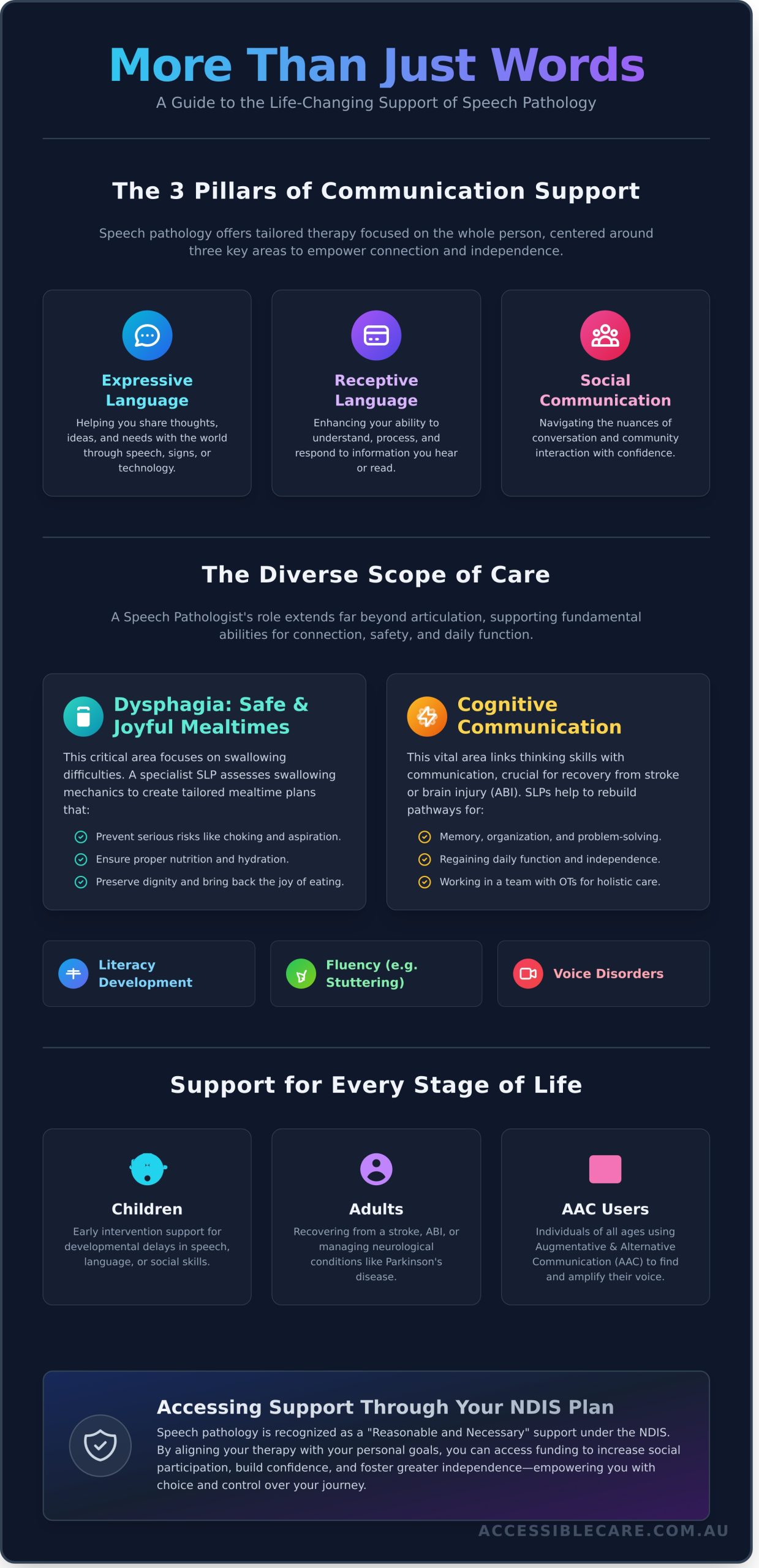
To better understand the support available, it helps to look at the core pillars of the field. Our skilled SLPs provide tailored therapy that focuses on the whole person, not just a single challenge. This support is often centred around three key areas:
- Expressive language: This is about finding the tools to share your thoughts, ideas, and needs with the world, whether through speech, signs, or technology.
- Receptive language: This focuses on enhancing your ability to understand, process, and respond to the information you hear or read.
- Social communication: We help you navigate the rich and sometimes complex nuances of conversation and community interaction with confidence.
Who Can Benefit from Speech Therapy?
The need for communication support knows no age, and our services are designed to honour each person’s unique journey. Our compassionate team provides person-centred speech pathology services for a diverse range of participants, including:
- Children who may need early intervention support for developmental delays in speech, language, or social skills.
- Adults who are recovering from a stroke, acquired brain injury, or managing a neurological condition like Parkinson’s disease.
- Individuals of all ages who use Augmentative and Alternative Communication (AAC) systems to find and amplify their unique voice.
More Than Just Words: The Diverse Scope of Speech-Language Pathology
When many of us think of speech therapy, we often picture a child learning to pronounce a tricky sound. While that is a vital part of the profession, the true scope of speech pathology extends far beyond articulation. It’s a field dedicated to supporting a person’s fundamental ability to connect, understand, and participate safely in the world. From the mechanics of a safe swallow to rebuilding cognitive pathways after an injury, a Speech-Language Pathologist (SLP) provides life-changing care.
Dysphagia: Supporting Safe and Joyful Mealtimes
One of the most critical yet lesser-known areas of speech pathology is the management of dysphagia, or swallowing difficulties. This requires specialist SLP intervention because a safe swallow is essential for health and wellbeing. Our compassionate SLPs assess the complex mechanics of swallowing to prevent serious risks like choking or aspiration. They then work with participants to create tailored mealtime management plans that preserve dignity, ensure proper nutrition, and help bring the joy back to eating.
Cognitive Communication and Neurological Recovery
For participants recovering from an acquired brain injury (ABI) or stroke, regaining daily function is a primary goal. Cognitive communication is the vital link between our thinking skills-like memory, organisation, and problem-solving-and our ability to interact successfully with others. To support this recovery, our SLPs often work closely with Occupational Therapists in a multidisciplinary team, creating a holistic plan that empowers participants on their journey towards independence.
The support doesn’t stop there. SLPs also play a crucial role in developing literacy, as the skills needed for reading and writing are deeply connected to language. Furthermore, they provide compassionate, evidence-based therapy for fluency challenges like stuttering and for voice disorders. The field of speech pathology, as supported by national bodies like Speech Pathology Australia, is dedicated to helping people of all ages find their voice, build their confidence, and engage more fully with the life they choose to live.
Navigating Speech Pathology Under the NDIS: Choice and Control
The National Disability Insurance Scheme (NDIS) is designed to give you choice and control over your supports, empowering you to live the life you choose. Speech pathology aligns perfectly with the NDIS goals of increasing social and economic participation, as communication is the foundation of connecting with others, building relationships, and pursuing opportunities.
For therapy to be covered, it must be considered “Reasonable and Necessary.” This means the support will help you pursue your goals, is related to your disability, and offers value for money. A comprehensive Functional Capacity Assessment (FCA) is often vital, especially during plan reviews, as it provides clear evidence of your needs and recommends the right level of therapeutic support to help you achieve your vision for the future.
Funding Categories for Speech Therapy
Understanding your NDIS plan is the first step. Speech therapy is most commonly funded under the Capacity Building budget, specifically within the Improved Daily Living Skills category. This funding is dedicated to therapeutic supports that help you build independence and skills. It’s different from your Core Supports budget, which is generally used for daily activities. Your Capacity Building funds can be used to book regular, ongoing sessions with a speech pathologist who truly listens and understands you.
The Multidisciplinary Advantage
Your goals are rarely one-dimensional, and your support shouldn’t be either. At Accessible Care, we integrate speech pathology with other therapies like Occupational Therapy (OT) and nursing because we know that a collaborative approach delivers better outcomes. For instance, your communication goals might be linked to social skills an OT is helping you with, or safe swallowing techniques supported by our nursing team. By working together, we ensure every therapist is aligned with your vision, creating a single, streamlined plan for your success. Learn more about the benefit of a multidisciplinary team in therapy.
What to Expect: Your Journey from Assessment to Empowerment
Beginning your speech pathology journey is a positive step towards greater independence and connection. At Accessible Care, we see this as a partnership built on trust, respect, and understanding. We listen first, ensuring your path is shaped by your needs and aspirations. Your journey with us is a clear, supportive process, moving from a gentle initial conversation and holistic assessment to a tailored therapy plan and celebrating the milestones you achieve along the way.
Your First Session with an SLP
Your first meeting with a Speech Language Pathologist (SLP) is simply a conversation, not a test. We want to understand your daily life, your hopes, and your challenges. To ensure you feel comfortable, we often conduct assessments in your home or another familiar community setting. We believe therapy is most effective when it involves your whole support network, so we warmly welcome family and carers to be part of the process from day one.
To help prepare for a stress-free first meeting, it can be helpful to bring:
- Any relevant reports from doctors or other therapists.
- Your NDIS plan details, if you have one.
- A few notes about the communication goals that are important to you.
Setting Meaningful Communication Goals
Effective therapy is about achieving real-life wins. We move beyond clinical markers to focus on what truly matters to you, whether it’s ordering a coffee with confidence, sharing a story with your family, or making a phone call to a friend. This is where our philosophy of “Your choice, your life, your way” comes to life. To ensure your goals are clear and effective, we help shape them to be SMART: Specific, Measurable, Achievable, Relevant, and Time-bound.
As a registered NDIS provider, we carefully track progress and provide comprehensive reports that meet all requirements. This process helps us celebrate every milestone with you and adjust your support as your skills and confidence grow. If you’re ready to start your journey, our compassionate speech pathology team is here to listen.
Finding Your Voice with Accessible Care: Our Person-Centred Approach
At Accessible Care, we believe that effective support begins with genuine connection. Our approach is built on a foundation of dignity, respect, and a commitment to truly listening to every participant. We understand that finding the right support can feel overwhelming. That’s why our entire process, from the first conversation to every therapy session, starts with empathy and ends with empowerment, ensuring you feel heard, valued, and in control of your journey.
Specialist Support in Melbourne and Adelaide
Our experienced and dedicated Speech Language Pathologists are proud members of the Melbourne and Adelaide communities. We offer specialised, community-based therapy with a strong focus on supporting adults with neurological disorders and complex communication needs. Our local teams provide expert, compassionate guidance in navigating the NDIS, helping you make the most of your plan. To learn more, please reach out to our team for a confidential, no-obligation chat about your goals.
Empowering You to Live the Life You Choose
We are here to be your partners in care, but we never forget that you are the expert in your own life. Our role is to provide the tools, strategies, and unwavering support you need to achieve your goals. High-quality speech pathology is more than just therapy; it is a pathway to stronger social connections, greater independence, and a more confident voice within your community. We are dedicated to helping you live the life you choose, on your terms.
Looking for a provider who listens? Contact Accessible Care for Speech Pathology support today.
Find Your Voice with Compassionate Support
As we’ve explored, the path to better communication is a journey of partnership and possibility. It’s about understanding that speech pathology goes far beyond just words, encompassing everything from swallowing difficulties to social interaction. Most importantly, it’s about recognising that your goals and choices are at the heart of any successful therapy plan, empowering you to connect with the world in a way that feels right for you.
At Accessible Care, we are here to walk that journey with you. As a registered NDIS provider in Victoria and South Australia, our team of experienced Speech Language Pathologists is part of a holistic, multidisciplinary care team dedicated to your complete well-being. We listen first, creating a supportive space where you have choice and control over your care. We believe in your potential and are committed to providing support that is respectful, empowering, and tailored to you.
Your voice deserves to be heard. Taking the first step is a powerful act of self-care. Empower your communication-book a compassionate consultation with our SLPs today.
Frequently Asked Questions About Speech Pathology
Is speech pathology only for people who can’t talk?
Not at all. While speech pathologists help non-verbal individuals, their support covers a very wide range of communication challenges. This includes helping children with unclear speech, supporting adults who have had a stroke, assisting with stuttering, and developing social communication skills. They also work on literacy (reading and writing) and voice problems. It’s about supporting any area of communication to help a person connect with others and express themselves with confidence.
How does the NDIS pay for speech therapy?
For NDIS participants, speech therapy is typically funded under the ‘Capacity Building’ support category in your plan, specifically within ‘Improved Daily Living’. To use your NDIS funds, the therapy must be considered ‘reasonable and necessary’ to help you achieve the specific goals outlined in your plan. Our compassionate team can help you understand how your funding can be used to access the support you need to find your voice and build your independence.
Can a speech pathologist help with swallowing difficulties?
Yes, absolutely. Difficulties with eating, drinking, and swallowing are known as dysphagia, and this is a key area of a speech pathologist’s expertise. They can assess how safely you are swallowing and identify any risks. Based on this, they provide strategies, recommend modified food and drink textures, or suggest exercises to make mealtimes safer and more enjoyable, supporting your health and wellbeing with dignity and respect.
What is the difference between a speech therapist and a speech pathologist?
In Australia, there is no difference between a speech therapist and a speech pathologist. The terms are used interchangeably to describe the same university-qualified allied health professional. The official professional title is ‘Speech Pathologist’, and they are registered with the national peak body, Speech Pathology Australia. So whether you are looking for a therapist or a pathologist, you are looking for the same dedicated and skilled professional to support your goals.
How long does it take to see progress in speech therapy?
Progress is unique to every individual and depends on many factors, including personal goals, the complexity of the communication challenge, and the frequency of therapy sessions. Some people may notice positive changes within a few weeks, while others may require longer-term support. Our person-centred approach focuses on celebrating every step forward and tailoring therapy to a pace that is right for you, ensuring you always feel supported on your journey.
Does Accessible Care provide speech pathology at home?
Yes, we believe in providing care where you feel most comfortable and empowered. Our dedicated speech pathologists can deliver tailored support directly in your home. This allows you to practice new skills in a familiar, real-world environment. Receiving speech pathology services at home provides convenience and helps integrate therapy strategies into your daily routines, making progress feel more natural and sustainable. Your choice, your life, your way.
What is AAC and can a speech pathologist help me set it up?
AAC stands for Augmentative and Alternative Communication. It refers to all the ways someone communicates besides talking. This can range from simple systems like picture boards or sign language to high-tech speech-generating devices. A speech pathologist is the key professional to help with AAC. They can assess your needs, recommend the most suitable system, help you get funding for it, and provide training to you and your family to use it effectively.
Do I need a GP referral for NDIS speech pathology?
No, you do not need a referral from a GP to access speech pathology services with your NDIS funding. If speech therapy is included as a support in your NDIS plan, you have the choice and control to engage a provider like Accessible Care directly. We are here to make the process as simple as possible. You can contact our friendly team to discuss your needs and how we can start supporting you to achieve your communication goals.

