


It’s 4 PM on a Tuesday. You’ve just finished the school run, and your mind is already racing ahead to tomorrow’s appointments and that fast-approaching NDIS review. You worry that in a busy clinical system, your child’s unique spark and specific challenges aren’t getting the focused attention they truly need to thrive.
You’re not alone. So many families seeking paediatric occupational therapy Adelaide feel this way. They’re looking for more than just a service; they want a genuine partner in their child’s development, a support system that fits into their life, not one that makes it more complicated. This guide was created with your family in mind. We promise to show you how a compassionate and dedicated OT team can empower your child with vital daily skills and bring much-needed clarity to your NDIS journey. Together, we’ll explore what person-centred care really looks like in 2026, from building practical independence at home to tracking progress in a way that makes sense for your goals.
Key Takeaways
- Discover how occupational therapy supports a child’s most important jobs: playing, learning, and connecting with others.
- Compare home and clinic-based options to choose the most supportive and convenient paediatric occupational therapy Adelaide for your family.
- Gain clarity on navigating your NDIS plan and learn which funding categories can be used for your child’s therapy sessions.
- Understand the powerful benefits of a coordinated care team, where therapists collaborate to support your child’s unique goals.
What is Paediatric Occupational Therapy and How Does It Support Adelaide Kids?
Watching your child grow is a journey filled with incredible moments. Sometimes, however, you might notice they face challenges with tasks that seem to come easily to other kids. This is where we can help. Paediatric occupational therapy is a compassionate and holistic approach designed to support children in their most important job: being a kid. It’s not about clinical diagnoses; it’s about empowering them to play, learn, and connect with the world around them with confidence.
The core of this support focuses on developing the skills needed for daily life. This includes everything from the fine motor control required to hold a crayon or tie shoelaces, to the social skills needed to make friends at their local Adelaide school. By addressing these areas early, we help build a strong foundation for long-term development, boosting self-esteem and independence. Unlike traditional clinical models that can feel sterile, our person-centred community support meets your child where they are, whether at home, in the classroom, or at their favourite playground. This approach makes our paediatric occupational therapy in Adelaide a truly integrated part of your child’s life.
The Role of an Occupational Therapist in Your Child’s Life
Think of an Occupational Therapist (OT) as a supportive partner on your family’s team. Our dedicated OTs start by listening, taking the time to understand your child’s unique strengths and the specific physical, cognitive, or sensory challenges they may be facing. We work closely with parents, teachers, and even siblings to create a circle of support that nurtures growth. Occupational therapy is the bridge between “can’t do” and “can do,” empowering children with adaptive strategies and newfound confidence.
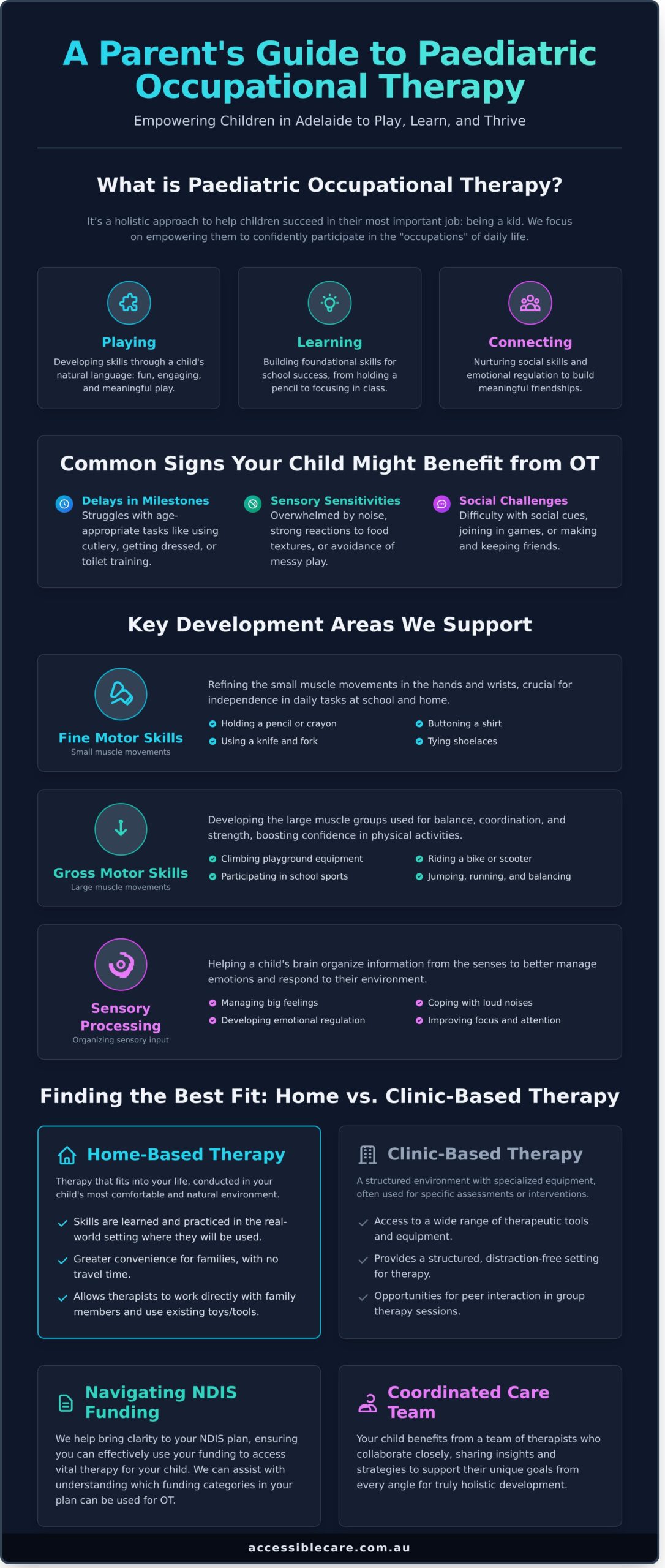
Common Signs Your Child Might Benefit from OT
It can be difficult to know when to seek support. Every child develops at their own pace, but certain persistent challenges may indicate that a little extra help could make a big difference. If you’re new to the concept, learning What is Occupational Therapy provides a great foundation. Here are a few common signs we see in the Adelaide community:
- Delays in Developmental Milestones: Your child might be struggling with age-appropriate tasks like using cutlery, getting dressed independently by age five, or mastering toilet training.
- Sensory Sensitivities: Many neurodivergent children experience the world differently. This can look like becoming easily overwhelmed by the noise at a birthday party, having strong reactions to certain food textures, or avoiding messy play.
- Challenges with Social Participation: You may notice your child has difficulty understanding social cues, struggles to join in playground games, or finds it hard to make and keep friends at school.
Recognising these signs is the first step. Providing dedicated paediatric occupational therapy in Adelaide means we can offer tailored support that respects your child’s individuality and empowers them to thrive. It’s about celebrating small victories and building skills for a happy, independent life.
Key Development Areas: How We Help Your Child Shine
A child’s world is built on play. It’s their most important job, or “occupation,” and it’s how they test boundaries, learn new skills, and make sense of their environment. At Accessible Care, our approach to paediatric occupational therapy in Adelaide is deeply rooted in this understanding. We don’t see therapy as a clinical task; we see it as a partnership where we join your child in their world, using their favourite activities and interests to build new skills. Every session is a guided adventure, built around goals that matter to your child, whether it’s mastering the monkey bars or writing their own name with pride.
Fine and Gross Motor Skills
Developing motor skills is fundamental to a child’s confidence and independence. We help children refine these abilities in ways that feel like fun, not work. Fine motor skills involve the small muscles in the hands, crucial for tasks like holding a pencil to write in their school workbook, using a knife and fork at a family dinner, or tying their own shoelaces before a game of footy. Gross motor skills involve the large muscle groups used for balance and coordination. We help children build the strength and confidence to climb playground equipment at a local Adelaide park, ride a scooter with friends, or participate fully in school sports.
Sensory Processing and Regulation
Sometimes, a child’s brain can have trouble organising the information it receives from the senses. This can feel overwhelming, like a constant sensory traffic jam. Our compassionate therapists help children and families understand these sensory needs. We provide practical tools to support emotional regulation, empowering your child to manage big feelings without becoming overwhelmed. This often includes creating a personalised “sensory diet,” which isn’t about food but is a carefully planned menu of activities to use at home and school. It might involve 10 minutes of trampoline jumping before school to feel settled or using therapy putty during class to stay focused.
Activities of Daily Living (ADLs)
Gaining independence in daily tasks is a huge step for any child, building self-esteem and reducing family stress. Our dedicated OTs work on these essential life skills, providing gentle guidance and clever strategies to make routines easier. We focus on areas like:
- Dressing: Managing buttons, zippers, and socks independently.
- Mealtimes: Using cutlery correctly and tolerating different food textures.
- Toileting: Building a confident and independent toileting routine.
- Grooming: Brushing teeth and hair as part of a morning schedule.
For children who need extra support, we can recommend simple assistive technology to make tasks more manageable. Understanding these daily challenges is a key part of NDIS planning, and our therapists can complete a comprehensive Functional Capacity Assessment to ensure your child’s NDIS plan accurately reflects their needs and goals. Understanding your child’s unique strengths is the first step, and our team is here to help create a supportive plan that works for you.
Home-Based vs. Clinic-Based Therapy: Finding the Best Fit in Adelaide
One of the first questions many families ask is, “Where should therapy happen?” For parents in Adelaide, the answer isn’t always simple. Juggling school runs and work commitments can make the thought of driving from the outer suburbs like Seaford or Gawler into a central clinic for a 45-minute session feel overwhelming. At Accessible Care, we understand these real-world challenges. We believe that the right environment is crucial for a child’s success, and that choice should always be in your hands.
Our commitment is to provide compassionate, community-based care that fits into your life. This means we don’t just offer one option; we partner with you to find the setting where your child will feel most comfortable, confident, and ready to learn. It’s about making therapy a natural part of life, not another stressful appointment on the calendar.
The Benefits of Therapy in the Natural Environment
For many children, the most powerful progress happens right at home. A child’s natural environment-their home, school, or local park-is where life actually happens. Practising how to use cutlery is more meaningful at your own kitchen table than at a sterile therapy table. Learning to navigate steps is more effective on your own front porch. This approach makes skills immediately relevant and easier for children to adopt into their daily routines. This focus on real-world learning is backed by leading bodies like South Australia’s Office for Early Childhood Development, which champions the importance of learning through everyday experiences.
A familiar setting also significantly reduces anxiety. Some children find clinical spaces intimidating, which can create a barrier to effective therapy before the session even begins. At home, they are surrounded by their favourite toys and familiar faces. This comfort allows our dedicated therapists to see your child at their most authentic self. It also provides a unique opportunity for us to coach you, the parent, in real-time. We can show you exactly how to integrate a new strategy using the toys and tools you already have.
When is a Clinic Setting Appropriate?
While home-based therapy offers incredible benefits, a clinic setting is sometimes the best choice for specific goals. Clinics often house specialised equipment that isn’t practical for a home visit, such as:
- Sensory swings and suspension systems
- Large-scale climbing equipment or rock walls
- Dedicated messy play areas
- Therapeutic listening programs
Clinics are also ideal for structured social skills groups or intensive school holiday programs, where children can interact with peers in a supported environment. The best providers of paediatric occupational therapy in Adelaide offer a flexible, hybrid approach. At Accessible Care, our philosophy is simple: Your choice, your life, your way. If a clinic setting or a combination of home and clinic visits will best help your child achieve their goals, we will support you in making that happen.
Navigating NDIS Funding for Paediatric OT in South Australia
Understanding how the NDIS funds paediatric occupational therapy Adelaide families need is the first step toward unlocking your child’s potential. We know the system can seem complex, but we are here to walk alongside you, making the process clear and supportive. Your child’s NDIS plan is a powerful tool, and our goal is to help you use it effectively to access the care they deserve.
Understanding Your NDIS Plan Categories
Your child’s NDIS funding is organised into different categories. For occupational therapy, the most important one is Capacity Building – Improved Daily Living. This is where funding is allocated for therapies that help your child build their skills, independence, and community participation. It directly covers assessments, therapy sessions, and resource development. Sometimes, your Core Supports budget can be used to fund a therapy assistant, who works under the direction of a qualified OT to help your child practice their new skills. How you use this funding depends on your plan management:
- Self-Managed: You have the most flexibility, paying providers directly and claiming funds back from the NDIA.
- Plan-Managed: A plan manager pays your invoices on your behalf, giving you choice and control without the administrative work.
- NDIA-Managed: You can only use NDIA-registered providers, and payments are handled for you.
For any support to be funded, it must meet the NDIS “Reasonable and Necessary” criteria. This means the support must be directly related to your child’s disability, represent value for money, and be likely to be effective and beneficial for them. We design all our therapy plans to clearly meet these essential requirements.
The Referral and Assessment Process
From your first phone call to the first therapy session, we’ve created a clear and caring pathway for Adelaide families. While wait times can vary, a typical journey with Accessible Care takes approximately 4 to 6 weeks.
Step 1: Initial Consultation (Week 1)
It all starts with a conversation. We take the time to listen to your story, understand your child’s unique strengths and challenges, and hear about the goals you have for your family. This initial meeting is about building trust and ensuring we are the right fit for you.
Step 2: Comprehensive Assessment (Weeks 2-4)
A skilled occupational therapist will conduct a comprehensive assessment, such as a Functional Capacity Assessment (FCA). This isn’t just a test; it’s a deep dive into your child’s daily life. The process takes 2-4 hours, and the detailed report, which forms the foundation of your child’s therapy, is typically completed within 14 business days.
Step 3: A Tailored Therapy Plan (Weeks 5-6)
Using the assessment findings, we work *with you* to create a personalised therapy plan. This plan outlines clear, measurable goals that are meaningful to your child and family. Once you approve the plan, therapy sessions can begin, often within a week. A great Support Coordinator can be your best advocate during this process, helping you find the right provider and understand how to best use your child’s NDIS plan. We work closely with many of Adelaide’s most dedicated Support Coordinators to ensure a smooth journey for your family.
If you’re ready to discuss your child’s NDIS plan and explore how our services can help, our Adelaide team is here to listen.
Accessible Care: A Multidisciplinary Approach to Child Development
Choosing the right support for your child is one of the most important decisions you’ll make. In Adelaide, we believe that support shouldn’t be fragmented or complicated. At Accessible Care, we’ve built a unique service model founded on a simple idea: comprehensive, collaborative care under one roof. We understand that a child’s development is interconnected, so we bring together a dedicated team of Occupational Therapists, Speech Pathologists, Positive Behaviour Support Practitioners, and Nurses to work as one cohesive unit for your child.
This isn’t just about convenience; it’s about creating better outcomes. Our compassionate caregivers don’t work in silos. They communicate daily, share insights, and build strategies that address your child’s needs holistically. This integrated approach ensures that progress in one area, like motor skills, is supported and reinforced by progress in another, like communication. We are committed to building a long-term relationship with your family, offering consistent and familiar support that grows with your child as they transition from their early years into adulthood.
Integrating OT with Speech and Behaviour Support
Imagine a child struggling with the fine motor skills needed for handwriting. Our Occupational Therapist can work on grip and control, while our Speech Pathologist simultaneously helps with the language skills to form sentences and express ideas. This synergy is central to our philosophy. Our practitioners create unified therapy plans where goals overlap, making learning more effective and less overwhelming for the child. When challenging situations arise, our Positive Behaviour Support practitioners step in, not just to manage behaviour, but to understand its function, often linking it back to sensory or communication needs identified by the OT and Speech Pathologist. The true power of Multidisciplinary Teams is in creating this seamless web of support, especially for children with complex needs.
Why Adelaide Families Trust Accessible Care
Trust is earned through action, and our commitment is to your family’s well-being and peace of mind. Our entire approach to paediatric occupational therapy adelaide is built on a foundation of dignity and respect. We don’t just provide services; we build partnerships. We listen to you, because you are the expert on your child. Our dedicated team is here to support your family’s journey with genuine care and professional expertise.
Families choose us because we offer:
- A Person-Centred Approach: Your child’s goals, interests, and choices are at the heart of every therapy plan. We empower them to live the life they choose.
- Experienced NDIS Navigation: Our therapists are not only clinical experts but are also highly skilled in navigating the NDIS, helping you maximize your plan and reduce administrative stress.
- A Team That Genuinely Cares: Every member of our team is chosen for their skill and their compassion. We are dedicated to creating a safe, nurturing, and positive environment for your child to thrive.
Your child deserves support that is as unique and wonderful as they are. Let us show you how our integrated and compassionate approach can make a real difference. Book a compassionate consultation with our Adelaide team today.
Empower Your Child’s Journey in Adelaide
Taking the first step in your child’s developmental journey is a powerful act of love. We’ve seen that support is within reach, from understanding how therapy builds essential daily skills to navigating your NDIS plan with confidence. Remember, you have choices, and you don’t have to figure it all out by yourself. The right support focuses on your child’s unique strengths and helps them flourish in their own way.
When you’re ready to find a compassionate partner for paediatric occupational therapy Adelaide, our team is here to listen. As a registered NDIS provider, Accessible Care offers specialized paediatric OT teams and integrated speech and behaviour support, ensuring your child receives holistic, person-centred care. We’re dedicated to building a plan that honours your family’s goals. Start your child’s journey to independence with Accessible Care Adelaide. Your child’s potential is limitless, and we’re here to help them shine.
Frequently Asked Questions
How much does paediatric occupational therapy cost under the NDIS in Adelaide?
The cost for NDIS participants is aligned with the official NDIS Pricing Arrangements. As of July 2023, the maximum rate for a therapy session with an Occupational Therapist in Adelaide is A$193.99 per hour. We don’t charge any more than this set rate. These funds are typically drawn from the ‘Improved Daily Living’ category in your child’s NDIS plan, ensuring there are no out-of-pocket expenses for approved families.
Can my child receive OT at their school or childcare centre in Adelaide?
Yes, we can absolutely provide therapy in your child’s natural environments. Our compassionate therapists offer mobile services and can visit your child at their school, kindergarten, or childcare centre anywhere in the Adelaide area. Working in a familiar setting often helps children feel more comfortable and allows us to collaborate directly with their educators. This approach helps them build practical skills exactly where they need to use them.
What is the difference between a paediatric OT and a regular OT?
A paediatric OT is a specialist who focuses exclusively on the development and wellbeing of children, from infants to adolescents up to 18 years old. While all OTs help people participate in daily activities, paediatric OTs use play-based and child-led approaches to address developmental milestones, sensory processing, fine motor skills, and social skills. A general OT more commonly works with adults, often focusing on rehabilitation, workplace modifications, or aged care.
How long will my child need to attend occupational therapy sessions?
The duration of therapy is tailored to your child’s unique needs and goals, so there isn’t a single answer. Some children achieve their goals within a short block of 6-10 sessions, while others with more complex needs may benefit from ongoing support over 12 months or longer. We believe in a person-centred approach, so we will regularly review your child’s progress with you and adjust their support plan together to ensure it’s always working for them.
Do I need a GP referral for my child to see an NDIS occupational therapist?
No, you don’t need a referral from a GP to access our NDIS occupational therapy services. If your child has an approved NDIS plan with funding in the ‘Improved Daily Living’ support category, you can contact us directly to arrange an initial assessment. While not required, any existing reports from paediatricians, schools, or other allied health professionals can provide valuable insight for our team.
What should I bring to my child’s first OT assessment in Adelaide?
For the first assessment, it’s helpful to bring your child’s NDIS plan and copies of any relevant reports from their school, paediatrician, or other therapists. Please also come prepared to share your main concerns and the goals you have for your child. Most importantly, you might bring a favourite toy, book, or snack to help your child feel comfortable and secure in the new environment. Your insights as a parent are our most valuable resource.
Can OT help my child with their fussy eating or mealtime issues?
Yes, our therapists are skilled at supporting children with fussy eating and complex mealtime challenges. We look at the whole picture, including sensory sensitivities to food textures and smells, oral motor skills, and the mealtime environment itself. Our paediatric occupational therapy Adelaide team uses gentle, evidence-based feeding therapy approaches to build positive experiences with food, reduce anxiety, and gradually expand the range of foods your child feels comfortable trying.
What happens if my child doesn’t engage with the therapist during a session?
It’s completely normal for a child to be shy or hesitant, and we never force participation. Our first priority is always building a trusting and positive relationship. If your child isn’t ready to engage in activities, our experienced therapist will follow their lead, using their interests to gently build rapport. A successful first session might just involve your child feeling safe and happy in the therapy space, which is a wonderful foundation to build on.

