


What if the key to unlocking the right NDIS support wasn’t about navigating a complex system, but about telling your story in a way that truly gets heard? It’s completely understandable to feel anxious about NDIS reviews. The jargon can be confusing, and there’s a constant worry that your unique needs won’t be fully understood, leaving you without the funding you rely on. You’re not just a case number; you’re a person with a life to live, and your voice deserves to be at the centre of your plan.
This compassionate guide is here to demystify the process. We’ll show you exactly how a thorough functional capacity assessment acts as the foundation for a successful NDIS journey in 2026, empowering you to secure the ‘reasonable and necessary’ supports you deserve. Together, we will walk through each step, from how to prepare for your assessment to understanding how the final report becomes your strongest advocate for a life lived your way.
Key Takeaways
- Discover how a comprehensive assessment is the key to demonstrating your support needs and unlocking the right NDIS funding.
- See why a multidisciplinary approach provides a more complete picture of your life, leading to better-tailored support recommendations.
- Get clear guidance on how to prepare for your functional capacity assessment and what transforms it into a powerful report for the NDIA.
- Gain insights into navigating the system in Melbourne and Adelaide and decide if an in-home or clinic assessment is right for you.
What is a Functional Capacity Assessment (FCA) and Why Does It Matter?
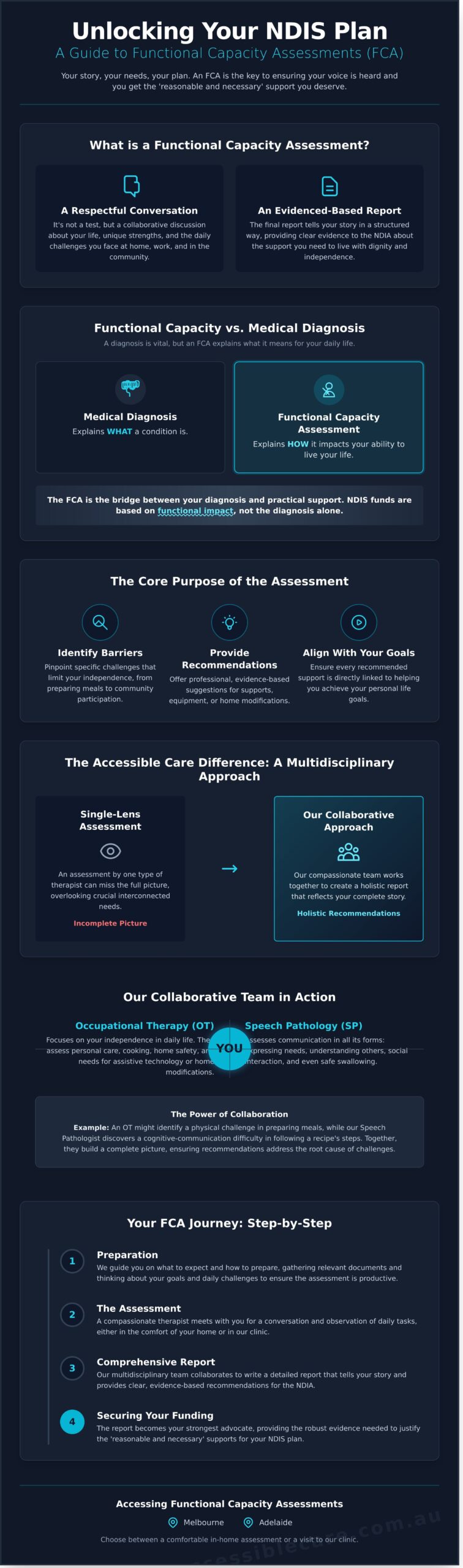
Navigating the NDIS can feel overwhelming, especially when you come across terms like ‘Functional Capacity Assessment’. We’re here to make it simple. Think of an FCA not as a test, but as a respectful conversation about your life. It’s a comprehensive evaluation, completed by a skilled therapist, that looks at your unique strengths, abilities, and the daily challenges you face. It focuses on how you manage tasks at home, at work, and in your community.
This process is about understanding you as a whole person. It’s a specific type of Functional Capacity Evaluation tailored to provide clear, evidence-based information for your NDIS plan. The final report tells your story in a way that helps the National Disability Insurance Agency (NDIA) understand exactly what support you need to live with dignity and independence.
So, why is this assessment so important? The NDIA uses the information from an FCA to determine if the supports you’re requesting meet their ‘Reasonable and Necessary’ criteria. This is the standard the NDIS uses for funding all supports. A thorough functional capacity assessment provides the clear evidence needed to justify funding for things like therapy, assistive technology, or a support worker. Whether you’re applying for the NDIS for the first time or preparing for a plan review, a well-written FCA is one of the most powerful tools you have to advocate for the right level of support. It ensures your plan is built around your real-world needs, not just assumptions.
The Core Purpose of the Assessment
The goal is to create a clear picture of your day-to-day life to ensure you get the right support. The assessment is designed to:
- Identify barriers: Pinpoint specific challenges that limit your independence, whether it’s preparing a meal, catching public transport, or participating in a hobby.
- Provide recommendations: Offer professional, evidence-based suggestions for supports, equipment, or home modifications that will make a meaningful difference.
- Align with your goals: Ensure that every recommended support in your NDIS plan is directly linked to helping you achieve your personal life goals.
Functional Capacity vs. Medical Diagnosis
A medical diagnosis is vital, but for the NDIS, it only tells half the story. A diagnosis might explain what a condition is, but an FCA explains how that condition impacts your ability to live your life. It shifts the focus from ‘what is wrong’ to ‘how you live’. The NDIS funds supports based on this functional impact, not the diagnosis alone. A Functional Capacity Assessment is the bridge between your clinical diagnosis and the practical, daily support you need to live a full life.
The Accessible Care Difference: A Multidisciplinary Approach
A person is not a single diagnosis. They are a whole individual with unique goals, challenges, and strengths. That’s why a single-lens assessment, conducted by just one type of therapist, often misses the full picture. It might capture physical challenges but overlook communication barriers, or vice versa. This can lead to an NDIS plan that doesn’t provide the right level or type of support you truly need to thrive.
At Accessible Care, we believe in a collaborative and person-centred approach. Our compassionate team works together to understand how different aspects of your life connect. We listen carefully to create a comprehensive report that reflects your complete story, ensuring no need is overlooked. This holistic view is the foundation of a truly effective functional capacity assessment.
The Role of Occupational Therapy (OT) in Your FCA
Our Occupational Therapists (OTs) focus on your independence in daily life. They assess your ability to manage Activities of Daily Living (ADLs) like personal care, cooking, and moving around your home. They also evaluate your environment for safety and accessibility, identifying needs for assistive technology, like specialised kitchen tools, or home modifications, such as grab rails or ramps, to help you live more safely and freely.
Integrating Speech Pathology and Communication Needs
Communication is fundamental to choice, control, and community participation. Our Speech Pathologists assess much more than just speech. They look at your ability to understand others, express your needs, interact socially, and even swallow safely. By including their expertise, we ensure your report captures how communication impacts every area of your life, from building relationships to engaging with support workers effectively.
The real power of our approach comes from how these skilled professionals work together. An OT might identify a physical challenge in preparing meals, while our Speech Pathologist may discover a cognitive-communication difficulty in following a recipe’s steps. Together, they build a complete picture. This collaboration ensures our recommendations are integrated and address the root cause of a challenge, not just the symptom.
For participants with complex health concerns, our experienced Community Nurses add another vital layer of support. They can assess clinical needs like medication management or wound care, ensuring your health and wellbeing are fully considered within your overall capacity. A strong report that details these interconnected needs is essential, as it provides the specific information required by the official NDIS evidence guidelines to justify funding for your supports.
Most importantly, this process is built around you. Your dignity, comfort, and choice guide every step. The assessment happens where you feel most comfortable, and you are the expert on your own life. We are here to listen and translate your goals into a clear, supportive plan. It’s your choice, your life, your way. If you’d like to learn more about our compassionate assessment process, our team is ready to help.
Step-by-Step: What Happens During Your Functional Capacity Assessment
Understanding what to expect can make the process feel much less daunting. A functional capacity assessment isn’t a test you can pass or fail; it’s a collaborative conversation designed to build a true picture of your life. It’s about understanding your strengths, identifying your challenges, and mapping out the support you need to live with dignity and independence. The process is respectful, person-centred, and always focused on you.
The entire assessment is built around listening to your story. To do this effectively, the assessor, usually a skilled Occupational Therapist (OT), will gather information through a few key phases. You’ll be asked to prepare by gathering any existing reports from your GP or other specialists and, most importantly, thinking about your personal goals. What do you want to achieve with the right support?
Phase 1: The Initial Consultation and History
This first step is simply a conversation. Your assessor wants to hear from you about your ‘typical day’ versus your ‘best day’. This distinction is crucial because it helps create a realistic picture of your support needs, not just a snapshot of when you’re feeling your strongest. Being open and honest about your challenges is the key to getting the right funding and support. You’re also welcome to involve family members or carers who can share their perspectives and support you during the discussion.
Phase 2: Functional Observations and ADLs
After your initial discussion, the OT will observe how you manage various tasks in your own environment. This isn’t about judging you; it’s about seeing firsthand where difficulties arise so the right solutions can be recommended. This process is a core component of what clinical experts refer to as a Functional Capacity Evaluation & Disability assessment, ensuring the recommendations are based on real-world evidence. Observations often cover:
- Self-Care (Activities of Daily Living): This includes personal tasks like showering, getting dressed, grooming, and moving around your home.
- Instrumental Tasks (Instrumental Activities of Daily Living): These are the more complex tasks required for independent living, such as preparing a simple meal, doing laundry, light cleaning, or managing your finances and appointments.
- Cognitive Skills: The assessment also looks at cognitive functions in a practical way. This could involve observing your ability to follow a recipe, make decisions while shopping, or remember to take medication.
Finally, the assessor will conduct an environmental review, looking at your home, work, or school to identify any barriers. They might suggest simple modifications or assistive technology to make your spaces safer and more accessible. All this information is then compiled into a comprehensive report that tells your story and clearly outlines the support needed to help you achieve your goals. Your choice, your life, your way.
The FCA Report: Turning Observations into NDIS Funding
The assessment is where we listen and observe, but the report is where your story is told. A well-written report does more than just list challenges; it builds a clear, compelling case for the supports you need to live with dignity and independence. It’s the crucial bridge between the assessment process and securing the right NDIS funding for your goals. We understand that this document holds significant weight for your future, and our compassionate team is dedicated to ensuring it accurately reflects your voice and aspirations.
To the NDIA, a high-quality report is one that is clear, objective, and evidence-based. It translates the functional gaps we identify into specific, justifiable support recommendations. For example, instead of simply stating “difficulty with meal preparation,” a strong report will detail why. It might explain that “due to limited upper body strength and fatigue, the participant is unable to lift pots or chop vegetables for more than 5 minutes, creating a safety risk and reliance on pre-packaged meals.” This detailed observation is then linked directly to a recommendation for a specific number of support hours or assistive technology, showing a clear cause and effect.
Key Components of a Successful NDIS Report
A successful report is structured to give the NDIA planner all the information they need to make an informed decision. It clearly links all findings to the NDIS framework, focusing on:
- Alignment with NDIS Domains: Every observation and recommendation is categorised under the six key NDIS functional domains: Mobility, Communication, Social Interaction, Learning, Self-Care, and Self-Management. This makes it easy for the NDIA to see how the requested supports will improve your capacity in these specific areas.
- Detailed Support Recommendations: We provide precise recommendations for support work and therapy. This includes the number of hours, the skill level of the support worker, and a clear justification. For instance, we might recommend 10 hours of 1:1 support per week to enable safe community access, which directly addresses goals related to social participation.
- Assistive Technology (AT) Justification: If AT is recommended, we provide a thorough cost-benefit analysis. A request for a A$4,000 specialised mattress, for example, will be justified by explaining how it prevents pressure sores, reducing the need for costly medical interventions and support worker assistance for repositioning, thereby offering long-term value and improved health outcomes.
Reviewing and Submitting Your Report
Your voice is the most important part of this process. That’s why we believe in a collaborative approach. Before anything is submitted, you will receive a draft of the report to review. This is your opportunity to ensure it accurately captures your experiences, goals, and challenges. We work with you to make any necessary changes, because this report is about you.
From the date of your final assessment session, you can typically expect to receive your completed functional capacity assessment report within 10 to 15 business days. Once your NDIS plan is approved based on this comprehensive report, the next step is to bring it to life. Learn how our Support Coordination can help you implement your plan and connect with providers who truly understand your needs.
Our goal is to create a report that not only meets the NDIS requirements but also empowers you on your journey. Ready to ensure your needs are clearly communicated? Speak with our caring team today about your assessment.
Accessing Functional Capacity Assessments in Melbourne and Adelaide
Finding the right support in a timely manner can be a challenge. In both Victoria and South Australia, NDIS participants often face significant waitlists for allied health services, with delays for occupational therapists sometimes stretching from 3 to 6 months in metropolitan areas. This waiting period can postpone access to crucial funding and supports. At Accessible Care, we are committed to providing responsive, person-centred services right where you live, reducing stress and helping you move forward with your goals.
We believe the most accurate and respectful way to understand your needs is in your own environment. That’s why we specialise in in-home assessments. Unlike a sterile clinic, your home tells a story about your daily routines, challenges, and aspirations. Conducting a functional capacity assessment in your personal space allows our therapists to see your life in context, leading to a more practical and meaningful report. It’s more comfortable for you, more convenient for your family, and provides a true-to-life picture of your support requirements.
Getting started with us is a simple and supportive process. We’ve designed our approach to be clear and free of stress because we know you have enough to manage. Here’s what you can expect:
- Step 1: Initial Contact. Reach out to our friendly team via phone or our online form. We’ll have a gentle, no-obligation chat about your situation.
- Step 2: Planning the Assessment. We listen carefully to your goals and schedule a time for one of our compassionate therapists to visit you at home, wherever you are in Melbourne or Adelaide.
- Step 3: The In-Home Assessment. The assessment is a collaborative conversation. We observe, ask questions, and work with you to understand your strengths and support needs.
- Step 4: A Comprehensive Report. You will receive a detailed, easy-to-understand report that clearly outlines our findings and recommendations, ready for you to share with the NDIS.
Support for Veterans and Complex Needs
Our experienced team is skilled in tailoring assessments for a diverse range of needs. We work closely with veterans, navigating DVA pathways to ensure their unique service-related requirements are properly documented. For participants with high-intensity or complex support needs, we provide dedicated care across both metro and regional areas, from Melbourne’s CBD to the Mornington Peninsula and from the heart of Adelaide to the Barossa Valley.
Your Choice, Your Life, Your Way
Every functional capacity assessment we conduct is guided by a deep respect for your dignity and autonomy. We see you as the expert in your own life. Our promise is to be a provider who truly listens, understands your goals, and advocates for the support that empowers you to live the life you choose. We are here to be your partner in care, not just a service provider.
Contact our compassionate team in Melbourne or Adelaide today to take the next step on your journey.
Take the Next Step Towards Your NDIS Goals
Navigating the NDIS doesn’t have to feel overwhelming. A thorough functional capacity assessment is your most powerful tool for clearly communicating your needs and securing the right funding for 2026 and beyond. It translates your daily life into an actionable plan that supports your independence and personal goals. At Accessible Care, our process is built on dignity, respect, and understanding.
As a registered NDIS Provider, our experienced multidisciplinary team serves communities across Melbourne and Adelaide. We listen carefully to understand your unique story because we are committed to empowering you to live the life you choose. Your goals are our priority.
Ready to move forward with clarity and confidence? Book Your Compassionate Functional Capacity Assessment Today and let’s build your path to NDIS success together.
Frequently Asked Questions
How much does a Functional Capacity Assessment cost under the NDIS?
A Functional Capacity Assessment is funded through your NDIS plan’s ‘Capacity Building’ budget. The total cost typically ranges from A$1,900 to A$4,000, as it covers 10 to 20 hours of professional work. This includes the face-to-face assessment, interviews with your support network, scoring, and the detailed report writing required to outline your support needs. The final price depends on the complexity of your situation and the time required.
Do I need an FCA for every NDIS plan review?
No, you don’t need a new FCA for every single plan review. An assessment is usually recommended when your circumstances or support needs have changed significantly since your last one. It is also vital if you are seeking funding for new or different supports to help you achieve your goals. Your support coordinator can help you decide if a new report would be beneficial for your upcoming review meeting.
Can a Functional Capacity Assessment be done via Telehealth?
Yes, a functional capacity assessment can often be conducted effectively through Telehealth. This is a wonderful option if you live in a remote area or find in-person appointments challenging. The process might involve video calls for interviews and for observing you complete certain tasks in your own home environment. Your therapist will work with you to determine if Telehealth is a suitable and supportive option for your specific needs.
Who is qualified to perform an NDIS Functional Capacity Assessment?
NDIS Functional Capacity Assessments are completed by qualified Allied Health Professionals, most commonly an Occupational Therapist (OT). OTs specialise in assessing daily living skills and functional abilities. Depending on your primary goals, a Physiotherapist or Psychologist may also conduct parts of the assessment. The professional must be registered with the Australian Health Practitioner Regulation Agency (AHPRA) to ensure they meet national standards of care and expertise.
How long does the actual assessment visit take?
The main in-person assessment visit usually takes between 2 and 4 hours. To ensure you don’t feel overwhelmed or tired, this can be split into two separate sessions. It’s important to remember this is just one piece of the puzzle. The therapist dedicates an additional 10-15 hours to reviewing documents, speaking with your family or support workers, and writing the comprehensive report that accurately reflects your strengths and needs.
What documents should I have ready before my assessment?
To help your therapist get a clear picture, it’s useful to gather any relevant documents beforehand. This includes your current NDIS plan, reports from other therapists (like a speech pathologist or physiotherapist), and letters from your GP or medical specialists. Having a simple list of your personal goals and the daily challenges you face is also incredibly helpful for guiding the conversation and ensuring nothing is missed.
Can I request a specific therapist for my FCA?
Yes, you can absolutely request a specific therapist for your assessment. Your choice and comfort are what matter most. If you’ve worked with a therapist before who understands your situation, or if someone has been recommended to you, you have the right to ask for them. Simply check with the provider to confirm that therapist’s availability and ensure they are a good match for your assessment needs. It’s your life, your way.
What happens if I disagree with the findings in my FCA report?
If you have concerns or disagree with the report’s findings, your first step is to speak directly with the therapist who wrote it. They can explain their reasoning and may be able to make changes if there was a factual error or misunderstanding. You should always be given a draft copy to review before it’s finalised. It’s your report, and it’s vital that it accurately represents you, your challenges, and your goals.

