


What if finding the right support for your loved one felt less like a maze and more like a clear, compassionate path forward? We know the journey into the world of ndis speech therapy can feel overwhelming. You’re trying to understand complex budgets while carrying the very real worry for a child’s developmental milestones or an adult’s journey to regain their speech. It’s a heavy weight, and you don’t have to carry it alone.
This guide is our promise to you for 2026: a clear, simple resource to build your confidence and empower your choices. We will help you understand exactly how your “Capacity Building” funding works for speech pathology and provide practical steps for finding skilled, available therapists in Melbourne and Adelaide. Together, we’ll explore how the right support can lead to greater independence, connection, and an improved quality of life for the person you care about.
Key Takeaways
- Understand how speech pathology can help both children and adults achieve key NDIS goals like greater independence and community participation.
- Discover which NDIS budget category to use for therapy, including the ‘Improved Daily Living’ line item in your plan.
- Follow a simple, two-step process to begin your ndis speech therapy journey, from initial assessment to a tailored support plan.
- Learn what to look for in a compassionate therapist in Melbourne or Adelaide who respects your dignity and empowers your voice.
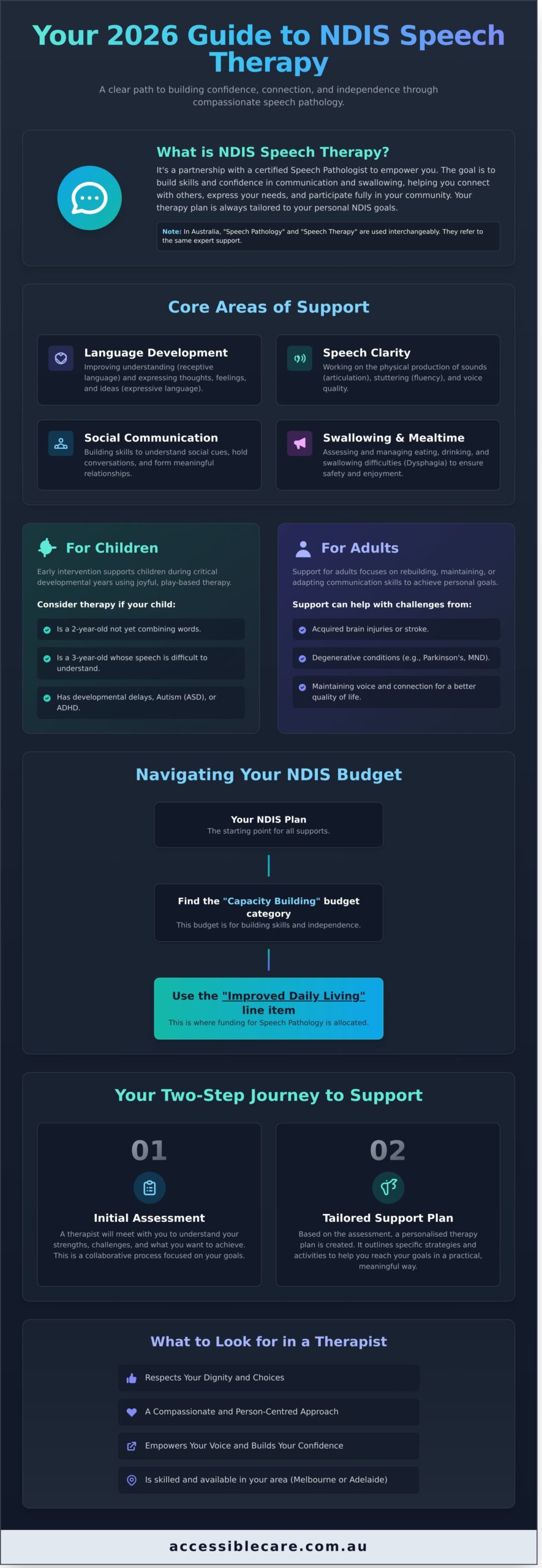
What is NDIS Speech Therapy and How Does it Support You?
At its heart, NDIS speech therapy is a compassionate and evidence-based support service designed to help you build confidence and skill in communication and swallowing. Delivered by certified Speech-Language Pathologists (SLPs), this therapy is far more than just “learning to talk.” It’s a partnership aimed at empowering you to connect with others, express your needs and ideas, and participate fully in your community. Your NDIS goals, whether they involve finding employment, making friends, or living more independently, are the foundation of your tailored therapy plan.
In Australia, you’ll often hear the term “speech pathology” used instead of “speech therapy.” They mean the same thing. “Speech pathology” is the clinical term for the profession, reflecting the deep scientific understanding of communication and swallowing disorders our specialists possess. We use both terms, but what matters most is the caring, professional support you receive.
Our approach is always person-centred. We see you, not just a diagnosis. We take the time to listen and understand what truly matters in your life. This philosophy aligns perfectly with the principles of the National Disability Insurance Scheme, which is built on providing you with choice and control over your supports. Together, we’ll develop a plan that respects your dignity and focuses on achieving practical, meaningful outcomes that improve your quality of life.
Core Areas of Speech Pathology Intervention
Our dedicated speech pathologists work across several key areas to provide holistic support. We tailor every strategy to your individual needs, ensuring the care you receive is relevant and effective. Key areas of focus include:
- Language Development: This involves supporting your ability to understand what others are saying (receptive language) and to share your own thoughts, feelings, and ideas clearly (expressive language).
- Speech Clarity: We work with you to improve the physical production of speech sounds (articulation), enhance fluency for those who stutter, and address voice disorders to ensure your message is heard.
- Social Communication: This vital area focuses on helping you understand and use social cues, engage in conversations, and build the meaningful relationships that are essential for community connection.
Beyond Speaking: Swallowing and Mealtime Support
A speech pathologist’s expertise extends to the critical functions of eating, drinking, and swallowing. For many NDIS participants, especially those with complex needs, this support is essential for safety and wellbeing. Our team helps by assessing swallowing function and creating mealtime management plans that reduce risks and make meals a more enjoyable experience.
Dysphagia, a medical term for difficulty with swallowing, represents a critical safety concern that speech pathologists address to prevent choking and aspiration, a priority that by 2026 will be even more central to NDIS quality and safeguarding frameworks. By providing strategies for safer swallowing and modifying food and drink textures, we empower participants and their support networks to manage mealtimes with confidence and dignity.
Who Benefits from Speech Therapy Under the NDIS?
Speech therapy is about so much more than just learning to speak clearly. It’s about connection, confidence, and the ability to participate fully in life. The National Disability Insurance Scheme (NDIS) supports a diverse range of participants, from young children reaching for their first words to adults working to maintain their voice. It recognises that communication is a fundamental human right, essential for building relationships, achieving personal goals, and living with dignity.
Whether it’s for early intervention or ongoing support, accessing ndis speech therapy can be a life-changing step. The goal is always person-centred, focusing on what matters most to you or your loved one. The NDIS provides funding for supports that are considered ‘reasonable and necessary’ to help participants pursue their goals, and this includes a wide array of NDIS-funded therapy supports designed to build capacity and independence.
Paediatric Speech Therapy: Helping Your Child Shine
For children under 9, the NDIS Early Childhood Early Intervention (ECEI) approach provides vital support during the most critical developmental years. You might consider seeking funding if you notice your toddler isn’t meeting key milestones, such as a 2-year-old not yet combining words or a 3-year-old whose speech is difficult for family to understand. Our compassionate speech pathologists use play-based therapy, turning learning into a joyful experience. Through games and engaging activities, we help children with developmental delays, Autism (ASD), or ADHD build foundational skills for school readiness, making friends, and expressing their wonderful personalities.
Adult Speech Therapy: Rebuilding Connection
For adults, communication challenges can arise for many reasons. A sudden neurological event like a stroke or an Acquired Brain Injury (ABI) can profoundly impact the ability to speak, understand, or even swallow safely. Our dedicated therapists work with you to rebuild those pathways, helping you regain the skills needed for daily life. For participants with degenerative conditions like Motor Neurone Disease (MND), the focus shifts to maintaining communication for as long as possible, often exploring augmentative and alternative communication (AAC) devices. This support is crucial for empowering adults to exercise their choice and control, ensuring their voice is always heard in decisions about their own care and life.
Support also extends to participants with intellectual disabilities who may need help with cognitive-communication skills. This involves more than just speech; it’s about improving memory, problem-solving, and understanding social cues to foster greater independence and community participation. Understanding your unique needs is the first step, and our compassionate team is here to listen and help you explore your options.
Navigating Your NDIS Budget for Speech Pathology
Understanding your NDIS plan can feel overwhelming, but it’s designed to give you choice and control over your supports. When it comes to funding speech pathology, your funds are allocated in a way that helps you build skills and increase your independence. We’re here to help you make sense of it all, so you can access the support you need with confidence.
Speech therapy is almost always funded under your Capacity Building budget. This part of your plan is dedicated to services that help you develop new skills and achieve your personal goals. Within this budget, you will find a specific line item called ‘Improved Daily Living’. This is where the funding for your ndis speech therapy sessions, assessments, and reports will be drawn from.
It’s helpful to understand the difference between this and your Core Supports budget. Core Supports are for your daily activities and essentials, like having a support worker assist with personal care. Capacity Building, on the other hand, is an investment in your future, empowering you with therapeutic supports that build lasting skills. Your plan also offers flexibility in how you manage these funds:
- Self-managed: You have the most control, paying providers directly and claiming reimbursement from the NDIA. This allows you to use any provider, even if they aren’t NDIS-registered.
- Plan-managed: A plan manager handles the financial side for you, paying your invoices from your NDIS funds. You still get the flexibility to choose non-registered providers without the administrative work.
- NDIA-managed (Agency-managed): The NDIA pays your providers directly, but you can only use NDIS-registered providers.
Understanding Therapy Rates and the NDIS Price Guide
The NDIS sets maximum hourly rates for services through its Price Guide to ensure fairness and consistency. For example, under the pricing arrangements for 2026, the rate for a speech pathologist is set at $193.99 per hour. Your provider can’t charge more than this for NDIS-funded services. If a therapist visits you at home in Melbourne or Adelaide, they may also claim a “travel allowance,” typically for up to 30 minutes of travel time each way. It’s also vital to budget for progress reports, as a detailed report for your NDIS plan review can take 2-4 hours for your therapist to complete.
AAC and Assistive Technology Funding
Augmentative and Alternative Communication (AAC) includes all the tools that support or replace speech, from simple picture boards to advanced speech-generating devices. If you or your loved one needs AAC, your speech pathologist plays a key role. They conduct a detailed Assistive Technology (AT) assessment, following best-practice guidelines set by bodies like Speech Pathology Australia, to identify the right solution. This formal assessment and report are then submitted to the NDIS to request specific funding for the recommended technology, which is separate from your therapy budget.
Getting Started: The NDIS Speech Therapy Process
Beginning your journey with NDIS speech therapy can feel like a big step, but it doesn’t have to be overwhelming. At its heart, the process is a partnership built on listening, understanding your unique goals, and creating a clear path forward. We’ve broken it down into four simple, supportive stages to show you exactly what to expect.
Think of this as your personal roadmap to achieving your communication goals, with our compassionate team beside you at every turn.
- Step 1: Your Initial Consultation. This first meeting is all about you. It’s a warm, respectful conversation where we listen to understand your strengths, your challenges, and what you hope to achieve. We’ll discuss everything from daily conversations to bigger life goals, ensuring we have a holistic picture of your needs.
- Step 2: A Tailored Therapy Plan. Using the insights from our initial chat, your speech pathologist will develop a therapy plan that is created just for you. This plan directly connects your personal communication goals to your NDIS objectives, such as ‘Increased Social and Community Participation’ or ‘Improved Daily Living Skills’. It’s a clear, practical document that outlines our shared strategy.
- Step 3: Ongoing Therapy Sessions. This is where the plan comes to life. Your sessions can be held where you feel most comfortable: in one of our welcoming clinics, in the familiarity of your own home, or conveniently via Telehealth. The choice is always yours.
- Step 4: Regular Progress Monitoring. We believe in celebrating every success. We carefully track your progress using evidence-based methods and data collection. This not only shows how far you’ve come but also provides the concrete evidence needed for your NDIS plan reviews, demonstrating the value of your therapy.
The Functional Capacity Assessment (FCA)
To secure the right level of funding in your NDIS plan, a comprehensive report is often required. The Functional Capacity Assessment (FCA) is the gold standard for this. A speech-focused FCA involves observing how you communicate in real-world settings to provide the NDIA with clear evidence of your support needs. This detailed report is crucial for justifying your funding. Our skilled therapists conduct a thorough Functional Capacity Assessment to ensure your needs are clearly and professionally documented.
Telehealth vs. In-Person Therapy
Many people ask if Telehealth is as effective as face-to-face sessions. For a significant number of participants, the answer is a resounding yes. Studies, including those reviewed by Speech Pathology Australia, show that Telehealth delivers comparable outcomes for many therapy goals. For participants with mobility challenges or social anxiety, at-home therapy provides a safe and comfortable environment for growth. Ultimately, the best format is the one that fits your life. It’s about empowering you with options, because we believe in: Your choice, your life, your way.
Ready to take the first step on your communication journey? Contact our compassionate team today to discuss how we can support your goals.
Accessible Care: Compassionate Speech Therapy in Melbourne & Adelaide
Finding the right support in your community is the final, most crucial step in your NDIS journey. It’s not just about qualifications; it’s about finding a partner who listens, understands, and respects your individual goals. At Accessible Care, we are committed to providing NDIS speech therapy that honours your dignity and empowers your unique voice. We believe that effective therapy is built on a foundation of trust and genuine connection.
Our approach is holistic. We recognise that communication challenges don’t exist in a vacuum. That’s why our Speech Language Pathologists (SLPs) work collaboratively with our in-house Occupational Therapists and Community Nurses. This multidisciplinary team ensures your communication goals are integrated into your broader health and daily living plans, creating a seamless support system. Serving the vibrant communities across Melbourne, greater Victoria, Adelaide, and South Australia, we have deep local expertise and a passion for putting you, the participant, at the very heart of every decision.
Our Experienced Speech Language Pathologists
Our dedicated team of SLPs brings a powerful combination of clinical expertise and heartfelt empathy to every session. We have extensive experience supporting participants with complex needs, including communication recovery following a stroke or traumatic brain injury, managing dysarthria associated with neurological conditions, and providing tailored paediatric support for children with Autism Spectrum Disorder (ASD) or developmental language delays. The Accessible Care difference is our commitment to blending professionalism with a gentle, reassuring approach. We take the time to demystify the NDIS, translating confusing jargon into clear, simple language so you can focus on what truly matters: your progress and well-being.
Your Journey, Your Way: Take the Next Step
Starting with us is simple and stress-free. You can refer yourself, a family member, or a client you support directly to our services. Your first step is a complimentary “Meet and Greet” with one of our compassionate therapists. This isn’t a formal assessment; it’s a relaxed, no-obligation chat where we get to know each other. During this meeting, we will:
- Listen carefully to understand your story, your challenges, and your goals.
- Discuss how speech therapy can specifically help you achieve what you want in life.
- Answer any questions you have about our services or your NDIS plan.
- Ensure you feel comfortable, heard, and respected from the very beginning.
This initial conversation is all about ensuring we are the right fit for you. Your comfort and confidence are our top priorities. Ready to be supported by a provider who truly listens? Get in touch with our caring team today.
Empower Your Communication Journey Today
Navigating your path to clearer communication is an achievable goal. Your NDIS plan is a powerful tool, and understanding how to use it for ndis speech therapy is the first step toward building confidence and connection. It’s all about finding a partner who listens and helps you turn your goals into reality.
Choosing the right support makes all the difference. At Accessible Care, our commitment is to you. As a Registered NDIS Provider, our experienced multidisciplinary team in Melbourne and Adelaide is dedicated to crafting a person-centred plan that respects your choices and empowers your voice. We’re here to support you with dignity and compassion every step of the way.
You don’t have to take this next step alone. Start your communication journey with Accessible Care and discover a partnership built on trust and respect. A more confident future is within your reach.
Frequently Asked Questions About NDIS Speech Therapy
Is speech therapy covered by the NDIS?
Yes, speech therapy is covered by the NDIS if it’s considered ‘reasonable and necessary’ to help you achieve your goals. This support typically falls under the ‘Capacity Building – Improved Daily Living’ category in your NDIS plan. Funding can be used for assessments, one-on-one therapy, and developing communication strategies to enhance your independence and community participation.
How many hours of speech therapy will the NDIS fund?
The NDIS doesn’t set a specific cap on the number of hours it will fund. Instead, the amount of therapy funded is based on your individual needs and the goals outlined in your plan. A comprehensive assessment report from a speech pathologist, which recommends a certain frequency and duration of therapy, provides the evidence the NDIA uses to determine an appropriate budget for you.
Can I use my NDIS funding for speech therapy if I am self-managed?
Yes, if you self-manage your NDIS plan, you have the flexibility to choose any speech therapist, even if they are not a registered NDIS provider. This gives you greater choice and control over your support. You are responsible for paying their invoices directly and then claiming the funds back from your NDIS portal, ensuring the therapist has an ABN and the service aligns with your plan goals.
What is the difference between a speech therapist and a speech pathologist?
In Australia, there is no difference; the terms ‘speech therapist’ and ‘speech pathologist’ are used interchangeably. ‘Speech pathologist’ is the professional title officially recognised by the national body, Speech Pathology Australia. Both terms refer to the same university-qualified allied health professionals who assess and treat communication and swallowing disorders.
Does Accessible Care offer speech therapy for adults with brain injuries?
Yes, our dedicated team at Accessible Care provides specialised speech therapy for adults living with the effects of an acquired brain injury (ABI). Our compassionate speech pathologists work with you to address challenges like aphasia or cognitive-communication difficulties. We create person-centred therapy plans focused on rebuilding skills and confidence to help you achieve your personal goals.
How do I get a speech therapy assessment for an NDIS plan review?
You can get an assessment by contacting a speech pathologist and booking a functional or review assessment, ideally 8-10 weeks before your plan review is due. The therapist will evaluate your progress and ongoing needs, then write a detailed report with evidence-based recommendations. This report is a crucial tool for demonstrating the need for continued ndis speech therapy funding to the NDIA.
What happens if my NDIS budget for therapy runs out?
If your therapy budget is running low before your plan is due to end, you can request an early plan review with the NDIA. You will need to provide evidence, such as a letter or report from your speech pathologist, explaining why continued support is critical and how your needs have changed. It’s important to start this process well before your funding is completely exhausted.
Are there waitlists for speech therapy in Melbourne or Adelaide?
Yes, waitlists for speech therapy services are common across both Melbourne and Adelaide, with wait times ranging from a few weeks to over 12 months depending on the clinic and specific need. At Accessible Care, we work hard to connect participants with our therapists as soon as possible. We encourage you to contact our team directly for the most up-to-date information on our availability.

