


Last Tuesday, Sarah spent three hours double-checking her daughter’s seizure management plan because she wasn’t sure if her new support worker had the right training. This quiet anxiety is a reality for many of the 610,000 Australians currently supported by the NDIS who require specialized clinical care at home. You deserve to feel certain that your safety is in expert, compassionate hands every single day. It’s completely natural to feel overwhelmed by the technical requirements and the complex language used to describe ndis high intensity supports. You shouldn’t have to choose between clinical safety and the comfort of your own home.
We want to replace that worry with genuine peace of mind. This guide will help you understand exactly what high intensity supports entail, how to secure the right funding categories, and how to find a provider who treats you with the dignity you deserve. We’ll break down the 2026 HIDPA categories and show you how to build a care plan that protects your health while empowering your independence. Your choice and your life matter. By the end of this article, you’ll have a clear roadmap to navigate the system and find the compassionate, skilled care your family needs to thrive.
Key Takeaways
- Learn how ndis high intensity supports provide specialized care for complex health needs, ensuring your safety and dignity are always the top priority.
- Discover the 2026 updates to the High Intensity Support Skills Descriptors and why mandatory competency evidence for workers is a game-changer for your quality of care.
- Navigate the process of securing funding within your Core Supports budget and learn which clinical documents are essential for a successful plan review.
- Understand the critical differences in training and supervision that distinguish high intensity care from standard support, including how these factors influence NDIS pricing.
- See how an integrated team of nurses and therapists can transform complex care into a supportive partnership that empowers you to live life your way.
What are NDIS High Intensity Supports (HIDPA)?
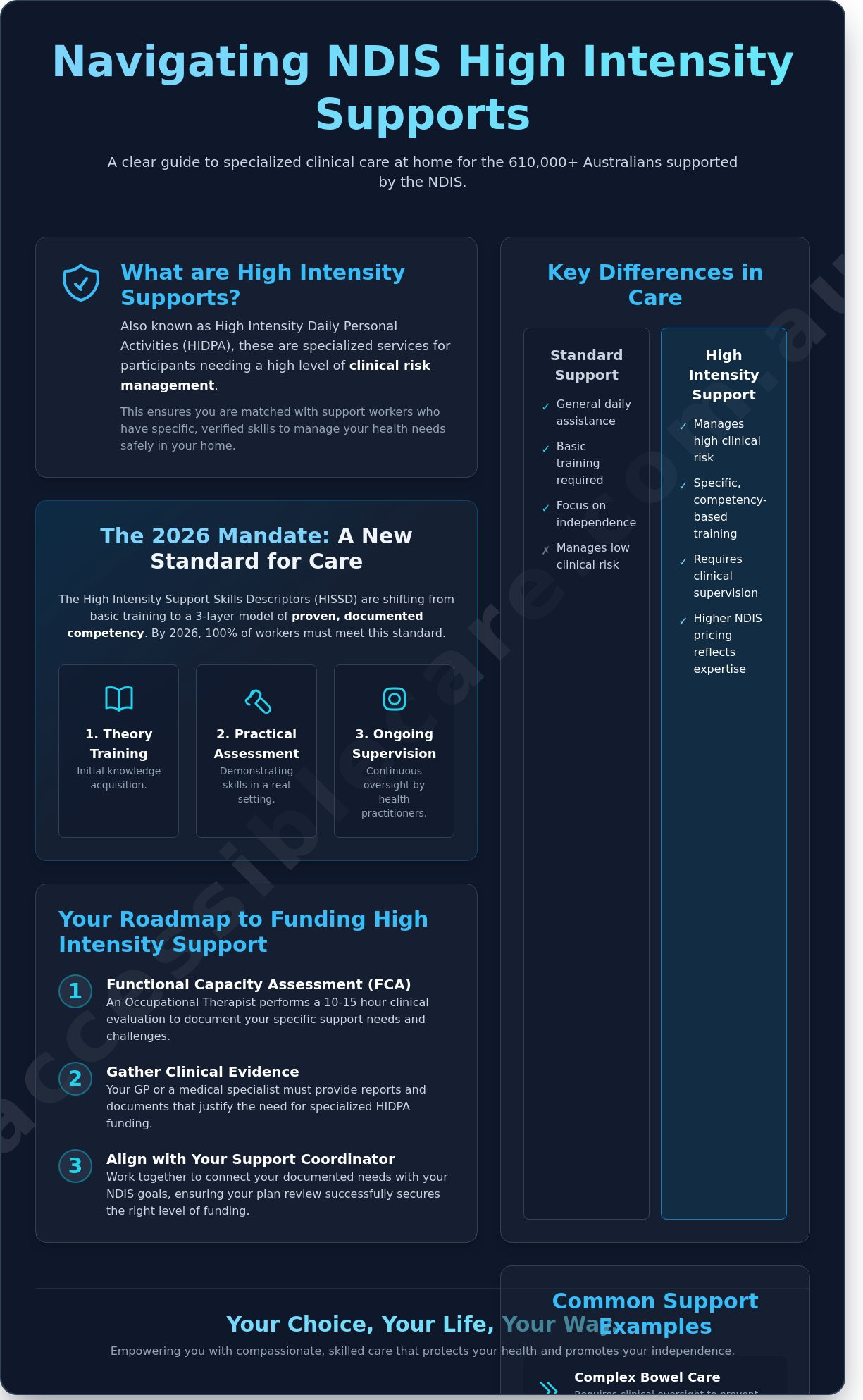
Living with complex health needs shouldn’t mean compromising on the quality of your daily life. NDIS high intensity supports, often referred to as High Intensity Daily Personal Activities (HIDPA), are specialized services designed for participants who require a higher level of clinical risk management. This isn’t standard personal care. It involves support that requires workers with specific training and experience to ensure your safety and well-being every single day. We understand that these needs can feel overwhelming, but the right support makes all the difference.
This label is vital because it determines the level of funding and the type of staff expertise required in your NDIS plan. When your plan includes ndis high intensity supports, it signifies that your care involves a higher degree of risk. This ensures you’re matched with support workers who possess the specific skills to manage your health requirements. It’s about more than just assistance; it’s about providing a safety net that allows you to live confidently in your own home.
The NDIS Quality and Safeguards Commission plays a central role in this process. They established the High Intensity Support Skills Descriptors, which were significantly updated in February 2023. These descriptors set the benchmark for what a support worker must know and be able to do. By following these national standards, providers ensure that care is consistent, safe, and professional across Australia. This regulatory oversight gives you and your family peace of mind that your care team meets rigorous safety requirements.
At Accessible Care, we provide these services across Melbourne and Adelaide with a deep commitment to your dignity. We don’t just see a clinical requirement; we see a person who deserves to live a full life. Our approach is built on the philosophy of “Your choice, your life, your way.” We listen to your preferences to ensure that even the most complex medical tasks are performed in a way that makes you feel comfortable and respected. We believe that professional care should always be delivered with a warm, human touch.
Common types of complex daily activities
Complex bowel care often requires a high degree of clinical oversight to prevent complications such as autonomic dysreflexia. We manage specialized hygiene needs with the utmost sensitivity and professional care. Enteral feeding, involving PEG or nasogastric tubes, ensures your nutritional health is maintained through precise administration and equipment management. For those requiring respiratory stability, our team provides tracheostomy and ventilator support, following the strict protocols required for constant monitoring and stability.
Who determines if you need high intensity support?
Identifying the need for these services starts with a Functional Capacity Assessment (FCA). This process typically involves 10 to 15 hours of clinical evaluation by an Occupational Therapist to document your specific challenges. Your GP or a medical specialist must also provide clinical evidence to justify HIDPA funding. You’ll then work closely with your Support Coordinator to align these needs with your NDIS goals, ensuring your funding reflects the actual level of professional care you require for a safe and independent life.
The 2026 High Intensity Support Skills Descriptors
The NDIS Quality and Safeguards Commission’s revised High Intensity Support Skills Descriptors (HISSD) set a new, rigorous benchmark for care that becomes fully mandatory by 2026. This update fundamentally changes how providers deliver ndis high intensity supports. It moves away from simple, one-off training sessions toward a model based on proven, documented competency. For you and your family, this shift means every person entering your home has the specific, verified skills needed for your unique situation. It’s a vital safety net designed to reduce health risks and ensure that complex needs never stand in the way of a full, independent life.
Competency in this new framework isn’t just a certificate on a wall. It involves three distinct layers: initial theory training, practical assessment in a real-world setting, and ongoing clinical supervision. A worker might understand the theory of a medical procedure, but they must also demonstrate they can perform it safely under the watchful eye of a qualified health practitioner. This rigorous process ensures that the care you receive is consistent, professional, and focused on your wellbeing. By 2026, 100% of workers providing complex care must have this evidence of competency, creating a higher standard of accountability across the entire disability sector.
Key skill areas your support team must master
Managing severe dysphagia is a critical skill under the updated descriptors. Support workers must follow a detailed Mealtime Management Plan to prevent choking or aspiration pneumonia, which is a leading cause of preventable hospitalisations. This involves preparing food to specific textures and recognizing subtle signs of swallowing distress. Similarly, urinary catheter care requires strict hygiene protocols to prevent infections. Proper maintenance at home ensures you stay comfortable and avoid unnecessary medical complications. For those requiring medication via subcutaneous injections, staff must be trained in sterile techniques and precise dose administration. These tasks are essential components of maintaining your health and dignity every day.
Verifying your provider’s expertise
You have the right to ask direct questions about who is providing your care. Start by asking a potential provider how often their staff’s competencies are reviewed by a Registered Nurse. A quality provider will have a clear, transparent schedule for these assessments. You should also ask how they document staff training specifically for ndis high intensity supports to ensure they meet the latest Commission standards. Having a Registered Nurse oversee high intensity care plans is not just a preference; it’s a necessity for safety and clinical oversight.
At Accessible Care, we ensure every team member meets the 2026 skill benchmarks today. We don’t wait for deadlines when it comes to your safety. Our Registered Nurses oversee every complex care plan, providing the clinical leadership and regular supervision required for peace of mind. If you’re looking for a partner who listens to your needs and prioritizes your safety, you can explore our tailored support options to see how we help you live life your way. We believe that expert care is the foundation of independence, and we’re committed to upholding the highest standards for every participant we serve.
Standard vs. High Intensity Care: Key Differences
Understanding the shift from standard care to high intensity support is vital for participants with complex medical needs. Standard support usually involves assistance with daily life tasks, such as meal preparation or social participation. However, ndis high intensity supports are required when a participant has health conditions that involve a higher level of risk. These supports require workers with specific skills to manage tasks like tracheostomy care, ventilator management, or complex wound care. Every worker providing these services must have their competency assessed by a qualified health professional, often a Registered Nurse, to ensure your safety is never compromised.
The NDIS Pricing Arrangements and Price Limits 2023-24 highlight the financial distinctions between these levels of care. For a standard weekday support session, the hourly rate is currently set at A$65.47. In contrast, high intensity supports are billed at A$71.83 per hour. This price gap exists because providers must invest more in staff training, higher wages for experienced workers, and ongoing clinical supervision. It isn’t just about the time spent with you; it’s about the specialized expertise required to manage complex health requirements safely and effectively.
Clinical governance is the framework that keeps complex care structured and accountable. It’s a system that ensures we’re always looking for ways to improve the quality of your care. At Accessible Care, this means our Registered Nurses regularly review your support plans and supervise the staff in your home. We don’t just “set and forget” your care. We maintain a clear line of responsibility from the support worker to the clinical management team. This oversight is a requirement of the NDIS Quality and Safeguards Commission, ensuring that every medical procedure performed in your home meets national health standards.
Many people worry that moving to ndis high intensity supports means they’ll lose their autonomy. This is the most common misconception we hear. In reality, having a skilled team to manage your medical needs actually increases your independence. It provides the safety net you need to stay in your own home and engage with your community, rather than being restricted to a hospital setting. You remain the expert in your own life. Our role is simply to provide the clinical expertise that allows you to live that life with confidence and peace of mind.
Risk management and safety protocols
Safety in complex care isn’t accidental; it’s planned. Every high intensity care plan we develop includes specific, step-by-step emergency response protocols tailored to your unique health profile. If a ventilator alarms or a feeding tube becomes dislodged, your support worker knows exactly which medical professional to call and what immediate actions to take. We use rigorous incident reporting to track any near-misses, which helps us refine our approach. This level of detail is why NDIS registration and specialized insurance are non-negotiable for providers in this space.
Preserving choice and control in complex care
We live by the philosophy of “Your choice, your life, your way.” Even when your care involves technical medical tasks, your personal routine remains the priority. Your support workers are guests in your home, and they’re trained to respect your preferences, from the time you wake up to the way you like your coffee. If your health needs change, we’ll guide you through the process of transitioning your NDIS funding. This ensures you always have the right level of help without ever feeling like you’ve lost control over your daily decisions.
How to Access & Fund High Intensity Support in Your Plan
Securing the right funding for your needs starts with looking at your Core Supports budget. Most ndis high intensity supports are funded under the “Assistance with Daily Life” category. You’ll specifically look for line items related to High Intensity Daily Personal Activities (HIDPA). These are different from standard care because they require staff with extra training to manage complex health risks safely. We know the NDIS system can feel like a lot to handle, but focusing on these specific areas helps ensure you have the resources you need to live comfortably at home.
To get this funding approved, you’ll need clinical evidence that’s clear and current. The NDIA usually requires a Functional Capacity Assessment or a specialist report dated within the last six months. If your condition involves risks like choking, severe seizures, or skin breakdown, your doctor must document these specific challenges. Providing this level of detail helps the NDIS understand why standard support isn’t enough to keep you safe. It’s about showing the “why” behind your care requirements so your budget reflects your reality.
The way you word your NDIS goals is also vital. Instead of a general goal like “I want help at home,” try using language that highlights your health needs. A stronger goal might be: “I want to access skilled support to safely manage my complex health needs so I can stay active in my community.” This specific wording directly links your health stability to your independence. It makes it much easier for planners to justify the higher hourly rates required for ndis high intensity supports.
Looking ahead, the NDIS is changing how it handles complex care. By July 2026, the NDIS pricing updates aim to simplify the current three-tier system for complex personal activities. This transition is designed to make pricing more transparent and reduce the administrative burden on participants. Staying informed about these shifts ensures your plan remains sustainable and continues to meet your evolving care needs over the coming years.
The role of Community Nursing in your funding
Nursing hours are a powerful tool in your NDIS plan. While personal care workers handle daily tasks, a Registered Nurse provides the oversight and training that keeps everything running smoothly. You can use nursing budget lines to pay for a nurse to train your support staff on your specific care plan. This creates a bridge between clinical expertise and daily support, ensuring your team feels confident and you feel safe. It’s a multidisciplinary approach that maximizes your budget while prioritizing your dignity.
Working with Support Coordinators
A Support Coordinator is your partner in finding providers who hold the correct HIDPA registrations. They don’t just find a worker; they find the right match for your specific medical requirements. Your coordinator also monitors your plan spend to make sure your funds last the full 12 months. If your health fluctuates and you need more intensive care, they’re the ones who advocate for a plan review. They help you speak the language of the NDIS so your voice is always heard.
If you’re ready to see how tailored care can make a difference in your life, we’re here to listen and help. Contact our compassionate team at Accessible Care to discuss your high intensity support needs today.
Why Accessible Care is the Choice for Complex Needs
Choosing a provider for ndis high intensity supports is a significant decision that impacts every part of your daily life. It’s not just about finding technical skill; it’s about finding a partner who values your dignity and understands the nuances of your routine. At Accessible Care, we’ve designed our service to be a sanctuary of support for participants across Melbourne and Adelaide. Our integrated approach brings together Registered Nurses, Occupational Therapists, and Speech Pathologists into one unified team. This eliminates the disconnect often found in healthcare, where different providers don’t talk to each other. Instead, our team shares insights and coordinates care to ensure every aspect of your health is covered under one roof.
We’ve seen that the best outcomes happen when we listen. We don’t just look at a clinical diagnosis and apply a generic template. We build care plans around your voice and your specific goals. If you want to spend more time in your garden or attend local community groups in your Melbourne suburb, we find the clinical pathways to make that safe. This commitment to listening helps us empower you to move beyond perceived limitations. With the right expert support, what once felt impossible becomes a manageable part of your daily life. Our local teams in Adelaide and Melbourne understand the regional health landscape, ensuring you get the most relevant resources available in your community.
Our compassionate multidisciplinary model
Complex care needs often overlap, requiring different types of expertise at the same time. For instance, our Speech Pathologists are essential for participants requiring dysphagia management. They work closely with our nurses to ensure mealtime plans are safe, reducing the risk of aspiration or choking. Simultaneously, our Occupational Therapists focus on your physical environment. They prescribe assistive technology, such as specialized pressure-relieving mattresses or custom wheelchairs, that directly improves your comfort and mobility. Having local, experienced clinicians available to your support team provides a level of reassurance that remote providers simply can’t match. This collaborative approach reduces risks and improves your overall quality of life.
Get started with Accessible Care
We’ve streamlined our onboarding process to make it as gentle as possible for you and your family. When you first reach out for ndis high intensity supports, we have a clear path forward. Your journey begins with a holistic assessment. This isn’t a rushed clinical tick-box exercise. It’s a deep dive into your lifestyle, your health history, and your dreams for the future. We’ll discuss everything from your medication management to your social preferences. This assessment forms the foundation of a tailored support plan that reflects our core philosophy: your choice, your life, your way. We’re here to guide you through the NDIS system with clarity and empathy.
If you’re looking for a team that treats you with the respect you deserve, we’re ready to help. Contact Accessible Care today for a compassionate consultation and discover how our dedicated team can support your independence and peace of mind.
Take the Next Step Toward Tailored Support
Navigating the 2026 High Intensity Support Skills Descriptors doesn’t have to be overwhelming for you or your family. You’ve seen how these updated NDIS Commission benchmarks and the distinction between standard and complex care impact your plan’s budget. It’s vital to partner with a team that respects your voice and masters the technical requirements of ndis high intensity supports. As a Registered NDIS Provider, Accessible Care brings an experienced multidisciplinary team to your side. Our staff completes specialized HIDPA competency training to ensure every participant receives dignified, high-quality assistance. We focus on your individual goals because we believe in your right to live life your way. You’re never just a number here; you’re a person who deserves peace of mind and reliable help. Let’s build a future where you feel supported every single day. We’re ready to listen and help you navigate the complexities of the NDIS with ease and compassion.
Empower your independence with expert care; get in touch with Accessible Care today.
Frequently Asked Questions
What qualifies as high intensity support under the NDIS?
NDIS high intensity supports are specific types of assistance for participants with complex health needs that require specialized skills. These tasks involve higher risks and require staff with specific training, such as managing a tracheostomy, complex bowel care, or sub-cutaneous injections. The NDIS Quality and Safeguards Commission defines these within the High Intensity Skill Descriptors to ensure safety and quality in every delivery for your peace of mind.
Do I need a Registered Nurse for all high intensity supports?
You don’t always need a Registered Nurse for daily tasks, but a nurse must oversee the training and assessment of your workers. For example, a support worker can manage a PEG feed once a nurse has signed off on their competency. However, certain complex clinical tasks, like changing a catheter or specialized wound care, must be performed directly by a nurse to maintain your health and dignity.
Can high intensity support be provided in my own home?
Yes, we provide high intensity support directly in your own home to help you stay independent and comfortable. Our team brings clinical expertise to your doorstep, whether you live in a private house or a shared living arrangement. This approach ensures you receive professional care in a familiar environment while following your personalized NDIS plan goals for community living and daily independence.
How do the 2026 skill descriptors affect my current support workers?
By February 2026, all support workers delivering complex care must meet updated competency standards set by the NDIS Quality and Safeguards Commission. These 2026 descriptors require workers to undergo formal assessments to prove they have the specific skills for tasks like ventilator management. We’re already transitioning our staff to these higher standards to ensure your care remains uninterrupted and safe during these regulatory changes.
Is high intensity support more expensive than standard daily care?
Yes, ndis high intensity supports are billed at a higher hourly rate than standard care because of the specialized skills required. For the 2023-2024 period, the NDIS Price Guide sets a higher price limit for these complex services to cover the cost of training and clinical supervision. This ensures your providers can afford to employ highly skilled staff who manage your complex health needs with the right level of expertise.
What happens if my support needs increase suddenly?
If your health needs change, we’ll work with you to adjust your care schedule within 24 hours. We can provide immediate clinical support and help you gather the medical evidence needed for an urgent NDIS plan review. Our team ensures you’re never left without the right level of care, coordinating with your GP and specialists to update your support plan as your situation evolves.
How do I add high intensity supports to my NDIS plan?
You can add these supports by requesting a plan review through the NDIS based on a “change of circumstances” report. You’ll need to provide documentation from a Registered Nurse or a specialist doctor that details your complex health requirements. We can assist by performing a clinical assessment and providing the necessary evidence to show why these specialized services are essential for your health and safety.
Does Accessible Care provide high intensity support in Melbourne and Adelaide?
Yes, Accessible Care provides dedicated high intensity support across the Melbourne and Adelaide metropolitan areas. Our local teams consist of experienced Registered Nurses and trained support workers who understand the specific health resources available in these regions. We’re committed to helping participants in both Victoria and South Australia access the professional, compassionate care they need to live safely and independently in their own communities.

