


On a Tuesday morning in July 2023, David found his world shifted in an instant after a sudden medical event. Like the 700,000 Australians currently living with an acquired brain injury, he and his family were suddenly thrust into a whirlwind of hospital wards and confusing terminology. You might feel that same heavy weight right now. It’s exhausting to balance the emotional toll of a diagnosis with the pressure of managing complex paperwork. You deserve to feel heard and respected, not just treated like another file in a cabinet.
We believe your recovery should be about more than just clinical milestones; it’s about reclaiming your dignity and your independence. This guide provides a clear roadmap to help you understand common symptoms and the long term impacts on your daily life. We’ll show you how to access integrated NDIS support that truly fits your personal goals. Whether you’re looking for compassionate care in Melbourne or skilled providers in Adelaide, you’ll discover how to build a support team that honours your choice, your life, and your way.
Key Takeaways
- Understand the true nature of an acquired brain injury and how distinguishing between traumatic and non-traumatic causes helps tailor a more effective recovery journey.
- Look beyond the common misconceptions to see how ABI impacts communication and daily living, offering clarity on complex conditions like aphasia and dysarthria.
- Discover the science of neuroplasticity and why a multidisciplinary team is essential for helping the brain rewire itself and regain vital independence.
- Learn how to navigate NDIS support categories and prepare for planning meetings with the specific evidence needed to secure the right funding for your goals.
- Find out how person-centred care in Melbourne and Adelaide empowers you to reclaim your choice and live life your way through dedicated, compassionate support.
What is an Acquired Brain Injury (ABI)?
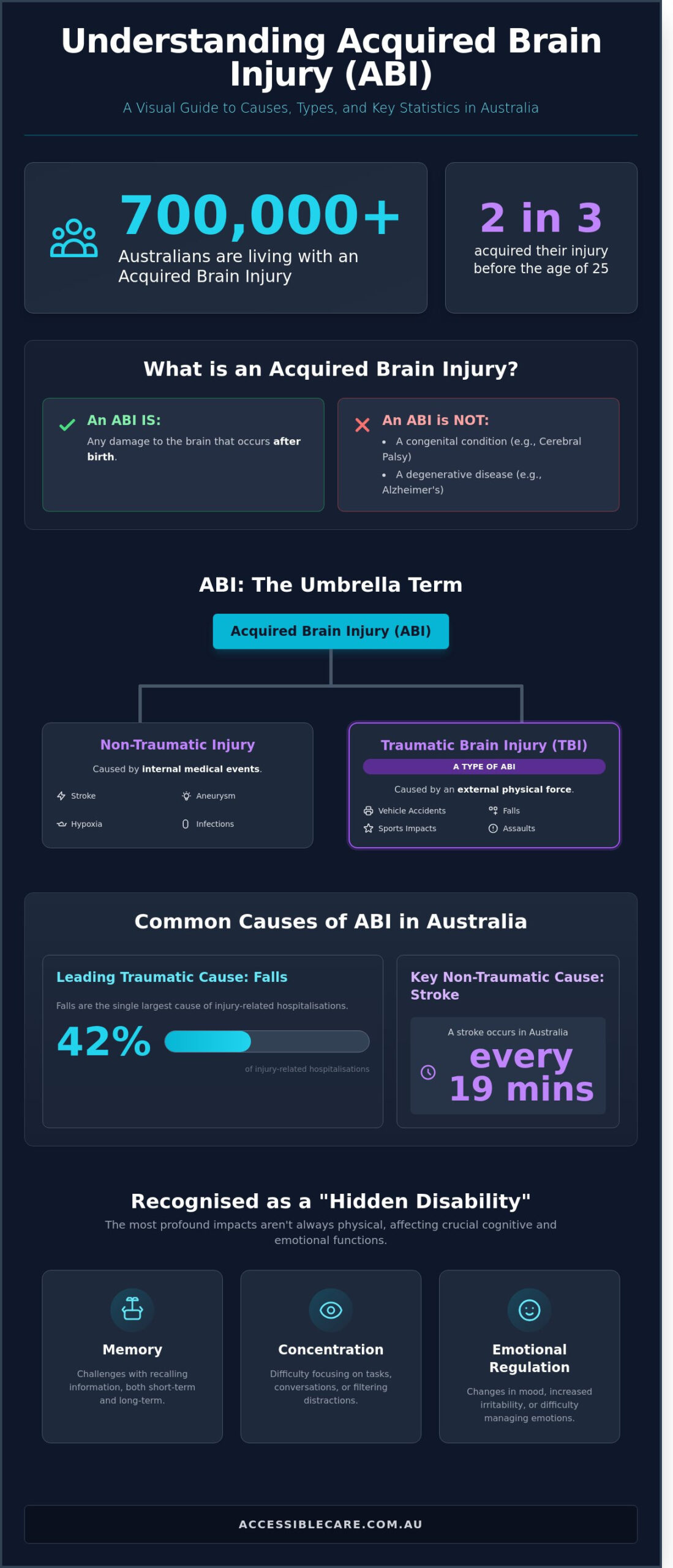
An acquired brain injury is any damage to the brain that occurs after birth. It’s distinct from conditions someone is born with, such as fetal alcohol syndrome or cerebral palsy. It also excludes degenerative diseases like Parkinson’s or Alzheimer’s. When we talk about What is an Acquired Brain Injury?, we’re referring to a broad category of injuries that can change a person’s life in an instant. Data from the Australian Institute of Health and Welfare (AIHW) in 2015 showed that over 700,000 Australians were living with an ABI, with two thirds of these individuals acquiring their injury before the age of 25.
Understanding the nuances of these injuries is vital for providing the right support. We often describe an acquired brain injury as a “hidden disability” because the most profound impacts aren’t always physical. While some participants might experience changes in mobility, many others face challenges with memory, concentration, and emotional regulation. These changes can be difficult for family members and friends to see, yet they impact every aspect of daily life and social connection.
Every individual’s journey with an ABI is entirely unique. Because the brain is such a complex organ, two people with the same type of injury might have completely different symptoms and recovery paths. This reality is why we champion a person-centred approach. We don’t just look at a clinical diagnosis; we look at the person, their goals, and their choices. This ensures that support is tailored to help each participant live the life they choose with dignity and respect.
Common Causes of ABI in Australia
The causes of brain injuries in Australia are diverse, ranging from sudden accidents to internal medical crises. According to AIHW reports from 2022, falls are the leading cause of injury-related hospitalisations, accounting for roughly 42% of cases. These incidents often occur in the workplace, during home maintenance, or among the elderly. Other common traumatic causes include motor vehicle accidents and sports-related impacts, particularly in high-contact Australian sports.
Medical events also play a significant role in ABI statistics. A stroke occurs every 19 minutes in Australia, making it a primary cause of non-traumatic brain damage. Other causes include:
- Infections: Conditions like meningitis or encephalitis that cause inflammation in the brain.
- Hypoxia: Brain damage resulting from a lack of oxygen, which can occur during a cardiac arrest or a near-drowning incident.
- Substance-related damage: Long-term heavy use of alcohol or certain chemicals that lead to toxic brain injury.
- Aneurysms: The rupturing of a blood vessel which causes pressure and bleeding within the skull.
The Difference Between ABI and TBI
While the terms are sometimes used interchangeably, it’s helpful to understand that Traumatic Brain Injury (TBI) is actually a specific type of ABI. A TBI is caused by an external physical force, such as a blow to the head or a rapid acceleration-deceleration movement during a car crash. In contrast, an ABI covers both these traumatic events and internal medical events like strokes or tumours. For doctors and clinical coders, this distinction helps determine the initial treatment plan in the hospital.
For participants and their families seeking long-term support, the distinction matters less than the functional impact. Whether the injury was caused by a fall or a medical event, the focus remains on regaining independence and navigating the community. An acquired brain injury is an umbrella term encompassing all types of brain damage that occur after birth, whether caused by external trauma or internal medical events. We focus on listening to your story and providing the compassionate care you need to move forward, regardless of how the injury occurred.
How ABI Impacts Communication and Daily Living
Many people assume an acquired brain injury only changes how someone moves or what they remember. This is the most common misconception we encounter. In reality, the effects are often “invisible” to the casual observer. An injury ripples through a person’s personality, their ability to plan a simple meal, and how they connect with friends. Around 700,000 Australians live with an ABI, and because every brain is wired differently, no two people experience these changes in the same way.
Communication changes are a frequent hurdle. You might hear specialists use terms like aphasia or dysarthria. Aphasia makes it difficult to find the right words or understand what others are saying. It’s often described as being in a foreign country where you know the language but the sentences won’t quite form. Dysarthria occurs when the muscles used for speech are weakened or uncoordinated. This leads to slurred or slow speech. These challenges can feel isolating, but they don’t change the person’s intelligence or who they are inside.
Have you noticed a loved one struggling to manage a budget or follow a multi-step recipe? This usually involves executive function. This is the brain’s control centre for planning, focus, and problem-solving. When this area is impacted, even small daily tasks feel overwhelming. Families often notice emotional and social shifts first. A participant might become easily frustrated, act impulsively, or seem less interested in socialising. These are not choices; they’re direct results of how the brain is processing the world post-injury.
The Role of Speech Pathology in ABI Recovery
Speech Pathologists (SLPs) are essential partners in rebuilding independence. They don’t just help with talking; they work on cognitive-linguistic functions to help participants process information more clearly. Current research into therapeutic approaches for ABI shows that consistent, targeted interventions can significantly improve social participation. SLPs also manage dysphagia, a swallowing difficulty that affects roughly 30% of brain injury survivors. For those who cannot speak verbally, SLPs introduce Augmentative and Alternative Communication (AAC) tools, such as speech-generating devices, to ensure every voice is heard.
Occupational Therapy: Relearning the Art of Living
Occupational therapists (OTs) focus on the “doing” part of life. They help you relearn Activities of Daily Living (ADLs) so you can get back to your routine. This might include:
- Improving fine motor skills for tasks like buttoning a shirt or using cutlery.
- Managing sensory processing so loud noises or bright lights aren’t distressing.
- Organising environmental modifications, such as installing grab rails or ramps.
If you’re navigating the NDIS, an OT will perform a Functional Capacity Assessment. This is a detailed report, often 10 to 15 pages long, that explains exactly what support you need to live safely. It’s a vital step in securing the right funding for your future. Adjusting to these changes takes time, and you don’t have to do it alone. Our team is here to provide the compassionate support you deserve while you focus on your recovery goals.
The Rehabilitation Journey: A Multidisciplinary Approach
Recovery after an acquired brain injury is rarely a straight line. Because the brain controls everything from your heartbeat to your personality, a single therapist cannot address every challenge. Effective rehabilitation requires a team of specialists working in harmony. This collaborative model ensures that your physical, emotional, and cognitive needs are met simultaneously. According to Synapse Australia, over 700,000 Australians live with a brain injury, and each one requires a uniquely tailored plan. We focus on the whole person, not just the clinical diagnosis.
The foundation of this journey is neuroplasticity. This is the brain’s remarkable ability to rewire itself by forming new neural connections. While damaged cells may not always regenerate, the brain can often find “workarounds” to restore lost functions. Research indicates that consistent, goal-oriented therapy within the first 12 months post-injury can significantly improve long-term independence. Our role is to facilitate this growth by providing the right environment and expertise at the right time.
Success depends on how well different professionals talk to one another. You might see an Occupational Therapist (OT) to relearn daily tasks like cooking, while a Speech Pathologist helps with communication or swallowing. Simultaneously, a nurse monitors your physical health. When these experts collaborate, they create a seamless support web. This prevents conflicting advice and ensures every therapy session moves you closer to your personal goals. We shift the focus from “fixing” a patient to empowering a participant. Your choice and control remain at the heart of every decision. You aren’t just receiving care; you’re leading your own recovery.
If you’re looking for more detailed information on clinical definitions, it’s helpful to understand What is an Acquired Brain Injury (ABI)? through official health resources. This knowledge helps families feel more prepared for the road ahead.
Positive Behaviour Support (PBS) and ABI
Changes in mood or behaviour are common after an acquired brain injury. Statistics suggest up to 50% of survivors experience increased irritability or emotional dysregulation. These aren’t “bad” behaviours; they’re often a form of communication when the brain struggles to process frustration. Positive Behaviour Support (PBS) focuses on understanding the “why” behind these actions. A PBS practitioner works closely with the family unit to adjust the environment and reduce triggers. Instead of using restrictive practices, we focus on building new skills and improving quality of life for everyone involved.
Community Nursing for Complex Medical Needs
Transitioning from a hospital ward to the comfort of home is a major milestone, but it requires careful planning. Our community nurses manage high-intensity supports like medication administration, catheter care, or complex wound management. In Australia, the NDIS provides specific funding for these clinical needs to ensure safety outside of a hospital setting. We prioritise dignity in every interaction, ensuring that clinical tasks never overshadow your humanity. Whether it’s managing a PEG feed or monitoring seizure activity, our nurses provide professional care that respects your privacy and your home environment.
Navigating the NDIS for Acquired Brain Injury
Managing your NDIS plan after an acquired brain injury can feel like a full-time job. We understand that the paperwork and terminology often feel heavy, but you don’t have to carry that weight alone. Under Section 24 of the NDIS Act 2013, an acquired brain injury is a recognized disability. This means if your injury results in a permanent impairment that impacts your daily life, you’re likely eligible for lifelong support. The NDIS frames your funding around two main categories. Core Supports cover your immediate needs, like help with showering or transport to appointments. Capacity Building focuses on your future, providing funds for therapies that help you regain lost skills or learn new ways to complete tasks.
Support Coordination acts as the glue that holds your recovery team together. When you’re managing a Speech Pathologist, an Occupational Therapist, and a Physiotherapist all at once, the communication can get messy. A Support Coordinator helps you find the right providers and ensures everyone is working toward the same goals. They take the stress out of the logistics, so you can focus on your health. Statistics from the Australian Institute of Health and Welfare show that over 700,000 Australians live with a brain injury, and those with dedicated coordination often report higher satisfaction with their NDIS outcomes.
Accessing ABI Support in Melbourne and Adelaide
Finding the right help in your local area makes a massive difference in your daily routine. In Melbourne, participants often access specialized neurological hubs in suburbs like Heidelberg or Caulfield, while Adelaide residents benefit from strong community networks near the CBD. We’ve seen that mobile, in-home therapy services are becoming the preferred choice for many families in Victoria and South Australia. Having a therapist come to your home reduces the fatigue of travel and allows you to practice skills in the environment where you actually live. Local community hubs also provide a safe space for social reintegration, helping you reconnect with your neighborhood at your own pace.
Preparing Your Evidence for the NDIS
Your NDIS planning meeting is your chance to advocate for the life you want to lead. To get the best result, you need clear, professional evidence from your clinical team. Reports from Speech Pathologists and Occupational Therapists (OTs) are vital because they provide the “functional impact” data the NDIS requires. Instead of just saying you have a memory issue, an OT report might explain that you need 2 hours of daily support to safely prepare meals. This level of detail makes it much easier for the NDIS to justify your funding.
- Speech Pathology Reports: These document your communication needs and any swallowing difficulties (dysphagia) that require specialized meal planning.
- Occupational Therapy Assessments: These focus on your “Activities of Daily Living” (ADLs) and identify any assistive technology you might need.
- Goal Linking: You must connect every funding request to a personal goal. For example, if you want to “go to the shops alone,” you can request funding for a support worker to practice the route with you until you feel confident.
We believe that every person deserves a plan that reflects their unique path. If you need help understanding your options or finding the right therapists in your area, our team is here to listen. We can help you turn your NDIS goals into a reality that restores your independence and dignity.
Ready to take the next step in your recovery journey? Contact Accessible Care today to discuss how we can support your NDIS goals with compassion and expertise.
Accessible Care: Your Partner in ABI Recovery
Your choice, your life, your way. This isn’t just a phrase we use; it’s the foundation of every interaction we have with our participants. When a person sustains an acquired brain injury, the path forward often feels uncertain and overwhelming. Our role is to provide a steady hand and a clear map. We operate with a dedicated multidisciplinary team across Melbourne and Adelaide, bringing together decades of collective experience in neurological rehabilitation. We understand that recovery is a marathon, not a sprint, and it requires a partner who is as committed to your long term goals as you are.
Our commitment begins with holistic, person-centred assessments. We don’t believe in a one size fits all approach because every brain injury is unique. Our clinicians spend time in your home environment to understand how your condition affects your daily routine. We look at your physical capabilities, your communication needs, and your emotional wellbeing. By focusing on the whole person rather than just the clinical symptoms, we create support plans that respect your history and your future aspirations. You’re invited to a no-pressure conversation with us to explore how these tailored assessments can make a tangible difference in your recovery journey.
Why Families Trust Accessible Care
Families often reach out to us during their most vulnerable moments. They stay with us because of our unwavering focus on dignity, respect, and empowering independence. We’ve seen that participants achieve better outcomes when they feel in control of their own care. Instead of dictating terms, we listen. This collaborative spirit ensures that every goal in your plan is something that matters deeply to you, whether that’s returning to a hobby or regaining the ability to complete daily tasks without assistance.
One of the biggest advantages for our families is the convenience of our integrated service model. We provide several essential services under one roof, including:
- Occupational Therapy: Focused on home modifications and daily living skills.
- Speech Pathology: Helping with communication and swallowing difficulties.
- Specialised Nursing: Managing complex medical needs with professional care.
This “one roof” approach eliminates the stress of coordinating between multiple different providers. Our staff members communicate with each other daily, ensuring that your Speech Pathologist knows exactly what your OT is working on. You’ll have direct contact with compassionate staff members who truly listen to your feedback and adjust care as your needs evolve over time.
Start Your Journey Today
The transition from a hospital ward to home support is a critical phase for anyone recovering from an acquired brain injury. Whether you’re moving from a facility like the Royal Melbourne Hospital or a rehabilitation centre in Adelaide, the change in environment can be jarring. We specialise in bridging this gap. We help you navigate the logistics of home based support, ensuring the right equipment is in place and your care team is ready before you even walk through the front door. This proactive planning reduces the risk of readmission and helps you settle into your new routine with confidence.
Getting started is a straightforward process designed to be as stress free as possible. It begins with an initial consultation where we discuss your NDIS goals and current challenges. We don’t use complex jargon or high pressure sales tactics. Instead, we provide clear information about what’s possible and how we can help you achieve it. Our team is here to support you through every step of the NDIS process, from the first meeting to the implementation of your daily support services. Get in touch with Accessible Care for compassionate ABI support and let us help you take that next vital step toward independence.
Take the Next Step Toward Your Independence
Living with an acquired brain injury brings significant changes, but you don’t have to face them without support. We’ve explored how a multidisciplinary approach and structured NDIS planning create a clear path to recovery. According to Brain Injury Australia, over 700,000 Australians live with an ABI, and having a local partner makes all the difference. As a Registered NDIS Provider, we offer expert care across Melbourne and Adelaide that’s built on dignity and respect. Our experienced team works directly with participants to ensure every goal is reachable. We believe in your right to lead the life you choose. It’s why we focus on tailored solutions that fit your specific needs and daily routine. You deserve a team that listens and empowers you every single day. We’re here to provide the professional guidance and warm support your family needs during this time. Empower your recovery-contact our compassionate team today and let’s start your journey toward a better quality of life.
Frequently Asked Questions
Is acquired brain injury considered a permanent disability under the NDIS?
Yes, an acquired brain injury is often recognized as a permanent disability under the NDIS if it results in a significant reduction in functional capacity. To qualify for support, the NDIA requires evidence that the impairment is likely to be lifelong and affects your ability to participate in daily activities. Currently, about 1 in 45 Australians live with an ABI, and many access the NDIS through List A or by meeting the disability requirements in Section 24 of the NDIS Act 2013.
Can an adult with ABI still benefit from speech therapy years after the injury?
Adults can definitely benefit from speech therapy even 10 or 20 years after their initial injury. Research shows the brain remains capable of neuroplasticity, which allows for new neural pathways to form long after the acute recovery phase. A 2021 study in the Journal of Head Trauma Rehabilitation highlighted that consistent therapy helps participants improve communication and swallowing safety. Our therapists focus on your specific goals to help you regain independence and confidence in social settings.
What is the difference between a stroke and an acquired brain injury?
A stroke is actually a specific type of brain injury caused by a disruption of blood flow to the brain. While the umbrella term covers any damage occurring after birth, a stroke accounts for about 1.3% of the total Australian population living with a disability. Other types include traumatic injuries from accidents or non-traumatic causes like infections. Understanding this distinction helps us tailor your support plan to your specific medical history and rehabilitation needs.
How much does NDIS-funded occupational therapy cost for ABI participants?
Under the current NDIS Pricing Arrangements for 2023-24, occupational therapy for acquired brain injury participants is capped at A$193.99 per hour in most Australian states. This rate applies to Capacity Building supports. If you live in a remote area, this price can increase to A$271.59 to cover travel costs. We’ll always provide a clear service agreement so you know exactly how your budget is being used to help you reach your milestones.
What should I do if my loved one’s behavior has changed after their brain injury?
It’s common for personality or behavior to shift after an injury; the first step is to consult with a neurologist or a specialist behavior practitioner. Around 50% of people with severe brain injuries experience some level of behavioral change like irritability or impulsiveness. We recommend looking into a Positive Behaviour Support (PBS) plan, which is a person-centered approach funded by the NDIS. Our team works closely with families to create a calm, supportive environment that respects your loved one’s dignity.
Does Accessible Care provide ABI support services in regional South Australia?
Yes, Accessible Care provides dedicated support for participants with an acquired brain injury across regional South Australia, including the Limestone Coast and Murraylands. We’re committed to ensuring that those living outside of Adelaide have access to the same high-quality, compassionate care as those in the city. Our staff travel to your home to provide tailored support that fits your lifestyle. You can call us on our local line to check availability in your specific postcode today.
How long does the rehabilitation process for ABI typically take?
The rehabilitation process is unique for everyone, but the most rapid recovery often occurs within the first 6 to 24 months. After this period, progress usually continues at a slower pace through lifelong management and community-based support. Data from Brain Injury Australia suggests that while the initial hospital phase might last weeks, the journey toward independence is a long-term commitment. We’re here to walk beside you for as long as you need, adapting your care as your goals evolve.

