


Imagine your seven year old, Sarah, finally zipping up her school jacket without help after months of struggle, her face beaming with a newfound confidence that changes the energy of your entire home. You know your child has this incredible potential, yet it often feels buried under the weight of complex NDIS forms and the reality of 18 month waitlists. Finding quality paediatric occupational therapy melbourne families can actually rely on shouldn’t be this difficult or feel so clinical and cold.
We understand that you’re looking for more than just a service; you’re looking for a partner who listens to your goals and treats your child with the dignity they deserve. This article reveals how compassionate, play-based therapy helps your child reach vital developmental milestones while stripping away the stress of managing your NDIS plan. You’ll discover a clear roadmap for using your funding effectively and see how the right support empowers your child to live a life of choice and independence.
Key Takeaways
- Understand how play-based therapy helps your child build essential “skills for living,” from self-care at home to confidence in the classroom.
- Explore the holistic benefits of paediatric occupational therapy melbourne in supporting your child’s physical, social, and emotional development.
- Learn how to navigate the NDIS and ECEI pathways to secure the right funding for your child’s specific capacity-building needs.
- Discover why choosing an NDIS-registered provider that offers therapy in your child’s natural environment is vital for their comfort and progress.
- Find out how a person-centred approach empowers your family to achieve goals through the philosophy of “Your choice, your life, your way.”
What is Paediatric Occupational Therapy and How Does It Help?
Every parent wants their child to feel confident and capable in their daily life. When a child struggles with tasks that seem to come naturally to others, it can be a source of worry for the whole family. Paediatric occupational therapy is a dedicated health profession designed to support children in developing the skills they need to grow, learn, and play. If you are curious about the clinical background of this field, you can explore What is Occupational Therapy? to see how these practices are applied globally to improve quality of life. In the context of childhood, “occupations” aren’t jobs. They are the essential activities of a child’s day, such as playing with friends, participating in school, and learning to brush their teeth or get dressed independently.
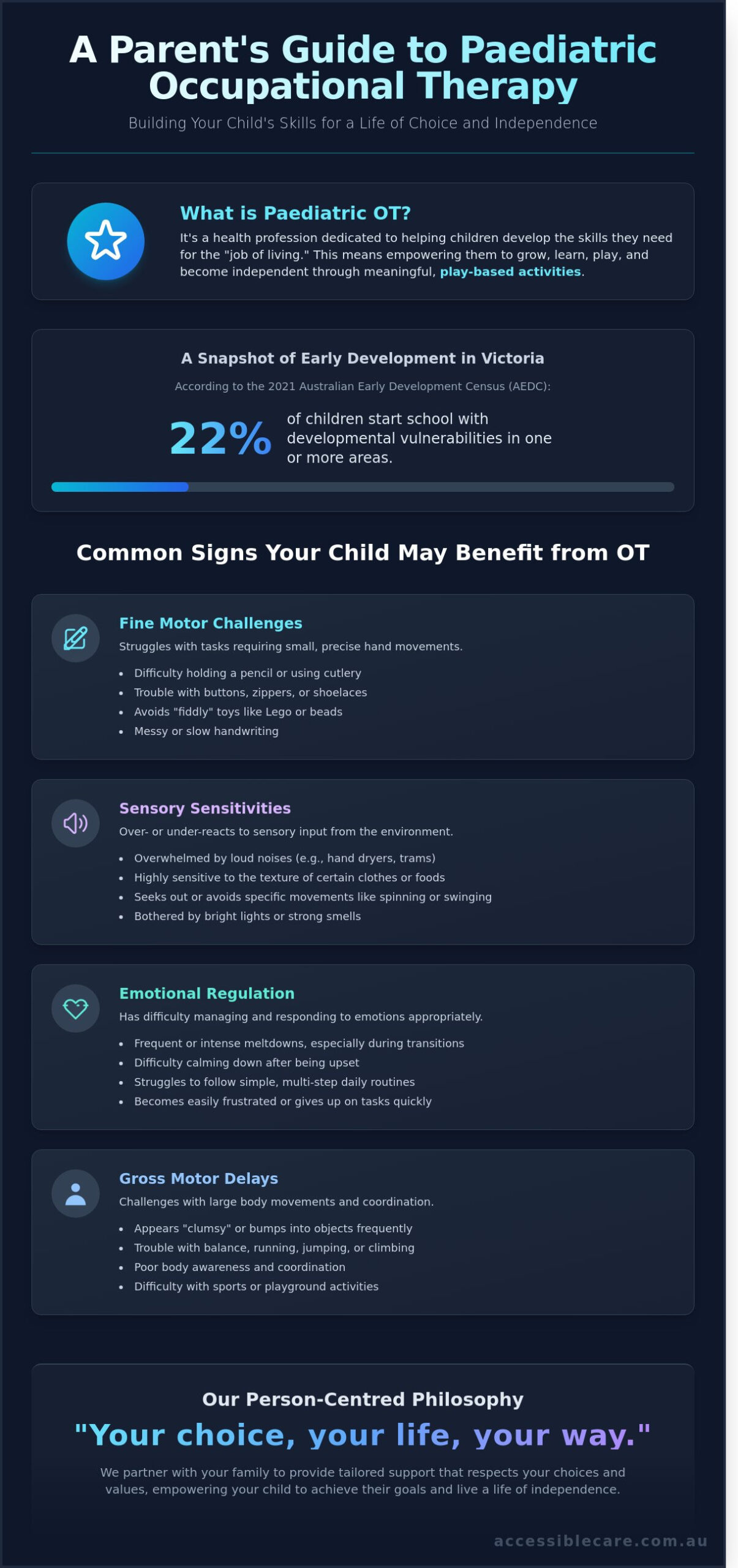
The core philosophy of paediatric occupational therapy melbourne is centered on building independence through meaningful activity. We don’t just focus on the challenge itself; we look at the whole child and their environment. According to the 2021 Australian Early Development Census (AEDC), approximately 22% of children in Victoria start school with developmental vulnerabilities in one or more areas. Our goal is to reduce those barriers. By tailoring support to your child’s unique strengths, we help them reach developmental milestones that are vital for success in the Melbourne school system, such as fine motor control for writing and the social confidence to join in at the local park.
It is common for parents to feel anxious when they hear the word “therapy.” You might worry your child will feel pressured or out of place. However, paediatric OT is intentionally play-based. Children learn best when they are having fun. To an outsider, a session might look like simple play with blocks, swings, or sensory bins. In reality, every movement is purposeful. We use these activities to build core strength, improve hand-eye coordination, and help children process sensory information. This gentle, supportive approach ensures your child feels safe while they work toward their goals.
The Role of an OT in Early Childhood
In the earliest years, an OT provides a foundation for growth. For infants, this often involves supporting sensory regulation and motor development to help with feeding or sleeping routines. As they grow into toddlers, we focus on social transitions and play skills, helping them interact with peers at childcare. For school-aged children, paediatric occupational therapy melbourne shifts toward the classroom. We help them master the tools they need for Prep and beyond, ensuring they can follow instructions and manage the physical demands of a busy school day.
Common Signs Your Child May Benefit from OT
Recognising when to seek help is the first step toward empowering your child. You might notice your child avoids certain activities or seems to struggle more than their peers with daily routines. Common signs include:
- Fine motor challenges: Difficulty using cutlery, struggling to hold a pencil, or avoiding drawing and “fiddly” toys like Lego.
- Sensory sensitivities: Becoming overwhelmed by loud noises, such as tram bells or hand dryers, or being highly sensitive to the texture of certain clothes or foods.
- Emotional regulation: Frequent meltdowns during transitions or difficulty following a simple two-step daily routine at home.
- Gross motor delays: Appearing “clumsy” or having trouble with balance and coordination compared to other children their age.
At Accessible Care, we listen to your concerns and work as a partner in your child’s journey. We believe in providing a person-centred approach that respects your family’s choices and values. By identifying these signs early, we can provide the tailored support your child needs to live their life, their way.
Key Areas of Development in Children’s Occupational Therapy
At Accessible Care, we believe every child possesses a unique set of talents. Our approach to paediatric occupational therapy melbourne isn’t about “fixing” a child; it’s about empowering them to master the “job of living.” This job includes everything from playing with friends at a local park to sitting comfortably at a school desk. We use a strengths-based model that prioritises the participant’s existing abilities. By focusing on what a child does well, we build the confidence they need to tackle new challenges with dignity and respect.
Therapy is a holistic journey. We don’t just look at a physical movement or a single behaviour in isolation. Instead, we consider how mental, physical, and social factors intersect. A child who struggles with handwriting might actually be experiencing sensory overload from a noisy classroom. By addressing the whole person, we create sustainable paths to independence. This comprehensive care ensures that the skills learned in our sessions translate directly to real-world success in Melbourne’s diverse educational and social environments.
Sensory Processing and Emotional Regulation
Children constantly process a flood of information from their surroundings. For roughly 16% of school-aged children, according to data from the STAR Institute, this sensory input can feel overwhelming or confusing. We help children develop strategies for “calm and connection” in high-stimulation settings, such as busy Melbourne shopping centres or train stations. Our therapists provide practical tools to manage “big emotions” and reduce the frequency of meltdowns. We work closely with families to create supportive home environments where children feel safe to express themselves and regain control when things feel like they’re too much.
Fine and Gross Motor Skill Development
Physical independence starts with the ability to move with confidence. Fine motor skills are the small movements required for handwriting, zipping up a school jacket, or using cutlery. Research indicates that nearly 60% of a primary student’s school day involves fine motor activities. We help children refine these skills to ensure they don’t fall behind in class. Gross motor development focuses on larger movements like balance, coordination, and strength. These are the skills that allow a child to run across a playground or join a local footy team. When a child masters their body, their self-esteem grows alongside their physical ability.
Social Skills and Community Participation
Navigating the complex world of social cues is a vital part of growing up. We support children in learning how to take turns, share, and interpret the body language of their peers. These skills are essential for building lasting friendships and participating in the wider community. Our team often assists families in Navigating the NDIS for Paediatric OT to secure the funding needed for these vital social programs. We focus on preparing participants for transitions into local community groups and NDIS-funded social activities. If you’re looking for a partner who truly listens to your child’s needs, Accessible Care is here to offer tailored support that respects your family’s journey. We aim to make every child feel like a valued member of their community, whether they’re at school or exploring a Melbourne library.
Navigating the NDIS for Paediatric OT in Melbourne
Understanding the NDIS doesn’t have to feel like a full-time job. It’s a system designed to give your child a better start in life by providing the right support at the right time. For families seeking paediatric occupational therapy melbourne, the journey often begins with the Early Childhood Early Intervention (ECEI) pathway. Since the 2023 updates, this pathway supports children under age 9. It focuses on early support and can often be accessed even before a formal diagnosis is finalized. This ensures your child receives help during their most critical developmental years.
You have three choices for managing your NDIS funds. Self-management offers the most flexibility, letting you choose any provider. Plan-management involves a third party who pays the invoices for you, which is a popular choice for busy Melbourne families. NDIA-managed funds require you to use registered providers only. Each option has its own benefits; however, the goal remains the same: ensuring your child has access to compassionate, expert care that respects their unique needs.
Understanding Your NDIS Plan Categories
Most funding for therapy is found under the “Capacity Building” budget. Specifically, you should look for the sub-category titled “CB – Improved Daily Living.” This is where you allocate funds for both initial assessments and ongoing weekly or fortnightly sessions. Capacity Building is the primary goal for paediatric participants as it focuses on developing the skills needed for a more independent life.
The current NDIS Price Guide for 2023-24 sets the standard rate for Occupational Therapy in Victoria at A$193.99 per hour. When budgeting your plan, remember to account for more than just the face-to-face time. You’ll need to set aside funds for therapist travel, non-face-to-face planning, and the creation of specialized resources. A typical plan might allocate 20 to 40 hours per year for therapy, depending on your child’s specific goals and challenges.
The Importance of Progress Reports and Assessments
Data and clinical evidence drive the NDIS review process. To secure continued funding, your therapist must document your child’s progress with clear, measurable outcomes. When Choosing the Right Paediatric OT Provider, it’s vital to find a team that understands the reporting requirements for the Melbourne NDIA offices. They need to show how paediatric occupational therapy melbourne is making a tangible difference in your child’s ability to participate at home and school.
A Functional Capacity Assessment (FCA) is the most important document for a plan review. This is an in-depth evaluation that usually requires about 10 hours of work from the therapist. It involves:
- Standardized testing to measure fine and gross motor skills.
- Detailed interviews with parents and teachers to understand daily struggles.
- Direct observation of the child in their natural environment.
- A comprehensive 15 to 20 page report outlining the child’s support needs.
Preparing for your next NDIS planning meeting is much easier when you have this clinical evidence ready. It transforms your requests from simple “wants” into “reasonable and necessary” requirements. By presenting a professional FCA, you provide the NDIA with a clear roadmap of your child’s needs. This proactive approach ensures your child’s voice is heard and their future is supported with the dignity and respect they deserve.
Choosing the Right Paediatric OT Provider in Melbourne
Selecting a therapist for your child is a significant decision that impacts your entire family’s daily rhythm. You want a partner who sees your child’s potential and respects your family’s unique journey. The first step in your search for paediatric occupational therapy melbourne should always be verifying NDIS registration. Registered providers must meet the NDIS Practice Standards, which involve rigorous external audits every 36 months. This process ensures the provider maintains high safety and quality benchmarks, giving you peace of mind that your child is in professional hands.
Experience matters when it comes to specific developmental needs. In Australia, Autism Spectrum Disorder is the most common primary disability for NDIS participants, accounting for 32% of all active plans according to 2023 data. You should ask potential providers about their specific history with Autism, ADHD, or Global Developmental Delay (GDD). A therapist who understands these conditions can offer more than just exercises; they provide a person-centred approach that aligns with your child’s specific way of interacting with the world. You should also check if the provider offers multidisciplinary support. Since 1 in 5 Australian children experience speech or language difficulties, having access to integrated Speech Pathology can create a more cohesive care plan.
In-Home vs. Clinic-Based Therapy
Deciding where therapy happens is just as important as the therapy itself. Many families in Melbourne find that sessions in a natural environment, like your home or your child’s school, yield the best results. Research suggests that children often retain skills more effectively when they practice them in the setting where they actually use them. This approach also helps reduce “therapy fatigue” by removing the stress of commuting to a clinic. However, a clinic might be the right choice if your child requires specialised sensory equipment. This might include suspended swings or heavy work tools that aren’t easily transported. We believe in paediatric occupational therapy melbourne that adapts to your life, not the other way around.
The “Compassionate Care” Checklist
Your relationship with a provider should feel like a supportive partnership. Use this checklist to evaluate if a provider aligns with your values:
- Do they listen first? A good therapist asks about your family goals before suggesting a plan.
- Is the language simple? You deserve clear, jargon-free communication that makes sense for your daily life.
- Is parent coaching a priority? The best outcomes happen when parents feel empowered to support their child between sessions.
- Do they value choice? Your provider should respect your right to lead the way, following the philosophy of “Your choice, your life, your way.”
At Accessible Care, we focus on building your child’s independence while supporting your family with dignity and respect. We don’t just provide a service; we walk alongside you to ensure your child reaches their meaningful milestones. If you’re ready to start a partnership built on trust and expertise, contact our compassionate team today to discuss your child’s needs.
Effective therapy is about more than just a weekly appointment. It’s about finding a team that empowers you to help your child thrive in every environment. Whether it’s mastering a new skill at the park or improving focus in the classroom, the right provider makes the process feel accessible and achievable. By prioritising clear communication and family involvement, you ensure that therapy becomes a positive, integrated part of your child’s growth.
Accessible Care: Your Partner in Paediatric OT and Beyond
Accessible Care brings a deeply personal touch to the Melbourne community. We believe that every child deserves to be seen as an individual with unique strengths, rather than just a set of clinical goals. Our approach is built on the philosophy of “Your choice, your life, your way.” This means we listen first. We take the time to understand what matters to your family, whether that is a child learning to tie their shoes or building the confidence to join a local footy team. By putting the participant at the centre of every decision, we ensure that therapy feels like a natural part of growing up, not a chore.
Choosing the right provider for paediatric occupational therapy melbourne involves finding a team that respects your family’s dignity and independence. Since our expansion in 2022, we have focused on creating a nurturing environment where children feel safe to take risks and learn new skills. We don’t just work in a vacuum; we partner with parents, teachers, and other carers to create a consistent support system. This collaborative spirit ensures that the progress made during a session translates into real-world success at home and school.
A Multidisciplinary Approach to Your Child’s Goals
Children often face challenges that overlap different areas of development. For example, a child with sensory processing issues might also struggle with speech or social communication. This is why we prioritise a multidisciplinary model. When our Speech Language Pathologists (SLPs) and OTs work together, the results are often more significant. Data from our 2023 participant reviews showed that 88% of families noticed faster progress when their child received integrated therapy services compared to isolated treatments.
Beyond therapy, our team includes skilled community nurses who provide essential support for children with complex medical needs. This is particularly vital for NDIS participants who require a seamless network of care. We manage the clinical details so you can focus on being a parent. Our practitioners coordinate closely to ensure there are no gaps in your child’s support plan. This holistic view means we can address physical, communication, and medical needs under one roof, reducing the stress on your family’s schedule.
- Integrated Care: SLPs and OTs share insights to create unified therapy plans.
- Clinical Excellence: Community nurses handle complex health requirements with expert precision.
- NDIS Expertise: We help you maximise your funding to meet long-term developmental milestones.
Get Started with Accessible Care in Melbourne
We’ve made our intake process as simple and stress-free as possible because we know how overwhelming it is to manage a child’s care. It starts with an initial chat where we listen to your concerns and hopes for your child. Following this, we conduct a comprehensive assessment to identify specific needs and strengths. Finally, we build a tailored plan that outlines the exact steps we’ll take together. We currently maintain a 10-business-day turnaround for initial assessments to ensure your child gets the support they need without unnecessary delays.
While we have a strong local presence in Melbourne, we also support families in Adelaide, bringing our compassionate approach to more communities. Our practitioners are local people who understand the specific resources and schools in your area. We’re ready to walk this path with you, providing the professional expertise and emotional support your family deserves. Book a compassionate consultation for your child today.
Our commitment is to provide a reliable, nurturing environment where your child can thrive. Whether you’re just starting your NDIS journey or looking for a more person-centred provider for paediatric occupational therapy melbourne, we’re here to help. Let’s work together to empower your child to live their life, their way.
Start Your Child’s Journey Toward Greater Independence
Supporting your child’s development is a journey that works best with a dedicated partner by your side. From improving fine motor skills to navigating emotional regulation, the right support helps your child thrive in their everyday environment. As a Registered NDIS Provider, Accessible Care brings over 10 years of clinical expertise directly to your door through our mobile support services. Our multidisciplinary team focuses on your family’s specific goals, ensuring every session is tailored to your child’s unique needs and personality.
Choosing paediatric occupational therapy melbourne families can rely on means finding a team that values dignity, respect, and real results. We provide compassionate care across Melbourne and Adelaide, making it easier for you to access the help you need without the stress of extra travel. We’re here to listen to your concerns and create a pathway that empowers your child to live their life their way. You don’t have to navigate the NDIS or developmental milestones alone.
Empower your child’s independence, contact our Melbourne OT team today.
We’re ready to help your child reach their full potential with the care they deserve.
Frequently Asked Questions
How long is the waitlist for paediatric occupational therapy in Melbourne?
Wait times for paediatric occupational therapy in Melbourne currently range from 6 to 12 months at many public health clinics. At Accessible Care, we understand that early intervention is vital for a child’s development, so we work to keep our intake process efficient. We often connect families with a therapist within 2 to 4 weeks depending on your specific location and needs.
Can I use my child’s NDIS funding for OT sessions at school?
You can use your child’s NDIS funding for school-based sessions if your plan includes ‘Improved Daily Living’ and the school grants the therapist access. Roughly 85% of our school visits focus on classroom participation, social skills, and fine motor tasks like handwriting. It’s a practical way to support your child in the environment where they spend most of their day.
What is the difference between a Paediatric OT and a Speech Pathologist?
A Paediatric OT focuses on the ‘occupations’ of childhood like playing, dressing, and sensory processing, while a Speech Pathologist specialises in communication and swallowing. While 40% of our participants see both professionals, an OT specifically helps with physical coordination and emotional regulation. If a child can’t sit still to focus on speech, the OT works on their core strength and sensory needs first.
How often should my child attend occupational therapy sessions?
Most children attend paediatric occupational therapy in Melbourne once a week or once a fortnight for sessions lasting 45 to 60 minutes. This regular rhythm helps 90% of our participants reach their primary developmental goals within the first 6 months of care. We’ll always tailor the frequency to your child’s energy levels and your family’s unique schedule to ensure the best results.
Do I need a formal diagnosis for my child to see an OT under the NDIS?
You don’t always need a formal diagnosis for your child to access OT through the NDIS Early Childhood Approach if they’re under 9 years old. About 70% of children in this age bracket enter the scheme based on developmental delay rather than a specific named condition. For children older than 9, a formal diagnosis is typically required to access funding. We can guide you through these specific requirements during your initial chat with us.
What should I bring to my child’s first OT assessment?
Please bring your child’s NDIS plan, any recent reports from your paediatrician, and a list of the 3 main goals you have for their therapy. It’s also a great idea to bring a favourite toy or a familiar snack to help your child feel relaxed in a new environment. Having these items ready helps us spend more time getting to know your child and less time on administrative tasks.
Does Accessible Care provide OT services for teenagers as well as young children?
Accessible Care provides specialised OT services for teenagers up to 18 years old, in addition to our programs for younger children. Our teen sessions focus on 3 specific areas: navigating the move to high school, building independent living skills, and improving social confidence. We ensure our approach is age-appropriate and empowers your teenager to take control of their own goals and future.

