


What if the hardest part of your NDIS journey isn’t managing your plan, but filtering through the 16,000 registered providers currently operating across Australia? For many families in Melbourne and Adelaide, the search for support often leads to 180-day waitlists and a stack of confusing paperwork rather than the care they deserve. Learning how to choose an ndis provider should feel like opening a door to new opportunities, not falling into a trap of provider fraud or generic, low-quality care. You’ve likely felt the weight of choice paralysis, wondering if a provider truly sees your goals or just your funding. It’s frustrating when you feel like a number in a system that is supposed to be person-centric.
We believe you deserve a partner who listens and respects your dignity. You shouldn’t have to settle for “good enough” when it comes to your independence and peace of mind. Our goal is to replace that uncertainty with a sense of control and calm. This guide provides a clear, step-by-step framework to help you build a reliable shortlist and gain the confidence to ask the hard questions before you sign any documents. We’ll walk through the essential checks for 2026, from verifying credentials to ensuring your service agreement is fair, transparent, and built around your choice, your life, and your way.
Key Takeaways
- Learn how to choose an ndis provider by understanding the “Choice and Control” principle and how a true partner empowers your long-term independence.
- Discover how to review your NDIS plan effectively to identify specific support categories, ensuring your provider search aligns with your unique personal goals.
- Master the use of local filters and community networks to find high-quality, trusted disability support services throughout Melbourne and Adelaide.
- Gain access to a practical five-question checklist designed to vet potential partners on critical factors like specialized experience and staff consistency.
- Explore the value of a person-centred approach that prioritizes your dignity and respects the philosophy of “your choice, your life, your way.”
Why Your Choice of NDIS Provider Matters for Your Independence
Your NDIS plan is more than just a budget. It’s a roadmap to the life you want to lead. At the heart of this system sits the principle of Choice and Control. This isn’t just a catchphrase; it’s a legal right established to ensure you decide who supports you and how that support is delivered. In 2026, the NDIS landscape has evolved to demand higher levels of transparency, making it easier for you to see exactly how your funding is used to build your independence.
A provider should be a partner, not just a service. While some agencies take a transactional approach by simply filling shifts, a compassionate partnership focuses on your long-term recovery and daily comfort. When you’re looking at how to choose an ndis provider, you’re looking for a team that listens to your story. They should treat you with dignity and respect, ensuring every interaction moves you closer to your personal version of success.
The 2026 NDIS Quality and Safeguards Commission standards now require providers to offer clear, accessible reporting. You deserve to know how your supports are performing. This shift away from “hidden” processes ensures you remain the leader of your own care team. Your choice, your life, your way is only possible when your provider values your voice as much as your plan goals.
The Impact of a Quality Provider on Your Goals
Consistent support is the bridge to achieving your NDIS milestones. When a provider matches you with the right support worker, you build trust and momentum. This consistency is vital for families too. According to recent 2025 sector reports, 68% of primary carers experience a significant reduction in burnout when they have a reliable, skilled provider managing daily tasks. For complex cases like an Acquired Brain Injury, specialized care isn’t optional. It requires a dedicated team that understands neuro-rehabilitation to ensure you don’t just maintain your lifestyle, but actually improve your functional capacity.
Registered vs. Unregistered: What You Need to Know
Understanding the difference between registered and unregistered providers is a key step in how to choose an ndis provider that fits your safety needs. A registered provider undergoes rigorous audits by the NDIS Quality and Safeguards Commission to meet strict Australian safety and quality standards. This is essential for high-intensity supports, such as manual transfers or complex medication management. You might choose an unregistered provider for niche, low-risk services like a local art class or a specific gardener, but registered providers offer an extra layer of protection and accountability for your core daily supports.
Preparing Your NDIS Provider Search: Start with Your Goals
Finding the right support begins with a clear understanding of your current NDIS plan. Since the 2024 NDIS legislative reforms, the focus has shifted heavily toward goal-based outcomes and evidence-based supports. Before you dive into how to choose an ndis provider, you need to categorize your funding pools. Your plan is generally divided into three areas: Core, Capacity Building, and Capital supports. Core supports handle your daily living needs, while Capacity Building focuses on therapy and skill development. Capital supports are reserved for high-cost items like home modifications or assistive technology.
Start by listing your non-negotiables. These are the specific requirements that ensure you feel safe and respected. You might require a support worker who speaks a specific language, such as Arabic or Mandarin, or you may prefer a specific therapist gender for personal care. Data from the NDIS Quality and Safeguards Commission indicates that participants who set clear boundaries early in their search report higher satisfaction levels. Your comfort is the priority. It’s about your choice, your life, and your way.
Mapping Supports to Your Lifestyle
Think about how your care fits into your weekly routine. Do you need a multidisciplinary team where your physiotherapist and occupational therapist collaborate? This holistic approach often leads to faster progress toward your goals. You should also decide between in-home visits and clinic-based therapy. In-home care can save you significant travel time, which is vital if you manage a busy schedule. If you require frequent support, such as four visits per week, look for providers with a large local staff pool to ensure you never miss a session due to worker illness.
The Importance of Support Coordination
A support coordinator acts as a professional guide through the complex NDIS landscape. As of June 2024, over 660,000 Australians are navigating the scheme, and a coordinator can help you cut through the noise. They help you shortlist providers who actually have capacity to take on new participants. Always ask your coordinator for provider-neutral recommendations. This ensures they aren’t just suggesting businesses they have financial ties with.
If you want the widest range of options, consider if self-managing your plan is right for you. Self-management allows you to hire both registered and unregistered providers, giving you more flexibility to find the perfect personality match. At Accessible Care, we believe in a partnership that values your voice above all else. You can explore our tailored support options to see how we prioritize your independence and dignity in every interaction. We’re here to listen and help you understand how to choose an ndis provider that fits your unique journey.
Finding Quality NDIS Providers in Melbourne and Adelaide
Finding the right support near you starts with the NDIS ‘Provider Finder’ tool. You should filter your search by postcode to see who actually operates in your street. In 2026, local reputation matters more than ever. Check if a provider sponsors local inclusive sports teams or attends community forums. This shows they’re invested in your neighborhood, not just running a head office from another state. When you’re learning how to choose an ndis provider, prioritize those with a physical presence in your suburb to ensure they can respond quickly to your needs.
Local families often share the most honest feedback. You can join Victorian or South Australian disability groups on social media to ask about specific experiences. Look for providers who have been active in the community for at least three years. This longevity usually indicates a stable workforce and reliable service delivery. If a provider is involved in local council disability advisory committees, it’s a strong sign they’re committed to systemic improvement and participant rights.
Navigating the Melbourne Disability Sector
Melbourne’s support network is vast but can feel complex. You’ll find high-quality disability support services in Melbourne, though availability changes depending on your postcode. Data from early 2025 showed that waitlists in Melbourne’s eastern suburbs like Box Hill were 15% longer than in western hubs like Sunshine. To get unbiased feedback, connect with advocacy groups like Victorians with Disability Network (VWDN). They offer lived-experience insights that a glossy brochure won’t provide. Always ask potential Melbourne providers about their staff retention rates in your specific suburb to ensure you won’t have a rotating door of support workers.
Accessing Support in Adelaide
South Australian participants often benefit from smaller, more integrated networks. If you’re looking to find occupational therapy in Adelaide, check for providers with short wait times in the 2026 calendar year. Many local SA health networks now offer integrated care pathways, so your OT can work directly with your GP. For those in outer areas like Gawler or Mount Barker, regional coverage is vital. Ask potential providers if they charge travel fees for your specific zone. This guide on how to choose an ndis provider suggests that finding a team with a strong local footprint in Adelaide’s surrounding communities helps you avoid unexpected costs and ensures your therapist understands local transport challenges.
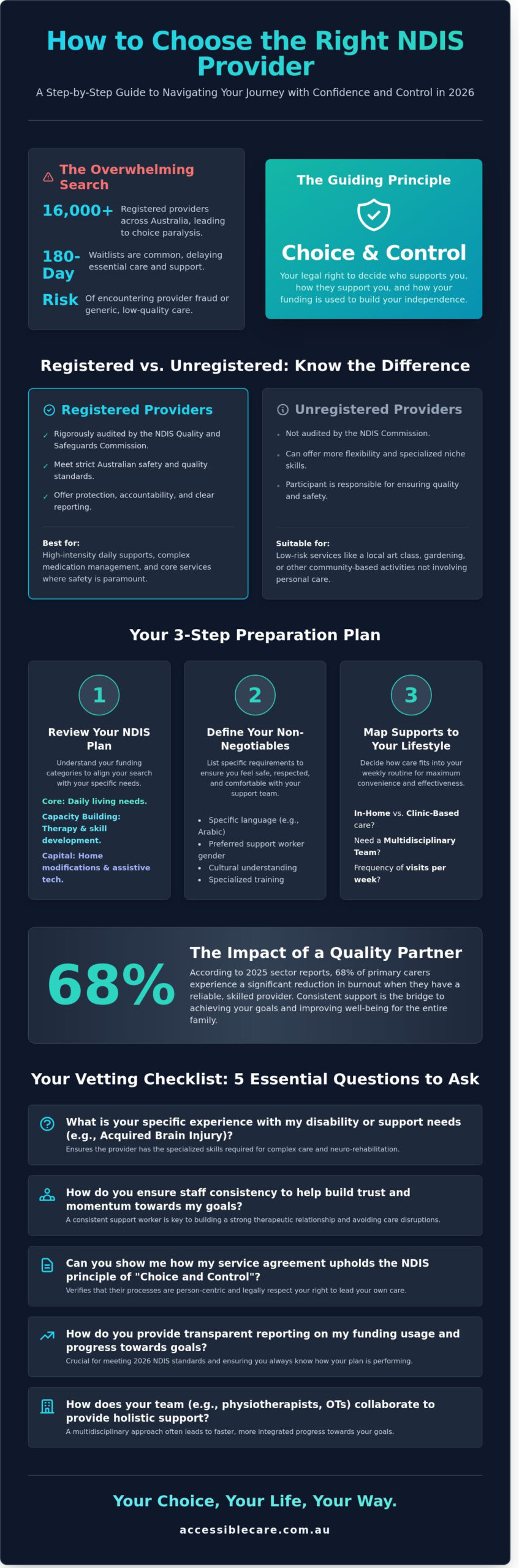
Your NDIS Provider Checklist: 5 Essential Questions to Ask
Finding a partner who truly listens is the most important part of learning how to choose an ndis provider. You deserve a team that sees you as a person, not just a plan number. Before you sign a service agreement, use these five questions to ensure the provider aligns with your values and needs.
- What is your experience with my specific disability or condition? Ask for examples of how they’ve supported others with similar goals. A provider should demonstrate deep understanding of your unique daily challenges.
- How do you handle staff consistency and what happens if my worker is sick? Continuity of care builds trust. Reliable providers have a backup pool of compassionate staff so you aren’t left without support.
- Can you explain your fee structure and any hidden travel costs? Most providers follow the NDIS Pricing Arrangements, which currently cap travel at A$1.00 per kilometer in many regions. Ensure there are no surprise administrative levies.
- How do you measure and report on my progress toward my goals? You should receive clear, written updates at least every 3 months. This data is vital for your plan reviews with the NDIA.
- What is your process for feedback or if I want to change my support? You have the right to speak up. A transparent provider makes it easy to share concerns or request a different support worker without feeling guilty.
Evaluating Clinical Expertise
When you need specialized care, checking the credentials of the actual practitioners is vital. If you’re seeking speech pathology or occupational therapy, verify that the therapists hold current AHPRA registration. Don’t hesitate to ask about their specific training in high intensity supports ndis if your care involves complex medical needs. You need to know the person entering your home has the skills to keep you safe and empowered.
Red Flags to Watch Out For
Trust your instincts during the initial consultation. If a provider pressures you to sign a 12-month contract within the first 24 hours, take a step back. High staff turnover, often exceeding 30 percent in some agencies, is another warning sign. It suggests a lack of stability that might affect your care. Most importantly, avoid any provider who makes decisions for you rather than with you. Your “choice and control” is the foundation of the NDIS, and it must be respected at every stage of your journey. Knowing how to choose an ndis provider means recognizing when a business puts their profit over your independence.
We’re here to support your journey with dignity and respect. Get in touch with Accessible Care to find out how our team can help you reach your goals.
Accessible Care: A Compassionate Partner in Your NDIS Journey
Finding the right support should not feel like an uphill battle. At Accessible Care, we treat every participant with the genuine dignity they deserve. We understand that your journey is entirely unique. That’s why our ‘Your choice, your life, your way’ philosophy isn’t just a slogan; it’s the core of how we operate every single day. Our multidisciplinary team provides person-centred care across Melbourne and Adelaide, focusing on what matters most to your specific circumstances.
Learning how to choose an ndis provider involves finding a team that actually listens to your story. We don’t just provide generic services. Instead, we build lasting partnerships. During your initial 60-minute consultation, we’ll sit down with you to map out your goals and discuss exactly how we can help you reach them. It’s a pressure-free environment designed to give you clarity and peace of mind from the very first meeting.
Our Specialized Allied Health Services
Our Speech Language Pathologists help participants improve cognitive and language skills through highly tailored sessions. Whether it’s for a child developing early communication or an adult regaining skills, the focus remains on personal empowerment. Our Occupational Therapy team works with both paediatric and adult clients to build the practical independence needed for daily life. We also offer specialized Positive Behaviour Support. This approach uses evidence-based data and compassionate strategies to manage complex challenges, creating safer and more fulfilling environments for participants and their families.
Ready to Start Your Journey?
We’ve streamlined our onboarding process to take the administrative weight off your shoulders. Making the right choice on how to choose an ndis provider means looking for transparency. You’ll receive a clear service agreement with no hidden surprises or unexpected administrative costs. Every A$1 of your funding is accounted for clearly so you can focus on your progress rather than paperwork.
Contact us today for a compassionate conversation about your needs. We’re here to listen, support, and help you live the life you choose on your own terms. Our team is ready to welcome you into a community that values your independence as much as you do.
Take the Next Step Toward Your Independence
Finding the right support is about more than just ticking boxes; it’s about reclaiming your independence and reaching the goals you’ve set for 2026. You’ve learned that the process begins with your personal vision and relies on asking the 5 essential questions we’ve outlined. Understanding how to choose an ndis provider ensures you find a team that truly listens to your needs rather than just delivering a service. It’s about finding a partner who values your dignity as much as your progress.
At Accessible Care, we’re a Registered NDIS Provider with an experienced multidisciplinary team dedicated to serving participants across Melbourne and Adelaide. We focus on person centred care that empowers you to live the life you choose. Our skilled staff bring years of expertise to help you navigate the system, ensuring your funding works exactly how you need it to. We believe in your choice, your life, and your way.
Book a compassionate consultation with Accessible Care today
You don’t have to navigate this journey alone. We’re here to walk beside you every step of the way and help you build the future you deserve.
Frequently Asked Questions
How do I switch NDIS providers if I am not happy with my current service?
You can switch providers at any time by following the notice period in your current service agreement, which is typically 14 or 28 days. First, check your contract for the “ending this agreement” section to confirm the required notice. Then, send a written letter or email to your provider stating your intention to finish. We focus on making this transition gentle and stress-free, ensuring your new supports are ready to start the moment your old ones end.
Can I use multiple NDIS providers for different services at the same time?
Yes, you can use as many providers as you need to meet your specific goals. For example, you might choose one team for daily personal care and a different specialist for occupational therapy. This flexibility is a core part of how to choose an ndis provider that truly fits your lifestyle. Managing multiple schedules requires clear communication, but it ensures you receive expert, tailored care for every unique part of your life.
What is a service agreement and why do I need one before starting support?
A service agreement is a legal contract between you and your provider that explains what supports will be delivered and how much they cost. It protects your rights by defining notice periods and how to resolve any concerns that might come up. Under NDIS Quality and Safeguards Commission rules, these documents ensure there are no hidden fees. Having a clear agreement in place before support begins in 2026 ensures your dignity and choice are always respected.
How much do NDIS providers charge for travel and transport?
Providers can charge for travel up to the limits set in the NDIS Pricing Arrangements, which is currently A$1.00 per kilometre for participant transport. For staff travel time, providers may bill up to 30 minutes in city areas or 60 minutes in regional zones. Always check your service agreement for these specific A$ figures before you sign. We believe in being transparent about costs so you can use your budget effectively to stay connected to your community.
Is there a difference between a registered NDIS provider and a private therapist?
Registered NDIS providers meet strict government standards for safety and quality, while private therapists may not have the same level of NDIS Commission oversight. If your plan is Agency-managed, you’re required to use registered providers. If you’re self-managed or plan-managed, you have the freedom to choose either option. This choice is vital when learning how to choose an ndis provider because it affects how you access your funding and the level of protection you receive.
What should I do if my NDIS provider isn’t helping me reach my goals?
If your provider isn’t helping you reach your goals, you should request a feedback meeting to discuss your concerns directly. You have the right to be heard and to have your support plan adjusted to better reflect your personal aspirations. If things don’t improve after your talk, you can choose to move your funding to a team that truly listens. Your NDIS plan belongs to you, and every hour of support should empower you toward greater independence.
How do I find NDIS providers with no waitlists in 2026?
Finding providers with no waitlists in 2026 requires checking real-time availability platforms or contacting boutique providers who often have more flexible schedules. Data from 2025 showed that 65 percent of participants found immediate openings by using support coordinators to scout local options. We prioritize keeping our intake process simple and fast. This ensures you get the compassionate care you need without waiting months for a start date. Your choice, your life, your way.
Can my NDIS provider help me prepare for my plan review?
Your NDIS provider can help you prepare for a plan review by writing detailed progress reports that highlight your achievements and ongoing needs. These reports provide the NDIA with the evidence required to justify your funding for the next 12 or 24 months. We sit down with you to review your journey, ensuring your voice is the loudest one in the room during your meeting. This collaborative approach makes the review process feel much less overwhelming and more empowering.

