


What if the simple act of making a cup of tea or buttoning your own shirt wasn’t a source of frustration, but a moment of quiet victory? It’s deeply exhausting when your home begins to feel like a series of obstacles rather than a sanctuary. We understand that needing help with basic hygiene or feeling anxious about community safety can feel like your independence is slipping away. This is why occupational therapy for daily living skills is so vital; it focuses on returning the power of “doing” back to you.
You deserve to feel respected and capable in your own space, and it’s okay to want more for your daily routine. This guide will show you how tailored support through the NDIS empowers you or your loved one to master essential tasks and reclaim personal autonomy. We’ll explore the various ways therapists help you find the right tools to make life easier and adapt your environment to fit your physical needs. By the end, you’ll see how a compassionate, professional partnership can transform daily hurdles back into comfortable, independent routines.
Key Takeaways
- Understand why mastering Activities of Daily Living (ADLs) is the first step toward regaining your dignity and personal autonomy.
- Learn how occupational therapy for daily living skills provides you with the specific techniques needed to manage self-care and domestic tasks with confidence.
- Discover how a Functional Capacity Assessment identifies the physical barriers in your home to ensure your therapy plan is perfectly tailored to your environment.
- Explore the NDIS funding pathways and Assistive Technology options that can simplify your everyday routine and reduce your reliance on others.
- See how a person-centric approach in Melbourne and Adelaide turns your personal goals into achievable milestones through professional, in-home care.
Understanding Occupational Therapy for Daily Living Skills
Living a self-directed life often comes down to the things we take for granted. Brushing your hair, preparing a meal, or popping to the shops are more than just tasks; they’re the threads that hold our sense of self together. When these tasks become difficult, it’s easy to feel like your independence is slipping away. Occupational therapy for daily living skills acts as a vital bridge. It connects where you are now with where you want to be, ensuring you don’t just survive your day, but actually lead it with confidence.
We believe that therapy shouldn’t feel like a clinical chore. It belongs where life happens. By working within your home and local community, our therapists see the actual barriers you face in real time. This compassionate approach ensures that the strategies we develop together are practical, sustainable, and respectful of your personal space. It’s about “doing” the things that matter most to you, whether that’s making your own breakfast or safely visiting a friend.
What are Activities of Daily Living (ADLs)?
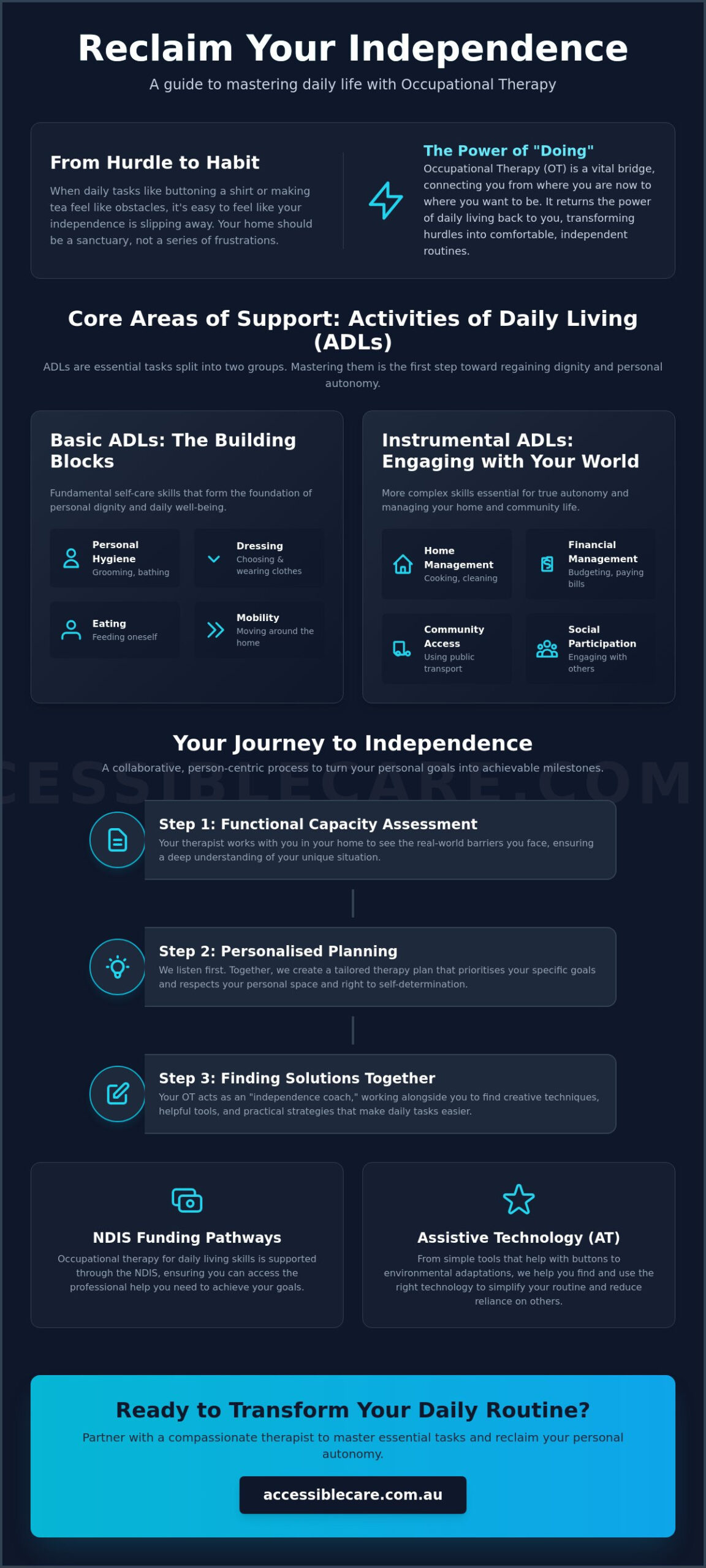
We often categorise these essential tasks as Activities of Daily Living (ADLs). These are split into two main groups. Basic ADLs are the fundamental self-care skills we use every morning and night. They include maintaining personal hygiene, dressing yourself without frustration, eating independently, and moving around your home safely. These are the building blocks of personal dignity.
The Role of an Occupational Therapist
Think of an Occupational Therapist as an independence coach. Whether they’re working with a child learning to manage their school bag or an adult re-learning how to manage a household after an injury, their focus is always on your unique journey. At Accessible Care, we use a person-centric model that prioritises your specific goals over a generic checklist. We want to understand what makes you feel empowered.
It’s helpful to understand what is occupational therapy in the broader NDIS context. It’s a collaborative partnership where your therapist listens first and acts second. By focusing on occupational therapy for daily living skills, we help you find creative ways to overcome physical or cognitive hurdles. We don’t just give advice; we work alongside you in your own kitchen or bathroom to find real-world solutions that honour your right to self-determination.
Core Areas of Support: From Self-Care to Community Participation
Independence isn’t a one-size-fits-all concept. It evolves as we grow and changes when life throws us unexpected challenges. By focusing on occupational therapy for daily living skills, we look at the whole picture of your life. We start with the most personal tasks and branch out into how you interact with the wider world. Our goal is to ensure you feel capable and respected in every environment you inhabit.
Self-care mastery is often the first priority. This involves finding gentle, effective techniques for independent dressing, grooming, and toileting. It might mean using a specific tool to help with buttons or learning a new way to balance while brushing your teeth. From there, we look at your domestic life. We work together on strategies for cooking, cleaning, and managing your household safely. These aren’t just chores; they’re the activities that make a house feel like a home you control.
Moving beyond the front door is equally important. Community participation involves building the confidence to use public transport and navigate local shops without anxiety. We also focus on the cognitive side of daily life, such as managing your weekly schedule or improving social communication. If you’re feeling overwhelmed by these tasks, our team is here to help you find a pathway forward that feels manageable and empowering.
Paediatric Skill Building
For children, we often say that “play is work.” This is how they learn about the world and their place in it. Our paediatric support focuses on developing fine motor skills through engaging, fun activities. We help your child prepare for the social and physical demands of school, ensuring they have the tools to participate fully with their peers. By focusing on occupational therapy for daily living skills through early intervention, we help your child shine and reach their unique potential in a nurturing, supportive environment.
Adult Rehabilitation and Maintenance
For adults, the focus often shifts toward reclaiming skills or adapting to new physical realities. This is particularly vital for those living with an acquired brain injury, where re-learning daily routines requires patience and specialized expertise. We teach energy conservation and joint protection techniques to ensure you can complete your daily tasks without unnecessary pain or fatigue. Whether you’re a veteran or a senior, our focus remains on maintaining your autonomy at home for as long as possible through professional, compassionate guidance.
The Journey to Independence: Assessments and Personalised Planning
Starting a new chapter in your health journey often feels like standing at the base of a mountain. You know where you want to go, but the path isn’t always clear. We believe the first step shouldn’t be stressful. Instead, it should be a moment of profound relief. By beginning our partnership with a thorough look at occupational therapy for daily living skills, we replace uncertainty with a clear, compassionate roadmap. This isn’t about highlighting what you can’t do; it’s about identifying the specific supports that will help you do more.
The Functional Capacity Assessment (FCA) serves as our collaborative starting point. Unlike a clinical test, this is a shared exploration of your life. We observe how you move through your actual home and community because that’s where life happens. Seeing how you navigate your own kitchen or use your front steps allows us to identify real-world barriers that a clinic visit might miss. Most importantly, you are the director of this process. Your goals, your preferences, and your comfort dictate every decision we make together.
What to Expect During Your Assessment
We approach every assessment with a gentle, non-judgmental lens. You don’t need to “perform” or worry about the state of your home. Our therapists are there to listen and observe your daily routines in a way that feels natural and supportive. We look at a variety of factors that influence your independence:
- Physical factors: Your strength, balance, and fine motor coordination during tasks.
- Cognitive factors: How you plan, remember, and sequence the steps of a routine.
- Environmental factors: How the layout of your home or local shops might be helping or hindering you.
This is a compassionate conversation about your future. Many participants find that simply being heard and understood provides an immediate sense of emotional relief. We take the time to understand not just what you do, but how you feel about doing it.
Creating Your Personalised Care Plan
Once we understand your unique situation, we translate those findings into actionable NDIS goals. Your personalised care plan is a living document. It’s designed to grow with you. As your skills improve and your confidence builds, we adjust the plan to keep it relevant to your evolving life. This iterative nature ensures you are always being challenged just enough to progress without feeling overwhelmed.
Success often requires a team effort. We take a multidisciplinary approach, which might involve collaborating with speech pathologists or support workers to ensure every angle of your well-being is covered. Regular reviews are a core part of our service. We meet frequently to celebrate your wins and refine our strategies, ensuring that your occupational therapy for daily living skills remains a powerful tool for your ongoing autonomy.
NDIS Funding and Tools to Support Your Daily Routine
Understanding the financial side of your care shouldn’t be a source of stress. The NDIS is designed to provide the resources you need to live a full, autonomous life, but the terminology can sometimes feel overwhelming. Most occupational therapy for daily living skills is funded under the Capacity Building budget, specifically within the “Improved Daily Living” category. This funding is an investment in your future, focused on giving you the skills and tools to reduce your reliance on others over time. By using these funds effectively, you are building a foundation for a more self-directed lifestyle.
For individuals with more complex health requirements, these services often work in tandem with ndis high intensity supports. This integration ensures that even when your care needs are high, the focus remains on your personal agency and comfort. Whether it’s managing complex hygiene routines or specialized feeding requirements, our therapists work alongside your nursing team to ensure every task is handled with the highest level of professional care and respect for your dignity.
If you’re ready to see how your plan can better support your independence, contact our team today to discuss your specific goals.
Assistive Technology for Everyday Life
Sometimes, the bridge to independence isn’t a new skill, but the right tool. Assistive Technology (AT) covers a wide range of items that make everyday tasks simpler and safer. Your therapist will help you trial different options to ensure the solution fits your life perfectly. Examples of AT that can transform your routine include:
- Adaptive cutlery and kitchen tools: Weighted or angled utensils that make mealtime easier for those with limited grip or tremors.
- Dressing aids: Simple devices like button hooks or long-handled shoehorns that remove the struggle from your morning routine.
- Smart home technology: Voice-activated lights, automated blinds, or specialized sensors that give you control over your environment without physical strain.
Finding the right tool can provide an immediate boost to your confidence. It also plays a vital role in reducing carer burnout, as it allows you to take back responsibility for tasks that previously required someone else’s help. We focus on finding the most “low-tech” and effective solution first, ensuring your home remains a comfortable space rather than a clinical one.
Navigating NDIS Reports and Reviews
Your Occupational Therapist plays a critical role in securing the ongoing support you deserve. During your plan review, the NDIS requires clear, professional evidence of how your funding is helping you achieve your goals. We provide detailed reports that document your progress in occupational therapy for daily living skills, highlighting the tangible improvements in your autonomy and well-being. This documentation is essential for justifying continued funding for therapy, equipment, or home modifications like grab rails or bathroom redesigns.
The latest NDIS Price Guide (version 1.1), effective from 24 November 2025, continues to emphasize the importance of evidence-based outcomes. We take this responsibility seriously, ensuring your reports are accurate, professional, and person-centric. We’ve found that ndis planning is easier with an experienced provider who understands how to translate your daily victories into the language the NDIS needs to hear. Our goal is to make the review process feel like a celebration of your growth rather than a bureaucratic hurdle.
Compassionate OT Support in Melbourne and Adelaide
At Accessible Care, we don’t view your daily routine as a series of boxes to check off a list. We see it as the foundation of your personal dignity and the key to your self-determination. Our commitment to your autonomy means we listen before we act. We honor your choices. We believe that occupational therapy for daily living skills should always be a supportive partnership where your voice is the loudest. You are the expert in your own life; our role is simply to provide the professional tools and strategies that help your vision become a reality.
We understand that the most meaningful progress happens where you feel most comfortable. This is why we have established a strong local presence across both Victoria and South Australia. By bringing our expertise directly to your doorstep, we ensure that therapy feels like a natural part of your day rather than an interruption. Whether you are located in the heart of Melbourne or the suburbs of Adelaide, our team is dedicated to providing high-quality, in-home support that respects your space and your schedule.
Mobile Therapy: We Come to You
Practicing new techniques in a clinical office is rarely the same as doing them in your own home. Our mobile therapists work with you in your natural environment, which is far more effective for long-term success. When we practice occupational therapy for daily living skills in your actual kitchen or bathroom, we can address the real-world challenges you face every morning. We see the exact height of your cupboards, the weight of your front door, and the specific layout of your shower. This context allows us to provide solutions that actually work for your specific home.
Our mobile service offers several key benefits for participants and their support networks:
- Practical learning: Skills are learned and mastered in the place where they will actually be used.
- Reduced anxiety: There is no need to worry about the stress of travel or navigating unfamiliar clinic spaces.
- Carer support: We can provide immediate, hands-on guidance to families and support workers in the home setting.
- Broad coverage: Our therapists travel across Melbourne and Adelaide to ensure regional and suburban families aren’t left behind.
This home-based approach is particularly helpful for busy families and carers who are managing multiple appointments. It creates a calm, methodical environment where you can focus entirely on your goals without the distraction of a clinical setting.
Start Your Journey to Independence Today
Reclaiming your independence is a brave and vital step. Our experienced team of adult and paediatric OTs is ready to walk alongside you, offering the technical expertise and nurturing care you deserve. We’ve simplified our referral process to make it as easy as possible for you to access the support you need. Whether you are looking to master self-care tasks or want to feel more confident in your local community, we are here to help you find the right path forward.
Your journey toward a more autonomous life begins with a simple conversation. We invite you to contact our compassionate team to discuss your goals and discover how we can support your unique vision for the future. Let’s work together to turn your daily challenges back into moments of personal achievement and quiet victory.
Embrace a More Autonomous Future
Reclaiming your independence is a journey built on small, meaningful victories. Whether it’s mastering a morning routine or navigating your local shops with confidence, every step forward counts. Occupational therapy for daily living skills provides the professional guidance and practical tools needed to turn these goals into reality. We’ve seen how the right support, delivered in the comfort of your own home, can restore not just your ability to perform tasks, but your sense of self-worth and dignity.
As a Registered NDIS Provider with experienced adult and paediatric OTs, we pride ourselves on a person-centric approach that puts you in control. Our team is dedicated to providing mobile services across Melbourne and Adelaide, ensuring you receive care where you feel most at ease. You don’t have to navigate these challenges alone. Contact Accessible Care for compassionate OT support today to discuss your vision for a more self-directed life. Your path to autonomy is waiting, and we’re honored to walk it with you.
Frequently Asked Questions
How does occupational therapy improve daily living skills for adults?
Occupational therapy helps adults by identifying specific barriers in their routine and teaching new ways to complete tasks safely. This might involve learning energy conservation techniques to manage fatigue or using specialized equipment to overcome physical limitations. By focusing on your unique goals, a therapist ensures you can continue managing your home and personal care with minimal stress and maximum dignity.
Can occupational therapy help my child with self-care tasks like dressing?
Yes, occupational therapists specialize in helping children develop the fine motor skills and coordination needed for dressing and grooming. We break down complex tasks into smaller, manageable steps that build your child’s confidence. Through playful engagement, your child learns to manage buttons, zippers, and laces; this fosters a sense of pride and early independence in their daily life.
What is the difference between basic and instrumental daily living skills?
Basic skills include fundamental self-care tasks like eating, dressing, and personal hygiene that are essential for survival. Instrumental skills are more complex activities that allow you to live independently in the community, such as managing finances, preparing meals, and using public transport. Both categories are vital for a self-directed life, and occupational therapy for daily living skills addresses both to ensure total autonomy.
Is occupational therapy for daily living skills covered by the NDIS?
Occupational therapy for daily living skills is typically funded under the “Improved Daily Living” category within your NDIS Capacity Building budget. This funding is specifically designed to help you build the skills and confidence needed to live more independently. Our team helps you document your progress during plan reviews to ensure your support remains aligned with your long-term goals.
How long does it take to see progress in daily living skills therapy?
Progress varies for every individual, but many people experience small, meaningful victories within the first few sessions. While mastering complex routines may take several months of consistent practice, the introduction of the right assistive tool can provide immediate relief. We focus on steady, sustainable growth that respects your personal pace, energy levels, and emotional well-being.
Do I need a referral to see an occupational therapist for daily living support?
You don’t usually need a formal GP referral to access our support if you’re an NDIS participant or a private client. You can contact us directly to begin your journey toward independence at any time. However, if you’re seeking a Medicare rebate through a specific health plan, your doctor will need to provide the necessary paperwork before your first session.
Can an OT help with home modifications to make daily tasks easier?
What happens during an initial OT assessment for daily living skills?
During your initial assessment, a therapist will visit your home to observe how you manage your usual daily routines in a comfortable, non-judgmental way. We have a compassionate conversation about what you find difficult and what you hope to achieve. This gentle observation helps us identify physical or environmental barriers, allowing us to create a personalized plan that honors your specific lifestyle.

