


What if the measures we take to ensure safety are actually the very things preventing a person from truly thriving? It’s a question many families and carers face, often accompanied by a quiet sense of guilt or the constant fear that removing a restriction might lead to injury. You aren’t alone in feeling overwhelmed by the complexities of “challenging” behaviours or the strict NDIS reporting requirements that seem to change every year. It’s understandable to want the best for your loved one while feeling stuck in a cycle of control rather than connection.
This guide is designed to help you navigate the journey of reducing and eliminating restrictive practices with confidence and compassion. We’ll show you how to move away from interventions that feel clinical or restrictive and toward empowering, person-centred support that prioritises dignity. You’ll learn how a collaborative approach involving Positive Behaviour Support, Speech Therapy, and Occupational Therapy can replace frustration with functional communication. We’ll also provide a clear look at the 2026 NDIS Commission standards, giving you a practical roadmap to improve quality of life while ensuring every safety requirement is met with heart and professionalism.
Key Takeaways
- Understand the five regulated categories of restrictive practices and how prioritising dignity leads to safer, more effective support.
- Explore why reducing and eliminating restrictive practices is essential for upholding human rights and addressing the underlying trauma that often triggers complex behaviours.
- Learn how a multidisciplinary team uses Speech Pathology and Occupational Therapy to bridge communication gaps and modify environments, removing the need for restraint.
- Gain a clear, step-by-step path for transitioning from restrictive interventions to empowering, person-centred strategies that foster true independence.
- Discover how professional Positive Behaviour Support practitioners act as partners to simplify NDIS compliance and improve overall quality of life.
Understanding Restrictive Practices: A Compassionate Overview
Historically, these measures were often used because of a lack of alternative strategies or resources to manage complex behaviours. However, we now know that relying on restriction can often lead to more distress for the individual. By shifting our focus toward understanding a person’s needs, we can create environments that foster independence rather than compliance.
The Five Types of Regulated Restrictive Practices
The NDIS Commission regulates five specific categories to ensure they are only used when absolutely necessary and under strict supervision. Understanding these categories is the first step in identifying where changes can be made.
- Chemical restraint: This involves using medication for the primary purpose of influencing or controlling a person’s behaviour, rather than treating a diagnosed medical condition.
- Environmental restraint: This limits a person’s access to their surroundings or specific items, such as locking a kitchen cupboard or restricting access to the outdoors.
- Mechanical restraint: This uses a device to prevent, restrict, or subdue a person’s movement, excluding therapeutic devices like wheelchairs or prescribed postural supports.
- Physical restraint: This involves the use of bodily force to prevent, restrict, or subdue movement of a person’s body.
- Seclusion: This is the solitary confinement of a person in a room or area from which they cannot leave of their own free will. Understanding Seclusion and Restraint helps highlight why these methods are viewed through a human rights lens globally.
Is it Always a Restrictive Practice?
It’s helpful to distinguish between therapeutic supports and restrictive interventions. The difference often lies in the “intent” of the action. Is the measure being used to build a person’s skills and protect their wellbeing, or is it simply to control them? For example, a seatbelt in a car is a safety requirement for everyone; however, a harness used specifically to stop someone from moving during a meal might be a restriction.
When we talk about reducing and eliminating restrictive practices, we focus on finding the “why” behind the behaviour. A restrictive practice is a temporary, emergency measure of last resort that should only be used to prevent immediate harm while a more supportive, permanent solution is developed. By shifting our perspective, we can create environments where these measures are no longer needed, allowing the individual to lead a more self-directed life.
Why Reducing and Eliminating Restrictive Practices is Essential
We must also consider the “Dignity of Risk.” This concept reminds us that life involves making choices that carry some level of risk. While safety is vital, preventing a person from experiencing life because of fear can be just as harmful as the risk itself. Managing safety reasonably, rather than through absolute restriction, allows individuals to grow, learn, and find joy in their daily lives. It’s about finding that balance where safety and freedom coexist.
The Trauma-Informed Care Approach
Most “challenging behaviours” aren’t random acts of defiance. They’re often a response to past trauma or a desperate attempt to communicate an unmet need. When a person feels misunderstood or unsafe, they may react in ways that others find difficult. If we respond with restrictive practices, we risk re-traumatising someone who is already vulnerable. This creates a cycle where the restriction actually exacerbates the very behaviour it was meant to stop.
Building trust requires a compassionate, non-restrictive environment. When a participant feels heard and respected, their need to use intense behaviours to communicate often decreases. If you’re feeling unsure about how to start this transition, our team at Accessible Care is here to listen and help you find a gentler way forward that keeps everyone safe.
Autonomy and Quality of Life
There’s a direct link between self-determination and a reduction in “behaviours of concern.” When people have control over their own lives, they’re generally happier and more relaxed. For example, we’ve seen participants who were once frequently placed in seclusion flourish when given the tools to communicate their choices. One individual we supported moved from a highly restricted environment to engaging in community sports simply because they finally felt in control of their own schedule.
Our approach focuses on autonomy and self-direction as the foundation of care. When we empower a person to make their own decisions, the frequency of distress-based behaviours naturally declines. This shift doesn’t just meet compliance; it transforms a person’s entire quality of life, replacing fear with a sense of belonging and purpose.
The Role of Multidisciplinary Therapy in Reduction
True progress in reducing and eliminating restrictive practices happens when we stop trying to “manage” a person and start trying to understand them. A multidisciplinary team brings together diverse perspectives to look at the whole person rather than just the challenging moment. By combining the expertise of speech pathologists, occupational therapists, and behaviour support practitioners, we create a wrap-around support system. This collaborative approach ensures that every intervention is focused on building skills and increasing autonomy, moving us closer to a life free from unnecessary restrictions.
Positive Behaviour Support (PBS) serves as the vital framework that binds these therapies together. It isn’t just about a plan on paper; it’s a shared philosophy of care. When therapists work in harmony, they can identify the specific triggers that lead to distress and replace them with empowering alternatives. This teamwork turns the goal of reduction from a clinical requirement into a compassionate reality for the families we support.
Communication as the Key to Elimination
At the heart of many behaviours of concern is a simple, unmet need to be heard. If a person cannot express that they’re hungry, tired, or in pain, they may resort to physical outbursts to get their message across. Our Speech Pathology team plays a critical role in identifying these communication gaps. By implementing Augmentative and Alternative Communication (AAC) tools, such as picture boards or speech-generating devices, we give the participant a voice. Speech pathologists work to replace physical outbursts with functional communication by providing the participant with the specific tools they need to express their feelings and requirements clearly. When a person knows they’ll be understood, the frustration that fuels the need for physical or environmental restraint begins to dissolve.
Occupational Therapy and Environmental Mastery
Sometimes, the environment itself is the source of the struggle. A room that’s too bright, too loud, or too cluttered can lead to sensory overload, which often results in behaviours that lead to restrictive measures. An Occupational Therapist starts by conducting a Functional Capacity Assessment to understand sensory triggers that might not be obvious to the naked eye. This deep dive into a person’s daily life helps us see the world from their perspective.
By modifying the home environment, such as installing dimmable lighting or creating dedicated “calm zones,” we can remove the very triggers that once necessitated environmental restraint. OTs also focus on developing self-regulation skills, teaching the participant how to manage their own sensory needs. This mastery over their surroundings is a powerful tool in reducing and eliminating restrictive practices, as it replaces external control with internal confidence and peace.
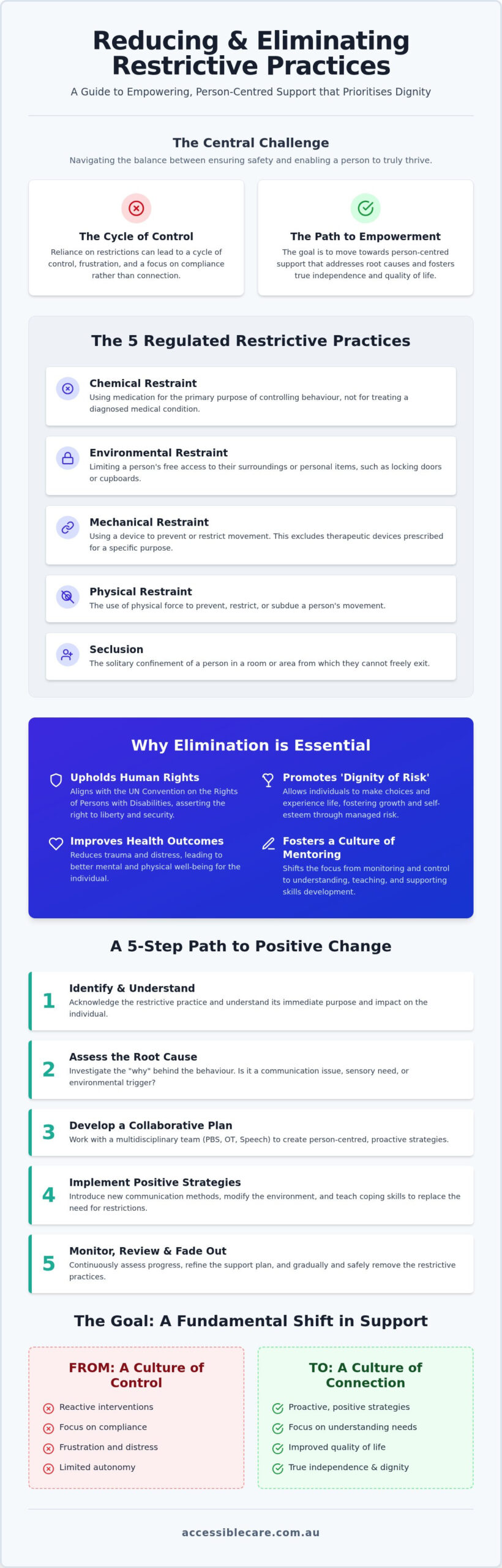
Steps to Safely Reducing and Eliminating Restrictive Practices
The journey toward reducing and eliminating restrictive practices is not a path you walk alone. It is a collaborative effort that brings together the participant, their family, and a dedicated team of practitioners. This isn’t about simply taking things away; it’s about building a foundation where those restrictions are no longer necessary. We view this process as a gentle transition toward a more liberated life where safety and dignity are held in equal regard.
The process begins with a Comprehensive Assessment. We look deep into the environment, health, and communication needs to find the root cause of the behaviour. Next, we develop a Positive Behaviour Support Plan (PBSP) with clear, achievable reduction goals. This is a living roadmap that changes as the participant grows. We then focus on skill building, teaching the participant new ways to communicate while training the support network to respond with empathy and consistency. Finally, we move into the fading phase, where we track progress and gradually reduce restrictions as new skills take hold.
Maintaining Safety During the Transition
A common fear for many carers is the question, “What if things go wrong?” This feeling is completely valid. We address this through proactive strategies that identify early signs of distress before a crisis occurs. By noticing the small changes in a person’s mood or body language, we can intervene early with support rather than restraint. We create a safety plan that protects everyone involved without relying on long-term restrictive measures. This plan ensures that any response used in an emergency is ethical, brief, and always focused on returning to a state of peace.
The Importance of NDIS Compliance
Navigating the requirements of the NDIS Quality and Safeguards Commission can feel overwhelming. It is important to remember that any regulated restrictive practice must be independently authorised and included in a current PBS plan. This oversight is a safeguard for the participant’s human rights. For families managing complex situations, High Intensity Supports integrate directly with these reduction strategies. This ensures that even the most challenging situations are met with the highest level of clinical expertise and care. If you need a partner to help manage these complexities, Accessible Care provides the expert support you need to move forward safely while reducing and eliminating restrictive practices.
Partnering with Accessible Care for Behaviour Support
At Accessible Care, we believe that every individual has the right to a life defined by freedom rather than force. Our compassionate approach to Positive Behaviour Support is built on the foundation of attentive listening and mutual respect. We don’t see behaviours as problems to be managed; we see them as opportunities to understand what a person truly needs. By choosing to work with us, you’re joining a team dedicated to reducing and eliminating restrictive practices through every stage of the NDIS journey.
Our strength lies in our multidisciplinary model. Having Speech Language Pathologists (SLPs), Occupational Therapists (OTs), and PBS practitioners working together under one roof allows us to see the full picture. Our Melbourne and Adelaide teams collaborate closely to support participants with high-intensity and complex needs. This holistic view ensures that when one therapist identifies a sensory trigger, another can provide the communication tool to address it. This teamwork makes the “Road to Elimination” a practical reality rather than just a distant goal.
What to Expect from Our PBS Practitioners
Your journey starts with an initial consultation where we prioritise your story. We want to hear your concerns, your fears, and your hopes for the future before we ever look at a clinical report. This connection allows us to develop evidence-based strategies that are specifically tailored to the participant’s unique personality and life goals. We don’t believe in one-size-fits-all plans. Instead, we create living documents that evolve alongside the person we’re supporting.
Support doesn’t end when the plan is written. We provide ongoing training for families and support workers, ensuring everyone in the participant’s life feels confident and empowered. By teaching the circle of care how to implement proactive strategies, we reduce the likelihood of crises and build a safer environment for everyone. This shared knowledge is a cornerstone of reducing and eliminating restrictive practices for the long term.
Start Your Journey Toward Empowerment
Choosing a registered NDIS provider means you’re choosing a partner held to the highest standards of safety and accountability. We handle the complexities of NDIS Commission reporting and compliance, so you can focus on what matters most: the wellbeing of your loved one. If you’re currently using a support model that feels more restrictive than supportive, we can help you transition to a model focused on reduction and autonomy.
You don’t have to navigate these challenges alone. Whether you’re in Melbourne or Adelaide, our team is ready to walk beside you. We invite you to Contact Accessible Care for a compassionate consultation today and take the first step toward a future defined by dignity, independence, and peace of mind.
Embracing a Future of Freedom and Dignity
Transitioning away from restrictive measures is a journey toward deeper connection and true autonomy. You’ve seen how a multidisciplinary team can bridge communication gaps and modify environments to make life easier for everyone involved. By focusing on reducing and eliminating restrictive practices, you aren’t just following NDIS guidelines; you’re honouring the rights and potential of your loved one. Safety doesn’t have to mean control. It can mean proactive support that respects a person’s history and unique needs.
As a registered NDIS provider in Melbourne and Adelaide, we’re here to guide you through every step of this process. Our specialised multidisciplinary care team uses trauma-informed Positive Behaviour Support to ensure the transition is safe, legal, and deeply respectful. You don’t have to face these complex decisions alone. We’re ready to listen and help you build a plan that prioritises peace of mind and quality of life for the whole family.
Begin a compassionate journey toward independence with Accessible Care. You have the power to create a more empowering environment today, and we’re honoured to walk beside you toward a brighter future.
Frequently Asked Questions
What is the definition of a restrictive practice under the NDIS?
A restrictive practice is any intervention that has the effect of limiting the rights or freedom of movement of a person with disability. The NDIS recognises five regulated categories: seclusion, chemical, mechanical, physical, and environmental restraint. These measures should only ever be used as a last resort to prevent harm. Our focus is always on understanding the person’s needs to move toward more supportive, less restrictive alternatives.
Can a family member authorise a restrictive practice?
While families are essential partners in care, they cannot legally authorise a regulated restrictive practice. Under Australian law, authorisation must come from an independent body or a designated official within your specific State or Territory. This ensures there’s clear oversight and that the person’s human rights are protected. We work closely with families to navigate this legal process while prioritising the participant’s dignity and safety.
How long does it take to eliminate a restrictive practice?
Every person’s path is different, so there isn’t a fixed timeline. The process of reducing and eliminating restrictive practices is a gradual one that focuses on building new skills and modifying environments. Some restrictions might be removed quickly after a sensory trigger is identified, while others require long-term support. We monitor progress constantly to ensure the transition is safe, steady, and respectful of the individual’s pace.
What happens if we stop using a restraint and the person becomes unsafe?
We never remove a restraint without a robust safety plan. If a reduction trial suggests a person’s safety is at risk, we immediately reassess the strategy. The goal is to replace the restraint with proactive support, such as sensory regulation or communication tools. We move at a pace that ensures everyone stays protected, using emergency measures only when absolutely necessary while we find a better, more compassionate solution.
Do all Positive Behaviour Support plans aim to eliminate restrictions?
Yes, it’s a legal requirement. The NDIS Quality and Safeguards Commission mandates that every PBS plan must include clear goals for reducing and eliminating restrictive practices. A plan that only focuses on “managing” behaviour without looking for ways to increase freedom wouldn’t meet current standards. Our practitioners are committed to finding the least restrictive options possible to help participants live more self-directed lives.
What is the difference between a prohibited practice and a regulated restrictive practice?
Regulated practices, like environmental restraint, are allowed only if they’re authorised and included in a PBS plan. Prohibited practices are interventions that the NDIS has banned entirely because they are harmful or unethical. These include things like aversive punishments or certain dangerous physical holds. It’s vital to know the difference to ensure the support provided is always safe, legal, and focused on the person’s wellbeing.
How does Speech Therapy help in reducing challenging behaviours?
Many behaviours are actually communication. If a person can’t tell you they’re in pain or overwhelmed, they might use their body to show you. Speech pathologists help by introducing Augmentative and Alternative Communication (AAC) tools. Once a person has a reliable way to be heard, their frustration often decreases. This naturally reduces the frequency of intense behaviours, often making the original restrictive measures unnecessary.
Are there penalties for using unauthorised restrictive practices?
Using unauthorised restrictive practices is a serious breach of NDIS compliance. Providers and workers can face significant civil penalties, and the Commission can issue banning orders to prevent them from working in the sector. In 2026, enforcement actions have increased significantly to protect participant safety. Any use of a restrictive practice that isn’t in a current, authorised plan must be reported to the Commission as a reportable incident.

