


What if the most effective space for reaching your NDIS goals isn’t a clinical office across town, but the very room where you’re sitting right now? For many families, the trip to a specialist is more than just a commute; it’s a source of travel fatigue and sensory overwhelm. It’s frustrating to watch a loved one master a new skill in a sterile clinic, only to find that those same abilities don’t seem to transfer to the kitchen or the bedroom. We understand that true progress happens when therapy respects your autonomy and fits into the rhythm of your real life.
By choosing in home disability support melbourne, you’re embracing the “home-court advantage.” This approach ensures that every breakthrough is sustainable because it happens exactly where it’s needed most. In this guide, we’ll show you how professional, home-based therapy leads to greater independence and reduced stress for carers. You’ll learn how a nurturing, multidisciplinary team can help you achieve your NDIS goals faster by focusing on the person, not just the process, all while staying in the comfort of your own home.
Key Takeaways
- Learn how therapy in your own space creates “ecological validity,” which helps you or your loved one master daily skills faster than in a clinical setting.
- Discover the best way to choose between home visits and other delivery modes by comparing your specific clinical needs with the comfort of your home environment.
- Navigate NDIS funding for in home disability support melbourne by understanding which budget categories cover professional therapy and personal care.
- See how a multidisciplinary approach, combining speech pathology, occupational therapy, and nursing, can significantly reduce travel fatigue and carer stress.
- Understand how person-centric support fosters greater autonomy, ensuring that clinical progress remains sustainable in real-world, everyday situations.
What is In-Home Disability Support? Redefining Care in Your Space
In-home disability support is a professional service that delivers clinical therapy and personal care directly within a participant’s primary living environment. This model offers a refreshing contrast to the traditional medical model, which usually requires individuals to visit clinical settings that can feel detached or intimidating. By bringing high-quality in home disability support melbourne to your doorstep, we ensure that care isn’t something you have to travel for; it’s something that fits into your day. This approach aligns with the core NDIS mission of fostering community inclusion and personal independence. Primary supports like Occupational Therapy, Speech Pathology, and Community Nursing are no longer confined to four white walls. Instead, they happen in your kitchen, your backyard, or your local park.
The Shift Toward Person-Centric Community Care
The introduction of the NDIS has fundamentally changed how Australians access therapy. It’s no longer about what a clinic offers; it’s about what the individual needs to thrive. Self-direction is at the heart of this change. You have the right to decide where your therapy occurs and who provides it. At Accessible Care, our philosophy is simple: we meet you where you feel most comfortable. Our team prioritises attentive listening to ensure every session respects your unique goals and personal agency. We believe that true autonomy starts with being in control of your surroundings. When therapy is delivered in a familiar space, it feels less like a clinical appointment and more like a supportive partnership.
Who is In-Home Therapy Designed For?
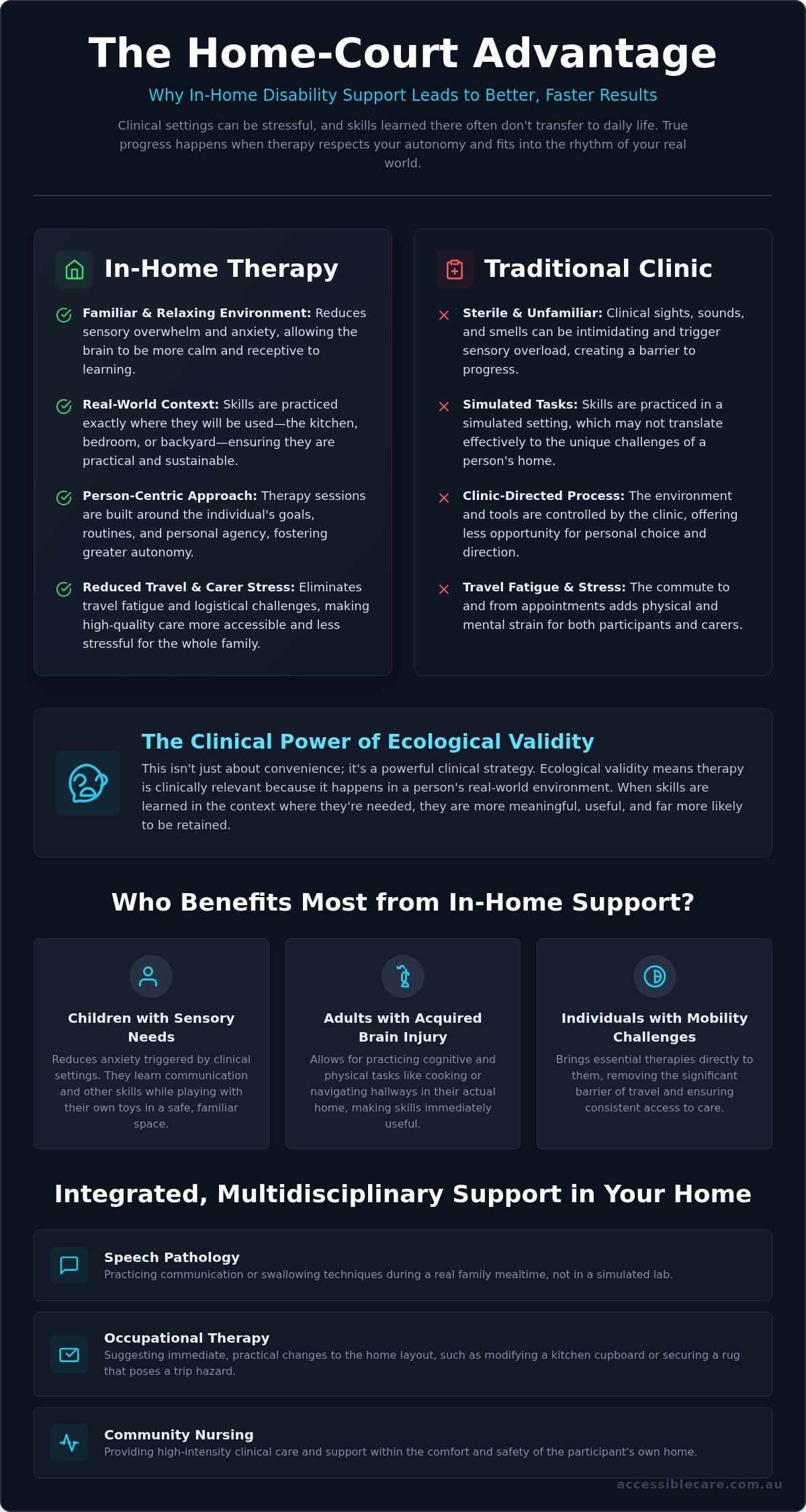
This support model is a lifeline for those with complex care needs or mobility challenges. For children, the familiar routine of home helps reduce the sensory anxiety often triggered by clinical sights and sounds. They can practice communication skills while playing with their own toys, which makes learning feel like play. Adults recovering from an acquired brain injury also benefit greatly. They can practice cognitive and physical tasks in their own kitchen, making the skills immediately useful. Understanding the broader context of Disability in Australia helps us see why these community-based solutions are vital. They don’t just provide care; they provide a pathway to a more meaningful and connected life.
The Clinical Power of Ecological Validity: Why Home Therapy Works
While many people view therapy at home as a matter of convenience, it’s actually a powerful clinical strategy. This approach is built on the concept of ecological validity. In a clinic, a therapist might simulate a task, but the home environment is the real thing. When you choose in home disability support melbourne, you’re removing the “anxiety barrier” that often comes with clinical settings. Unfamiliar smells, bright fluorescent lights, and the hum of a waiting room can cause sensory overload. At home, the brain is relaxed. This calm state allows for better cognitive engagement, meaning the participant can focus entirely on the session goals.
The therapist’s role also shifts in a home setting. They aren’t just observing; they’re adapting the actual environment. If a doorway is a trip hazard or a kitchen cupboard is too high, the therapist sees it in real-time. They can suggest immediate, practical changes that improve safety and independence. This is the “home-court advantage” in action. It turns every corner of your living space into a tool for progress, ensuring that therapy isn’t a separate event, but a natural part of your daily life.
Practicing Skills Where They Actually Happen
Learning happens best in context. For instance, speech pathology sessions held during a family mealtime allow a participant to practice communication or swallowing techniques in a real-world scenario. Occupational therapy in your own kitchen or bathroom ensures that safety modifications are tailored to your exact space. Ecological validity is the clinical relevance of therapy to a person’s real-world environment. Because the skills are practiced where they’ll be used, they’re more likely to stick. There’s no need to “translate” a skill from a clinic desk to a home benchtop; the learning is immediate and practical.
Involving the Support Network and Family
Home visits turn therapy into a collaborative effort. When a therapist works in your living room, carers and family members see the techniques first-hand. This real-time learning is invaluable. It helps build a sustainable support system that continues long after the therapist has left for the day. Instead of waiting for a written report, families can ask questions and refine their approach on the spot. This inclusive method empowers the participant’s autonomy within their own household. It ensures that everyone is on the same page, moving toward shared goals with confidence. If you’re ready to see how this approach can benefit your family, you can explore our tailored support options today.
Home vs. Clinic vs. Telehealth: Making the Right Choice
Deciding how to access your NDIS supports is a deeply personal choice. While traditional clinics offer certain benefits, such as access to specialised heavy equipment that isn’t easily moved, they also come with hidden costs. The most significant of these is travel fatigue. For many participants in Melbourne, the stress of traffic and the physical toll of a long commute can result in “zoning out” during the actual session. If you’re exhausted by the time you arrive, you aren’t getting the full value of your funding. This is why in home disability support melbourne is often considered the gold standard for functional skill development. It allows you to save your energy for what matters: the therapy itself.
Choosing the right mode depends on your specific goals. Here are a few reasons why families often prefer the home environment:
- Energy conservation: You avoid the physical and mental drain of a commute.
- Practical application: Skills are practiced exactly where they’ll be used daily.
- Family involvement: Carers can observe and participate without the stress of travel.
When In-Home Visits are Essential
Certain clinical goals require a therapist to be physically present to ensure safety and accuracy. For example, occupational therapy often involves transfer training. This means learning how to safely move from a bed, a sofa, or a car. A therapist needs to see the height of your furniture and the texture of your flooring to give the best advice. Similarly, high-intensity nursing care requires hands-on monitoring that a camera simply can’t replace. We also find that physical presence is vital for building trust. If a participant has a history of trauma or experiences complex behaviours, having a calm, professional caregiver in their own safe space helps foster a sense of security that a clinic or a screen cannot replicate.
The Role of Telehealth as a Hybrid Tool
Telehealth has become a valuable part of the support landscape, but it works best when used strategically. It’s a wonderful tool for parent coaching or quick progress reviews where physical contact isn’t needed. However, it’s not always the right fit. For paediatric participants who require sensory regulation, a digital session can sometimes be more distracting than helpful. At Accessible Care, we believe in a flexible approach. We don’t force you into one delivery mode. Instead, we listen to your needs and create a hybrid plan that might include weekly home visits with a monthly telehealth check-in. This ensures you receive the highest level of care while maintaining the autonomy to manage your own schedule.
Navigating NDIS Funding for Home-Based Support
Understanding your funding is the first step toward peace of mind. Most therapy services delivered in your own space are funded through the Capacity Building – Improved Daily Living budget category. To access in home disability support melbourne, the support must meet the NDIS “Reasonable and Necessary” criteria. This means the therapy should help you reach your goals, be effective, and represent good value. If a clinical setting causes you significant stress or travel fatigue, receiving care at home is often the most reasonable path forward. It’s about making the scheme work for your life, not the other way around.
Understanding Travel Rules and Metro Melbourne Caps
Providers can charge for the time it takes to travel to your home, but these costs are strictly regulated. In metropolitan areas like Melbourne and Adelaide, provider travel is typically capped at 30 minutes. These costs are deducted from your NDIS plan, not your own pocket, provided your plan is managed correctly. Travel billing must follow the NDIS Price Guide to ensure plan sustainability. This transparency ensures that more of your funding goes toward actual therapy. We believe in being open about these costs so you can plan your budget with confidence.
Setting Functional Goals for Home Success
When you set goals, think about your daily life. Instead of a general goal like “improving mobility,” try something specific to your home. You might aim for “accessing my garden independently” or “using my kitchen safely to prepare tea.” A Functional Capacity Assessment (FCA) conducted in your home provides the most accurate data for your NDIS plan review. It shows how you actually interact with your environment. This leads to better funding outcomes. Learning is personal. Your space matters. We listen first.
If you’re looking for a partner to help you navigate these rules, you can contact our team for a transparent support plan today.
Choosing the right provider is a big decision. Use this checklist to help you find the best fit:
- Are they a registered NDIS provider with a multidisciplinary team?
- Do they have experience with complex care and high-intensity support?
- Is their travel billing transparent and within the 30-minute metro cap?
- Do they prioritise your autonomy and self-direction?
- Do they offer attentive listening and a compassionate, non-clinical tone?
Empowering Independence: The Accessible Care Difference
Choosing a provider is about more than just checking boxes; it’s about finding a team that respects your story and honours your autonomy. At Accessible Care, we believe that the best support is built on a foundation of trust and expert knowledge. Our multidisciplinary team includes experienced Speech Language Pathologists (SLPs), Occupational Therapists, and dedicated community nurses. This diverse expertise allows us to provide holistic in home disability support melbourne that grows with you. Whether you’re seeking paediatric support for a child or complex care for an adult, our focus remains on the person rather than the process. We’re here to facilitate your goals, not to direct your life.
Attentive listening is our signature promise. We understand that you’re the expert on your own life and your own home. By prioritising your perspective, we ensure that every therapy session is relevant, respectful, and empowering. Our team doesn’t just deliver a service; we build a partnership. We take the time to understand your daily rhythms and the specific challenges you face. This person-centric approach ensures that the clinical progress you make is sustainable and meaningful in the real world. Your independence is our priority, and we’re committed to helping you achieve it on your own terms.
Local Support Across Melbourne and Victoria
Starting your journey with a new support partner can feel like a big step, so we’ve made our process as gentle and transparent as possible. It begins with a simple, compassionate chat where we listen to your needs and answer your questions. There’s no clinical pressure or detached phrasing; just a genuine conversation about how we can help. From there, we move to a thorough home assessment. This allows our therapists to see your environment first-hand and suggest practical ways to improve your daily living tasks. We prioritise your comfort at every stage, ensuring that you feel in control of the process from day one. If you’re ready to explore a more nurturing way to reach your NDIS goals, Contact our compassionate team today to discuss your in-home therapy options.
Embrace a Future of Independence in Your Own Home
Choosing therapy in your own space is a powerful decision that prioritises your comfort and your long-term success. By leveraging the “home-court advantage,” you ensure that the skills you learn today become a natural part of your daily life tomorrow. We’ve seen how ecological validity turns your kitchen or living room into a vital clinical tool; helping you reach your goals faster while avoiding the exhaustion of travel. Navigating in home disability support melbourne doesn’t have to be overwhelming when you have a partner who truly listens to your needs.
As a Registered NDIS Provider with an experienced multidisciplinary team, Accessible Care is proud to serve families across Melbourne and Adelaide. We’re here to help you navigate the system and provide the nurturing care you deserve. You don’t have to manage this journey alone. We’re ready to listen and support your vision for a more autonomous life.
Begin your journey to independence with a compassionate home therapy partner.
Your goals are within reach, and we’re honoured to help you achieve them in the place where you feel most like yourself.
Frequently Asked Questions
Is in-home therapy as effective as clinic-based sessions?
In-home therapy is often more effective because skills are learned in the same environment where they’ll be used daily. This eliminates the need for a participant to translate clinical exercises to their actual home life. You avoid the stress of travel fatigue, which means more energy is available for the session itself. For many, the home-court advantage leads to faster, more sustainable progress toward NDIS goals in a familiar, low-anxiety setting.
How does the NDIS fund travel costs for therapists visiting my home?
The NDIS funds travel through your specific budget categories, such as Capacity Building – Improved Daily Living. In metropolitan areas like Melbourne, provider travel is typically capped at 30 minutes per visit. These costs come directly from your plan funding rather than your own pocket. It’s a transparent process designed to ensure you receive high-quality in home disability support melbourne without unexpected financial stress or complicated out-of-pocket expenses for your family.
What kind of equipment does an occupational therapist bring to my house?
Our occupational therapists bring a variety of portable assessment tools and therapeutic resources tailored to your goals. This might include sensory regulation items, fine motor skill aids, or specialised equipment for trial. While they don’t bring heavy clinical machinery, they focus on using your own furniture and household items to practice daily living tasks. This ensures that any recommendations or modifications they suggest are perfectly suited to the unique layout of your home.
Can I receive speech therapy at home if I have an acquired brain injury?
Yes, you can certainly receive speech therapy at home following an acquired brain injury. Practicing communication and swallowing techniques in your own kitchen or dining room is incredibly beneficial for recovery. It allows our therapists to see the real-world challenges you face, such as background noise or specific seating arrangements. This context-heavy approach helps rebuild confidence and ensures that the strategies you learn are immediately applicable to your everyday interactions with family.
Do you provide paediatric occupational therapy in Adelaide at home?
We provide paediatric occupational therapy in both Melbourne and Adelaide, delivering professional care right to your doorstep. Children often feel more secure and open to learning when they’re in a familiar environment with their own toys and routines. Our therapists work closely with parents and carers to integrate therapy into the child’s natural day. This nurturing approach helps reduce sensory overwhelm and makes it easier for children to reach their developmental milestones.
What should I do to prepare my home for a therapist’s visit?
Preparing for a visit is simple and doesn’t require any major changes to your household. We suggest clearing a small, comfortable area where you and the therapist can work without too many distractions. It’s also helpful to have any relevant NDIS documents or previous reports handy for the initial assessment. Most importantly, just be yourself. Our team is there to support your natural routine, so there’s no need to tidy up or change how you live.
How many hours of support can I get through my NDIS plan?
The number of support hours you receive depends entirely on your individual NDIS plan and what is deemed reasonable and necessary to meet your goals. During your planning meeting or review, the NDIS will look at your functional needs and the impact of your disability. Our team can help you understand your in home disability support melbourne budget and how to best allocate your hours to ensure you receive consistent, high-quality care throughout your plan period.
Is community nursing different from standard in-home therapy?
Community nursing focuses on clinical and medical needs, while standard therapy usually involves allied health professionals like OTs or speech pathologists. Our nurses handle tasks such as medication management, wound care, or monitoring complex health conditions. While therapy helps you build functional skills for independence, community nursing ensures your health is stable and well-managed. Both services work together in a multidisciplinary approach to provide you with comprehensive, person-centric care that supports your overall wellbeing.

