


There isn’t one training checklist that fits every NDIS support worker. It’s understandable to feel unsure when advice about ndis support worker training requirements can make it sound as though every role follows the same rules. In practice, preparation depends on the work being done and the participant’s support needs.
This guide separates general expectations from role-specific preparation, so you can understand what to consider before a support task begins. It explains how worker screening, orientation, first aid and task-specific competencies fit into the picture without treating every item as a universal requirement.
You’ll learn what to consider for support work in Victoria and South Australia, including how to assess whether a worker is prepared for the tasks they’ll undertake. Good training is more than a compliance exercise. It helps workers provide safe, respectful support that listens to the participant, honours their choices and supports everyday independence.
Key Takeaways
- The ndis support worker training requirements depend on the role and tasks involved. One certificate shouldn’t be treated as preparation for every type of support.
- Understand how the NDIS Code of Conduct and the Worker Orientation Module, Quality, Safety and You, contribute to safe, respectful practice.
- Match learning to the work, such as communication, mealtime support, infection prevention or safe handling, when it’s relevant to a participant’s needs.
- Use a clear process to identify duties, assess competence and record training outcomes. Keep these records distinct from screening checks and qualifications.
- In Melbourne and Adelaide, effective preparation should help workers support each person’s goals, choices and everyday participation.
What NDIS support worker training requirements apply in Australia, Victoria and SA?
There isn’t one course that prepares a worker for every NDIS support task. The ndis support worker training requirements are best understood as a combination of general expectations and preparation matched to the role, service and participant. A worker supporting someone with community access may need different practical preparation from a worker assisting with personal care.
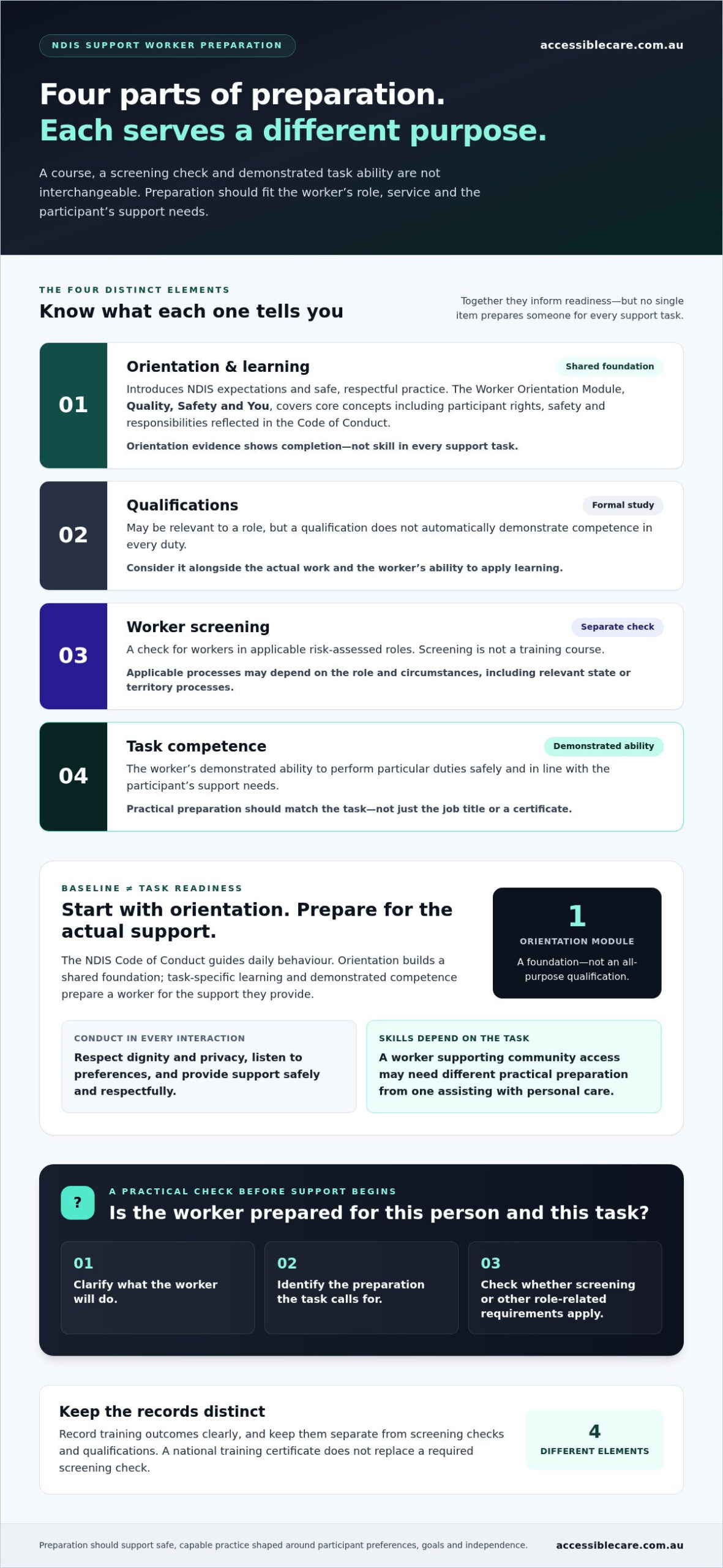
It helps to distinguish four things that are often grouped together:
- Orientation and learning: Information that helps workers understand NDIS expectations and safe, respectful practice.
- Qualifications: Formal study that may be relevant to a role, but doesn’t automatically demonstrate competence in every task.
- Worker screening: A separate check for workers in applicable risk-assessed roles. It isn’t a training course.
- Task competence: The worker’s demonstrated ability to perform particular duties safely and in line with the participant’s support needs.
These elements work together, but they aren’t interchangeable. Completing a course alone doesn’t prepare someone for every support task. Workers also need suitable guidance and the ability to apply their learning in practice. For a plain-language overview of the scheme itself, see the National Disability Insurance Scheme (NDIS). For detailed worker requirements, refer to current NDIS Commission guidance.
Is there one mandatory training list for every NDIS support worker?
No single course list covers every worker and task. The NDIS Commission’s Worker Orientation Module is titled Quality, Safety and You. It introduces core ideas about participant rights, safety and the NDIS Code of Conduct. It’s an orientation resource, not an all-purpose qualification or proof that a worker is ready for every duty.
Further learning depends on provider obligations, the service and the person receiving support. Preparation for one role may not be enough for duties with different requirements or complexity. Providers are responsible for ensuring workers are suitable and competent for their work. Workers and participants can use this distinction to ask a practical question: “Has this person been prepared for the support they’ll provide me?” Check current Commission guidance, as requirements and module information can change.
How Victoria and South Australia fit into the picture
National NDIS expectations apply across Australia, while relevant state or territory processes may also affect worker screening or particular responsibilities. The process can depend on the role and circumstances. A national training certificate doesn’t replace a required screening check, and a process used in one state may not describe the process in another.
For people arranging support in Melbourne or Adelaide, consider both the NDIS-wide expectations and any applicable local process. Before a task begins, clarify what the worker will do, what preparation it calls for and whether screening or other role-related requirements apply. This keeps the focus on more than paperwork. The goal is support that’s safe, capable and shaped around the participant’s preferences, goals and independence.
How the NDIS Code of Conduct and worker orientation shape safe support
Orientation gives workers a shared foundation for understanding rights, safety and their responsibilities. The NDIS Code of Conduct guides how they put those principles into practice. Neither replaces the provider’s responsibility to prepare workers for their duties and support them to work safely and competently.
Orientation establishes a baseline; task-specific learning and demonstrated competence prepare a worker for the support they provide. Respectful conduct is expected in every interaction, while the practical skills needed depend on the task and the participant.
What does the Worker Orientation Module cover?
The NDIS Quality and Safeguards Commission’s NDIS Worker Orientation Module: Quality, Safety and You introduces key NDIS concepts, including participant rights, safety and responsibilities reflected in the Code of Conduct. Registered providers can include it in workforce preparation. Workers should follow the Commission’s current instructions for accessing and completing the module.
After completing the module, workers can retain the completion evidence provided and share it with their employer if requested. This shows that orientation has been completed, but doesn’t demonstrate skill in every support task. A certificate alone can’t show that someone knows how to follow an individual’s communication preferences, support a particular routine or carry out a specific task safely. The module’s official page provides current access and completion guidance.
What the NDIS Code of Conduct means in daily support
The Code is a standard of conduct, not a course certificate. It applies to NDIS workers, including those working for registered and unregistered providers. In daily practice, its principles are reflected in actions such as protecting a person’s privacy, listening to their preferences and providing support safely, respectfully and competently.
- Respect dignity and privacy: Explain what you’re doing, seek the person’s agreement and protect personal information.
- Support choice: Offer meaningful options and respect the participant’s decisions instead of taking over because it seems quicker.
- Communicate with care: Listen, allow time for a response and use communication approaches that work for the individual.
- Act safely and honestly: Follow relevant instructions, stay within your competence and raise concerns through the appropriate channels.
For a broader overview of the scheme, readers can also consult the guide to the National Disability Insurance Scheme (NDIS) mentioned earlier. The Code sets expectations for conduct; registered providers’ NDIS Practice Standards shape the systems that support quality and safety. Those systems can include induction, guidance and appropriate oversight, helping workers apply shared principles consistently.
For participants and families, these expectations should be visible in the support itself: the worker listens, explains, respects boundaries and makes room for the person’s choices. If you’re exploring NDIS support services, look for an approach that values capable support and participant autonomy.
Which NDIS training depends on the support worker’s role and tasks?
Once a worker understands general expectations, preparation should become more specific. The right learning depends on what the worker will do, the participant’s support plan and preferences, and the risks involved. These examples are prompts for matching preparation to duties, not a universal list of legal training requirements.
- Communication support: Learn the participant’s preferred ways to communicate, how they express choices or discomfort, and how to allow time for responses. A speech therapist or the participant may help explain useful strategies.
- Personal support: Understand the person’s routines, privacy preferences and agreed approach to support. Safe handling techniques may be relevant if the role involves assisting with movement or transfers.
- Mealtime support: Follow the person’s assessed needs and documented guidance. Preparation may include understanding relevant mealtime instructions, recognising when something is wrong and knowing how to respond.
- Infection prevention: Learn the hygiene and protective practices relevant to the worker’s duties, setting and participant. The level of preparation should reflect the tasks performed.
- Medication-related or complex support: Make sure the worker has role-appropriate instruction and can demonstrate the required steps before undertaking the task. Knowing the theory isn’t the same as being competent in practice.
Training for communication, personal support, and meals
Good preparation starts with the individual, not a generic checklist. A worker may need to know whether someone communicates through speech, gestures, assistive communication or a combination of approaches. For personal support, clear guidance about consent, privacy and the person’s preferred routine helps preserve dignity and control.
Mealtime support should reflect the participant’s assessed needs and relevant instructions, not assumptions based on diagnosis. Workers should understand their role and how to seek guidance if the person’s needs change. Include infection prevention in preparation when it’s relevant to the worker’s responsibilities, rather than treating it as identical training for every task.
When a task calls for specialised preparation
Some duties carry greater risk or require specific practical skills. High-intensity daily personal activities are one example: a worker may need training tailored to the participant and the particular support. The NDIS Commission’s dedicated guidance on high-intensity supports can help readers explore the topic further.
Separate preparation into stages: learn the relevant procedure, practise it with appropriate supervision where needed, then demonstrate competence for the task. A qualification or course can contribute, but it doesn’t automatically establish that a worker can safely perform every procedure in a particular person’s circumstances. The same distinction applies to screening: the NDIS Worker Screening Check is a screening process, not evidence of practical skill.
For support teams, ask specific questions: What does this participant need? What tasks will the worker perform? How will readiness be assessed? This task-focused approach helps keep support safe while respecting the person’s choice and independence. Learn more about support work services shaped around individual needs and goals.
How providers check competency, records, and refresher needs in Victoria and SA
A practical competency process connects each worker’s preparation to the support they’ll provide. It also helps providers identify gaps and respond when a participant’s needs or duties change. For the ndis support worker training requirements, a useful sequence is:
- Identify the duties: Be clear about the tasks the worker is expected to perform.
- Understand the support needs: Consider the participant’s preferences, relevant guidance and any risks linked to the task.
- Arrange suitable learning: Provide role-specific information, instruction or training where needed.
- Assess competence: Check that the worker can apply the learning safely, with supervision or practical assessment where appropriate.
- Record the outcome: Keep evidence of learning and any relevant assessment, then review it when circumstances change.
This is more useful than treating course attendance as the finish line. If a support task changes, for example, a provider can revisit the worker’s preparation and assess whether further guidance or practice is needed before the new duties begin.
What should a useful training record show?
A clear record helps a provider see what preparation a worker has completed and what it relates to. It can include the learning activity, completion date, available evidence and the role or task covered. Where suitable, record the outcome of a competency assessment, practical observation or supervision. There isn’t one universal template for every task, so records should make the worker’s preparation understandable and relevant.
Keep the categories distinct. A training record describes learning and assessment; a qualification records formal study; a worker screening record relates to a separate safeguarding check. One doesn’t stand in for the others.
How worker screening differs from training
Worker screening is a safeguard used to assess suitability for relevant roles. It doesn’t teach a support skill or show that a worker can perform a task competently. Providers and workers should use current NDIS Commission guidance and the applicable Victorian or South Australian process, rather than assume the procedures are identical or rely on outdated details.
Refresher learning should respond to current obligations, changes in the work, emerging risks and assessed support needs. It may be appropriate when guidance changes, a worker takes on different duties, or a review identifies that more practice would help. Don’t assume one fixed refresher timetable suits every role. The aim is to maintain readiness for the support being delivered while respecting the participant’s choices and routines.
Certificates and demonstrated competence are connected, but answer different questions: a certificate shows that learning was completed, while an assessment shows how well it can be applied to a task. For person-centred NDIS support services in Melbourne and Adelaide, explore support shaped around individual needs and goals.
What good NDIS support worker preparation means for participants in Melbourne and Adelaide
For a participant, preparation matters most in everyday moments: whether a worker listens, understands what support is wanted and helps the person stay in control. Training isn’t the end goal. The goal is assistance that supports safety and wellbeing while making room for personal choice, relationships and ordinary routines.
That is why the ndis support worker training requirements should be considered alongside the individual’s support needs. A generic checklist can’t tell a worker how a particular person communicates, what matters to them or how they want assistance provided. Those details should guide both preparation and the support itself.
What participants and families can expect from prepared support
A prepared worker takes time to listen and follows the agreed support arrangements. They explain what they’re doing, respect privacy and check how the participant wants to be involved. If a worker is unsure about a task or instruction, it’s reasonable to raise the question respectfully before proceeding. Clear communication helps avoid assumptions and gives the participant a chance to express their preferences.
Families can help by sharing relevant information with the participant’s agreement, while keeping the person’s voice at the centre. For example, a worker supporting someone on an outing should understand the person’s goals for the activity and how they prefer to make choices along the way. Support should enable participation, not take over.
Connect NDIS guidance with support that respects personal goals
NDIS guidance sets important expectations, while role-appropriate preparation helps workers apply them to a particular person and task. For a broader introduction to the scheme, see the article National Disability Insurance Scheme (NDIS). Then bring the focus back to the individual: What are they working towards? What does safe, respectful assistance look like to them? How can support encourage independence rather than create unnecessary dependence?
In Melbourne and Adelaide, these principles apply whether support helps someone take part in a community activity, follow a daily routine or build confidence with everyday tasks. Effective support is attentive and collaborative. It respects the person’s decisions, adapts to their communication and helps them pursue goals in ways that feel right for them.
- Choice: Ask how the participant wants to be supported and respect their decisions.
- Clarity: Explain the task and raise uncertainties before support proceeds.
- Participation: Support the person to take part in daily life in line with their goals.
- Respect: Protect privacy, listen carefully and follow agreed arrangements.
Accessible Care provides support services in Melbourne and Adelaide, including support work shaped around people’s needs and goals. Explore Accessible Care’s support work and other services for support that helps participants take part in everyday life with greater choice and independence.
Make your next support step your own
Before support begins, consider one question: what would help you feel heard, safe and in control? Sharing your preferences, communication needs and personal goals can help shape support around what matters in your daily life. You can also raise questions about a task and discuss what feels comfortable before it proceeds.
The ndis support worker training requirements matter most when preparation leads to support that fits the person, not just the paperwork. A worker’s readiness should connect to the tasks involved and the participant’s needs, while leaving room for choice, dignity and independence.
Accessible Care is a registered NDIS provider serving Melbourne and Adelaide, with support work alongside therapy and community-based disability services. If you’re considering support that recognises your goals and preferences, explore support that respects your goals with Accessible Care.
Your voice matters. The right support should help you take part in life in ways that feel safe, meaningful and your own.
Frequently Asked Questions
Is NDIS Worker Orientation training mandatory for support workers?
For workers of registered NDIS providers, the Commission’s Worker Orientation Module, Quality, Safety and You, is a required orientation module under current guidance. It introduces NDIS rights, safety and worker responsibilities; it isn’t training for every practical duty. Before relying on 2026 advice, check the Commission’s latest completion instructions and keep completion evidence as directed. Workers still need preparation matched to their assigned tasks and the participant’s support needs.
Do NDIS support workers need a Certificate III?
No. A Certificate III in Individual Support isn’t a universal qualification requirement for every NDIS support role. Some employers may prefer or require it, while particular duties or service settings can call for other qualifications or evidence of capability. Check the position’s actual duties, provider requirements and current official guidance rather than treating the certificate as mandatory for everyone or irrelevant. A qualification also doesn’t automatically prove task-specific competence.
What training does an NDIS support worker need for medication support?
Preparation depends on the participant’s needs, the worker’s assigned duties and the applicable support procedures. First clarify exactly what assistance the role involves, then make sure the worker has appropriate instruction and can carry out those duties competently. A general medication course alone shouldn’t be assumed to cover every person or situation. If instructions are unclear or the task falls outside the worker’s competence, pause and seek guidance through the provider’s process.
How often do NDIS support workers need refresher training?
There isn’t necessarily one refresher interval that applies to every worker and topic. Providers should follow current requirements for specific learning while considering the worker’s duties, identified risks and any changes to a participant’s support arrangements. A new task, revised instructions or a competency review may signal that further guidance or practice is needed. Keeping a record of review decisions helps explain why learning was refreshed or why existing preparation remains suitable.
Does an NDIS support worker need a Worker Screening Check as well as training?
Where a role is risk-assessed, worker screening is a separate safeguard from training and competency assessment. It considers suitability for the role; it doesn’t teach support skills or show that a worker can perform a specific task. Whether a check applies depends on the role and current rules. Workers and providers should verify NDIS Commission guidance and relevant state processes, including the current requirements in Victoria or South Australia.
Can an NDIS support worker start a task after completing an online module?
Not automatically. An online module can help a worker understand general expectations, but completing it doesn’t establish readiness for every practical task. Before a worker takes on a duty, the provider should consider the task’s instructions and risks, arrange suitable preparation and assess whether the worker can apply it. Depending on the task, that may involve supervision or practical observation. If a worker is unsure, they should seek guidance before proceeding.
Are NDIS support worker requirements different in Victoria and South Australia?
National NDIS expectations apply in both states, and relevant state processes may also matter, including worker screening where applicable. Don’t assume a summary of requirements in one state fully describes the process in the other. For a particular role, use current NDIS Commission guidance alongside official Victorian or South Australian information. This is especially useful before a worker starts a role or takes on duties with different screening or preparation needs.

