


You check your NDIS plan and discover a budget is nearly empty, or a claim hasn’t been paid. What should you do first? If you’re asking what to do when ndis funding runs out, it’s understandable to worry about whether essential supports can continue and what to tell the NDIA.
Start by identifying exactly what’s affected. A budget may be low for one support category or funding period, while other parts of your plan may be different. Check your plan dates, available budgets and recent claims before deciding what to do next.
This guide explains what to check, who to contact and what information to prepare. You’ll learn how plan variations differ from reassessments, how to discuss continuity with your providers, and when to contact the NDIA or a support coordinator. The aim is to help you make informed, person-led decisions. If you receive support in Melbourne or Adelaide, Accessible Care can discuss your priorities and relevant support in the context of your plan.
Key Takeaways
- Before deciding what to do when ndis funding runs out, identify which budget, support category or funding period is affected.
- Compare the available balance with upcoming bookings, invoices and claims to understand the size and timing of the gap.
- Prepare a clear account of what has changed and how a pause in support could affect daily life or personal goals.
- Discuss priorities and upcoming supports early with your providers, and contact the NDIA to ask about relevant next steps.
- Use a simple follow-up plan to track who you’ve contacted, what information you’ve shared and any response still needed.
NDIS funding running out? Start with these immediate steps
A low or exhausted NDIS budget can feel alarming, especially if you rely on regular support. Before assuming all funding has stopped, establish what has changed. It could be one support budget, a funding period, the plan end date, or a payment that hasn’t been processed. Identifying the issue helps you choose the right next step.
If you’re unsure what to do when ndis funding runs out, check the facts first, then seek guidance based on what you find. Don’t assume extra funding will be added automatically. Any change to plan funding depends on the NDIA’s decision and the rules that apply to your plan.
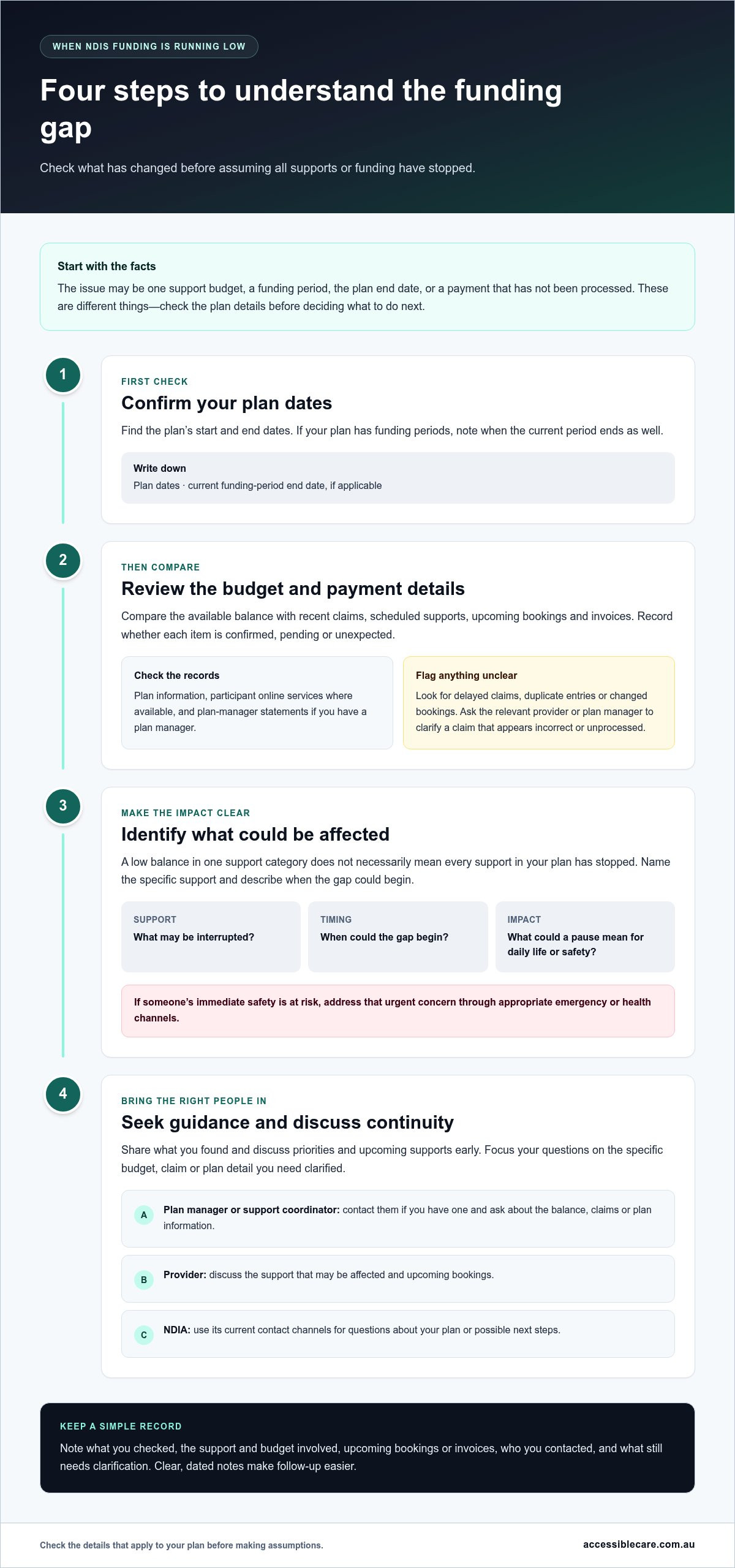
- Check your plan dates. Note the plan’s start and end dates, and when the current funding period ends if your plan has funding periods.
- Review budget and payment information. Compare the available balance with recent claims, scheduled supports, upcoming bookings and invoices. Note anything delayed or unexpected.
- Identify what’s affected. List the supports that may be interrupted, when the gap could begin, and any immediate safety or daily living concerns.
- Seek guidance. Contact your plan manager or support coordinator, if you have one, and discuss the issue with your provider. For questions about your plan or possible next steps, contact the NDIA through its current contact channels.
What should you do first when NDIS funding is nearly gone?
Write down the specific support, the next expected booking and what a pause could mean for you. A low balance for one type of support doesn’t necessarily mean every support in your plan has stopped. Clear notes make it easier to explain the gap and ask focused questions. If someone’s immediate safety is at risk, address that urgent concern through appropriate emergency or health channels.
Is the plan exhausted, or is there a budget or payment issue?
Your plan’s end date is different from the balance for an individual support or funding period. A plan can still be current while a particular budget is low, and a funding period can have its own limits. Check the plan details before assuming funds can move between categories or periods. Follow the rules and instructions that apply to your plan.
Look for delayed claims, duplicate entries or changes to booked supports that could explain an unexpected balance. If a claim appears incorrect or hasn’t been processed, ask the relevant plan manager or provider to clarify its status, then record the response. A plain-English guide to NDIS plan basics can help you understand the terms as you review your documents. For broader background, Understanding the National Disability Insurance Scheme provides an overview of the scheme and its administration.
How to review your NDIS plan, budget, and remaining funding
Once you know a budget looks low, match the balance to the plan details that govern how and when funding is available. The NDIA’s participant online services, including the my NDIS participant portal or app where available to you, can help you review plan information. Access and screens may vary. If you have a plan manager, their statements can also show claims and spending. Keep your own records so you can compare information across sources.
Which NDIS plan details should you check?
Locate your plan’s start and end dates, stated support budgets, any funding periods, and how the plan is managed. Compare these with recent statements, provider invoices, scheduled appointments and claims. A booking is not necessarily a processed claim, so record each item’s status rather than treating it as confirmed spending.
If a balance or transaction doesn’t match your records, flag it for clarification. A dated note of what you checked and who you contacted will make follow-up easier.
How do funding periods and support categories affect the balance?
A total shown in a plan doesn’t always mean the full amount is available to spend at once. Some plans divide funding into periods, while support budgets may be set out by category. The rules for using a particular budget depend on your plan and current NDIA guidance. Don’t assume funds can be moved between categories or periods, or carried forward, without checking what applies to your plan.
For a practical overview, list upcoming supports and expected invoices alongside the balance shown for the relevant budget or period. A balance may look sufficient overall but still not show what’s available in a particular period. If you’re unsure how a limit applies, ask your plan manager or the NDIA to explain the plan information before making decisions based on an assumption.
A simple tracker brings the details together. Record the date you checked, the budget or period, the displayed balance, claims or invoices still being resolved, upcoming bookings, and any questions or conversations with your provider or plan manager. Update it when a new statement or response arrives. This helps you spot changes and explain the issue clearly if you need guidance about what to do when ndis funding runs out.
- Balance: Note the amount shown and where you checked it.
- Commitments: List upcoming bookings and invoices, including their dates and status.
- Follow-up: Record who you contacted, when, and what still needs clarification.
If you receive support in Melbourne or Adelaide, Accessible Care’s NDIS support team can discuss your priorities and the supports you’re planning within your current plan.
What options can you discuss with the NDIA when funding runs out?
Contacting the NDIA can feel daunting, but you don’t need to have every answer ready. Explain the support gap clearly: what support is affected, when the problem began or is expected to begin, what has changed, and how this affects daily life or your goals. Ask which current process fits your circumstances. A conversation or request doesn’t guarantee a plan change or extra funding. The NDIA makes those decisions under the rules that apply to your plan.
How can you explain a change in support needs?
Describe the practical impact, not just the budget shortfall. Explain which everyday activities have become harder, whether there are safety concerns, and what may happen if a particular support pauses. Connect the information to your goals and priorities, using your own words or preferred communication method. If you’re a nominee or representative, keep the participant’s preferences central.
Gather relevant evidence you already have, such as a therapist’s report or other professional information describing support needs and their effect on daily activities. Useful evidence depends on the situation, so don’t assume every request needs the same documents. Prepare a concise summary with dates, key changes, upcoming support gaps and any documents you can provide.
When should you ask about a plan reassessment or other review?
Ask the NDIA which pathway applies before submitting a request. A plan variation may suit a smaller change, such as correcting an error or changing how funding is managed. A plan reassessment is generally for significant changes in circumstances or support needs. Under current 2026 guidance, an overspend by itself generally isn’t a reason for an unscheduled reassessment; a significant and ongoing change may be more relevant.
Since 27 August 2026, a plan reassessment request can be made only by the participant, their nominee or their child representative. The NDIA has up to 90 days to decide. If it hasn’t made a decision within that period, the request is considered refused and the participant can seek a review. Confirm the current process and terms with the NDIA. Asking for information is separate from making a formal request and from a decision that changes a plan.
Before contacting the NDIA, prepare a short, dated record so you can explain your circumstances consistently. You might note:
- The support gap: Which support is affected and when it may be interrupted.
- What has changed: Relevant changes in circumstances or needs, and their practical effects.
- Your evidence and questions: Documents you can share and what you need clarified about the process.
This preparation can make it easier to discuss what to do when ndis funding runs out without assuming a particular outcome. A provider can listen and discuss support priorities within your plan, but only the NDIA can decide whether a plan or its funding changes.
How to plan support continuity while NDIS funding is limited
A funding shortfall doesn’t automatically tell you which support should change. Priorities depend on your needs, routines, safety and goals. A conversation with your provider can help you understand upcoming commitments and discuss possible adjustments before a booking takes place. Any change should be agreed with you and remain consistent with your plan and the rules that apply to it.
How can you prioritise supports without losing sight of your goals?
Start with the participant’s immediate needs and what matters most to them. Consider whether a pause could affect safety, essential daily routines, communication, independence or progress towards a stated goal. Note which upcoming supports are time-sensitive and which might be discussed for rescheduling. There’s no universal ranking of support types; the impact of a change depends on the person and their circumstances.
It may help to sort upcoming supports into three practical groups:
- Time-sensitive: Supports with an approaching date or a practical consequence if delayed.
- Important to routine or goals: Supports that help maintain daily activities, participation or progress.
- Worth discussing for flexibility: Bookings where you and the provider could explore another timing or arrangement.
This is a discussion tool, not a direction to stop or reduce a particular support. Keep the participant involved in decisions, including how their preferences and communication needs are represented. If family, a nominee or support coordinator is helping, make sure the person’s views remain central.
What should you discuss with your provider about upcoming supports?
Share the balance information you’ve reviewed, the relevant dates and any bookings or invoices you’re concerned about. Be specific: “This budget is limited, and these appointments are coming up. Can we discuss what’s scheduled and what options fit my plan?” Raise questions before support is delivered, so there’s time to understand the likely impact and agree on any proposed change together.
Ask your provider to clarify upcoming bookings and any invoices that may affect your available budget. If you have a plan manager or support coordinator, include them where useful. A provider can’t approve extra NDIS funding, and an alternative arrangement isn’t automatically allowed. Check plan requirements before agreeing to changes, and don’t commit to private payment unless you’ve considered whether it’s suitable and understand the arrangement.
A short continuity checklist can keep the conversation focused:
- Confirm: List the next booked supports and their dates.
- Discuss: Identify possible adjustments with the participant and provider before they take effect.
- Record: Note what was agreed, what remains undecided and who will follow up.
If you’re in Melbourne or Adelaide, Accessible Care can discuss your priorities and how supports may fit within your plan.
Getting help after NDIS funding runs out: a clear next-step plan
When funding is exhausted, it can be hard to know which conversation to have first. Keep the next steps manageable: clarify what the balance means, describe the support gap, speak with the people involved in your supports, then follow up on unanswered questions. You don’t need to resolve everything in one call. A short written summary helps you explain the situation consistently and track what happens next.
What information should you have ready for a support conversation?
Bring your plan dates and relevant budget information, along with a list of upcoming bookings, invoices or claims that may affect available funds. Write down which supports matter most to you, when a pause could occur and what practical effect it may have on daily life or goals. Prepare a few questions, such as what’s scheduled and what needs clarification. You can invite a trusted family member or nominee if you choose.
A simple follow-up checklist can help you stay organised:
- Clarify: Note which budget or funding period is affected and what information you used.
- Document: Record the support gap, relevant dates and any practical impacts.
- Communicate: Share your priorities and questions with the NDIA and the people involved in your supports, as appropriate.
- Follow up: Keep a note of responses, agreed actions and anything still unresolved.
This record isn’t a guarantee of a plan change or extra funding. It helps you keep the facts, questions and next steps clear while you seek guidance.
How can Accessible Care support people in Melbourne and Adelaide?
Accessible Care is a registered NDIS provider in Melbourne and Adelaide. The team can listen to your priorities and discuss relevant support in the context of your circumstances and plan. Services include support work, occupational therapy for children and adults, speech therapy, positive behaviour support, community nursing and high-intensity support. The focus is a respectful conversation about what matters to you and how your supports relate to your goals.
Providers don’t decide whether the NDIA approves or increases plan funding. A discussion with a provider is separate from an NDIA decision, and support arrangements need to fit the participant’s plan and applicable rules. Being clear about your priorities can still make conversations about support more focused.
If you’re in Melbourne or Adelaide, explore support options with Accessible Care and discuss your needs and relevant services in the context of your plan.
Choose one next step that feels manageable
Funding uncertainty can make the future feel hard to plan. You don’t need to settle every question at once. Choose one action that would make the next conversation clearer, such as writing down the support you most want to protect or the question you need answered first. This can help keep your needs and preferences at the centre of decisions.
If you’re still considering what to do when ndis funding runs out, remember that asking for guidance is a step towards understanding your options, not a commitment to a particular outcome. Take the time you need to consider what feels right for you, and involve someone you trust if that would help.
Accessible Care offers support work alongside therapy, community nursing, positive behaviour support and high-intensity support. To explore support services in Melbourne or Adelaide, visit Accessible Care’s website.
You deserve to feel heard as you decide what comes next.
Frequently Asked Questions
Does NDIS funding automatically renew when it runs out?
No. Don’t assume an exhausted budget or expiring plan automatically renews with the same funding. Check your plan end date and any information from the NDIA about what happens next. A renewed plan may have different budgets and rules. Under current guidance, from 1 February 2027, unspent funds from a previous plan won’t carry over into a renewed plan. Contact the NDIA if your next plan arrangements aren’t clear.
Can I keep receiving NDIS supports if my funding has run out?
It depends on what has run out, your plan arrangements and the support involved. If a specific budget is exhausted, don’t assume a provider can continue delivering support and claim it from another budget. Ask the provider to explain the payment position before the next booking, and contact your plan manager or the NDIA for guidance. If your plan has ended, clarify your current plan status before relying on ongoing NDIS funding.
Can I pay privately for supports if my NDIS funding runs out?
You may be able to arrange private payment with a provider, but discuss the terms and full cost before agreeing to or receiving support. Don’t assume the NDIS will reimburse a private payment later, or that paying privately changes your plan budget. If you’re considering this, ask for the arrangement in writing and take time to decide whether it suits your circumstances. You can also ask the provider about options that remain within your current plan.
Can unused funding in one NDIS category cover another support?
Not necessarily. Whether funding can be used across supports depends on your plan structure and current NDIA rules. A balance in one category doesn’t automatically mean it can pay for a different support, and funding may also be limited by a funding period. Before booking or changing a support, check the plan conditions and ask your plan manager or the NDIA to clarify how the relevant budget can be used.
What should I do if an NDIS claim is delayed or appears incorrect?
First, identify the specific claim and confirm whether it has been submitted, processed, rejected or paid. Ask your provider or plan manager to check the claim details against the invoice, service date and support delivered. Keep copies of relevant records and note any reference number or explanation you receive. Avoid submitting a duplicate claim before you know its status, as that may make it harder to track the original issue.
Can a support coordinator or provider increase my NDIS funding?
No. A support coordinator or provider can help you explain your support needs, organise relevant information or discuss options, but the NDIA decides whether plan funding changes. Under current 2026 guidance, only a participant, their nominee or their child representative can request a plan reassessment. An overspend alone generally isn’t a reason for an unscheduled reassessment; explain any significant, ongoing change in circumstances and ask the NDIA which pathway applies.
Who should I contact if losing support creates an immediate safety concern?
If someone is in immediate danger or needs urgent emergency assistance in Australia, call 000. For a serious health concern that isn’t an emergency, contact an appropriate health professional or health service for advice. Also tell the provider and, if relevant, your support coordinator about the risk and the support that may stop. Be clear about what is happening now and what help is needed to keep the person safe.

