


A tongue thrust can affect more than swallowing: it may also change how some speech sounds come out. It’s a pattern where the tongue pushes against or between the teeth during swallowing, speaking or breathing, and some children naturally outgrow it by age 4 or 5. Speech therapy for tongue thrust can address tongue movement and speech sounds when support is appropriate.
If you’ve noticed a tongue-forward swallow or a lisp, it’s understandable to wonder whether they’re connected. An interdental lisp may make “s” and “z” sound more like “th,” but each child’s speech and swallowing patterns are different.
This article explains tongue thrust, how it can affect speech and swallowing, and what may contribute to the pattern. You’ll also learn how speech and dental professionals assess tongue movement, when therapy may be considered, and how support can reflect a child’s individual needs.
Key Takeaways
- Learn how a forward tongue position during swallowing or speech differs from a developing infant swallow.
- Recognise how tongue thrust may affect tooth alignment and contribute to speech sound differences.
- Explore possible contributing factors, including oral habits, muscle tone and breathing concerns.
- Understand what speech and dental professionals may observe when assessing tongue movement and swallowing.
- Find out what to consider when seeking an Australian speech pathologist with orofacial myofunctional therapy experience.
What is a Tongue Thrust?
Tongue thrust is a pattern in which the tongue pushes against or between the teeth during swallowing, speaking or breathing. If it persists, the Cleveland Clinic says it can contribute to a poor bite or speech disorder.
Dental and Facial Effects
Repeated forward pressure can affect how the front teeth grow and meet. Teeth may flare outward, or an open bite may develop, leaving a gap when the back teeth close. Missing teeth or an existing open bite can also contribute to tongue thrust, so dental changes may be both a factor and an effect.
These changes can affect a smile’s appearance and how the bite functions. A routine dental assessment—such as those offered by family practices like Blue Ridge Family Dentistry—can identify tooth or jaw alignment concerns and determine whether orthodontic care is relevant. Addressing tongue position alone may not correct an established bite problem, so dental and therapy input can serve different purposes.
Swallowing and Eating Effects
During a tongue-thrust swallow, the tongue moves forward against or between the teeth instead of staying behind them. This pattern can affect how the lips, tongue and jaw coordinate to move food and liquid. For example, a child may visibly push the tongue forward while swallowing from a cup.
Eating concerns vary. Some children may find certain textures or managing food in the mouth more challenging, while others may swallow without obvious difficulty. Observing the tongue during a meal or drink can help clarify what happens during everyday eating, rather than relying only on speech sounds or tooth alignment.
Treatment and Follow-Through
Treatment may include speech therapy, myofunctional exercises, or both, depending on the tongue’s resting position and movement during swallowing and speech. Activities can practise tongue strength, coordination and range of movement. Repeating appropriate exercises in daily routines gives children opportunities to practise the targeted movement in familiar situations.
One estimate places treatment success at 75 percent on average. The same estimate attributes about 20 percent of unsuccessful treatment to limited commitment or compliance, and five percent to other reasons. Regular practice matters because a strong, repeated habit can be difficult to change. Progress also depends on addressing relevant dental or health factors, rather than focusing on exercises alone.
Possible causes and contributing factors
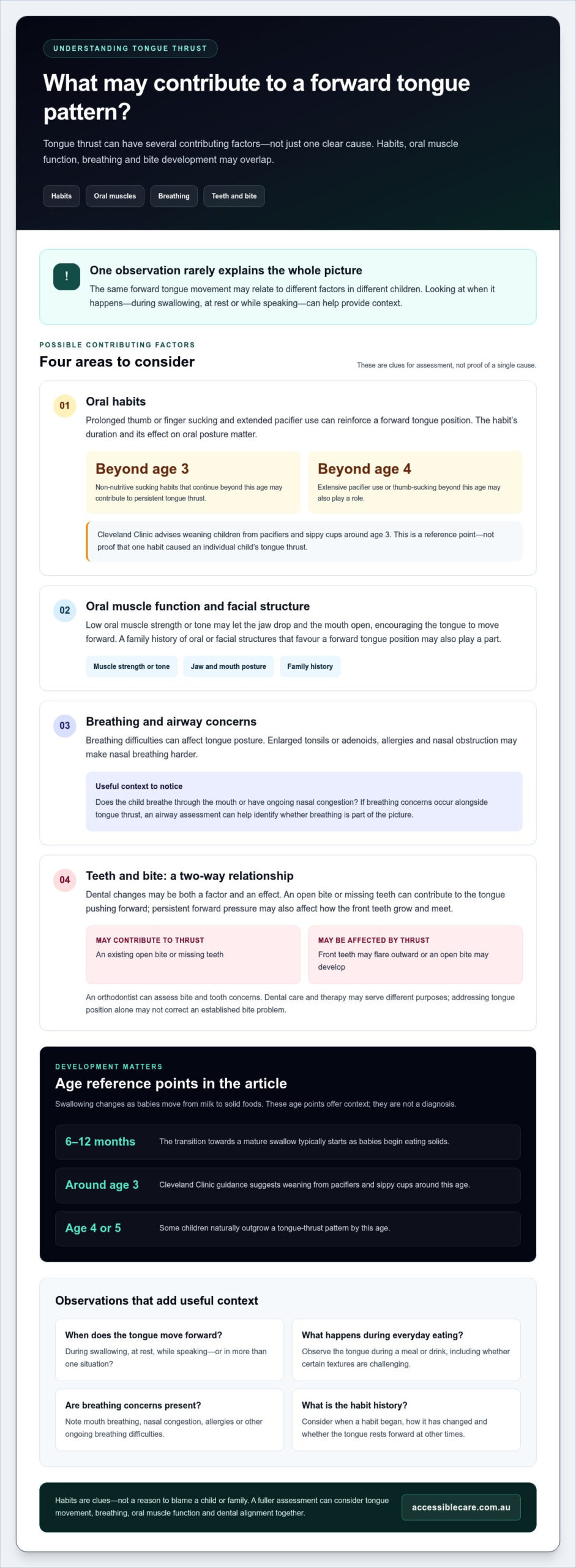
Tongue thrust can have several contributing factors rather than one clear cause. Looking at habits, oral muscle function and breathing can help explain why a child’s tongue moves forward.
Possible Causes
Low oral muscle strength or tone may let the jaw drop and the mouth open, encouraging the tongue to move forward. A family history of oral or facial structures that favour a forward tongue position may also play a part. These factors can overlap, so observing how a child rests, breathes and swallows provides useful context.
Breathing difficulties can affect tongue posture, too. Enlarged tonsils or adenoids, allergies and nasal obstruction may contribute by making nasal breathing harder. If these concerns occur alongside tongue thrust, an airway assessment can help identify whether breathing is part of the picture.
Contributing Habits
Prolonged thumb or finger sucking and extended pacifier use can reinforce a forward tongue position. Non-nutritive sucking habits that continue beyond age 3 may contribute to persistent tongue thrust; extensive pacifier use or thumb-sucking beyond age 4 may also play a role. The habit’s duration and its effect on oral posture matter more than simply noticing that a child has used a pacifier.
Cleveland Clinic advises weaning children from pacifiers and sippy cups around age 3. This guidance provides a reference point for families reviewing habits, but it doesn’t establish that a single habit caused an individual child’s tongue thrust. Consider the child’s overall pattern, including how often the habit occurs and whether the tongue rests forward at other times.
Babies begin developing new swallowing patterns as they move towards solid foods. If forward tongue movement continues beyond the expected transition, the pattern may reflect more than a feeding habit. Oral muscle function, breathing and facial structure can all interact with swallowing, so one observed behaviour rarely explains the whole picture.
A practical way to notice possible contributing factors is to consider when the tongue moves forward. Does it happen mainly during swallowing, or also when the child is resting or speaking? Does the child breathe through the mouth or have ongoing nasal congestion? These observations can help distinguish a repeated habit from a pattern that may involve airway or muscle factors.
Contributing habits are not a reason to blame a child or family. They are clues that help shape a fuller assessment. A clear account of when a habit began, how it has changed, and whether allergies or nasal obstruction are present can help professionals understand what may be causing or maintaining the forward movement.
Tongue thrust definition and swallowing pattern
Swallowing changes as babies move from milk to solid foods. Tongue position, tooth contact and oral muscle coordination help distinguish an early pattern from a more mature swallow.
Development of the Swallowing Reflex
A tongue-thrust pattern is normal in infants, and swallowing develops alongside feeding. The transition towards a mature swallow typically starts when babies begin eating solids between 6 and 12 months. Introducing solids supports changes in how the tongue moves food around the mouth.
That transition takes time. Some descriptions place the start around 4 to 6 months, as solids are introduced, with molar contact appearing in a mature swallow around 24 to 36+ months. Children are expected to move towards a more mature pattern by age four, though some forward movement can remain normal in young toddlers.
The tongue-thrust reflex should diminish by ages 4-6. These milestones help explain why age and feeding stage matter when observing a child’s swallow. A forward movement in a baby has a different developmental context from a persistent pattern in an older child.
Tongue Placement and Swallowing Exercises
In a mature resting posture, the lips and teeth are closed, with the tongue tip resting against the ridge behind the upper front teeth. During swallowing, the tongue should move food backwards rather than pushing forward between the teeth. This placement supports coordinated movement during everyday eating and drinking.
Myofunctional exercises may practise tongue movement during swallowing and help establish a resting position. For example, a clinician may guide a child to notice where the tongue tip rests, then practise moving it during a swallow. The activity should suit the child’s needs and ability to follow the movement.
Repeated practice matters because a familiar tongue pattern can be hard to retrain. Exercises can be incorporated into daily routines, such as practising a specific movement during a suitable meal or drink. The goal is coordinated function, not simply holding the tongue in one position.
Swallowing Difficulties
Tongue thrust describes a movement pattern, but it doesn’t automatically mean a child has difficulty swallowing. Some children eat and drink without obvious problems, while others may show effort or unusual tongue movement during a meal. Observing how the tongue handles food and liquid provides useful context.
For example, notice whether the tongue pushes forward when the child swallows water or manages a different food texture. A speech pathologist can assess swallowing alongside speech and oral movement. This broader view helps distinguish a persistent pattern from age-appropriate changes as a child develops.
Swallowing involves coordinated movement, not tongue position alone. The lips, jaw and tongue work together as food moves through the mouth, and molar contact is one feature of a mature pattern. A child’s feeding stage, oral posture and movement during an actual swallow all help describe how this coordination is developing.
When forward movement persists, the key question is how it affects function. A clinician may observe the child at rest, during speech and while swallowing. Comparing these situations can show whether tongue position changes with the task or remains forward across different activities.
Age provides another important point of comparison. A toddler beginning solids has different swallowing experience from a child past age four, when a more mature pattern is expected. These developmental markers guide assessment without treating every early tongue movement as a problem.
Tongue thrust and speech sound production
Tongue position helps shape speech sounds, so forward movement can influence how some sounds are produced. The key is not simply seeing the tongue move, but noticing whether its placement changes a sound. For example, an interdental lisp can make “s” or “z” sound more like “th.” This connection gives families a useful reason to observe speech closely.
Children with tongue thrust may also have difficulty producing “sh” and “j.” These sounds need controlled tongue placement, and an outward movement can alter how they sound. Listen for patterns across familiar words, such as “sun,” “zoo,” “shoe” and “jam.” A speech pathologist can assess whether the child’s tongue position relates to the sound difference.
Speech and swallowing patterns can overlap, but one doesn’t automatically explain the other. A child may show forward tongue movement during eating, speech, or both. Assessment considers what happens during each activity, including whether breathing, resting posture or oral movement also affects tongue placement. This helps clarify which communication needs therapy should address.
Speech therapy can target both the tongue-thrust habit and affected sounds. A speech pathologist may work on tongue strength, coordination and range of movement, then practise specific sounds in words. For instance, a child might first practise a target sound on its own, then use it in a familiar word. The focus is accurate, functional speech, not simply keeping the tongue back.
Practice can become part of everyday routines as a child learns a new sound. A family might reinforce a therapist-selected word during a book, conversation or play activity. Creative, play-based tasks can keep children involved and offer repeated opportunities to practise. Activities should match the sound being targeted and the child’s current speech skills.
Some children need support with speech sounds, while others need attention to tongue movement during swallowing or feeding. A speech-language pathologist can evaluate whether speech therapy, myofunctional therapy, or both are appropriate. This distinction matters because sound practice alone may not address tongue position during eating, and movement exercises alone may not teach a child a new sound.
Families can make their observations useful by noting which sounds are unclear and when the tongue moves forward. A short list of examples, such as difficulty with “s” in several words, gives an assessment a practical starting point. Speech therapy for tongue thrust can then be shaped around the child’s communication goals, speech patterns and oral movement.
How do I find an Australian speech pathologist experienced in orofacial myofunctional therapy?
Look for a speech pathologist who assesses tongue movement during speech and swallowing, not just speech sounds. A useful assessment considers the person’s goals and daily experiences, such as unclear “s” sounds, a forward tongue position at rest, or visible tongue movement while drinking.
Orofacial myofunctional therapy focuses on the muscles and movements of the mouth and face. For tongue thrust, relevant experience includes assessing resting tongue posture, lip closure, swallowing movement and oral coordination. Speech therapy for tongue thrust may also address sounds affected by tongue placement, so clarify whether communication goals are part of the assessment.
A practical way to understand a clinician’s approach is to look for these features in their service information and care process:
- Assessment across activities: They consider tongue position at rest, during speech and while swallowing.
- Individual goals: They connect observations to the person’s priorities, such as clearer speech or more coordinated swallowing.
- Relevant therapy methods: They can explain how movement exercises, sound practice or both relate to the person’s needs.
- Everyday practice: They show how suitable activities can fit into daily routines for repeated practice.
These points help distinguish a narrow focus on one speech sound from a broader look at tongue function. For example, a child who says “th” for “s” may need sound practice, while forward tongue movement during swallowing may call for a broader assessment. A speech pathologist can evaluate whether speech therapy, myofunctional therapy, or both are appropriate.
Dental and health factors may also shape the next steps. An open bite or other tooth alignment concern calls for dental consideration, while allergies or nasal obstruction may make breathing relevant to tongue posture. A speech pathologist’s assessment can identify concerns that need coordinated attention, rather than treating every tongue movement as a speech issue.
Before an appointment, note examples that describe the concern: which sounds are unclear, when the tongue moves forward, and whether eating or breathing seems affected. These observations give the assessment a clear starting point and help keep therapy goals connected to everyday communication and function.
For support with communication goals, explore speech therapy support and discuss how assessment can reflect the person’s needs.
Accessible Care: NDIS Support Services
Accessible Care offers Speech Therapy for people seeking support with communication concerns, including speech patterns affected by tongue movement. If tongue thrust makes certain sounds difficult or affects everyday communication, speech therapy can help identify relevant goals and support practice suited to the person.
Accessible Care also provides NDIS Support Services, alongside Occupational Therapy and Positive Behaviour Support. These supports may be relevant when a person has broader needs alongside speech goals. The next step is to share what you’ve noticed, such as unclear sounds or tongue movement while speaking, and discuss support that fits the person’s priorities.
For a thoughtful conversation about support, contact Accessible Care.
Choose a Supportive Next Step
Noticing a speech or swallowing pattern is a useful starting point. Share what you’ve observed and describe what matters most to the person, whether that’s feeling more confident speaking or communicating more clearly in everyday situations. Those priorities can help shape a considered conversation about support.
Speech therapy for tongue thrust can be part of a broader support plan when communication goals connect with other daily needs. Accessible Care offers Speech Therapy, Occupational Therapy and NDIS Support Services, with support shaped around the person’s needs and goals.
You don’t need to have every answer before reaching out. A conversation can help you explain your concerns, ask about support options and identify a practical way forward. Contact Accessible Care to discuss your needs.
Each person’s goals are their own. With attentive support, they can take the next step at a pace that feels right for them.
Frequently Asked Questions
When Should I Speak with a Speech Pathologist?
Speak with a speech pathologist if a child’s speech is difficult to understand, or tongue movement seems to affect communication. For example, note whether “s” sounds consistently come out like “th,” and whether this happens in familiar words as well as new ones. A brief record of examples can help describe your concern. Children aged four or older with suspected tongue thrust should also visit a paediatrician or dentist.
What is tongue thrust and how can it affect speech and swallowing?
Tongue thrust is a pattern in which the tongue pushes against or between the teeth during activities such as speaking and swallowing. For speech, this placement can affect sounds such as “s” and “z.” During meals, forward movement may be visible as the tongue moves food or liquid. The pattern’s effects differ between people, so observations during conversation and eating can help show where support may be useful.
How can a speech pathologist assess tongue thrust in Australia?
A speech pathologist can observe tongue position at rest, during conversation and during a swallowing task. They may listen for sound patterns, such as a lisp, and ask about communication or eating concerns. Families can bring examples of words that are hard to understand and describe when the tongue moves forward. If tooth alignment or breathing concerns are also present, those observations help inform the broader picture.
What speech therapy exercises are used to treat tongue thrust?
Exercises depend on the person’s speech and oral movement goals. A session may include practising a target sound, such as “s,” first by itself and then in words, or activities that build tongue coordination and movement. Some tasks can be practised through play or everyday routines. A speech pathologist chooses exercises based on assessment, because repeating an unsuitable movement won’t address the specific sound or function being targeted.
How long does speech therapy for tongue thrust usually take?
There isn’t one fixed duration for everyone. The time involved depends on the person’s goals, the speech or swallowing patterns being addressed, and how consistently practice fits into daily routines. A plan may also change as skills develop or other contributing concerns need attention. Ask how progress will be reviewed and what signs will show that a person is ready to move from practising sounds to using them in everyday conversation.
How much does tongue thrust speech therapy cost in Australia?
The cost depends on the individual’s needs and is provided after a quote request. Factors include the type and complexity of assessment, the therapy approach, session format and amount of support involved. If you’re comparing possible costs, distinguish assessment from ongoing therapy and ask what each quoted service covers. No general industry price should be taken as Accessible Care’s fee for speech therapy.
Does Medicare, private health insurance or the NDIS cover speech therapy for tongue thrust in Australia?
Funding depends on the person’s circumstances, the relevant scheme’s eligibility rules and the purpose of the support. For NDIS funding, consider whether speech therapy relates to the participant’s disability support needs and plan. Medicare and private health insurance have their own conditions, which can differ by individual eligibility and policy. Review the relevant plan or policy wording to understand what applies to your situation.
Is speech therapy alone effective for tongue thrust, or is dental or orthodontic treatment also needed?
Speech therapy can address speech sounds and tongue movement, while dental or orthodontic care addresses tooth and bite concerns. If a child has an open bite, missing teeth or other alignment issues, dental assessment matters alongside communication goals. A speech pathologist can evaluate whether speech therapy, myofunctional therapy or both suit the observed pattern. The right combination depends on the needs being addressed, not on tongue movement alone.

