


NDIS support worker hourly rates for 2026 depend on the support provided and when it takes place; the NDIS Pricing Schedule sets different price limits for weekday, weekend and public holiday support. The 2026-27 schedule took effect on 1 July 2026. These limits are not the same as a worker’s minimum pay under the SCHADS Award.
It’s understandable to want a clear figure when planning support. The amount can vary by day and time, while a worker’s Award rate also depends on their classification and employment type. Casual loading and penalty rates affect wages, but the NDIS price limit and a worker’s pay are not interchangeable.
This guide explains how the 2026-27 limits relate to SCHADS minimum wages, casual loading and penalties across weekdays, weekends and public holidays. It also clarifies why the support type and time of service matter when understanding the figures.
Key Takeaways
- Learn what an NDIS price limit represents and how it relates to the amount charged for a support session.
- See how worker classification and casual employment affect minimum pay under the SCHADS Award.
- Understand how Saturday, Sunday and public holiday penalties change pay calculations.
- Use the day-and-time rate breakdown to make sense of which support category applies to a service.
NDIS Support Worker Pay: What Is the Hourly Rate?
For 2026-27, standard self-care support has different NDIS price limits by time and day. These limits describe provider charges, not the support worker’s wage.
Provider Charges and Price Limits
An NDIS price limit sets the maximum charge for a support item, not a worker’s take-home pay.
Provider travel may be claimed for up to 30 minutes per session at the applicable support rate. This answers the travel part of the question; the limit depends on the support category and time. Activity-based transport should be understood separately from the hourly support amount, so the service arrangement matters.
Price Limits Versus Worker Wages
The price limit covers a provider’s charge for delivering support, while the SCHADS Award sets minimum employee wages. For a SACS Level 2 pay point 1 full-time or part-time worker, the minimum weekday daytime wage is A$36.22 per hour, according to the Fair Work Ombudsman.
The difference is not automatically the provider’s profit. A provider charge and a worker wage are separate amounts, and employment costs and service delivery sit between them. A casual worker’s pay also includes a 25% loading in lieu of paid leave, which affects wages rather than changing the NDIS price limit.
Weekend and Public Holiday Price Limits
These figures show how the maximum charge varies by service day.
It should not be compared directly with an hourly wage. Matching the support item and timing helps explain the amount charged and how it differs from a worker’s penalty-based pay.
SCHADS Award minimum wages and casual loading
The SCHADS Award sets minimum employee wages. The applicable rate depends on classification, employment type and when the work is performed. These wage rules are separate from NDIS support price limits.
Minimum Wages and Pay Rates
The Award minimum is the lowest hourly wage that applies to an employee’s classification and work arrangement. For a SACS Level 2 pay point 1 full-time or part-time worker, the minimum weekday daytime wage is A$36.22 per hour, according to the Fair Work Ombudsman.
This gives participants useful context when distinguishing a disability support worker’s wage from a provider’s charge. Modern award wage rates increased by 4.75%, effective from 1 July 2026. The SCHADS Award covers social, community, home care and disability support roles.
Award Classification Levels
Award classifications organise roles according to their duties and responsibilities. A worker’s correct classification helps determine their minimum hourly rate, so the title “support worker” alone does not establish their pay.
Standard, high-intensity and specialised support describe different support requirements or service categories; they do not automatically determine an employee’s Award level. The NDIS price limit for a support item and a worker’s SCHADS classification answer different questions. Higher support intensity may affect the applicable NDIS item, while employee pay still follows the relevant Award classification and work conditions.
Casual Loading and Penalty Rates
Casual employees receive a 25% loading in lieu of paid leave under the SCHADS Award. For casual social and community services employees working ordinary Saturday hours, the rate is 175% of the ordinary hourly rate; casual Sunday work is paid at 225%.
For comparison, permanent employees receive 200% of the ordinary hourly rate for Sunday work. Public holiday work has a minimum penalty rate of 250% of the ordinary base rate for full-time or part-time SACS Level 2 pay point 1 employees. Employment type and the day worked both affect the calculation.
Calculating Rates Under the Award
To understand an hourly wage, identify the worker’s Award classification, employment type and shift timing. Relevant penalty rates or casual loading affect the base rate. These factors determine employee pay, not the NDIS price limit.
For example, weekday, Saturday and Sunday base rates differ, and casual loading is separate from weekend penalties. Start with the applicable classification and shift conditions to calculate pay, not the support item’s NDIS cap. This keeps Award wages separate from participant charges.
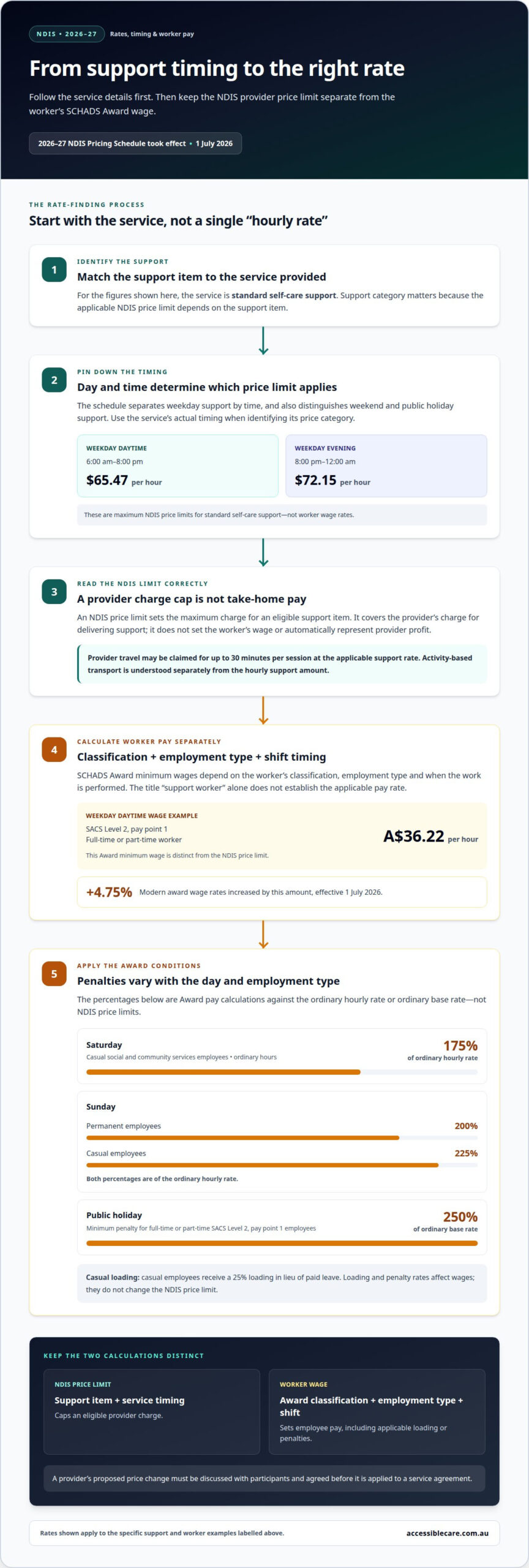
Saturday, Sunday and public holiday penalties
Weekend and public holiday support can affect both worker pay and NDIS pricing, but the amounts follow separate rules. The SCHADS Award sets employee penalty rates; NDIS price limits cap eligible support charges.
Saturday Penalty Rates
Under the SCHADS Award, ordinary Saturday hours for casual social and community services employees are paid at 175% of the ordinary hourly rate. Permanent Saturday wages use a different calculation, so employment type matters when interpreting a worker’s pay.
For NDIS pricing, the service category matters too. The worker’s penalty rate does not determine the participant’s price limit.
Sunday Penalty Rates
Under the SCHADS Award, Sunday work is paid at 200% of the ordinary hourly rate for permanent employees and 225% for casual employees. That distinction shows why a single “weekend rate” can’t describe every worker’s pay.
This cap applies to the provider’s charge for the support item, not the worker’s Sunday wage. To compare like with like, separate the NDIS service category from the employee’s Award classification and employment type.
These amounts describe different things, even when they relate to the same assistance. NDIS providers must discuss proposed price changes with participants and obtain agreement before applying them to a service agreement. Consider the day, support item and agreement when reviewing holiday pricing.
2026-27 NDIS support worker rates by time and day
In Australia, the NDIS Pricing Schedule took effect on 1 July 2026. Standard self-care price limits vary by weekday time, weekend or public holiday, and these caps are not worker pay rates.
For standard self-care support in 2026-27, the maximum hourly amounts are:
- Weekday daytime (6:00 am to 8:00 pm): $65.47 per hour
- Weekday evening (8:00 pm to 12:00 am): $72.15 per hour
- Weekday night (12:00 am to 6:00 am): $73.30 per hour
- Saturday: $91.95 per hour
- Sunday: $118.43 per hour
- Public Holiday: $144.91 per hour
These figures apply to standard assistance with self-care activities through providers like Accessible Care. The applicable price limit can also vary by location.
Agency, employee and independent contractor arrangements describe different ways of organising and paying for support. An employee’s pay depends on their Award classification, employment type and shift conditions. An agency arrangement involves a provider charge, while an independent contractor’s charge is set through their service arrangement. These amounts should not be confused with the NDIS price limit for a support item.
Use the schedule by matching the support type, time of day and location, then distinguish the applicable cap from the worker’s minimum pay rate. Support intensity can affect the relevant category, while weekday daytime and active night support have separate limits. This helps participants understand how scheduled assistance is priced.
Accessible Care: NDIS Support Services
Accessible Care can help you explore NDIS Support Services when planning support around your goals and daily life. If you need practical assistance, our support work can align with the arrangements discussed with you.
For communication or everyday activity goals, Accessible Care also offers Speech Therapy and Occupational Therapy. These services address different goals from support work. Identifying what you want help with can guide a conversation about suitable supports.
Knowing how price limits and worker pay differ can make support planning clearer, but the right service also needs to fit your priorities. Accessible Care can discuss its NDIS support options with you. Contact Accessible Care to talk about your support needs.
Shape support around the life you want
Understanding NDIS support worker hourly rates for 2026 is one part of planning. Your next step is to connect the support arrangement with what matters in everyday life, such as greater independence, participation or communication. A budget becomes more useful when it reflects personal priorities, not just a roster of hours.
Accessible Care offers NDIS Support Services, Speech Therapy and Occupational Therapy. These services can address different goals, from practical assistance to communication and everyday activities. Consider which outcomes matter to you, then discuss how the relevant support may fit your needs and NDIS plan.
You deserve to have a say in the support that shapes your days. For a conversation about your support needs and possible next steps, contact Accessible Care. Your goals can help guide a thoughtful discussion about the support that feels right for you.
Frequently Asked Questions
Are support worker pay rates the same in all states?
NDIS price limits and SCHADS Award minimum wages apply nationally, so the base rate for the same worker level does not change between Perth and Adelaide. Location can affect the service area classification: remote and very remote price limits can exceed metro limits. A worker’s Award classification and employment conditions still determine their wage, regardless of the state.
The Big Question: Why Does a Sunday Shift Cost the Participant Almost Twice as Much?
Sunday support can appear close to twice weekday daytime pricing because the NDIS maximum for standard self-care is higher on Sundays. That does not mean every Sunday booking is charged at the cap or that the support worker receives that amount. The participant’s charge follows the agreed service pricing, while the employee’s wage follows their Award classification, employment type and applicable penalties.
What Sits Between the Price Limit and Worker Pay?
The difference between a price limit and a worker’s wage isn’t automatically paid to the worker. A provider’s charge supports service delivery, while an employee receives Award pay and applicable entitlements. Superannuation is 12% from 1 July 2025, and employment arrangements can also involve leave costs, rostering and administration. These are distinct components, not an extra amount paid directly to the worker.
What about in remote locations?
Remote pricing is higher than metro pricing under NDIS location categories. MMM 6 remote areas have price limits 40% higher than metro rates, and MMM 7 very remote areas are 50% higher.
What else impacts support worker pay?
In addition to classification and casual status, shift timing and applicable Award allowances can affect a worker’s total pay. These allowances are separate from the hourly base wage and apply to relevant work circumstances, not every shift.
What are the NDIS support worker hourly rates for 2026-27?
These are maximum provider charges for that support category, not universal worker wage rates. The schedule took effect on 1 July 2026, and intensity or location can change which limit applies.

