


Navigating challenging behaviours at home can leave you feeling overwhelmed, isolated, and unsure of where to turn. You want to help, but you worry about making things worse, struggling to understand the needs your loved one is trying to communicate. If you’re searching for a kinder, more effective way forward, you are in the right place. This is where a positive and person-centred approach to behaviour support can transform your daily life, replacing stress with understanding and connection.
This compassionate guide is here to help. We will walk you through gentle, proven strategies designed to build trust and reduce distress. You will learn how to decode what behaviour is really communicating and how to respond in a way that supports your loved one’s dignity and goals. Our aim is to equip you with the confidence and tools to create a calmer, more predictable home environment-a place where everyone feels safe, heard, and empowered to thrive.
Key Takeaways
- Learn a compassionate approach that focuses on improving a person’s quality of life, not just managing difficult behaviours.
- View challenging behaviour as a form of communication, helping you to understand the unmet needs behind the action.
- See how a collaborative behaviour support plan acts as a practical roadmap, ensuring everyone provides consistent and compassionate care.
- You don’t have to navigate this journey alone; discover when and how to connect with a professional for expert guidance.
What is Positive Behaviour Support (and What It Isn’t)?
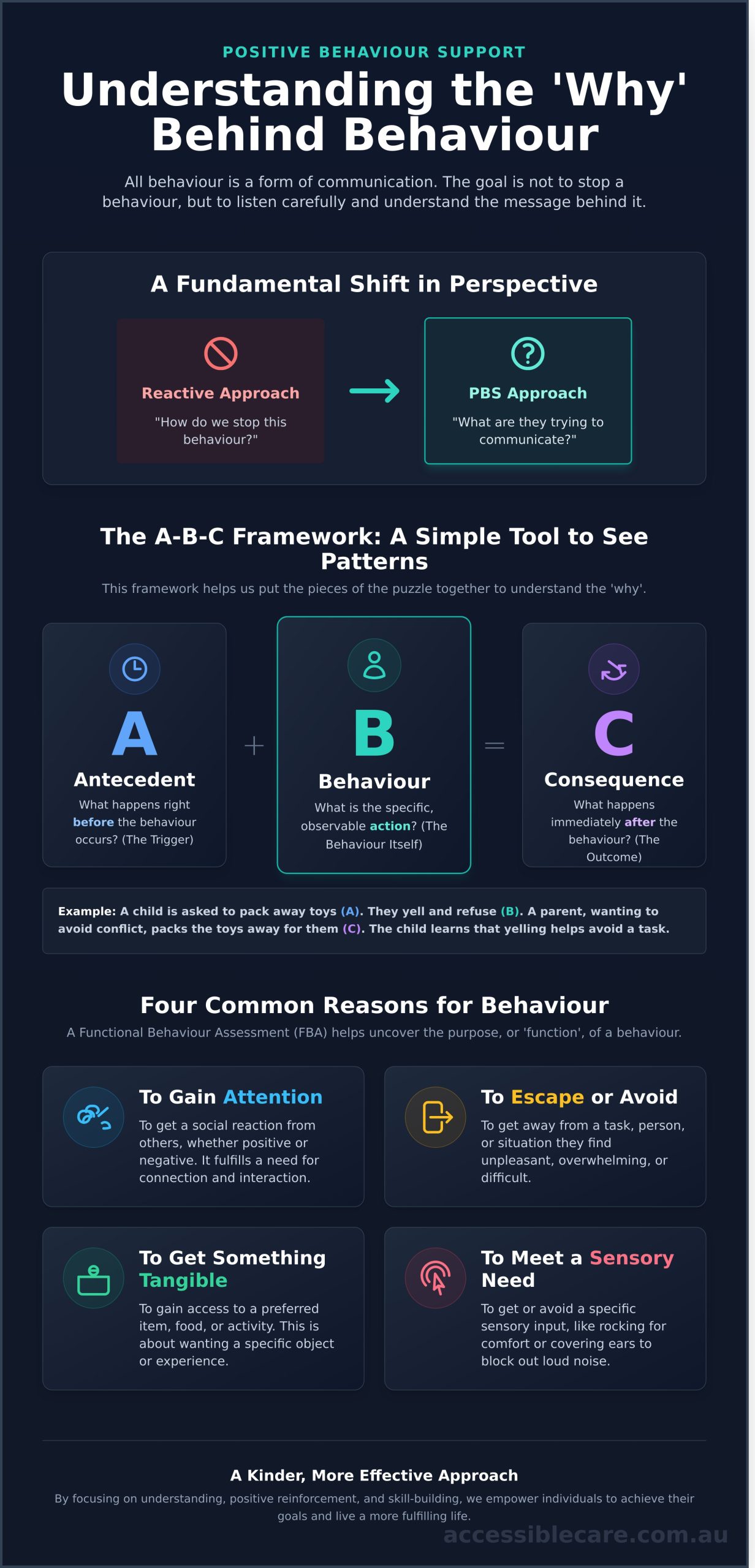
Positive Behaviour Support (PBS) is a compassionate and evidence-based framework designed to understand and support individuals, not just manage their actions. At its heart, it’s about improving a person’s quality of life. Instead of asking, “How do we stop this behaviour?”, we ask, “What is this person trying to communicate, and what do they need?” This person-centred approach ensures that every strategy is tailored with dignity and respect, focusing on the individual’s unique goals and needs. It moves away from outdated methods and focuses on creating positive, lasting change.
The Core Philosophy: Understanding, Not Just Managing
The goal of PBS isn’t simply to control behaviour; it’s to understand the reasons behind it. We believe that challenging behaviours are often a way of communicating an unmet need. This approach to behaviour support focuses on proactively building skills and creating a supportive environment where a person feels safe and understood. Rather than just reacting, we work to:
- Teach new, more effective ways to communicate needs and wants.
- Build positive, trusting relationships between participants and their support network.
- Create environments that promote well-being and reduce stress.
Moving Beyond Punishment: A Kinder, More Effective Approach
For a long time, many approaches relied on punishment or negative consequences. We now know these methods are often ineffective and can damage trust, increase anxiety, and harm a person’s self-worth. PBS is fundamentally different. For a deeper look into its framework, many find it helpful to ask, What is Positive Behaviour Support?, and discover its evidence-based roots. It is a long-term strategy for growth and happiness, grounded in compassion. By focusing on positive reinforcement and skill-building, we empower individuals to achieve their goals and live a more fulfilling life, secure in the knowledge that they are respected and heard.
Understanding the ‘Why’: All Behaviour is a Form of Communication
At the heart of Positive Behaviour Support (PBS) is a simple yet profound idea: all behaviour, especially behaviour that challenges us, is a form of communication. It’s not random or meaningless. Instead, it’s a person’s way of expressing a need, a want, or a feeling when they may not be able to use words. The goal of compassionate behaviour support is not to simply stop a behaviour, but to listen carefully and understand the message behind it.
By shifting our perspective from “how do we stop this?” to “what is this person trying to tell me?”, we can respond with empathy and create solutions that truly help. This approach respects the individual’s dignity and empowers them by meeting their underlying needs in a more positive and effective way.
What is a Functional Behaviour Assessment (FBA)?
A Functional Behaviour Assessment (FBA) is the respectful and collaborative process we use to understand the ‘why’. It’s not a test, but a way of gathering information by observing, talking with the person and their family, and identifying patterns. This professional process is a cornerstone of effective professional support for behaviour, ensuring that strategies are built on deep understanding, not guesswork. The insights gained from an FBA allow for a truly personalised support plan that addresses the root cause of the behaviour.
The A-B-C of Behaviour: A Simple Framework
To help identify patterns, support teams often use a simple A-B-C framework. It’s a straightforward tool that helps put the pieces of the puzzle together.
- A – Antecedent: What happens right before the behaviour occurs? (The trigger)
- B – Behaviour: What is the specific, observable action? (The behaviour itself)
- C – Consequence: What happens immediately after the behaviour? (The outcome)
For example: A child is asked to pack away their toys (Antecedent). They yell and refuse (Behaviour). A parent, wanting to avoid a bigger conflict, packs the toys away for them (Consequence). In this case, the child may learn that yelling is an effective way to avoid a task they dislike.
Common Reasons for Behaviours of Concern
An FBA helps uncover the purpose, or ‘function’, of a behaviour. While every person is unique, behaviours often serve one of four main purposes:
- To gain attention: To get a social reaction from others, whether positive or negative.
- To escape or avoid: To get away from a task, person, or situation they find unpleasant or overwhelming.
- To get something tangible: To gain access to a preferred item, food, or activity.
- To meet a sensory need: To get or avoid a specific sensory input, like rocking for comfort or covering ears to block noise.
Creating a Positive Behaviour Support Plan (BSP) for Home
A Positive Behaviour Support Plan (BSP) is more than just a document; it’s a compassionate roadmap designed to provide consistent and understanding care for your loved one. It’s built on a deep respect for the individual and is always created collaboratively with you and your family. The goal is to create a shared understanding of your loved one’s needs and agree on the most supportive ways to respond. The Association for Positive Behavior Support (APBS) offers valuable insights into Creating a Positive Behaviour Support Plan, emphasising its focus on improving quality of life through teaching new skills and creating supportive environments.
A strong plan focuses on proactive strategies, ensuring that the primary goal of your behaviour support is to prevent distress before it starts. It provides a clear, gentle framework that empowers everyone involved to provide care with confidence and empathy.
Proactive Strategies: Setting Your Loved One Up for Success
These strategies are the foundation of a BSP and are used before a behaviour occurs. The aim is to create a predictable and reassuring environment that reduces anxiety and makes your loved one feel safe and understood. Examples include:
- Modifying the environment: This could mean reducing sensory overload by dimming lights or creating a quiet, calm-down corner.
- Using visual schedules: Pictures or lists that show what will happen next can create predictability and ease transitions.
- Clear communication: Using simple language and allowing time for processing helps prevent misunderstanding and frustration.
Reactive Strategies: Responding with Calm and Care
When a challenging behaviour does occur, a BSP provides clear guidance on how to respond calmly and safely. The priority is always to de-escalate the situation while maintaining dignity and respect for the individual. These strategies are not about punishment, but about support. They might involve redirecting your loved one to a preferred activity, offering a simple choice to restore a sense of control, or providing quiet space to self-regulate.
Teaching New Skills: The Heart of the Plan
This is where long-term positive change happens. Instead of just managing behaviours, the focus shifts to teaching your loved one alternative ways to communicate their needs and feelings. This is the most empowering part of positive behaviour support. We can help them learn how to ask for a break when feeling overwhelmed, use communication aids to express their wants, or develop self-soothing techniques to manage difficult emotions, fostering greater independence and confidence.
When and How to Get Professional Support
Navigating behaviours of concern can be challenging, and it’s important to remember you don’t have to do it alone. Reaching out for professional help is a positive step towards creating a more peaceful and supportive home environment. But how do you know when it’s the right time?
Often, the time to seek support is when:
- Behaviours are becoming more frequent, intense, or pose a safety risk.
- Family stress levels are high, and it’s impacting everyone’s wellbeing.
- The strategies you’ve been using are no longer effective.
- You want a deeper understanding of the reasons behind the behaviour to create lasting change.
Seeking professional help can take many forms, including psychotherapy, which helps uncover the root causes of distress and builds healthier family dynamics. Though based in the UK, Jonathan Cullen Therapy provides a clear example of how dedicated counselling can help families navigate these challenges and foster better communication.
Exploring professional support can involve looking at various services. For instance, counselling and formal assessments can offer a broader understanding of mental health and provide additional coping mechanisms for the whole family. To see what this kind of support entails, you can learn more about WJW Counselling & Mediation.
Professional behaviour support doesn’t replace your efforts; it empowers them. It provides a structured, evidence-based framework that complements your love and deep understanding of your family member.
The Role of a Behaviour Support Practitioner
A Behaviour Support Practitioner is a qualified specialist dedicated to understanding the function of behaviour. They work collaboratively with you and your family to conduct a Functional Behaviour Assessment (FBA) to uncover the ‘why’ behind the actions. From there, they develop a person-centred plan and provide hands-on training and support to help you implement positive strategies effectively.
What to Expect When Working with Accessible Care
Our approach always begins with listening. We want to hear your story, understand your challenges, and learn about your goals for a better quality of life. We take a compassionate, team-based approach with your family at the very centre of everything we do. Our goal is to develop practical, easy-to-follow plans that fit into your real home life, empowering you with the confidence and skills to move forward. Talk to our compassionate behaviour support team today.
Using Your NDIS Funding for Behaviour Support
Positive Behaviour Support is funded through the National Disability Insurance Scheme (NDIS). If you are an NDIS participant, this support is typically funded under your ‘Capacity Building’ budget in the specific support category of ‘Improved Relationships’. We recommend checking your NDIS plan or speaking with your Support Coordinator or Local Area Coordinator (LAC) to see if you have funding allocated for this vital support.
Your Journey to a Calmer, More Connected Home
Embarking on the path of positive behaviour support is a profound act of love and commitment. As we’ve explored, the journey begins with understanding that all behaviour is a form of communication-an expression of an unmet need. By shifting from a reactive mindset to creating a proactive and compassionate plan, you build a foundation of trust and safety for your entire family.
Remember, you don’t have to navigate this journey alone. Seeking professional guidance is a sign of strength. At Accessible Care, our person-centred approach to behaviour support ensures that your family’s unique needs and goals are always at the forefront. As a registered NDIS provider with experienced Behaviour Support Practitioners in Melbourne and Adelaide, our dedicated team is here to listen, understand, and empower you with effective strategies.
Let us help you create a more peaceful and supportive home environment. Your choice, your life, your way.
Start your journey to a calmer home. Get in touch with our caring team.
Frequently Asked Questions About Behaviour Support
How long does it take for Positive Behaviour Support to work?
The journey with Positive Behaviour Support is unique for every person, so there is no set timeline. Progress depends on many factors, including the individual’s specific needs, their environment, and the consistency of the support team. It is a gradual process focused on building skills and improving quality of life, not a quick fix. We believe in celebrating small victories along the way, as these are the building blocks for lasting positive change.
Is Positive Behaviour Support only for people with autism?
While PBS is often associated with autism, it is a supportive framework that can help anyone, regardless of their diagnosis. It is a person-centred approach designed to understand the reasons behind a person’s actions. This compassionate method is effective for individuals with a wide range of disabilities who may use certain behaviours to communicate their needs. The focus is always on the individual, their dignity, and their unique circumstances.
What is a ‘restrictive practice’ and why is it a last resort?
A restrictive practice is any action that limits a person’s rights or freedom of movement. In line with Australia’s NDIS Quality and Safeguards Commission, these are always a last resort. Our primary focus is on proactive, positive strategies that uphold a person’s dignity and choice. Restrictive practices are only considered to prevent serious harm and must be used in the least restrictive way for the shortest time possible, with rigorous professional oversight.
Can I create a Behaviour Support Plan by myself without a professional?
Creating an effective Behaviour Support Plan requires specialised skills to understand why behaviours occur. A qualified PBS practitioner conducts a comprehensive assessment to develop a plan that is safe, respectful, and tailored to the individual. Under the NDIS, plans must be developed by a registered practitioner. Working with a professional ensures the plan is based on evidence and upholds the participant’s rights, leading to better, safer outcomes for everyone.
How is PBS different from other therapies like ABA?
While both approaches aim to support individuals, Positive Behaviour Support (PBS) has a different core focus. PBS is primarily concerned with understanding the reason, or ‘function,’ behind a behaviour and improving a person’s overall quality of life. The goal is to make challenging behaviours unnecessary by teaching new skills and creating more supportive environments. It’s a holistic approach that prioritises the individual’s needs, dignity, and long-term wellbeing.
What if the behaviour support plan isn’t working?
A behaviour support plan is a living document, and it’s normal for it to need adjustments. If you feel a plan isn’t working, the first step is to communicate with the support team and the PBS practitioner. A collaborative review can help identify what needs to change, such as re-assessing the reasons for the behaviour or trying new strategies. We are committed to listening and working together to ensure the support truly meets the person’s evolving needs.

