


At a bustling café last week, did you find yourself smiling and nodding, completely lost in the conversation around you? That overwhelming sense of ‘listening fatigue,’ the feeling of being a step behind, or the unfair labels of ‘lazy’ or ‘inattentive’ are all too common for many people. It’s an exhausting and often isolating experience that can leave you questioning yourself.
You’re not alone, and it’s not a reflection of your intelligence or your effort. This guide is here to offer the validation and clarity you deserve. We promise to help you understand the true neurological nature of auditory processing disorder (APD) and show you that there is a compassionate, supportive path forward. Together, we’ll demystify how the brain processes sound and provide a clear roadmap for accessing dedicated, NDIS-funded therapy and support right here in Melbourne and Adelaide, empowering you to find your voice in every conversation.
Key Takeaways
- Understand the crucial difference between ‘hearing’ and ‘listening’ to see why a standard hearing test can miss the signs of APD.
- Learn to identify the common signs of auditory processing disorder in your loved ones, from classroom challenges to difficulties in conversation.
- Discover how to distinguish the symptoms of APD from similar conditions like ADHD to ensure you pursue the right support pathway.
- Find a clear, step-by-step guide to navigating the NDIS in 2026 to access compassionate and effective therapy for APD.
Understanding Auditory Processing Disorder (APD): When the Brain Can’t Hear
Has your child passed a standard hearing test with flying colours, yet still struggles to follow conversations in a noisy classroom? Do they often ask “what?” or seem to mishear instructions? You’re not imagining it, and it’s a frustration shared by many families. This experience is often the first sign of an auditory processing disorder (APD), a condition that isn’t about the ears’ ability to detect sound, but about the brain’s ability to interpret it.
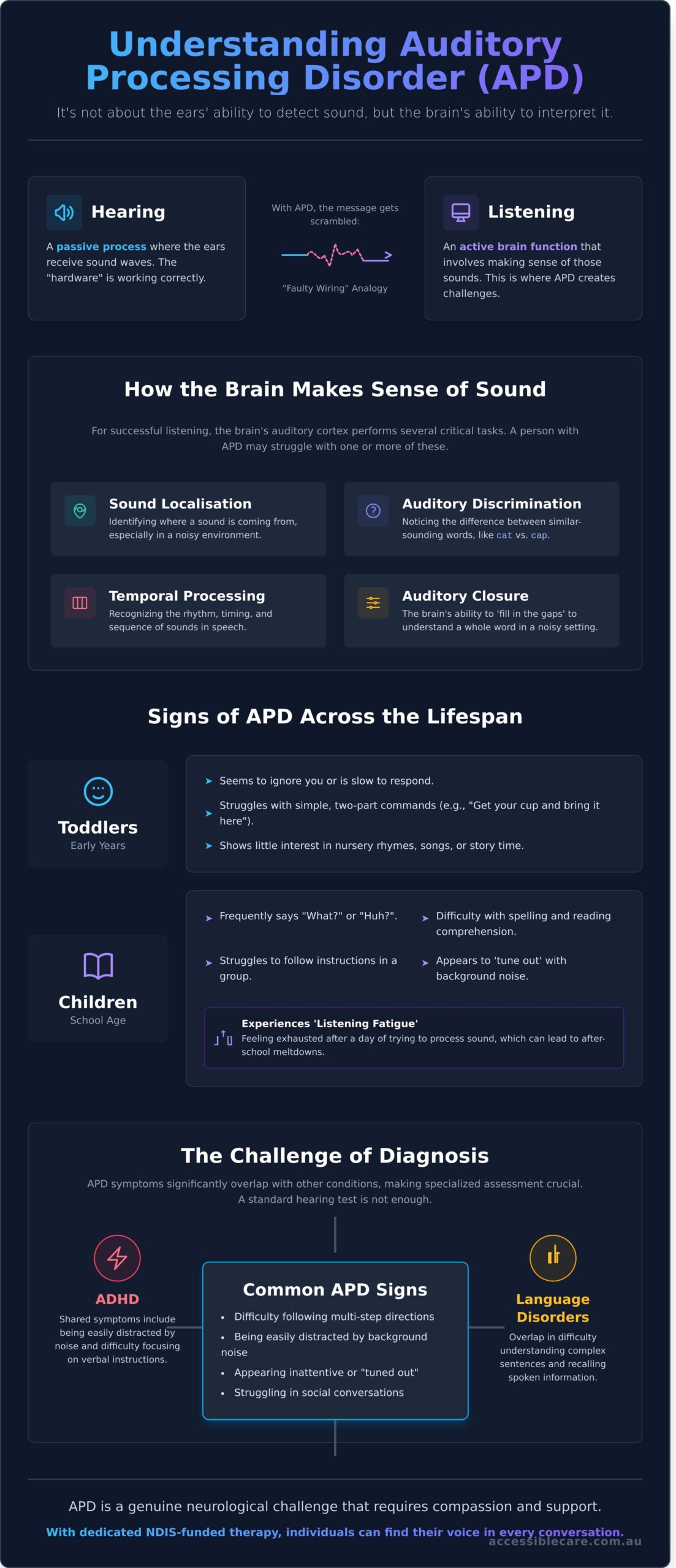
The key is understanding the difference between hearing and listening. Hearing is a passive process where the ears receive sound waves. Listening is an active brain function that involves making sense of those sounds. For a child with APD, the sound gets in perfectly, but the brain scrambles the message along the way. Think of it like a clear radio signal being sent to a radio with faulty wiring; the information arrives, but it’s distorted and hard to understand.
This “invisible” disability can take a significant emotional toll. A child with APD might be incorrectly labelled as inattentive, defiant, or having behavioural problems. They may feel isolated or frustrated, knowing they are trying their best but still can’t keep up. It’s vital to remember that APD is not a reflection of a child’s intelligence or their willingness to cooperate. It’s a genuine neurological challenge that requires compassion, support, and the right strategies to manage.
How the Brain Processes Sound
When sound enters the outer ear, it travels a complex path to the brain’s primary auditory cortex to be processed. This journey involves several critical tasks that allow us to understand what we hear. Key among them are:
- Sound Localisation: Identifying where a sound is coming from.
- Auditory Discrimination: Noticing the difference between similar-sounding words, like cat and cap.
- Temporal Processing: Recognising the rhythm, timing, and sequence of sounds in speech.
A crucial part of this is auditory closure, which is the brain’s ability to fill in missing speech gaps to understand a whole word or sentence in a noisy environment.
Why APD is Often Misdiagnosed
One of the biggest hurdles for families is getting an accurate diagnosis. The symptoms of an auditory processing disorder, such as difficulty following multi-step directions and being easily distracted by background noise, significantly overlap with conditions like ADHD, language disorders, and cognitive delays. A comprehensive look at What is Auditory Processing Disorder? shows just how complex these neurological processes are. Because a standard hearing test only checks the ear’s function, it cannot identify a processing issue in the brain. A specialised assessment by an audiologist who focuses on APD is essential. A person-centred approach that listens to your concerns is the first step toward clarity and effective support for your child.
Signs and Symptoms Across the Lifespan: From Toddlers to Adults
Auditory Processing Disorder (APD) isn’t a one-size-fits-all condition. Its challenges can look very different in a noisy playground than in a quiet office, and they evolve as a person grows. Understanding these signs at each stage of life is the first step toward providing compassionate and effective support. From a toddler struggling with simple songs to an adult feeling lost in conversation, the core issue remains the same: the brain isn’t making sense of what the ears hear.
In the earliest years, you might notice subtle signs. A toddler with APD may seem to ignore you or have trouble following simple, two-part commands like, “Please get your teddy and put it in the box.” They might not enjoy nursery rhymes or show little interest in story time, as they struggle to process the rhythm and sounds of language. These early difficulties can be mistaken for defiance or inattention, but they often point to a deeper processing challenge.
APD in Children and Early Childhood
As children enter preschool and kindergarten, APD can directly affect their reading readiness. The ability to hear the distinct sounds in words, known as phonological awareness, is a crucial building block for literacy. Many children also experience ‘listening fatigue’ after a long day of trying to filter out classroom noise, leading to unexplained after-school meltdowns. For families in Melbourne and Adelaide seeking guidance, our dedicated paediatric therapy services offer tailored support to help build these foundational skills.
Once in primary school, the classroom environment can become overwhelming. A child with APD may:
- Frequently say “What?” or “Huh?”
- Struggle to follow instructions given in a group setting.
- Have difficulty with spelling and reading comprehension.
- Seem to ‘tune out’ when there’s background noise, like other children talking or a fan running.
This difficulty in filtering and interpreting sound is a core challenge of auditory processing disorder, a condition where the brain struggles to make sense of what the ears hear perfectly well. It’s not a hearing problem; it’s a processing problem.
Adult APD and Acquired Neurological Conditions
In adulthood, APD can manifest as social and professional hurdles. An adult may find it hard to understand sarcasm or the punchline of a joke, misinterpret a speaker’s tone, or feel exhausted after fast-paced workplace meetings. For some, these symptoms only appear later in life following an Acquired Brain Injury (ABI), such as a stroke or traumatic brain injury, which can disrupt the brain’s existing neural pathways for processing sound. This can lead to social anxiety as individuals begin to avoid conversations they find difficult to follow. Rebuilding these skills with support from adult speech pathology can empower individuals to regain confidence in their communication.
APD vs. ADHD and Autism: Distinguishing Processing Challenges
Does your child sometimes seem to ignore you, only to be fully engaged a moment later? Do they struggle to follow instructions in a busy classroom? As a parent, it can be confusing and disheartening when you see your child having a hard time listening. Often, the behaviours associated with Auditory Processing Disorder (APD) can look very similar to those seen in Attention-Deficit/Hyperactivity Disorder (ADHD) and Autism Spectrum Disorder (ASD). This significant overlap is why these conditions often co-exist, a factor known as comorbidity.
Understanding the difference is crucial. While the resulting behaviour might be the same, such as not responding when called, the root cause is very different. Is your child struggling because their attention has drifted, because the sound is physically overwhelming, or because their brain simply isn’t decoding the words correctly? Teasing these challenges apart is the first step toward finding the right support that honours your child’s unique needs.
The Link with ADHD
The confusion between APD and ADHD is one of the most common hurdles for families. A child with ADHD may struggle to listen because their focus is pulled in many directions. A child with APD, however, might be trying their best to listen, but their brain can’t make sense of the sounds it receives. To put it simply, ADHD can affect the brain’s ‘filter’ for distractions, while an auditory processing disorder affects the clarity of the ‘signal’ itself. This is why medication for ADHD may improve focus but won’t solve the underlying auditory decoding issue.
Sensory Processing and Autism
For autistic individuals, sensory processing differences are very common. Sounds might be experienced as painfully loud (hypersensitivity) or unusually muted (hyposensitivity). This can mimic APD symptoms but stems from a different challenge. An Occupational Therapist plays a vital role here, helping participants manage auditory hypersensitivity with strategies like noise-cancelling headphones or creating quiet spaces. At the same time, a Positive Behaviour Support (PBS) plan can help manage the frustration that comes from miscommunication, empowering participants to choose communication environments where they feel safe and understood.
Because these conditions can present so similarly, a single assessment is rarely enough to get a clear picture. A comprehensive, multidisciplinary assessment is essential to understand exactly what your child is experiencing. This collaborative team often includes:
- An Audiologist to conduct specific tests and diagnose APD.
- A Speech Pathologist to evaluate language and communication skills.
- A Psychologist or Paediatrician to assess for ADHD or Autism.
- An Occupational Therapist to look at sensory processing challenges.
Working with a dedicated team ensures that every aspect of your child’s wellbeing is considered. A thorough assessment is the foundation for developing a plan for holistic therapy for APD and any co-existing conditions. Getting the right diagnosis isn’t about finding a label; it’s about unlocking the tailored support your child needs to connect, learn, and thrive with confidence.
Navigating the NDIS Pathway for APD Support in 2026
For many parents, securing NDIS funding for an auditory processing disorder can feel like a complex journey. But with the right preparation, it’s a pathway you can navigate with confidence. The key isn’t just proving a diagnosis; it’s about clearly showing how APD impacts your child’s ability to participate in daily life. Here is a clear, four-step guide to help you prepare your NDIS application for 2026.
Your journey begins with a formal diagnosis from a specialized audiologist who has experience with APD. This is your foundational medical evidence. From there, the focus shifts from the diagnosis itself to its real-world impact. You’ll need to secure a comprehensive assessment of your child’s abilities, link their challenges to specific life goals, and finally, choose a dedicated provider to deliver the support they need.
The Role of Functional Capacity Assessments
A Functional Capacity Assessment (FCA) is one of the most powerful tools in your NDIS application. It’s a detailed report, usually completed by an Occupational Therapist, that translates your child’s APD diagnosis into practical, everyday challenges. For instance, it documents how difficulty filtering background noise prevents your child from participating in group conversations at school, or how trouble following multi-step instructions impacts their ability to complete tasks independently at home. This report is your primary evidence of ‘reduced functional capacity’.
For NDIS planning meetings in 2026, a strong FCA report completed within the last 12 months is essential. It must clearly outline the functional limitations and recommend specific, funded supports to address them. At Accessible Care, our person-centred approach ensures assessments capture the complete picture of your child’s strengths and challenges, giving the NDIS a clear rationale for funding. Learn more about our compassionate Functional Capacity Assessments and how we can support your application.
Funding and Support Categories
Understanding NDIS funding categories helps you advocate effectively for your child. For an auditory processing disorder, supports typically fall under ‘Capacity Building’. This category is designed to help participants build skills and independence. Your goal is to show how specific therapies will achieve this.
- Speech Pathology: You can advocate for this by linking it to goals like “improving my ability to understand my teacher in a noisy classroom” or “building confidence to speak with friends at birthday parties.”
- Occupational Therapy (OT): Frame this support around goals like “learning strategies to manage sensory overload in shopping centres” or “developing routines to complete homework without becoming overwhelmed.”
Having a multidisciplinary team that works together provides the most holistic support. A good team, including therapists and a Support Coordinator, ensures your child’s NDIS plan is managed effectively. When choosing providers in Melbourne or Adelaide, look for those with demonstrated experience in APD and a commitment to working collaboratively to help your child achieve their goals. Your choice, your life, your way.
Holistic Therapy: How Speech and Occupational Therapy Transform Lives
Receiving a diagnosis for your child can feel overwhelming, but it’s also the first step on a path toward understanding and empowerment. Holistic therapy for auditory processing disorder isn’t about “fixing” a problem; it’s about providing your child with a personalised toolkit to navigate the world with confidence. By combining the expertise of speech pathologists and occupational therapists, we can create a supportive environment where your child can truly thrive.
This journey is a partnership. It involves building new skills, adapting environments, and using smart technology to make listening easier. At Accessible Care, we are committed to a person-centred approach that honours your child’s unique strengths and challenges, always focusing on their dignity, respect, and growing independence.
Rewiring the Brain: Auditory Training
A skilled speech pathologist works to strengthen the brain’s ability to interpret sound. This is achieved through targeted, evidence-based exercises that improve key auditory skills. For example, auditory training can enhance phonemic awareness, which is the ability to distinguish between similar-sounding words like “coat” and “boat.” Programs like Fast ForWord have demonstrated in studies published in journals such as Brain and Language that they can improve auditory processing speed by an average of 30% in just a few months.
Beyond exercises, therapy focuses on developing ‘meta-cognitive’ strategies, or the ability to ‘think about listening.’ This means teaching your child practical skills like:
- Asking for clarification when they miss something.
- Predicting what might be said next in a conversation.
- Learning to find a quieter spot in a noisy room to focus.
These strategies are developed in compassionate, one-on-one sessions where your child feels safe and understood. This trusting relationship is the foundation for building not just auditory skills, but also self-esteem and resilience.
Environmental and Sensory Support
Occupational therapy plays a crucial role by addressing how your child’s environment and sensory system impact their ability to process sound. An occupational therapist can help you make simple yet powerful modifications at home and advocate for changes at school. This might include adding soft furnishings like rugs and curtains to reduce echo or creating a quiet, dedicated homework nook free from distractions. At school, solutions as simple as placing tennis balls on the legs of chairs can reduce background noise by up to 10 decibels.
Therapists also use sensory integration techniques to help your child’s nervous system manage sensory input more effectively. Activities like swinging, using a weighted blanket, or jumping on a trampoline can have a profound calming and organising effect, making it easier for them to cope with auditory overload. This support builds resilience from the inside out. Are you ready to explore how tailored support can make a difference for your family? Get in touch with our compassionate team today.
Assistive technology provides another layer of powerful support. A Frequency Modulation (FM) system, for instance, is a game-changer in the classroom. The teacher wears a small microphone, and their voice is transmitted directly to your child’s headphones, cutting through background noise. This can improve the clarity of a teacher’s voice by 15-20 decibels, making it much easier to follow instructions. For overwhelming situations like shopping centres or school events, noise-cancelling headphones can provide an instant sense of calm and control.
At Accessible Care, we understand that managing an auditory processing disorder is a collaborative journey. Our dedicated team is here to listen to your needs and work with you to create a support plan that empowers your child to live the life they choose. It’s your choice, your life, your way.
Your Path Forward: Navigating APD with Confidence
Understanding that an auditory processing disorder is a neurological challenge, not a hearing problem, is the first crucial step toward empowerment. The journey ahead can feel complex, but it’s important to remember you’re not alone and that targeted support makes a profound difference. By combining holistic strategies from speech and occupational therapy with a clear understanding of the 2026 NDIS pathway, individuals and families can confidently navigate APD and unlock a world of clearer communication and connection.
If you’re ready to take the next step, Accessible Care is here to help. As a registered NDIS provider, our compassionate, multidisciplinary team in Melbourne and Adelaide is dedicated to your well-being. Our experienced Speech Language Pathologists listen to your unique needs to create a person-centred plan that builds skills and fosters independence. We are committed to helping you achieve your goals, your way.
Empower your journey with compassionate NDIS support. Contact Accessible Care today.
Frequently Asked Questions About Auditory Processing Disorder
Is Auditory Processing Disorder considered a disability under the NDIS?
Yes, Auditory Processing Disorder (APD) can be considered a disability under the NDIS if it results in a permanent and significant functional impairment. An NDIS application requires comprehensive reports from a qualified audiologist detailing how APD impacts daily life activities like communication and learning. It’s often diagnosed alongside a primary disability, such as Autism Spectrum Disorder (ASD), which can strengthen an access request.
Can Auditory Processing Disorder be cured, or is it lifelong?
Auditory Processing Disorder is a lifelong condition, and there is no known cure. However, its impact can be significantly managed with the right support and strategies. Through targeted therapies like speech pathology and auditory training, individuals can build new skills and develop effective coping mechanisms. Our focus is on empowering individuals to thrive by managing their symptoms and building confidence in their abilities.
What is the difference between a hearing test and an APD assessment?
A standard hearing test checks if the ears can detect sounds at different pitches and volumes. In contrast, an APD assessment evaluates what the brain does with that sound. A person can pass a hearing test perfectly yet still have APD. The specialised assessment, performed by an audiologist, uses complex listening tasks to see how the brain processes speech in noise, identifies sound patterns, and distinguishes between similar-sounding words.
How do I know if my child has APD or just isn’t listening?
This is a common and understandable question for parents, and a professional assessment is the only way to be certain. A key sign of APD is inconsistency; your child might follow directions perfectly in a quiet room but seem completely lost in a noisy classroom. They may also frequently mishear words or ask “what?” a lot. If you see a persistent pattern of listening difficulty despite normal hearing, it’s a good reason to seek an expert opinion.
What types of assistive technology help with APD at school or work?
The most effective assistive technology for APD is a Remote Microphone (RM) system, also known as an FM system. This simple device dramatically improves the clarity of a speaker’s voice. A teacher or colleague wears a small microphone, which sends their voice directly to a discreet receiver or headphones worn by the person with APD. This technology cuts through distracting background noise, making it much easier to focus and understand.
Does Accessible Care provide APD therapy in both Melbourne and Adelaide?
Yes, our dedicated and compassionate teams at Accessible Care provide tailored APD therapy and support services across both Melbourne and Adelaide. We believe in a person-centred approach, listening to your needs and creating a support plan that empowers you or your child. Our local professionals are ready to help you navigate your journey with skill and understanding. Please reach out to connect with your local Accessible Care team.
Can an adult be diagnosed with APD for the first time?
Absolutely. It’s quite common for adults to be diagnosed with APD for the first time after a lifetime of unexplained challenges. Many have unknowingly developed coping strategies to get by, often feeling they were just “bad listeners” or “daydreamers.” Receiving a diagnosis as an adult can be incredibly validating. It provides clarity and opens the door to targeted support that can improve communication in their careers and personal lives.
How much does NDIS-funded speech therapy for APD cost?
If you have an NDIS plan, there are no out-of-pocket costs for speech therapy sessions funded through your plan. The service is paid for directly from your NDIS funding in line with the official NDIS Pricing Arrangements and Price Limits. For the 2023-2024 period, the standard rate for a Speech Pathologist is $193.99 per hour. Our team can help you understand your plan and how to best use your funding for support.

