


As a parent, noticing your child might need a little extra support can feel overwhelming. Suddenly, you’re faced with a world of questions, confusing systems, and deep worries about their future. It’s easy to feel lost, isolated, or concerned about your child being ‘labelled’. We understand, and we want you to know that you are not alone on this journey.
This is where early childhood early intervention (ECEI) can make all the difference, transforming uncertainty into confident action. It’s not about labels; it’s about providing caring, personalised support to help your child thrive. In this compassionate guide for 2026, we will gently walk you through what ECEI is, why it’s so vital for development, and how to access trusted support in Melbourne and Adelaide. Our goal is to give you clarity, hope, and a simple path forward, so you feel empowered to take the next best step for your child.
Key Takeaways
- Understand what ECEI is: It’s specialised, play-based support designed to help children under 9 build a strong foundation for learning and life.
- Discover why acting early matters: A young child’s brain is incredibly adaptable, and the right support can make a lifelong positive impact on their development.
- Learn the clear steps to access support: Our guide demystifies the NDIS Early Childhood Approach, the main pathway for early childhood early intervention in Melbourne and Adelaide.
- See what therapy looks like in practice: For a child, effective therapy feels like guided play, creating a positive and empowering experience for your whole family.
What is Early Childhood Early Intervention (ECEI)? A Hopeful Start
We understand that noticing your child might need extra support can be a confusing and emotional time. You may have questions and feel uncertain about the future. Please know that you are not alone, and taking the first step to learn more is a powerful act of love. This is where the hopeful journey of early childhood early intervention begins.
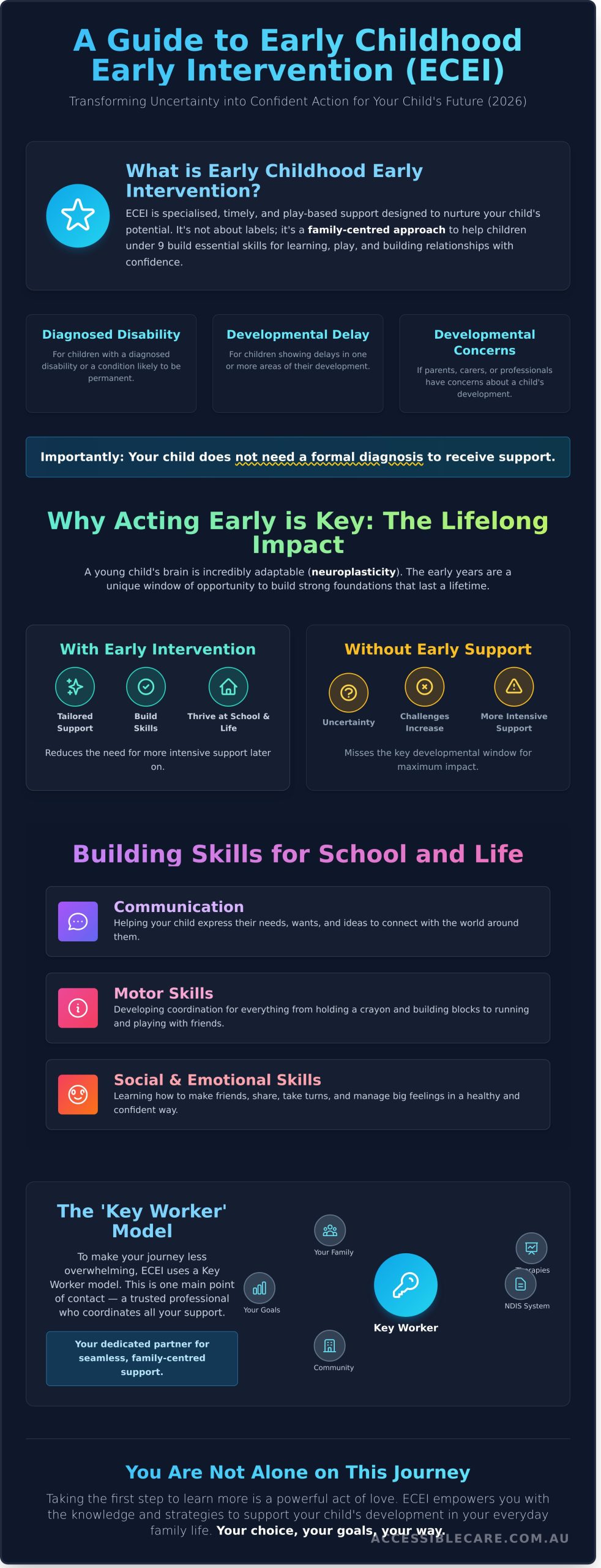
In simple, compassionate terms, early childhood early intervention is specialised, timely support for children under the age of 9 who have a developmental delay or disability. The goal is not to “fix” your child, but to nurture their potential. It’s about providing the right therapies and supports to help them develop the essential skills they need to learn, play, and build relationships with confidence and independence. This approach, which you can learn more about in this overview of What is Early Childhood Intervention (ECEI)?, is designed to give children the best possible start in life.
Crucially, this is a family-centred approach. You are the expert on your child, and we are here to be your partner. We listen to your goals and concerns, empowering you with the knowledge and strategies to support your child’s development in your everyday family life. Your choice, your goals, your way.
Who is ECEI for?
The NDIS Early Childhood Approach is designed to provide support as early as possible. It is for children from birth to their ninth birthday who:
- Have a diagnosed disability or a condition that is likely to result in a permanent disability.
- Have a developmental delay.
- Have parents, carers, or professionals who have concerns about their development.
Importantly, your child does not need a formal diagnosis to receive support through this approach.
The ‘Key Worker’ Model Explained
To make your journey less overwhelming, the ECEI approach often uses a ‘Key Worker’ model. This means your family will have one main point of contact-a trusted, skilled professional who gets to know you and your child. This person coordinates all the different therapies and supports, answers your questions, and helps you navigate the system with clarity and confidence. They are your dedicated partner, ensuring your support is seamless and centred around your family’s needs.
Why Acting Early is Key: The Lifelong Impact of ECEI
As a parent, you know your child best. When you feel something might be different, acting on that instinct is one of the most powerful things you can do. A young child’s brain is incredibly adaptable, a concept known as neuroplasticity. This means the early years are a unique window of opportunity to build strong foundations for learning and wellbeing that will last a lifetime.
This is the core principle behind early childhood early intervention (ECEI). By providing tailored support during these formative years, we can help your child develop essential skills, often reducing the need for more intensive support later on. It’s about giving them the best possible start to thrive at school, in the community, and throughout their life, while also supporting your family’s wellbeing.
Building Skills for School and Life
The goal of ECEI is to help your child participate meaningfully in everyday life. We work with you and your child to build foundational skills in a way that feels like play, focusing on key areas:
- Communication: Helping your child express their needs, wants, and ideas, and connect with the world around them.
- Motor Skills: Developing the coordination needed for everything from holding a crayon and building blocks to running and playing with friends.
- Social & Emotional Skills: Learning how to make friends, share, take turns, and manage big feelings in a healthy and confident way.
Empowering Parents and Caregivers
We believe that support for your child means support for your whole family. The ECEI approach is not about clinical appointments; it’s about weaving practical strategies into your daily routines at home and in the community. Our compassionate team listens to your family’s needs, providing you with practical tools and a better understanding of what ECEI looks like in practice. This partnership builds your confidence, reduces family stress, and connects you with a strong support network. You are your child’s first and most important teacher, and our role is to empower you on that journey.
What ECEI Looks Like in Practice: A Guide to Therapies
The idea of therapy can feel overwhelming, but early childhood early intervention is designed to be gentle, supportive, and empowering for your family. The most important thing to remember is that for your child, therapy should feel like guided play. Our compassionate therapists work in the places your child feels most comfortable-at home, childcare, or kindergarten-using their everyday activities and interests to build new skills.
Often, your child’s support will be a team effort. A multidisciplinary team, which might include an Occupational Therapist, a Speech Pathologist, and a Behaviour Support Practitioner, works together. This holistic approach ensures all areas of your child’s development are considered, creating a tailored plan that truly supports their individual needs and goals.
Paediatric Occupational Therapy (OT)
An Occupational Therapist (OT) helps children participate in the important ‘jobs’ of daily life, such as playing with friends, learning at kindergarten, and developing self-care skills like dressing. A session might look like playing on a swing to support sensory integration or using fun games and craft activities to build fine motor skills. It’s all about empowering your child with confidence and independence in their daily routines.
Learn more in our comprehensive Paediatric Occupational Therapy in Adelaide guide.
Paediatric Speech Pathology
A Speech Pathologist supports all facets of communication, from understanding instructions to expressing thoughts and interacting socially. They use engaging, play-based activities to help your child grow. This could involve reading picture books to build vocabulary, singing songs to practice sentence structures, or playing turn-taking games to develop conversational skills in a fun, natural way.
Explore how we can help with our NDIS Speech Therapist in Melbourne services.
Positive Behaviour Support (PBS)
Positive Behaviour Support focuses on understanding the reasons behind challenging behaviours, rather than just the behaviours themselves. A practitioner works with your family to identify a child’s needs and teaches them new, positive ways to communicate them. This is a proactive and compassionate approach-not a form of punishment-that builds skills and confidence, ensuring your child feels heard, understood, and supported.
Your First Steps: How to Access ECEI Support in Melbourne & Adelaide
Taking the first step towards getting support for your child can feel overwhelming, but we are here to guide you. The main pathway for early childhood early intervention in Australia is through the NDIS Early Childhood Approach. The reassuring news is you don’t need a formal diagnosis to begin the conversation, and support can often be provided while you wait for full NDIS access. Here is a simple, clear guide to help you get started.
Step 1: Talk to an NDIS Early Childhood Partner
Think of an NDIS Early Childhood Partner as the warm and welcoming front door to support for children under 9. They are experienced professionals who will listen to your concerns with compassion and guide you through the process. Your first step is to connect with the partner in your local area.
You can find your nearest partner using the official NDIS Partner Finder tool. During your first conversation, they will gently ask about:
- Your child’s name, age, and where you live
- Your main concerns about your child’s development
- Any existing reports you might have (it’s okay if you don’t)
Step 2: Understanding Your Child’s Needs
After your initial chat, the Early Childhood Partner will arrange a meeting with you. This is a collaborative discussion where they work with you to understand your child’s strengths, needs, and your family’s goals. Together, you will explore what a good life looks like for your child and what support might help them thrive. This process may lead to short-term support directly from the partner or assistance in developing a full NDIS plan if your child has more comprehensive needs.
Step 3: Choosing Your Providers
If your child becomes an NDIS participant, you gain choice and control over the providers you work with. Finding the right team is key to successful outcomes. When looking for a provider, consider their experience, their compassionate approach, and whether they feel like a good fit for your family. You deserve a partner who listens and respects your role as the expert on your child.
Our dedicated team in Melbourne and Adelaide is here to help you navigate this process with care and dignity. We believe in empowering you to make the best choices for your child. Your choice, your life, your way.
How Accessible Care Partners with Your Family on the ECEI Journey
Navigating the NDIS can feel overwhelming, but you don’t have to do it alone. At Accessible Care, our approach is built on a simple, powerful promise: to be your trusted partner. We believe in a family-centred philosophy, where your voice is heard, your choices are respected, and your child’s well-being is at the heart of everything we do. Our goal is to empower your family with the right support and strategies, helping your child to learn, grow, and thrive.
With deep expertise and dedicated local teams in Melbourne and Adelaide, we provide compassionate, professional support that is tailored to your unique circumstances. We are here to walk alongside you on every step of this important journey.
A Team That Listens and Cares
We begin by listening. Our first priority is to take the time to understand your family’s story, your goals, and the unique strengths of your child. Our experienced team of allied health professionals includes:
- Occupational Therapists
- Speech Pathologists
- Positive Behaviour Support Practitioners
Working collaboratively with you, we develop practical and effective strategies that fit seamlessly into your daily life. We understand that successful early childhood early intervention is built on a foundation of trust and genuine partnership. We are committed to celebrating every milestone with you, big and small, providing encouragement and expert guidance along the way.
Ready to Take the Next Step?
Reaching out for support is a positive and powerful step forward for your child and family. It’s a sign of strength, and our compassionate team is here to make the process as simple and reassuring as possible. We are ready to answer your questions and discuss how we can support your child’s development.
If you are in Melbourne or Adelaide and looking for a dedicated partner in early childhood early intervention, we invite you to get in touch.
- Melbourne Team: Call us on 1800 555 123 or email info@accessiblecare.com.au
- Adelaide Team: Call us on 1800 777 456 or email info.sa@accessiblecare.com.au
Your child’s future is bright, and with the right support, they can achieve wonderful things. Contact Accessible Care today, and let’s work together to unlock their full potential.
Your Family’s ECEI Journey Starts Here
Navigating the path of early childhood early intervention is a journey of hope, and your proactive steps today can shape a brighter, more confident future for your child. The key is to remember that early support has a profound, lifelong impact, and that a dedicated team is ready to walk alongside your family. You are not alone, and every question you ask is a step in the right direction.
At Accessible Care, our compassionate, family-centred approach is at the heart of everything we do. As a registered NDIS provider with a team of experienced paediatric therapists in Melbourne and Adelaide, we are committed to listening to your story and understanding your goals. We partner with you to create a supportive plan that empowers your child to thrive.
When you are ready to take the next step, we are here to help. Talk to our caring team about your child’s needs and discover how we can support your family on this important journey.
Frequently Asked Questions
What is the difference between Early Childhood Intervention and the NDIS?
Think of it this way: the NDIS is the government scheme that provides funding for people with a disability, while Early Childhood Intervention is the name for the specialised supports that help young children. The NDIS Early Childhood Approach is simply the pathway for children younger than 9 to access this vital support. It’s designed to be a caring and family-centred way to get your child the help they need to thrive.
At what age does Early Childhood Early Intervention stop?
The NDIS Early Childhood Approach provides support for children from birth until their 9th birthday. It’s designed to give children and families dedicated support during these crucial early years. As your child gets closer to turning nine, your Early Childhood Partner will help you and your family with the process of transitioning to other supports if needed, ensuring a smooth and supportive journey continues.
Do I need a doctor’s referral to access ECEI services?
No, you do not need a doctor’s referral to get started. If you have any concerns about your child’s development, you have the choice to contact an NDIS Early Childhood Partner in your area directly. These partners are there to listen to your concerns, understand your child’s needs, and guide you through the next steps in a compassionate and respectful way. You are your child’s greatest advocate, and you can initiate this process yourself.
What if my child doesn’t get an NDIS plan? Can they still get support?
Yes, absolutely. Even if your child is not eligible for an NDIS plan, they can still receive valuable support. Your NDIS Early Childhood Partner is dedicated to helping all families who reach out. They can connect you with other wonderful community and mainstream services, such as local health services, playgroups, or family support organisations. You are not alone, and there is a community of care available to you.
How much does Early Childhood Early Intervention cost?
If your child is eligible for the NDIS, the funding for their approved early childhood early intervention supports is covered by their NDIS plan. This means there are no out-of-pocket costs for the therapies and services included in the plan. The initial support from an NDIS Early Childhood Partner to understand your child’s needs and determine the best pathway forward is also provided at no cost to your family.
What is a developmental delay?
A developmental delay means a child is taking longer to reach certain developmental milestones compared to other children their age. These milestones could be related to how they move (like sitting or walking), communicate (like talking), learn, or socialise with others. Every child develops at their own unique pace, and a delay is simply an indicator that they may benefit from some extra support to build their skills and confidence.
How can I support my child’s development at home?
Supporting your child’s development can be woven into your everyday life through simple, loving activities. Things like playing on the floor together, reading books, singing songs, and talking about your day all make a huge difference. Your Early Childhood Partner can give you personalised strategies that turn daily routines, like bath time or meals, into fun learning opportunities that empower both you and your child.

