


Watching a loved one struggle with communication can be a deeply worrying experience. When you add the complexities of clinical terms and navigating the NDIS, the search for the right support can feel overwhelming. The simple search for a compassionate speech therapist near me can quickly become a journey filled with questions and uncertainty. You might be wondering: Who can I trust? How does NDIS funding work for speech therapy? And how do I know I’m making the right choice for my family?
We understand. This guide is here to bring clarity and confidence to your search. We will walk you through what to look for in a skilled, person-centred speech therapist in Melbourne and Adelaide, break down the NDIS process into simple steps, and empower you to find the respectful care your loved one deserves. Your journey to better communication starts with feeling supported and understood, and that’s exactly where we’ll begin.
Key Takeaways
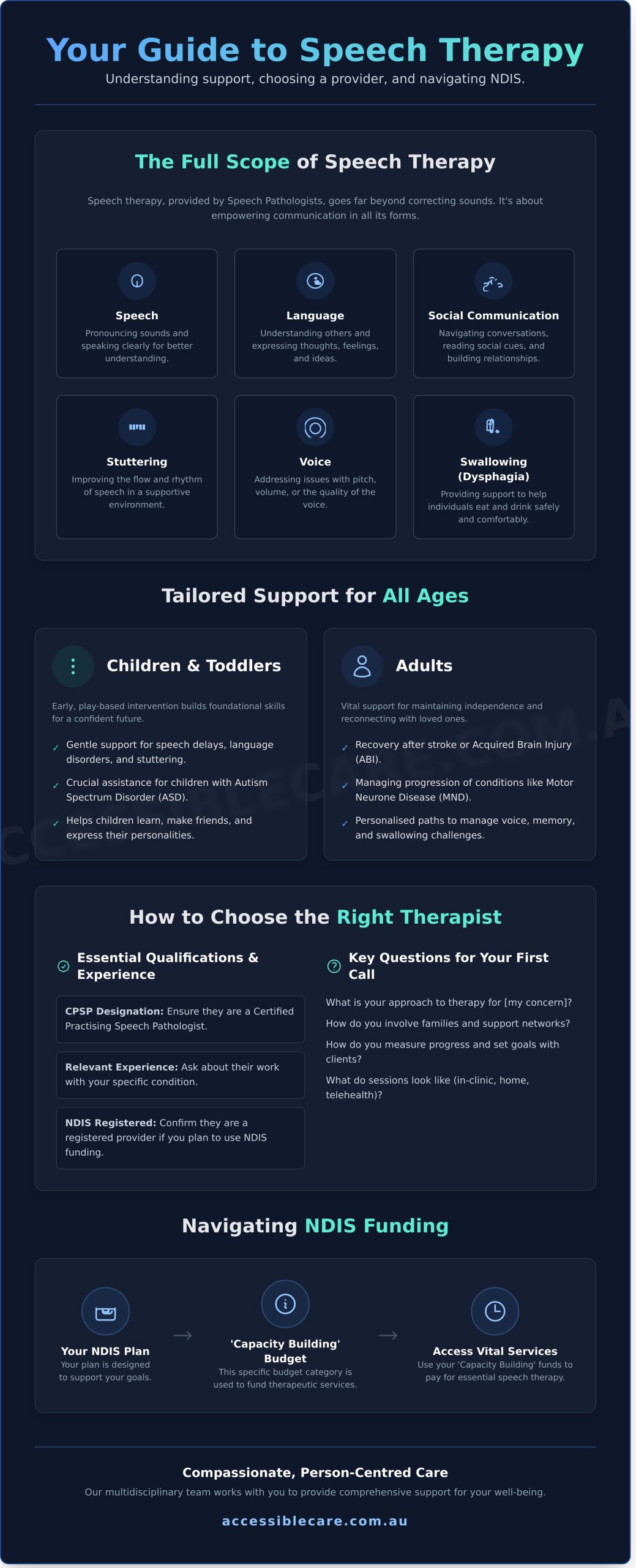
- Understand the full scope of speech therapy, which goes beyond speech sounds to include language, social communication, and swallowing support.
- Access a simple checklist of questions to ask potential providers, helping you find a therapist who is the right fit for your family’s unique needs.
- Demystify NDIS funding by learning how your ‘Capacity Building’ budget can be used to access vital speech therapy services.
- Learn the key benefits of working with a local speech therapist near me in Melbourne or Adelaide for consistent, high-quality care.
What Does a Speech Therapist Do and Who Can They Help?
Taking the first step to find support for communication challenges can feel overwhelming, but it’s a positive and powerful decision. At its heart, speech therapy is about helping people of all ages find their voice, communicate with confidence, and connect with the world around them. It’s a journey of empowerment, guided by a compassionate professional dedicated to your goals.
Many people think speech therapy is only about correcting how we say certain sounds, but its scope is much broader. In Australia, these dedicated professionals are often called Speech Pathologists. Understanding what speech-language pathology is reveals how they provide tailored support across many areas of life. When you start looking for a speech therapist near me, you’re seeking a partner who can help with:
- Speech: Pronouncing sounds and speaking clearly so others can understand.
- Language: Both understanding what is said to you and expressing your own thoughts, feelings, and ideas.
- Social Communication: Navigating conversations, understanding non-verbal cues, and building relationships.
- Stuttering: Improving the flow and rhythm of speech in a supportive, gentle way.
- Voice: Addressing issues with pitch, volume, or the quality of your voice.
- Swallowing (Dysphagia): Helping you eat and drink safely and comfortably.
Support for Children and Toddlers
For children, early intervention can make a world of difference. A speech therapist provides gentle, play-based support for challenges like speech delays, language disorders, and stuttering. They also offer crucial assistance for children with developmental conditions such as Autism Spectrum Disorder (ASD), helping them build the foundational skills needed to learn, make friends, and express their unique personalities with confidence.
Support for Adults
Communication is central to our independence and relationships. For adults, therapy can be a vital step in recovery after a stroke, an acquired brain injury (ABI), or with the progression of neurological conditions like Motor Neurone Disease (MND). A skilled therapist can help you manage challenges with voice, memory, and swallowing (dysphagia), creating a personalised path to help you regain skills and reconnect with your loved ones.
How to Choose the Right Speech Therapist for Your Needs
Once you have a list of potential providers, the next step is finding the perfect fit. The goal isn’t just to find any speech therapist near me, but the right one for you or your loved one. The most successful therapeutic relationships are built on a foundation of trust, respect, and a shared understanding of your goals. This is the heart of a person-centred approach-a partnership where your needs and aspirations guide every step of the journey, empowering you to achieve the best possible outcomes.
Essential Qualifications and Experience
Before you begin, it’s important to check a therapist’s credentials to ensure you are receiving high-quality, professional care. In Australia, always look for a Certified Practising Speech Pathologist (CPSP) designation. Don’t hesitate to ask about their specific experience with your condition, whether it’s for a child with autism or an adult recovering from a brain injury. If you plan to use NDIS funding, you must confirm they are a registered provider. You can learn more about how your plan can fund these services on the official NDIS website.
Key Questions to Ask During Your First Call
Your initial conversation is an opportunity to see if you feel comfortable and heard. A good therapist will welcome your questions and provide clear, reassuring answers. Being prepared helps you make an informed choice and find a supportive partner for your journey. Consider asking:
- What is your approach to therapy for [your specific condition or concern]?
- How do you involve families, carers, and support networks in the therapy process?
- How do you measure progress and set goals with your clients?
- What do your therapy sessions typically look like, and are they offered in-clinic, at home, or via telehealth?
Finally, consider the value of a multidisciplinary team. Communication challenges rarely exist in isolation. A truly supportive speech therapist near me often works alongside other professionals, like Occupational Therapists and Behaviour Support Practitioners. This holistic approach ensures all your needs are met in a coordinated way, providing comprehensive care that supports your overall well-being and independence.
Navigating NDIS Funding for Speech Therapy
One of the first questions we hear is, “How can I pay for this?” It’s a valid and important concern. We want to reassure you that for many Australians, speech therapy is a funded support through the National Disability Insurance Scheme (NDIS). As a dedicated NDIS provider, we are here to support you with compassion and clarity, helping you access the care you deserve.
Speech therapy is funded under the NDIS Capacity Building budget. This funding is designed to help you build skills, increase your independence, and achieve your personal goals. Our role is to partner with you, ensuring your therapy directly supports the goals outlined in your NDIS plan.
Understanding Your NDIS Plan
In your NDIS plan, funding for speech therapy is typically found under the ‘Improved Daily Living’ support category. Understanding how your funds are managed is key to accessing services smoothly. There are three ways your NDIS funds can be managed:
- Self-managed: You have the flexibility to choose any provider (registered or not) and pay them directly from your NDIS funds.
- Plan-managed: A plan manager handles the financial side for you, paying your providers from your NDIS plan on your behalf.
- NDIA-managed: The National Disability Insurance Agency (NDIA) pays your registered NDIS providers directly.
No matter how your plan is managed, it’s vital that your therapy goals align with your overall NDIS goals. For example, a therapy goal of improving communication skills can directly support an NDIS plan goal of building relationships or participating more in the community.
Our Simple Process for NDIS Participants
We believe in making your journey as straightforward and stress-free as possible. When you choose Accessible Care, our process is clear and person-centred:
- Initial Consultation: We begin with a warm and welcoming conversation to listen to your needs, understand your goals, and discuss how therapy can help.
- Service Agreement: We create a clear service agreement that outlines the proposed therapies, costs, and schedule. This ensures complete transparency before we begin.
- Therapy and Reporting: Once you are comfortable, we commence therapy. We provide regular updates and comprehensive reports to support you during your NDIS plan reviews, demonstrating progress towards your goals.
Finding the right support is a crucial first step. If you’re looking for a speech therapist near me and need guidance on using your NDIS plan, our compassionate team is here to help you navigate the process with confidence and care.
Finding Local Support: Speech Therapists in Melbourne & Adelaide
We understand that finding available, high-quality local care can feel overwhelming. When you search for a “speech therapist near me,” you’re looking for more than just a service; you’re looking for a trusted partner in your community. Choosing a provider with a dedicated local team means you get support from professionals who understand your area and can offer the flexibility of sessions in a clinic or the comfort of your own home.
At Accessible Care, we are proud to have compassionate, skilled teams on the ground in both Melbourne and Adelaide, ready to provide person-centred care that empowers you to achieve your goals.
Your Local Melbourne NDIS Speech Therapy Team
Our Melbourne team is comprised of experienced speech pathologists who specialise in both adult and paediatric therapy. We are dedicated to providing tailored support that addresses the unique needs of each participant. We proudly serve communities across Greater Melbourne, including:
- The Eastern Suburbs (including Ringwood and Box Hill)
- The Western Suburbs (such as Werribee and Sunshine)
- The Northern Suburbs (from Essendon to Craigieburn)
- The South-Eastern corridor (including Dandenong and Frankston)
If you are looking for a dedicated speech therapist near me in Melbourne, we are here to listen. Connect with our Melbourne team today to discuss how we can support you or your loved one.
Compassionate Speech Pathology in Adelaide
In Adelaide, our dedicated speech pathologists are deeply committed to supporting the South Australian community. We work closely with NDIS participants and their families to build confidence, improve communication skills, and enhance quality of life. Our approach is always centred on dignity, respect, and your personal goals, ensuring you feel heard and supported every step of the way.
For families across Adelaide seeking gentle and professional speech pathology, we’re here to help. We invite you to reach out for a warm, no-obligation chat with our Adelaide team to learn more about how we can make a positive difference.
Our Approach: Compassionate, Person-Centred Care at Accessible Care
At Accessible Care, our approach to speech therapy is guided by a simple yet powerful philosophy: Your choice, your life, your way. We understand that searching for a “speech therapist near me” is about finding more than just a provider; it’s about finding a genuine partner who listens, understands, and respects your unique journey. Our gentle, empathetic approach ensures that you and your family are always at the heart of every decision, creating a supportive space where you feel heard and valued from day one.
We are proud to have a dedicated team of experienced Speech Language Pathologists (SLPs) who combine deep clinical expertise with profound compassion. They are not just therapists; they are advocates committed to helping you or your loved one achieve communication goals, build confidence, and live a more connected and independent life.
What to Expect When You Work With Us
When you choose Accessible Care, you are choosing a partnership built on trust, dignity, and collaboration. We are dedicated to providing support that is truly person-centred. This means you can always expect:
- A team that truly listens: We take the time to understand your personal story, challenges, and aspirations before recommending any course of action.
- A tailored therapy plan: Your support plan is designed specifically around your individual needs and goals, never a one-size-fits-all solution.
- Collaborative support: We work closely with your family, support coordinators, and other allied health professionals to ensure holistic and consistent care.
Take the First Step Today
Reaching out for support is a positive and empowering decision. Taking that first step is the most important part of the process, and we are here to make it as simple and reassuring as possible. There is no pressure, only a friendly conversation waiting for you to explore your options.
If you’re ready to see how our compassionate approach can make a difference, we invite you to get in touch. Contact our friendly team in Melbourne or Adelaide to discuss your needs. Let’s start the conversation together.
Find Your Voice with the Right Support
The search for the right support can feel overwhelming, but it’s a hopeful and empowering journey. Remember that finding the best speech therapist near me is about more than qualifications; it’s about finding a partner who listens, understands your unique goals, and offers compassionate, person-centred care. By considering your specific needs and exploring funding pathways like the NDIS, you can confidently take the next step towards clearer communication and greater independence.
At Accessible Care, we are committed to being that partner for you. As a registered NDIS provider with a dedicated team of experienced Speech Language Pathologists serving Melbourne and Adelaide, our approach is built on respect, dignity, and choice. We believe in empowering you to live the life you choose. If you’re ready to find support that truly understands, we’re here to listen.
Talk to our caring team today to find the right support for you.
Frequently Asked Questions About Speech Therapy
Do I need a doctor’s referral to see a speech therapist in Australia?
No, you do not need a doctor’s referral to see a speech pathologist in a private practice in Australia. You can contact a clinic directly to book an assessment. However, if you wish to claim a rebate through Medicare, you will need a specific referral from your GP, such as a Chronic Disease Management (CDM) plan. We recommend discussing your options with your doctor to find the most supportive and cost-effective pathway for your care.
What are the first signs that my toddler might need speech therapy?
It can be worrying when you feel your child isn’t meeting their milestones. Some early signs include limited babbling by 12 months, not using simple words like “mama” by 15-18 months, or not combining two words together by age two (e.g., “more milk”). Other indicators can be difficulty understanding simple instructions or frustration when trying to communicate. A compassionate speech pathologist can provide a gentle assessment and give you peace of mind and clear next steps.
How much does speech therapy typically cost in Australia?
Understanding the costs is an important part of planning your care. In Australia, a private speech therapy session can range from A$190 to over A$300, depending on the clinic and session length. Some costs may be subsidised through a Medicare plan from your GP or through private health insurance. For NDIS participants, speech therapy can be fully funded under their plan. We can help you understand the funding options available to you and your family.
How long does a person usually need speech therapy for?
The duration of speech therapy is tailored to each individual’s unique needs and goals. There is no one-size-fits-all timeline. For some, a short block of sessions may be enough to achieve their goals, while others with more complex needs may require longer-term support. The length of therapy depends on the specific communication challenge, the person’s age, and the consistency of practice. Your dedicated therapist will work with you to create a person-centred plan.
Can speech therapy be done online or via telehealth?
Yes, absolutely. Online speech therapy, or telehealth, is a highly effective and convenient way to receive support. It allows you to connect with a skilled professional from the comfort of your own home, which can be especially helpful for busy families or those in remote areas. If you are finding it difficult to locate a specialised speech therapist near me, telehealth provides wonderful access to quality, person-centred care that fits into your life.
What is the difference between a speech pathologist and a speech therapist?
In Australia, the professional and legally protected title is “Speech Pathologist.” This is the term used by the national governing body, Speech Pathology Australia. However, the term “speech therapist” is very commonly used and widely understood by the public to mean the same thing. So, while you may be searching for a speech therapist near me, you will find they are qualified professionals who hold the official title of Speech Pathologist. Both terms refer to the same caring experts.
How can speech therapy help an adult after a stroke?
A stroke can profoundly impact communication, but compassionate support can make a significant difference. Speech therapy helps adults regain skills and confidence. A therapist can assist with aphasia (difficulty finding or understanding words), dysarthria (slurred speech due to muscle weakness), and apraxia (difficulty coordinating speech movements). They also provide vital support for dysphagia (swallowing difficulties), helping to make eating and drinking safer and more enjoyable, promoting dignity and independence.

