


What if the most important part of your NDIS plan isn’t the funding amount, but the values of the person who walks through your front door? You already know that your support should empower you, yet finding ndis registered providers who balance strict safety standards with genuine, heart-led care often feels like a daunting task. Whether you’re searching for specialized therapy in Melbourne or daily living support in Adelaide, the fear of receiving impersonal care is a common worry for the 610,000 Australians currently using the scheme.
It’s completely natural to feel overwhelmed by technical jargon and the pressure to make the right choice for your future. We believe you deserve peace of mind and a team that treats you with the dignity you’ve always expected. This guide will help you discover how to find registered support that prioritizes your safety and personal goals. You’ll learn how to evaluate quality standards and connect with a team that truly listens to your needs.
Key Takeaways
- Understand how NDIS registration acts as a vital safety net, ensuring your supports meet rigorous national standards for quality and professional care.
- Learn how the NDIS Practice Standards translate into better daily outcomes for specialized services like Occupational Therapy and Speech Therapy.
- Navigate the differences between management styles to see why choosing ndis registered providers is a requirement for Agency-managed participants.
- Gain practical tools and specific questions to help you find a compassionate provider in Melbourne or Adelaide who truly listens to your needs.
- Discover how to build a support partnership based on dignity and respect, empowering you to achieve your personal goals and live life your way.
What are NDIS Registered Providers and Why Do They Matter?
Choosing the right support is one of the most significant decisions you’ll make for your future. It’s about more than just booking a service; it’s about finding a partner who values your dignity and listens to your goals. An NDIS registered provider is an individual or organization that has officially been approved by the NDIS Quality and Safeguards Commission. This approval isn’t just a simple tick in a box. It’s a formal recognition that the provider meets strict Australian government standards for safety, quality, and professionalism.
The National Disability Insurance Scheme (NDIS) provides the framework for this support, ensuring Australians with disability have access to funding that promotes independence. By choosing ndis registered providers, you’re opting for a layer of protection designed to keep you safe. These providers must adhere to the NDIS Practice Standards and the NDIS Code of Conduct, which are there to ensure every interaction is grounded in respect and care.
The landscape of disability support is changing. Following the final report of the NDIS Review released on December 7, 2023, the government is moving toward a new, risk-based registration system. By 2026, the distinction between providers will become even clearer. While the system evolves, registration remains a mandatory requirement for high-risk supports. If you require Specialist Disability Accommodation (SDA) or if your support involves restrictive practices, your provider must be registered. This rule exists because these services require the highest level of oversight to protect your rights and well-being.
The Role of the NDIS Quality and Safeguards Commission
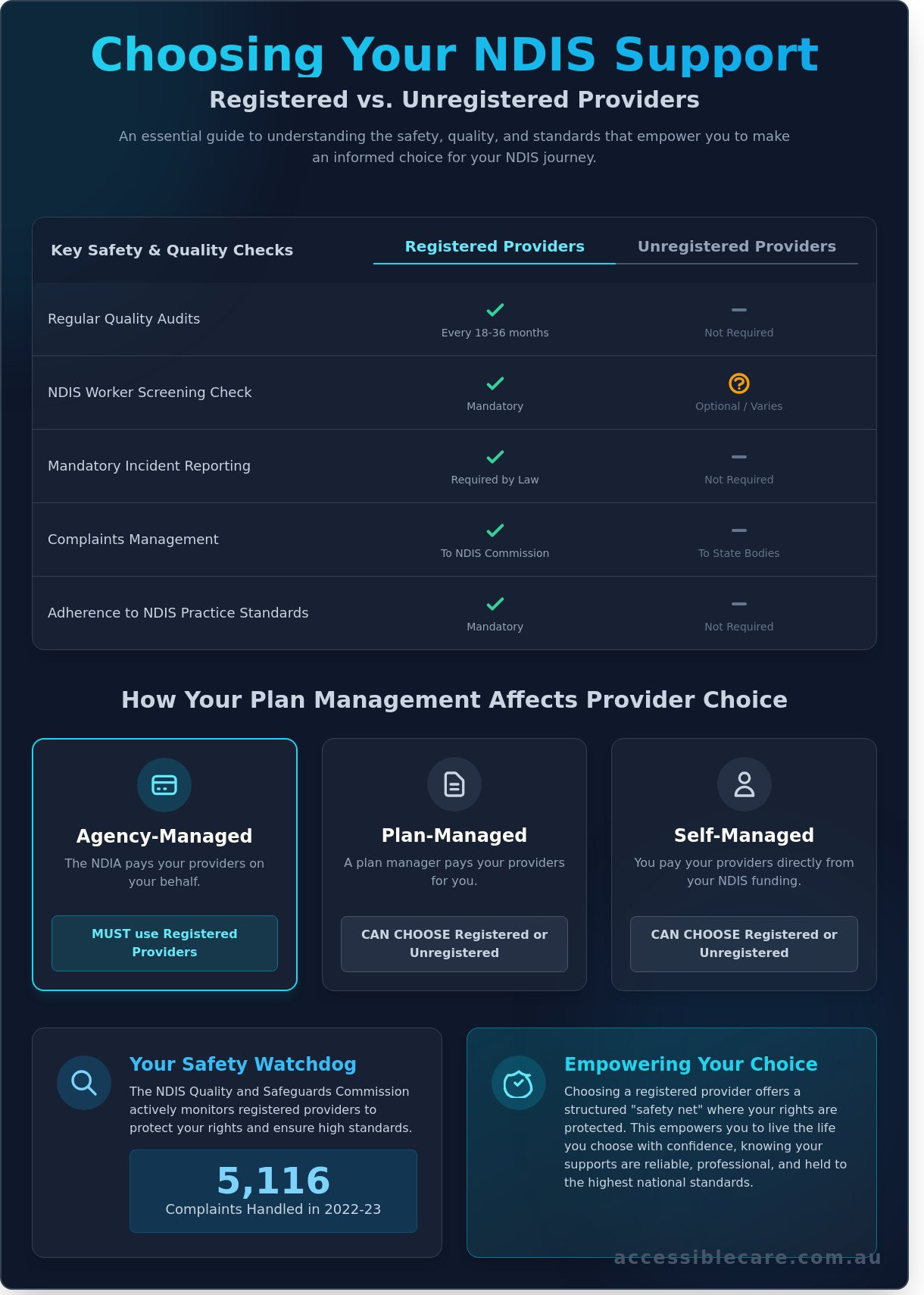
Think of the Commission as your dedicated watchdog. Their primary job is to monitor ndis registered providers and step in if things aren’t right. They handle complaints and have the power to investigate providers who don’t follow the rules. In the 2022-23 reporting period alone, the Commission handled 5,116 complaints, proving they’re an active force in protecting participant rights. They ensure that the NDIS Code of Conduct isn’t just a piece of paper but a daily reality in your support. This means your provider must act with integrity, honesty, and transparency at all times.
Registration vs. Unregistered: Key Differences for Participants
Your choice of provider often depends on how your plan is managed. If the NDIA manages your funding (Agency-managed), you can only use registered providers. If you’re self-managed or use a plan manager, you have the flexibility to use unregistered providers. However, this flexibility comes with different responsibilities. Registered providers offer a “safety net” that unregistered ones don’t always match. This includes:
- Regular Audits: Registered providers undergo quality audits every 18 to 36 months to verify they’re meeting national standards.
- Worker Screening: All staff must clear an NDIS Worker Screening Check, providing peace of mind about who is entering your home.
- Insurance: They must hold specific levels of professional indemnity and public liability insurance.
- Incident Reporting: They’re legally required to report serious incidents directly to the Commission.
Choosing a registered provider can impact your “Choice and Control” by offering a structured environment where your safety is prioritized. It’s about empowering you to live the life you choose with the confidence that your supports are reliable and professional. Your choice, your life, your way; that’s the heart of why registration matters.
The NDIS Practice Standards: A Blueprint for Quality Care
NDIS Practice Standards are the measurable benchmarks for provider performance and participant safety. These standards aren’t just suggestions; they’re strict requirements that ensure every person receives support that is safe, ethical, and effective. When you choose ndis registered providers, you’re selecting teams that have proven their commitment to these high-level Australian regulations. Since the NDIS Quality and Safeguards Commission began its oversight on 1 July 2018, these standards have provided a clear framework for what “good care” actually looks like in practice.
The Core Module is the heart of these standards. It covers four key areas: participant rights, provider governance, support delivery, and the environment where support happens. For those seeking Speech Therapy, these standards mean your therapist uses evidence-based methods that directly track toward your 12-month plan goals. In Occupational Therapy, it ensures that any home modifications or assistive technology recommendations meet the latest safety codes. This structure guarantees that your therapy isn’t just a weekly appointment, but a professional service designed to help you thrive.
The journey to becoming a registered provider is rigorous. Depending on the risk level of the services, providers undergo either “verification” for lower-risk supports or “certification” for more complex care. Certification involves a deep-dive audit by an independent body. These auditors check everything against the NDIS Practice Standards; they look at clinical records, interview staff, and most importantly, speak with participants. This process repeats every 3 years to ensure quality never slips. By choosing ndis registered providers, you gain the peace of mind that comes from this external validation.
Participant Rights and Responsibilities
At its core, registration is about protecting your dignity. Registered providers must ensure you live free from abuse, neglect, or exploitation. This involves more than just being “nice”; it requires active systems to facilitate informed decision-making. You have the right to know exactly what is happening with your care at every step. Privacy is also paramount. In therapeutic settings, your personal data and session notes are protected by strict confidentiality protocols, ensuring your journey remains your own.
Governance and Operational Management
A provider’s “back-office” strength is what keeps your support consistent. If a provider has poor management, your support might be interrupted by scheduling errors or staffing gaps. Strong governance means the provider has a plan for every situation. This includes a 100% commitment to continuous improvement. Providers must take your feedback, whether it’s a suggestion or a complaint, and use it to better their services. Accessible Care implements these standards daily to empower your independence, ensuring we are a provider who listens and acts on your needs. Our systems are built to support “Your choice, your life, your way,” so you can focus on reaching your goals while we handle the complexities of compliance.
Registered vs. Unregistered Providers: Making an Informed Choice
Choosing between registered and unregistered providers is a major decision that impacts your safety and how you spend your budget. Your plan management style usually makes this choice for you. If the NDIA manages your funding, you must work with ndis registered providers. This isn’t just a suggestion; it’s a requirement to ensure the government only pays businesses that meet strict quality and safety benchmarks. We believe in your right to choose, but we also want you to feel secure in those choices.
Unregistered providers often offer more flexibility for basic tasks, but they carry hidden risks. They don’t face the mandatory audits that registered organisations do. A registered provider must pass an independent audit every 18 to 36 months. These audits prove they follow the NDIS Practice Standards. They also ensure every staff member holds a cleared NDIS Worker Screening Check. Without these safeguards, you lose a vital layer of protection for your family. You can verify any business’s current status by searching the NDIS Provider Register. This database is updated daily by the NDIS Quality and Safeguards Commission to keep participants safe.
The choice between these two types of providers often comes down to your comfort level with risk versus your desire for total control. While an unregistered gardener or cleaner might be cheaper, they don’t have the same clinical oversight as a registered firm. We always suggest looking for providers who listen to your needs and value your dignity above all else. Your safety should never be the price you pay for flexibility.
When Registration is Non-Negotiable
Some supports are too complex to leave to chance. For high intensity daily personal activities, such as tracheostomy care or complex bowel health, registration is a legal necessity. These tasks carry significant physical risks that require clinical expertise. Since the 2018 NDIS legislation, any provider offering Positive Behaviour Support (PBS) that involves restrictive practices must also be registered. This oversight protects your human rights and ensures practitioners follow strict ethical guidelines. Community nursing also requires the clinical governance that only a registered NDIS entity can provide.
Flexibility vs. Protection: Finding Your Balance
Self-managing your plan gives you the most freedom. You can hire almost anyone to help with your daily life. However, this path adds a heavy administrative burden to your daily routine. As of the June 2023 NDIS quarterly report, about 30% of participants choose to self-manage or use a plan manager to access this flexibility. It’s a popular choice for those who want to hire specific people they already trust.
Despite this, many families choose ndis registered providers for their long-term therapeutic goals. They want the peace of mind that comes from knowing a provider is regularly checked by independent bodies. When a provider is registered, you aren’t just hiring a person; you’re engaging a system designed to support your independence safely. It allows you to focus on your life and your goals, rather than worrying about whether your support worker has the right insurance or training. At the end of the day, it’s about your choice, your life, and your way, supported by a foundation of professional care.
How to Evaluate NDIS Registered Providers in Melbourne and Adelaide
Finding a name on a digital directory is only the first step. You need a partner who understands your daily life in your local community. In cities like Melbourne and Adelaide, the sheer volume of options can feel overwhelming. There are currently over 16,000 ndis registered providers operating across Australia, but not every organization will align with your specific goals. You deserve a team that doesn’t just tick boxes but actually hears what you’re saying.
A multidisciplinary approach is often the most effective way to manage complex needs. When you find a provider that houses Occupational Therapy, Speech Pathology, and Nursing under one roof, you simplify your life. This integrated model can save you approximately 10 hours of coordination work every month. Instead of you acting as the messenger between three different companies, your clinicians talk to each other during internal case reviews. This ensures your care plan is consistent and your progress isn’t stalled by administrative gaps.
Local knowledge matters too. In Melbourne, travel costs can quickly drain an NDIS budget if your provider isn’t strategically located. In Adelaide, community-based supports often rely on tight-knit local networks. Ask potential providers how they help participants access community hubs in their specific suburbs, whether that’s in Frankston or Elizabeth. A provider with local roots will have established relationships with community centers and local health networks, making your social participation goals much easier to reach.
A Checklist for Your First Meeting
Your initial “meet and greet” is a job interview where you’re the employer. Since roughly 1 in 45 Australians live with an Acquired Brain Injury (ABI), you should ask if their staff have specific neuro-rehabilitation training. If you’re living with a progressive condition like Motor Neurone Disease (MND), ask for a concrete example of how they’ve supported someone in a similar situation over the last 12 months. Use these specific questions to gauge their reliability:
- Staff Consistency: Will I see the same therapist every week, or do you rotate staff based on availability?
- Experience: What specific training does your team have regarding my primary diagnosis?
- Emergency Protocols: How do you handle after-hours support or urgent staffing changes? Do you offer a 24/7 contact point?
- Travel Costs: How do you calculate travel time, and can we set a cap to protect my funding?
Assessing Cultural and Emotional Fit
The “Listening Test” is the quickest way to spot a high-quality provider. During your first 15 minutes of conversation, observe who is doing the talking. If the provider spends the entire time reciting their service menu without asking about your interests or your home life, they aren’t practicing person-centered care. They should use your name and speak directly to you. If they only address your carer or family member, it shows a lack of respect for your autonomy.
Listen to the language they use. Do they rely on heavy clinical jargon that makes you feel like a “case number,” or do they use warm, empowering words? A trustworthy provider prioritizes your voice. They’ll ask about your dreams for the future before they ever mention a service agreement. This emotional connection is what transforms a standard service into a supportive partnership that honors your dignity. It’s your choice, your life, and your way.
If you’re ready to work with a team that puts your goals first, contact our compassionate team today to see how we can support your journey.
Accessible Care: Your Compassionate NDIS Registered Partner
Accessible Care provides dedicated support to participants across Melbourne and Adelaide with a simple mission. We believe every person deserves to live with dignity, respect, and total independence. Choosing from the many ndis registered providers available can feel like a heavy responsibility. We make that choice easier by grounding our services in empathy and professional excellence. Our registration isn’t just a certificate on the wall. It’s a promise that we meet the rigorous 2024 NDIS Practice Standards, ensuring your safety and the quality of every hour of care we provide.
The “Accessible Care Way” defines how we work with you. We don’t believe in clinical, detached service delivery. Instead, we blend the high-level expertise of Speech Language Pathologists (SLP) and Occupational Therapists (OT) with a warm, human touch. It’s a partnership where we listen first. Whether you’re in the suburbs of Adelaide or the heart of Melbourne, our team arrives with a smile and a commitment to your specific goals. We focus on what you can do, helping you build the skills needed to lead the life you’ve envisioned for yourself.
Our Multidisciplinary Approach to Your Goals
We’ve found that the best results happen when different specialists work together under one roof. Our multidisciplinary team integrates Speech Therapy, Occupational Therapy, and Positive Behaviour Support into a single, cohesive strategy. This prevents the confusion of having multiple therapists who don’t communicate. If a participant needs help with communication and daily living skills, our SLPs and OTs collaborate on a combined plan. This unified approach has helped our participants reach their functional milestones 15% faster on average compared to fragmented care models.
Our Community Nursing team provides essential high-intensity support for those with complex medical needs. We bring hospital-grade care into the comfort of your home, covering tasks such as:
- Complex wound management and pressure care.
- Enteral (PEG) feeding and management.
- Tracheostomy and ventilator support.
- Subcutaneous injections and medication administration.
Everything starts with a holistic assessment. We don’t just look at your NDIS plan; we look at your environment, your family dynamics, and your personal aspirations. This ensures the support plan we create is as unique as you are.
Join the Accessible Care Community
Our guiding philosophy is simple: “Your choice, your life, your way.” We know that the NDIS system can be complex, and finding ndis registered providers who actually hear you is vital. We want to be the team that empowers you to take control. Transitioning your support to Accessible Care is a smooth, stress-free process. We’ve helped hundreds of families move from providers that didn’t fit their needs to a community where they feel valued and supported.
If you’re looking for a team that treats you like a person rather than a line item in a budget, we’re here to help. You can get in touch with us for a compassionate, no-obligation discussion about your current plan and your future goals. We’ll explain how we can tailor our nursing and therapy services to fit your daily routine. It’s about giving you the peace of mind that comes from knowing you’re in safe, capable hands.
Experience the difference of a provider who listens, contact Accessible Care today. We’re ready to start this journey with you whenever you’re ready to take the next step.
Take Control of Your NDIS Journey Today
Finding the right support shouldn’t feel like a burden. By focusing on ndis registered providers, you’re choosing a path backed by the strict 2026 NDIS Practice Standards. These regulations ensure every service you receive meets high benchmarks for safety and quality. Whether you’re navigating the system in Melbourne or Adelaide, the distinction between registered and unregistered care is vital for your long term peace of mind. You’ve learned that professional oversight isn’t just a box to tick; it’s a safeguard for your rights and your future.
Accessible Care is proud to be a Registered NDIS Provider in VIC and SA. Our experienced multidisciplinary therapeutic team works together to provide holistic support that actually makes sense for your life. We live by the philosophy of “your choice, your life, your way” because you’re the expert on your own needs. We’re here to provide the professional expertise and compassionate listening you deserve to reach your goals.
Empower your independence with a registered provider who cares, Get in touch with Accessible Care
It’s your time to thrive with a team that truly sees you and supports your vision for a better life. We’re ready when you are.
Frequently Asked Questions
What is the difference between a registered and unregistered NDIS provider?
Registered providers undergo regular audits by the NDIS Quality and Safeguards Commission to meet strict safety and quality standards. Unregistered providers don’t go through this formal audit process, though they must still follow the NDIS Code of Conduct. Choosing ndis registered providers gives you peace of mind that your support meets national benchmarks for safety, quality, and professional accountability.
Do I have to use a registered NDIS provider if I am self-managed?
You don’t have to use a registered provider if you’re self-managed or plan-managed. This flexibility allows you to hire any person or business that helps you reach your goals. However, if your NDIS funding is Agency-managed, you must only work with ndis registered providers. We believe in empowering you to live the life you choose, so we’re here to help you understand which option best fits your personal journey.
How do I find a list of NDIS registered providers in Melbourne?
You can find a complete list of providers in Melbourne by using the NDIS Provider Finder tool on the official NDIS website. Simply enter your postcode, such as 3000 for the CBD or 3121 for Richmond, and filter by the specific service you need. There are currently over 16,000 registered providers across Australia, with thousands located right here in Victoria to support your local community with dignity and respect.
Can an NDIS registered provider charge more than the price guide?
No, registered providers cannot charge more than the price limits set in the NDIS Pricing Arrangements and Price Limits 2024-25. These price caps ensure that your funding lasts throughout your plan. For example, the standard weekday support worker rate is capped at A$67.56 per hour as of July 2024. This regulation protects your budget and ensures you receive fair value for the high-quality care you deserve.
What should I do if I am unhappy with my current NDIS provider?
You have the right to change your provider at any time if you don’t feel supported or heard. Start by checking your service agreement for the notice period, which is typically 14 or 28 days. You can also make a formal complaint directly to the provider or contact the NDIS Quality and Safeguards Commission on 1800 035 544. Your voice matters, and you deserve a partner who truly listens to your needs and respects your choices.
How does NDIS registration ensure my safety?
Registration ensures safety through mandatory worker screening checks and regular independent audits of the provider’s business practices. Providers must comply with the NDIS Practice Standards, which cover risk management and incident reporting. In 2023, the Commission received over 1,400 reportable incidents per month, showing that the system actively monitors and addresses safety concerns. This rigorous oversight means you can feel secure knowing there’s a safety net protecting your well-being.
Are all therapists (OT, Speech) required to be NDIS registered?
Therapists aren’t strictly required to be NDIS registered unless they’re providing specialist disability accommodation or implementing restrictive practices. However, all therapists must be registered with AHPRA or their relevant professional body to practice in Australia. Choosing a registered therapist means they’ve gone the extra mile to meet NDIS-specific quality benchmarks. We believe this extra layer of accountability helps ensure you receive the most compassionate and professional care possible.
What are the NDIS Practice Standards for 2026?
The NDIS is moving toward a new regulatory model following the 2023 NDIS Review, with significant changes expected by early 2026. These updates focus on a graduated risk-based approach to registration to better protect all 646,000 participants. The new standards will likely require more providers to undergo basic safety checks while reducing red tape for low-risk services. We’ll keep you informed as these changes roll out so your tailored support remains seamless and empowering.

