


Stepping into the world of the NDIS can feel overwhelming. With so much information and so many choices, it’s easy to feel lost or worried about making the right decision for yourself or your family. This is especially true when it comes to understanding and accessing the right ndis therapy services-the very support designed to help build skills, foster independence, and empower you to live a fuller life.
You are not alone in feeling this way. That’s why we created this compassionate guide for 2026. We are here to gently walk you through every step, turning confusion into clarity and concern into confidence. In this article, we will explore the main types of therapy, explain how to get support funded in your NDIS plan, and share a simple framework for choosing a provider who listens, respects your choices, and partners with you on your journey. Let’s take the next step, together.
Key Takeaways
- Discover the main types of NDIS therapies and the real-world goals they help you achieve, from improving communication to building daily living skills.
- Follow a clear, step-by-step guide to getting ndis therapy services funded in your plan, helping you feel prepared and less overwhelmed.
- Use our practical checklist to choose the right therapist, ensuring you find a provider who truly listens and supports your journey to independence.
- Understand how compassionate therapy support can empower you or your loved one to build confidence and participate more fully in the community.
What Are NDIS Therapy Services? Understanding the Basics
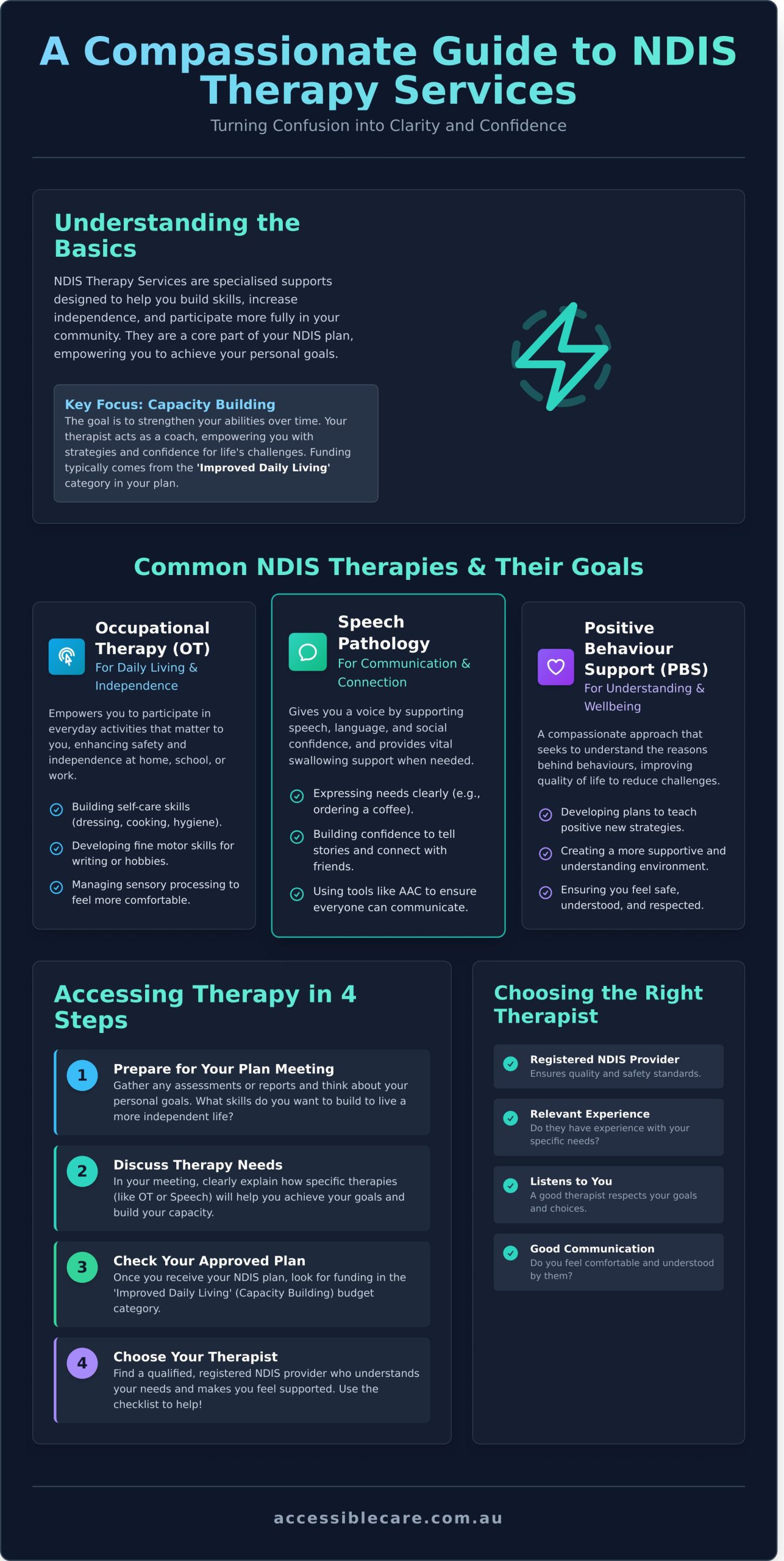
Navigating the NDIS can feel overwhelming, but understanding the supports available is the first step towards a more independent life. In simple terms, ndis therapy services are specialised supports designed to help you build skills, increase your independence, and participate more fully in your community. They are a core part of the National Disability Insurance Scheme (NDIS), focused on helping you achieve your personal goals.
These services are typically funded under the ‘Improved Daily Living’ category in your NDIS plan. Unlike other supports, such as funding for home modifications or consumable items, therapeutic supports are all about developing your abilities over time. Taking the time to understand these services is an empowering first step, putting you in control of your journey.
The Goal of Therapy: Building Your Capacity
The NDIS uses the term ‘capacity building’ to describe the goal of therapy. At its heart, this is a compassionate approach focused on strengthening your abilities. Think of your therapist as a dedicated coach who partners with you to learn new skills for life. The focus is always on empowering you with the strategies and confidence to manage challenges and live with greater choice, not on ‘fixing’ you.
Who Delivers These Services?
High-quality ndis therapy services are provided by qualified Allied Health Professionals (AHPs) who have experience working with NDIS participants. These dedicated professionals bring specialist knowledge to help you achieve your goals. Key examples include:
- Occupational Therapists (OTs) who help with skills for daily tasks and activities.
- Speech Pathologists who support communication, language, and swallowing.
- Behaviour Support Practitioners who develop strategies to understand and manage complex behaviours.
- Psychologists who provide support for mental health and well-being.
Choosing a registered NDIS provider is crucial. It ensures your support is delivered by a qualified, vetted professional who adheres to strict quality and safety standards, giving you and your family complete peace of mind.
Common NDIS Therapies and the Goals They Help You Achieve
Navigating the world of therapy can feel overwhelming, but the right support is about finding a partner who helps you achieve your specific goals. The NDIS funds therapeutic supports that are directly related to your disability, aiming to build your skills and independence. Each of the ndis therapy services available is tailored to your individual needs, as outlined in the official NDIS therapy support guidelines, to help you live a more fulfilling life. Here are some of the most common therapies and the real-world outcomes they help you work towards.
Occupational Therapy (OT): For Daily Living & Independence
Occupational Therapy is all about empowering you to participate in the everyday activities that matter to you. A compassionate OT works with you in your own environment-whether at home, school, or work-to find practical solutions that enhance your safety and independence. This support is vital for both children and adults, focusing on goals like:
- Building self-care skills for dressing, cooking, and personal hygiene.
- Developing fine motor skills for writing, typing, or hobbies.
- Managing sensory processing to feel more comfortable and engaged.
OTs often conduct Functional Capacity Assessments (FCAs) to provide a clear picture of your support needs for your NDIS plan.
Speech Pathology: For Communication & Connection
Clear communication is the foundation of connection. A Speech Pathologist provides support to help you express your needs, understand others, and build social confidence. It’s not just about speech sounds; it’s about giving you a voice. Relatable goals include ordering a coffee with ease, telling a story to a friend, or understanding complex instructions. They can also provide vital swallowing support and introduce tools like Augmentative and Alternative Communication (AAC) to ensure everyone has a way to communicate.
Positive Behaviour Support (PBS): For Understanding & Wellbeing
PBS is a compassionate and proactive approach that looks beyond a behaviour to understand the reason behind it. Instead of focusing on discipline, it aims to improve a person’s quality of life, which in turn reduces the need for challenging behaviours. A skilled Behaviour Support Practitioner works collaboratively with you and your support network to develop a plan. This plan focuses on teaching new positive strategies and creating a more supportive environment, ensuring you feel understood, safe, and respected.
A Step-by-Step Guide: Accessing Therapy in Your NDIS Plan
Navigating the NDIS to get the support you need can feel overwhelming, but it doesn’t have to be. We believe in making this process as clear and simple as possible. Think of it as a collaborative journey where your goals are the map, and we are here to help you read it. This guide breaks down how to get therapeutic support included in your NDIS plan into three manageable steps.
Step 1: Linking Your Goals to Therapy Needs
Everything in your NDIS plan starts with your personal goals. Before your planning meeting, take some time to think about what you want to achieve. Instead of thinking about a specific service, focus on the outcome. For example, a goal might be, “I want to manage my daily routine with more independence and less stress.” This goal clearly points to a need for an Occupational Therapist who can help develop practical skills and strategies. Understanding the different types of NDIS-funded therapies available can empower you to see how professional support directly connects to your life aspirations.
Step 2: Gathering Evidence and Reports
To fund therapy, the NDIS needs to understand why it is ‘reasonable and necessary’ for you. This is where evidence from professionals becomes crucial. Reports from your GP, paediatrician, psychologist, or other specialists provide the NDIS with a clear picture of your needs. An assessment, such as a Functional Capacity Assessment (FCA), is often very powerful evidence. It details your functional abilities and recommends specific supports to help you reach your goals. A compassionate provider can offer gentle guidance on the reports that will best support your request.
Step 3: During Your Plan Meeting
Your plan meeting is your opportunity to share your story and advocate for your needs. Bring your list of goals and any reports you have gathered. When you talk to your NDIS Planner or Local Area Coordinator (LAC), clearly explain how specific ndis therapy services will help you achieve those goals. It’s important to request that the funding be allocated to your Improved Daily Living budget. Remember, this is your plan and your life. Feel empowered to ask questions and ensure the person you’re speaking with truly understands what you need to live with choice and dignity.
How to Choose the Right NDIS Therapist: A Checklist
Understanding what NDIS therapy can do is the first step. The next, and most crucial, is choosing who will be your partner on this journey. Finding the right therapist is about more than qualifications on a page; it’s about finding a connection built on trust, compassion, and shared goals. This checklist is designed to empower you to make an informed choice that feels right for you and your family.
Key Questions to Ask a Potential Provider
When you speak with potential providers, having a few key questions ready can help you understand their approach and values. Consider asking:
- What is your specific experience supporting individuals with goals or behaviours similar to ours?
- How will you involve me and my family in setting goals and planning the therapy process?
- What qualifications, training, and specialisations does your therapy team have?
- Can we expect to work with the same therapist consistently to build a strong, trusting relationship?
- How do you measure progress, and how will you communicate updates with us?
- How do you collaborate with other supports in a participant’s plan, such as support coordinators?
What to Look For Beyond Qualifications
The best therapeutic relationships go beyond clinical expertise. The right fit is often found in the human connection and the culture of the provider. Look for a team that demonstrates:
- A compassionate, listening ear: You should feel heard, respected, and valued. A great provider honours your choices and recognises you as the expert in your own life.
- A team-based approach: Many goals are best supported by multidisciplinary care. A provider who can offer a connected team of therapists ensures a holistic and comprehensive approach to your wellbeing.
- Local knowledge and presence: A team that understands your local community, whether in Melbourne or Adelaide, can connect you with relevant resources and provide more accessible support.
- A warm and supportive attitude: From your very first phone call, the communication should be clear, welcoming, and reassuring. You should feel supported, not stressed.
Ultimately, choosing the right provider for ndis therapy services is about finding a partner you feel comfortable and confident with. At Accessible Care, we build every relationship on a foundation of dignity, choice, and genuine care, empowering you to live the life you choose.
Begin Your Therapy Journey with Accessible Care
Understanding how therapy can support positive behaviour is a significant step. The next is finding a provider who truly listens, understands your unique situation, and puts your goals at the heart of everything they do. At Accessible Care, we believe that effective support is built on a foundation of trust, respect, and genuine partnership. We are here to empower you with the expertise and compassion needed to navigate your NDIS journey with confidence.
Our dedicated team provides a range of professional ndis therapy services designed to work together to support you or your loved one. We focus on creating holistic, person-centred strategies that foster independence and improve quality of life. Our core services include:
- Occupational Therapy (OT) to build practical skills for daily living and community participation.
- Speech Pathology to enhance communication, language, and social interaction.
- Positive Behaviour Support (PBS) to understand the reasons behind behaviours and develop supportive, long-term strategies.
Our Compassionate Approach in Melbourne & Adelaide
With dedicated teams on the ground in Melbourne and Adelaide, we offer more than just services; we bring local understanding and a real connection to the communities we serve. We live by our promise of ‘Your choice, your life, your way,’ ensuring every support plan is tailored to the individual. Our therapists collaborate closely, meaning you have a unified team working together to help you achieve your goals.
Taking the First Step is Easy
We know that reaching out for help can feel overwhelming. That’s why we’ve made our process simple and welcoming. Your initial conversation with us is a pressure-free opportunity for us to listen and understand what you’re looking for from your ndis therapy services. Whether you prefer a phone call or our online contact form, our friendly team is ready to guide you.
Ready to explore how we can support you? Talk to our friendly NDIS support team today to discuss your goals and see how we can make a positive difference in your life.
Take the Next Step with Confidence and Care
Navigating your NDIS plan can feel complex, but understanding your options is the first step towards achieving your goals. This guide has shown that with the right knowledge, you can confidently access therapies, choose a provider who listens, and make the most of your funding. The right ndis therapy services are not just about support; they are about empowering you to live a more independent and fulfilling life.
At Accessible Care, we are more than just a Registered NDIS Provider. With experienced teams in Melbourne and Adelaide, our person-centred and compassionate approach means we see you, not just your plan. We are dedicated to being your partner, providing the guidance you need with the dignity and respect you deserve.
Are you ready to begin? Get in touch with our caring team to start your therapy journey. Your choice, your life, your way-and we’re here to support you on that path.
Frequently Asked Questions About NDIS Therapy for Behaviour
What is the difference between therapy and support work in an NDIS plan?
Therapy focuses on building your skills and capacity to help you achieve your long-term goals. A therapist, like a psychologist or behaviour support practitioner, provides specialised strategies to improve your independence. Support work, on the other hand, provides direct assistance with daily tasks, such as personal care or community participation. Both are vital, but therapy aims to increase your abilities, while support work helps you manage day-to-day life.
How many hours of therapy can I get funded in my NDIS plan?
The NDIS does not set a specific limit on therapy hours. Instead, funding is based on what is considered ‘reasonable and necessary’ to help you pursue your individual goals. During your planning meeting, you will discuss your needs, and the amount of therapy funded will directly relate to the evidence you provide and how it connects to achieving the goals outlined in your plan. It is a person-centred and goal-oriented process.
What happens if a certain type of therapy isn’t working for me?
Your NDIS plan is built on choice and control, and this absolutely includes your therapy. If a particular approach isn’t helping you progress, you have the right to change it. We encourage you to first discuss your concerns with your therapist. If you are not comfortable, you can speak with your support coordinator or look for a different provider who offers an approach that is a better fit for you and your goals.
Can NDIS therapy services be provided at home or in school?
Absolutely. High-quality ndis therapy services can be delivered in the environments where you need support the most, including your home, school, or workplace. This approach helps you learn and practice new skills in real-life settings, making the strategies more effective and meaningful. Your therapist will work with you to determine the most supportive and convenient location to help you achieve your goals with dignity and confidence.
Are group therapy sessions covered by the NDIS?
Yes, group therapy sessions can be funded by your NDIS plan if they are a reasonable and necessary support for achieving your goals. Group sessions are often a wonderful way to build social skills, connect with peers, and learn in a supportive community setting. They can also be a more cost-effective way to use your funding, allowing you to access valuable therapeutic support alongside others who share similar experiences.
How do I find NDIS registered therapists in my area?
Finding the right therapist is a key step. You can use the NDIS Provider Finder tool on the myplace portal to search for registered providers near you. Your support coordinator or Local Area Coordinator (LAC) is also an excellent resource, as they can connect you with trusted local professionals. Don’t hesitate to ask for recommendations from your community, as personal experiences can offer valuable insight into finding a compassionate and skilled therapist.
What therapies are generally not funded by the NDIS?
The NDIS funds supports that are proven to be effective and are directly related to a participant’s disability. Therapies that lack a strong evidence base or are considered ‘alternative’, such as reiki or aromatherapy, are generally not funded. The focus for NDIS therapeutic supports is on established, goal-oriented approaches. If you are unsure, it is always best to discuss a specific therapy with your NDIS planner or support coordinator.

