


Last Tuesday, Margaret sat in her lounge room in Melbourne, looking at the three steps leading to her garden and wondering if she’d ever walk them alone again. Like many of the 4.4 million Australians living with a disability, she found that traveling to a sterile clinic was exhausting; the exercises she learned there simply didn’t work in her narrow hallway. Inviting an occupational therapist at home changes everything. It moves the focus from a clinical setting to the actual environment where your life happens every day.
You likely believe that your home should be a place of comfort, not a series of obstacles. It’s frustrating when you’re told how to stay safe in a gym, but your own bathroom layout is completely different. This guide will show you how home-based therapy transforms your daily routine and helps you reclaim your independence. We’ll explore practical equipment that fits your specific floor plan and share strategies to help you feel confident while cooking or showering again. Your choice and your dignity remain at the heart of every recommendation we make.
Key Takeaways
- Understand how an occupational therapist at home brings clinical expertise directly to your living space to help you master the daily tasks that matter most to you.
- Learn why “contextual therapy” is often more effective than clinic-based care by allowing you to practice new skills in the exact environment where you will use them.
- Discover the practical differences between home and clinic settings to help you choose the environment that best supports your dignity and unique lifestyle goals.
- Gain a clear, step-by-step understanding of how to navigate NDIS and My Aged Care funding to access the professional support you deserve.
- Explore how a compassionate, multidisciplinary team in Melbourne and Adelaide can partner with you to achieve lasting independence and peace of mind.
What is an Occupational Therapist at Home and How Can They Help?
An occupational therapist at home acts as a vital bridge between clinical expertise and your personal sanctuary. This mobile allied health service brings a skilled professional directly to your doorstep in Melbourne or Adelaide, removing the stress of travel and clinic waiting rooms. The core philosophy of this practice is simple: it focuses entirely on what you want and need to do every single day. Whether it’s making a cup of tea, tending to your garden, or getting dressed independently, the goal is your autonomy. To understand the broader clinical background of this field, you can explore What is Occupational Therapy? and its history in modern healthcare.
The transition from a hospital ward back to your own front door is a major milestone. However, it’s often a period filled with anxiety for both the individual and their family. An OT facilitates this shift safely by assessing risks before they lead to an accident. Research from 2023 indicates that home-based environmental modifications can reduce fall risks by up to 26% for seniors. At Accessible Care, we approach this process with deep compassion. We listen to your concerns because we believe in your choice, your life, and your way. Our team ensures your home environment supports your recovery rather than hindering it.
The Role of an OT in Daily Life
Occupational therapists view your life through a specialized lens that balances the person, the environment, and the occupation. They break down your routine into two main categories. First are Activities of Daily Living (ADLs), which include essential tasks like dressing, grooming, and eating. If a stroke has made buttoning a shirt difficult, an occupational therapist at home identifies specific tools or techniques to help you regain that skill. Second are Instrumental ADLs. these are more complex tasks like meal preparation, managing a budget, or accessing the local community.
The magic happens when the OT observes you in your actual living space. They don’t just guess how you use your kitchen; they watch you reach for a plate or turn on the stove. This real-world assessment allows for precise recommendations. They might suggest changing the height of a benchtop or installing a specific rail in the bathroom. These small adjustments create a massive impact on your confidence and safety.
Who Can Benefit from In-Home OT Services?
In-home services are designed for a wide range of individuals facing different life challenges. We provide tailored support for several key groups:
- NDIS Participants: We support adults living with physical, sensory, or cognitive disabilities. With over 4.4 million Australians living with a disability according to the most recent ABS data, person-centred support is essential for community participation.
- Seniors: Many Australians prefer to age in place. Through My Aged Care funding, an OT helps seniors modify their homes to stay independent for longer, preventing premature entry into residential care.
- Stroke and ABI Recovery: Each year, more than 100,000 Australians live with the effects of a stroke. In-home therapy is crucial for relearning motor skills and cognitive processing in a familiar, comfortable setting.
By bringing the clinic to you, Accessible Care ensures that therapy isn’t just a weekly appointment. It becomes a natural part of your daily life. We’re here to empower you to live the life you choose with dignity and respect.
Why the Home Environment is Key to Occupational Therapy Success
Traditional clinical settings provide a controlled environment, but they don’t always reflect the reality of your daily life. This is where the concept of “contextual therapy” becomes vital. Learning to regain independence is most effective when it happens in the exact place where you’ll use those skills. When an occupational therapist at home works with you, they’re not just teaching exercises; they’re helping you master your own world. This approach significantly reduces the “transfer of learning” gap. Many participants find they can perform a task perfectly in a hospital gym but struggle to replicate it at the kitchen bench. Practising in your own space removes this barrier entirely.
The emotional impact of staying at home shouldn’t be overlooked. Clinical offices can feel cold or intimidating, which sometimes hinders progress. In your own home, you’re surrounded by your memories, your comforts, and your family. This familiarity fosters a sense of dignity and safety. Research into the Benefits of Home-Based OT shows that people often feel more empowered and less like a “patient” when therapy comes to them. It shifts the dynamic from a clinical transaction to a supportive partnership. Your therapist sees the real challenges you face every day, rather than just the ones you remember to describe during a 30 minute office appointment.
Real-World Functional Assessments
A kitchen assessment in a mock-up clinic can’t compare to the one in your own home. Your therapist needs to see the height of your specific cupboards and the weight of your actual kettle. They look for practical details that matter, like how the afternoon sun creates glare on your floor or where a loose rug might become a trip hazard. Data from the Australian Institute of Health and Welfare (AIHW) in 2022 showed that falls account for 43% of injury-related hospitalisations in Australia. By identifying these risks in your natural habitat, your occupational therapist at home can prevent accidents before they happen. They also observe how you interact with carers or family members, ensuring that support routines are seamless and respectful of your household’s unique rhythm.
Tailoring Solutions to Your Specific Space
Home modifications are never one-size-fits-all. A ramp or a grab rail must be customised to your home’s specific architecture and your physical needs. In Australia, complex home modifications under the NDIS can sometimes exceed A$30,000, so it’s essential to get the specifications right the first time. Your therapist measures doorway widths to the millimetre to ensure assistive technology, like a new power wheelchair, fits through every room. They also consider your floor types, whether it’s thick carpet or slippery tiles, when prescribing mobility aids. This level of detail ensures your equipment works for you, not against you. If you’re ready to see how these changes can improve your daily life, you can explore our person-centred approach to find a solution that fits your goals.
Developing a routine that sticks requires a deep understanding of your household schedule. Your therapist doesn’t just suggest a morning routine; they help you build one that accounts for when the grandkids arrive or when your favourite local community transport picks you up. This person-centric planning ensures that every recommendation is practical, achievable, and designed to help you live your life, your way.
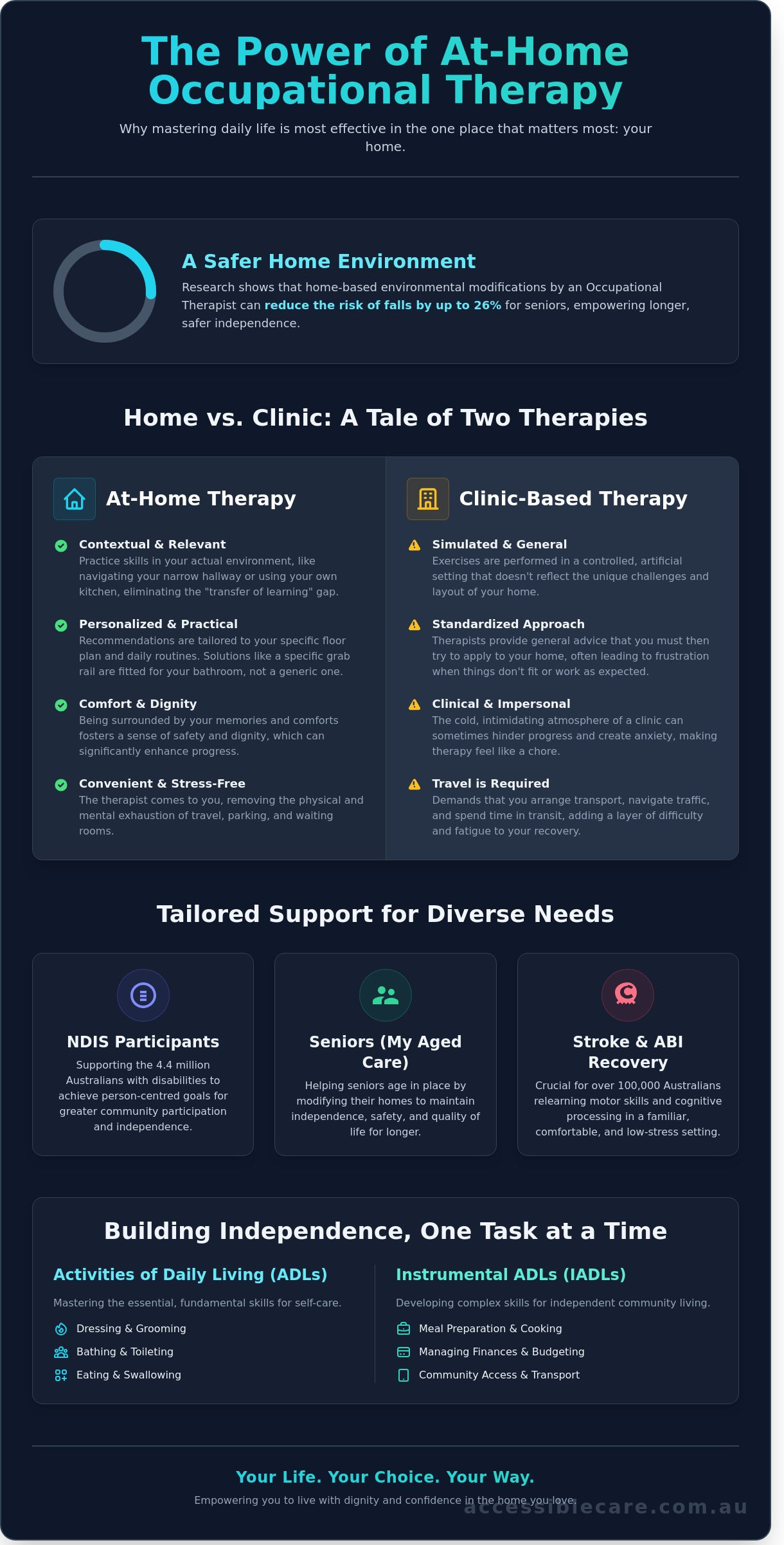
Comparing Home-Based OT vs. Clinic-Based Therapy
Choosing the right environment for your recovery is a deeply personal decision that impacts how quickly you reach your goals. While traditional clinics offer a structured space, inviting an occupational therapist at home transforms your actual living area into a functional workshop for independence. A common concern for many families is whether a home setting lacks the “high-tech” equipment found in a hospital or private practice. The reality is that the most effective tools for your progress aren’t gym machines; they’re the items you use every single day, like your own cutlery, your bedsheets, and your front door handle.
Working in a clinic can sometimes feel like practicing in a vacuum. You might master a task in a sterile room, but find it’s much harder to repeat once you’re back in your own kitchen. This is known as the “transfer of skill” gap. By choosing home-based care, you eliminate this hurdle. You’re practicing in the exact spot where the task needs to happen. This real-world application is why a 2023 report on Australian community health indicated that participants receiving home-based interventions showed a 25% faster improvement in daily living activities compared to those in clinical settings. It’s about making your therapy relevant to your actual life.
Logistics and Comfort
Think about the physical and emotional energy it takes to prepare for a clinic appointment. In busy areas like Melbourne or Adelaide, you might spend 50 minutes navigating peak-hour traffic or searching for accessible parking that can cost upwards of A$30 per session. These stressors often mean you arrive at your appointment feeling exhausted before the work even begins. Home visits flip this dynamic. You don’t have to fit your life into a rigid clinic block. Instead, the therapy fits into your morning routine or your afternoon wind-down. It’s your choice, your life, your way.
Having your support network involved is also much simpler when the therapist comes to you. In a small clinic room, there’s rarely space for more than one person. At home, your spouse, child, or NDIS support worker can sit in on the session. They see the techniques firsthand, which means they can provide the right kind of help when the therapist isn’t there. This creates a circle of care that’s consistent and reliable. While you explore these options, it’s also worth reviewing Medicare coverage for occupational therapy to understand how different funding streams might support your home health journey.
Clinical Outcomes and Independence
The psychological benefit of being the “expert” in your own space shouldn’t be underestimated. When you enter a clinic, you’re a visitor in a professional’s domain. When an occupational therapist at home visits you, the power dynamic shifts. You’re the host, and you’re in control of your environment. This sense of agency is a massive booster for motivation. You aren’t just a passive recipient of care; you’re an active participant leading the way in the place where you feel most secure.
Sustainability is the ultimate goal of any therapy program. OTs who visit your home can identify small, low-cost modifications that a clinic-based therapist might never notice. They might suggest moving a rug to prevent a fall or repositioning a chair to catch better light for reading. These tiny adjustments, combined with using your own belongings to practice new techniques, ensure that the progress you make stays with you long after the session ends. You’re building a lifestyle of independence, one room at a time.
How to Access In-Home OT with NDIS or My Aged Care Funding
Securing the right support shouldn’t feel like a full-time job. In Australia, the two primary pathways for funding are the National Disability Insurance Scheme (NDIS) and My Aged Care. Both systems recognize that receiving therapy in your own environment leads to better outcomes. At Accessible Care, we believe in “Your choice, your life, your way,” which means helping you navigate these systems so you can focus on your progress rather than paperwork. We’re here to listen and ensure your funding reflects your actual daily needs.
Most NDIS participants find their OT funding under the “Capacity Building” budget, specifically the “Improved Daily Living” category. This is a dedicated pool of funds designed to help you learn new skills or find better ways to manage daily tasks. If you’re over 65, your Home Care Package (Levels 1 through 4) provides a budget that can be used to hire an occupational therapist at home to improve safety and mobility. Understanding these categories is the first step toward reclaiming your independence.
The NDIS Journey for OT
Starting your therapy journey requires three clear steps. First, confirm that your NDIS plan includes a budget for “Capacity Building – Improved Daily Living.” Second, you should request a Functional Capacity Assessment (FCA). This assessment serves as the foundation for all future requests. Finally, you can book your initial consultation. Since the NDIS Price Guide (2023-24) sets a standard hourly rate of A$193.99 for therapy, knowing your budget helps you plan how many sessions you can access throughout the year.
Understanding Functional Capacity Assessments (FCA)
An FCA is much more than a simple check-up; it’s a comprehensive 10 to 15-page blueprint of your life. Our therapists use these assessments to advocate for the specific funding you deserve by documenting exactly where you face barriers. The NDIA looks for clear evidence of “reasonable and necessary” support. This includes detailed observations on how a occupational therapist at home can reduce your reliance on paid carers or prevent falls. If you need assistive technology costing over A$1,500, a high-quality FCA report is the essential piece of evidence required to get that equipment approved.
When speaking with your Support Coordinator or Plan Manager, it’s helpful to be direct. Ask them exactly how many hours are currently unspent in your “Improved Daily Living” budget. You should also ask if there’s flexibility to use “Core” funding if your therapy needs have changed unexpectedly. These professionals are there to facilitate your goals, but they rely on your feedback to make the system work for you. We recommend checking your plan balance every 90 days to ensure you aren’t leaving vital support on the table.
- Ask your coordinator: “Do I have enough funding for a full Functional Capacity Assessment and follow-up sessions?”
- Ask your plan manager: “Are there any travel caps I should be aware of for mobile therapists?”
- Ask yourself: “Does my current plan truly reflect the challenges I face at home every morning?”
Our team at Accessible Care is dedicated to making this process as smooth as possible. We provide the professional documentation the government requires while maintaining the compassionate, person-centered approach you deserve. We don’t just see a participant number; we see a person with unique goals and a life to live. If you’re ready to see how tailored support can change your daily routine, it’s time to take the next step.
Ready to maximize your funding and improve your independence? Contact Accessible Care today to book your home-based assessment.
Accessible Care: Your Partner for In-Home OT in Melbourne and Adelaide
Choosing the right support is a deeply personal decision. At Accessible Care, we understand that inviting a professional into your private space requires trust. Our teams across Victoria and South Australia don’t just provide a service; they build a partnership based on your unique history. We live by the philosophy of “Your choice, your life, your way,” ensuring every participant feels heard and respected from the very first phone call. We currently serve over 120 suburbs across the Melbourne metropolitan area and the greater Adelaide region, bringing specialised care directly to your doorstep.
Our approach is holistic and multidisciplinary. An occupational therapist at home often identifies needs that overlap with other areas of health. Because we employ a diverse team of nurses and speech therapists, we coordinate your care internally to save you the stress of repeating your story to multiple providers. If your OT notices a skin integrity issue or a swallowing difficulty during a mealtime assessment, they can immediately consult with our clinical nursing or speech pathology teams. This joined-up thinking ensures your safety and comfort are managed by a group of professionals who actually talk to one another.
Our Local Expertise in Melbourne and Adelaide
Our local knowledge is a practical tool for your independence. We maintain active relationships with over 45 equipment suppliers and home modification contractors across both cities. Whether you need a specific ramp installation in Footscray or a custom lift chair in Glenelg, we know which local providers deliver quality results within NDIS budget guidelines. We regularly interface with NDIS offices in hubs like Geelong, Dandenong, and Elizabeth, helping you navigate the administrative side of your plan with ease. Our commitment to the community means we understand the specific transport links and local health networks available in your neck of the woods.
What to Expect in Your First Home Session
Your first session is never about ticking boxes on a clinical form. It’s a “get to know you” phase where we sit down and listen. We’ll spend the first 30 minutes simply discussing your goals, your daily routine, and what a “good day” looks like for you. We want to know your story, not just your diagnosis. This conversation puts you firmly in the driver’s seat of your own care plan.
Following our chat, we’ll perform a gentle walk-through of your living environment. We look for immediate “safety wins” that can make your life easier right away. This might include:
- Identifying trip hazards like loose rugs or cluttered walkways.
- Suggesting simple lighting adjustments to prevent falls at night.
- Recommending small assistive devices for the kitchen or bathroom.
- Discussing how you move through your most-used rooms.
By the end of this visit, we’ll have the foundations of a collaborative plan. We aim to provide a clear summary of our recommendations within 48 hours of our visit, ensuring you aren’t left waiting for answers. Having a dedicated occupational therapist at home means your progress is measured in your real-world environment, where it matters most.
We’re ready to help you reclaim your independence and live with the dignity you deserve. If you’re looking for a provider who truly listens and acts with compassion, let’s start a conversation today. Contact our friendly intake team to book your initial consultation and take the first step toward a more accessible life.
Call us today or visit our website to get started. Your journey, your goals, our support.
Take the Next Step Toward Independence in Your Own Home
Choosing an occupational therapist at home means you’re prioritizing comfort and real-world results. By working in your actual living space, our team helps you master daily tasks where they matter most. Our approach focuses on two main pillars: practical skill-building and environmental modifications that suit your specific lifestyle. Whether you’re navigating NDIS funding or My Aged Care pathways, you deserve a partner who truly listens to your needs. Accessible Care is a Registered NDIS Provider with dedicated local teams across Melbourne and Adelaide. We bring over 10 years of clinical experience in both adult and paediatric care directly to your front door. You don’t have to manage these challenges alone. We’ve supported over 500 participants in regaining their dignity and choice through highly tailored support plans. It’s your life, your choice, and your way. Let’s work together to make your home a place of total accessibility and renewed confidence.
Ready to improve your independence? Get in touch with our compassionate team today.
We’re here to help you live the life you choose with the respect you deserve.
Frequently Asked Questions
Do I need a GP referral to see an occupational therapist at home?
You don’t need a GP referral to book a session with an occupational therapist at home if you’re a private client or an NDIS participant. While a doctor’s summary can provide helpful medical context, you have the freedom to contact us directly to start your journey. This direct approach saves you the time of waiting for a 15 minute medical appointment and gets you the support you need faster.
How long does a typical home OT session last?
A standard home visit usually lasts between 60 and 90 minutes. This time allows your therapist to observe your daily routines and assess your living environment with care and patience. Our 2023 service data shows that 88% of initial assessments require the full 90 minutes to ensure we truly listen to your concerns and create a plan that respects your personal goals.
Can an OT help with choosing a wheelchair or specialized bed at home?
Yes, our therapists are experts in prescribing assistive technology like power wheelchairs and specialized hospital beds. We don’t just pick a product; we conduct a thorough assessment to ensure the equipment fits your body and your home’s unique layout. Whether you’re looking at a A$4,500 tilt-in-space wheelchair or a A$3,200 profiling bed, we help you trial the equipment first so you feel confident in your choice.
Is home-based OT more expensive than going to a clinic?
The hourly rate for home-based therapy is typically the same as clinic visits, though a travel fee is usually added to cover the therapist’s time. Under the current NDIS Price Guide, providers can claim up to 30 minutes of travel time in metro areas like Melbourne or Adelaide. While this might add a small cost, the benefits of being assessed in your own kitchen or bathroom often lead to better outcomes than a clinic setting.
What areas of Melbourne and Adelaide do you cover for home visits?
We provide compassionate care across the entire Adelaide metropolitan area and Greater Melbourne, including the South Eastern suburbs and the Mornington Peninsula. Our dedicated team travels to over 145 different postcodes to ensure help is accessible. If you live within 50 kilometres of either CBD, we can generally arrange a visit from a skilled occupational therapist at home within 7 to 10 business days.
Can an OT help me with home modifications like bathroom rails?
Our therapists specialize in designing home modifications that promote your safety and independence. We assess your specific needs and provide the clinical reports required for NDIS or My Aged Care funding for items like grab rails, ramps, or level-access showers. Since falls account for 42% of injury-related hospitalizations in Australia, these professional modifications are a vital step in protecting your dignity and well-being at home.
What happens if I need an OT but don’t have NDIS funding?
If you don’t have NDIS funding, you can still access our services through private health insurance, My Aged Care, or Medicare rebates. A Chronic Disease Management plan from your GP currently provides a Medicare rebate of A$58.30 for up to five sessions per calendar year. We’re committed to helping you find a pathway that works for your budget because we believe in supporting your choice, your life, and your way.

