


The stares from strangers in the supermarket. The quiet exhaustion after another crisis at home. For many families supporting a loved one, these moments can feel incredibly isolating and misunderstood.
It’s natural to feel overwhelmed, and we understand that terms like ‘behaviour support’ can bring up fears of old-fashioned control methods or confusion about your NDIS plan. This guide is here to offer clarity and hope. We promise to show you how a professional behaviour support practitioner works with compassion, not control, focusing on understanding the ‘why’ behind a behaviour to improve quality of life for everyone.
You’ll discover how evidence-based Positive Behaviour Support (PBS) strategies can reduce family stress, empower your loved one with new skills, and help you use your NDIS ‘Improved Relationships’ funding to build a more connected, harmonious future.
Key Takeaways
- Understand that ‘behaviours of concern’ are often a way of communicating an unmet need, not just a problem to be solved.
- Learn how a behaviour support practitioner uses a data-driven process called a Functional Behaviour Assessment (FBA) to create effective strategies.
- Discover why a holistic approach that includes specialists like Speech Pathologists and Occupational Therapists is crucial for lasting positive change.
- Get practical tips for finding the right practitioner for your family and navigating NDIS rules in Victoria and South Australia.
Understanding the Role: What is a Behaviour Support Practitioner?
When you hear the term ‘behaviour support’, it’s easy to imagine a practice focused on stopping or controlling actions. The modern reality, however, is a world away from that outdated idea. A behaviour support practitioner is a highly skilled specialist who partners with NDIS participants and their families to improve quality of life by understanding, rather than managing, behaviour.
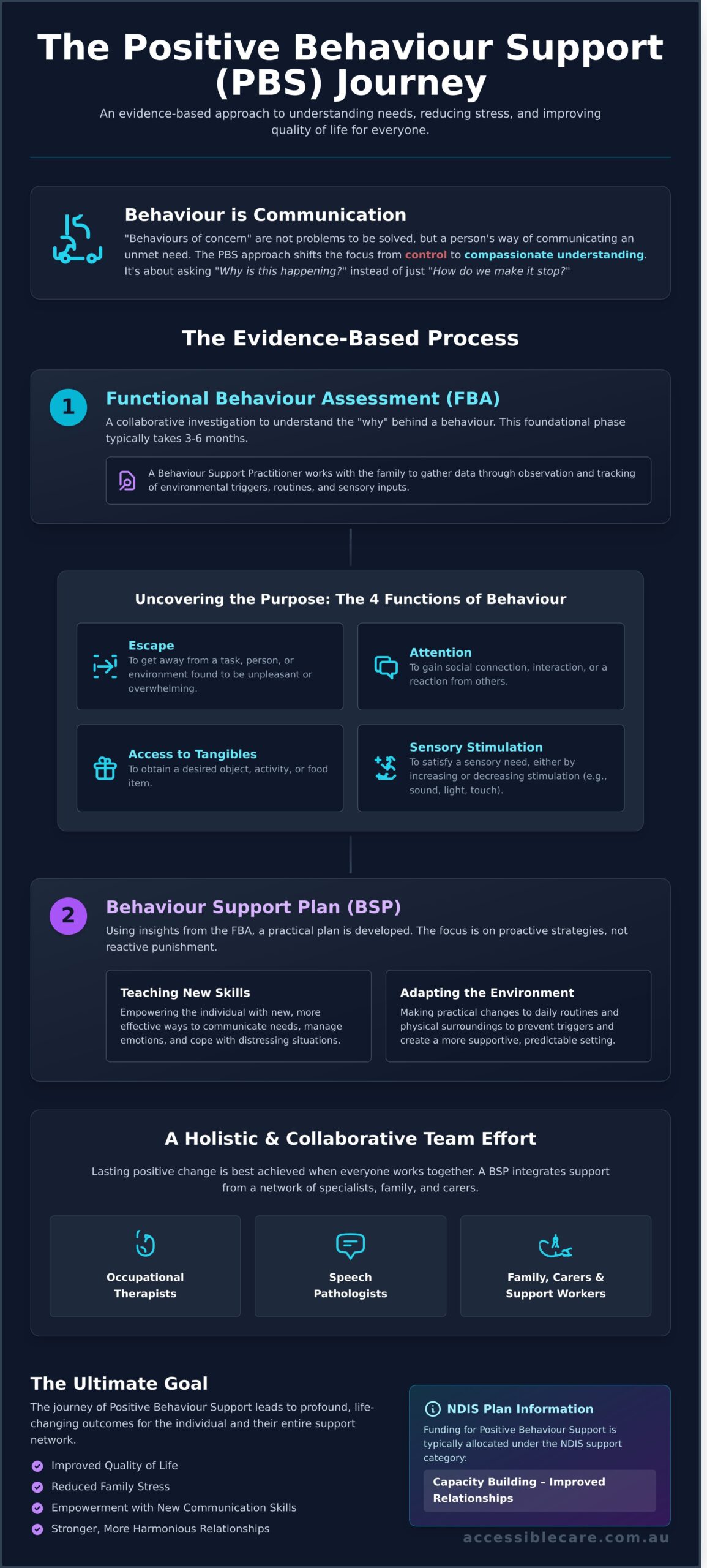
Their work is guided by a compassionate and person-centred philosophy. At its core is the belief that every ‘behaviour of concern’ is a form of communication. It’s a person’s way of expressing an unmet need, whether that’s a need for safety, connection, or a way to cope with overwhelming sensory input. This fundamental shift moves the focus from control to understanding, from reaction to proactive support. It’s about asking “Why is this happening?” instead of just “How do we make it stop?”.
To ensure the highest standards of safety and care, all practitioners delivering these NDIS-funded services must be registered with the NDIS Quality and Safeguards Commission. This registration, a requirement since the commission’s full implementation across Australia in 2020, guarantees that the support you receive is ethical, evidence-based, and upholds the rights and dignity of every participant.
The Difference Between PBS and Traditional Therapy
While both aim to improve wellbeing, the approach of a behaviour support practitioner is distinct from standard psychology or counselling. They use an evidence-based framework known as Positive Behaviour Support (PBS). Instead of focusing solely on the individual in a clinical setting, PBS looks at the whole person and their environment. The practitioner works collaboratively in the places where life happens, like at home, school, or in the community. It’s a proactive approach designed to teach new skills and adapt the environment to prevent distress, rather than simply reacting after a challenging situation occurs.
Who Needs a Behaviour Support Practitioner?
A family or individual might seek this specialised support when a person shows signs of significant distress that impact their safety or ability to engage with their community. Common scenarios include:
- Actions that risk harm, such as self-injury or aggression towards others.
- Behaviours that cause damage to property.
- Significant social withdrawal or difficulty building relationships.
Within an NDIS plan, funding for this service is typically allocated under the ‘Capacity Building – Improved Relationships’ support category. A practitioner doesn’t just work with the participant; they provide crucial guidance and training for the entire support network, including family, carers, and support workers. This ensures everyone has the tools and confidence to create a consistent, positive, and empowering environment for the person they care for.
The Evidence-Based Process: Functional Behaviour Assessment (FBA)
When you work with a behaviour support practitioner, you are partnering with a professional who relies on evidence, not guesswork. Understanding behaviour is a careful and respectful process. It’s not about judgment; it’s about discovery. The foundation of every successful Behaviour Support Plan (BSP) is a thorough investigation called a Functional Behaviour Assessment (FBA).
Think of the FBA as a collaborative effort to understand the ‘why’ behind a behaviour. Your practitioner will spend time observing, listening, and gathering information to identify patterns. They look for specific ‘triggers’ (what happens right before a behaviour) and the ‘function’ or purpose the behaviour serves for the person. This deep understanding is crucial for creating strategies that are truly helpful and respectful of the individual’s needs. The initial 3-6 months of engagement are dedicated to this foundational work, ensuring the resulting plan is built on a solid understanding of the person and their environment.
How Data Collection Works in a Home Setting
Gathering information doesn’t have to feel clinical or overwhelming. Families are the experts on their loved ones, and their insights are invaluable. Simple tracking can involve making a brief note in a diary or on a phone about what was happening before, during, and after a behaviour of concern. A skilled behaviour support practitioner will guide you on what to look for, focusing on the environment, such as sensory inputs like loud noises or bright lights, or changes in routine. This process of understanding the ‘why’ is what the NDIS calls a Functional Behaviour Assessment, as detailed in the official NDIS guideline on behaviour support. The goal is to identify which of the four main functions the behaviour is meeting:
- Escape: To get away from a task, person, or environment they find unpleasant.
- Attention: To gain social connection or a reaction from others.
- Tangible: To get access to a preferred item or activity.
- Sensory: To receive sensory stimulation or relieve a state of sensory discomfort.
Developing the Positive Behaviour Support Plan
Once enough data is gathered, the practitioner develops the Behaviour Support Plan (BSP). An interim BSP may be created within the first month to address any immediate safety concerns. The comprehensive BSP is a more detailed, long-term document developed over the next few months. It’s a roadmap for positive change.
A key part of this plan is creating ‘replacement behaviours’. These are new, safer skills that meet the same need. For example, if a person throws items to escape a noisy room (function = escape), the plan might focus on teaching them to use noise-cancelling headphones or to ask for a “quiet break”. The behaviour support practitioner doesn’t just write the plan and leave. They play a vital, hands-on role in training family members and support workers to implement these strategies consistently and with confidence. This hands-on training and partnership is central to how our compassionate practitioners work with families, empowering everyone involved to create a more supportive and positive environment.
A Holistic Approach: PBS, Occupational Therapy, and Speech Pathology
Behaviours of concern rarely exist in a vacuum. They are often a person’s most effective way of communicating an unmet need, a frustration, or a sensory overload. A truly effective Positive Behaviour Support (PBS) plan looks beyond the behaviour itself to understand the whole person and their environment. This is why a skilled behaviour support practitioner doesn’t work alone. They act as a central point, collaborating closely with other allied health professionals to build a complete picture of support.
At Accessible Care, we believe in this integrated model because we’ve seen it create lasting, positive change for our participants in Melbourne and Adelaide. By bringing together the expertise of Speech Pathologists and Occupational Therapists, we address the root causes of behaviour, rather than just managing the symptoms. This collaborative approach is built on a foundation of dignity, respect, and a deep commitment to understanding each person’s unique world.
The Speech Pathology Connection
Imagine not being able to ask for a drink, say you’re in pain, or tell someone you need a quiet moment. This is the reality for many individuals with communication barriers, and the resulting frustration is a primary driver of challenging behaviours. Augmentative and Alternative Communication (AAC) provides a direct voice for individuals, empowering them to express their needs clearly and proactively, which can drastically reduce behaviours born from frustration. For example, a non-verbal participant we support previously expressed being overwhelmed by throwing items. After working with an NDIS Speech Therapist Melbourne, he now uses a tablet with a communication app. A simple tap on an icon for “I need a break” has replaced the throwing, reducing these incidents by over 75% in his first three months with the device.
The Occupational Therapy Connection
Our sensory system is how we interpret and interact with the world. For some NDIS participants, this system can be overwhelming. Lights might feel too bright, sounds too loud, or textures unbearable. Behaviours like rocking, humming, or retreating can be attempts to self-regulate in a world that feels chaotic. This is where an Occupational Therapist (OT) provides vital support. They can design sensory diets, which are personalised plans of activities that provide the right sensory input at the right times, and recommend environmental modifications to reduce triggers. A behaviour support practitioner and an OT work together to create powerful emotional regulation tools. When our teams see a behaviour that serves a sensory function, an Occupational Therapy Adelaide professional can introduce strategies like weighted blankets or quiet spaces, reducing the ‘need’ for the behaviour and teaching healthier coping skills instead.
This teamwork ensures that every angle of a participant’s well-being is considered. It moves the focus from “how do we stop this behaviour?” to “what is this person trying to tell us, and how can we help them?”. By listening and working together, we build a support system that fosters communication, enhances regulation, and ultimately empowers individuals to live the life they choose.
Working with a Practitioner: What to Expect in Melbourne and Adelaide
Beginning your journey with a behaviour support practitioner can feel like a big step. You’re inviting someone into your life to understand your family’s unique challenges and goals. It’s about more than just finding a qualified professional; it’s about finding someone who listens, understands your values, and feels like a true partner. The right practitioner builds a relationship based on trust and respect, empowering you every step of the way.
The process is practical and person-centred. It often begins with conversations and observations in the environments where support is most needed. This could mean home visits in Melbourne suburbs like Essendon or school observations in Adelaide communities like Morphett Vale. Your practitioner works to understand the whole picture, always with your consent. Remember, you are in control. You have the right to give informed consent for any assessment or strategy, choose who is involved, and request a review of your plan at any time. It’s your life and your choice.
Navigating Restrictive Practices and Audits
The NDIS Commission has clear rules to protect participants. A key role for any behaviour support practitioner is to help reduce and eliminate the use of ‘regulated restrictive practices’. These are actions that limit a person’s rights or freedom of movement, and the ultimate goal is always to find safer, more positive alternatives. At Accessible Care, we navigate this complex process with the utmost dignity and respect, ensuring every participant’s rights are protected while working towards positive outcomes.
Local Support: Melbourne and Adelaide Context
Finding the right local support looks different depending on where you live. A family in metropolitan Melbourne may have a wider choice of practitioners compared to someone in regional South Australia. We understand these local realities and work to build a support network that fits your life. This can include collaborating with local community nursing teams, especially when behaviours may be linked to underlying medical needs. Your NDIS plan is built on ‘choice and control,’ and that extends to choosing a local team you trust. Talk to us today to find a compassionate behaviour support practitioner in your area.
Choosing Accessible Care for Positive Behaviour Support
Finding the right support for yourself or a loved one is a significant decision. It’s about more than just managing behaviours; it’s about finding a partner who sees the whole person and is committed to fostering a life of dignity, choice, and independence. At Accessible Care, our entire approach is built on one simple, powerful belief: you are not your behaviour. Your actions are a form of communication, and our job is to listen, understand, and work alongside you to build a better path forward.
We empower participants by creating tailored strategies that build skills and confidence. Our multidisciplinary teams across Victoria and South Australia bring together diverse expertise to develop compassionate, evidence-based support. We don’t believe in one-size-fits-all solutions. Instead, every strategy is co-designed with you, ensuring it aligns with your personal goals and enhances your quality of life. Your journey to independence is our shared goal.
The Accessible Care Difference
Our commitment begins with listening. We prioritise your voice, ensuring you feel heard, respected, and valued throughout the entire process. Our teams have extensive experience, with more than 15 years of combined practice in supporting individuals with complex needs, including Acquired Brain Injury (ABI) and high-intensity daily personal activities. We understand the nuances of challenging situations and approach them with skill and genuine empathy.
“For the first time, we felt truly heard. The team at Accessible Care didn’t just look at reports; they took the time to understand our son as an individual. That has made all the difference.”
Get Started Today
Transitioning your NDIS plan into an active support program shouldn’t be complicated. We’ve made our intake process simple, direct, and supportive, so you can get the help you need without unnecessary stress. It starts with a simple conversation. A skilled behaviour support practitioner will take the time to understand your circumstances and explain how we can help. The process typically involves:
- An initial, confidential chat to discuss your needs and goals.
- A comprehensive assessment to understand the function of specific behaviours.
- The collaborative development of a Positive Behaviour Support Plan.
- Ongoing support and training for you, your family, and your support network.
If you’re ready to partner with a provider who puts you first, our teams in Melbourne and Adelaide are here for you. We invite you to reach out for a pressure-free, confidential discussion about your needs. Let’s work together to create positive, lasting change. Empower your journey-get in touch with our Behaviour Support team today.
Begin Your Journey to Positive Behaviour Support
Navigating the path to effective support begins with understanding. A behaviour support practitioner doesn’t just address actions; they seek to understand the reasons behind them using evidence-based tools like a Functional Behaviour Assessment. This person-centred approach ensures that support strategies are not only effective but also delivered with dignity and respect, enhancing skills and improving quality of life for everyone involved.
Choosing the right partner is crucial. At Accessible Care, we are a registered NDIS provider with a dedicated, multidisciplinary team of Occupational Therapists, Speech Pathologists, and practitioners who specialise in high intensity and complex care. We listen first, creating tailored plans that empower you and your family.
If you’re ready to see how a compassionate, professional team can help, we invite you to take the next step. Book a Consultation with a Compassionate Practitioner and let’s build a more positive future, together.
Frequently Asked Questions
What exactly is a behaviour support practitioner?
A behaviour support practitioner is a qualified professional who helps understand why a person uses challenging behaviours. They work closely with the individual, their family, and their support team to develop a Positive Behaviour Support plan. This plan is designed to improve the person’s quality of life and teach new skills, which reduces the need for concerning behaviours. All practitioners must be registered with the NDIS Quality and Safeguards Commission.
Is behaviour support only for children with autism?
No, behaviour support is not just for children with autism. It is a valuable support for people of all ages with a wide range of disabilities where challenging behaviours are present. This includes individuals with intellectual disabilities, acquired brain injuries, and other complex support needs. The focus is always on understanding the person’s unique needs and communication style, not on their diagnosis. The goal is to empower the individual, regardless of their age or condition.
How much does an NDIS behaviour support practitioner cost?
The cost is set by the NDIS Pricing Arrangements and Price Limits, so you won’t have out-of-pocket expenses if you have funding. As of the 2023-24 NDIS Price Guide, the rate for a practitioner (Level 2) is A$214.41 per hour, while a specialist practitioner (Level 3) is A$234.83 per hour. These funds are paid directly from the ‘Improved Relationships’ budget in an NDIS participant’s plan.
What is the difference between a psychologist and a behaviour support practitioner?
The main difference is their primary focus and the scope of their work. A psychologist can diagnose and treat mental health conditions using therapies like CBT. A behaviour support practitioner focuses specifically on identifying the function of challenging behaviours and creating practical, hands-on strategies to implement within a Positive Behaviour Support plan. While some professionals have dual qualifications, the roles are distinct in the NDIS framework.
Can a behaviour support practitioner help reduce the use of medication?
Yes, a key goal of positive behaviour support is to reduce and, where possible, eliminate restrictive practices, which can include certain medications used for behaviour management. By understanding why a behaviour is happening and teaching new ways to communicate, the triggers can be reduced. This often decreases the need for medication. This process is always managed carefully in collaboration with the person’s doctor or psychiatrist to ensure it is done safely.
How long does it take to see results from a Positive Behaviour Support plan?
The timeline for seeing results is different for everyone because each plan is highly personalised. You might notice small, positive shifts within a few weeks as new strategies are introduced by your support team. However, building lasting skills and creating significant change is a gradual process that often takes between 3 to 6 months of consistent effort. Patience and teamwork are key to achieving long-term success and improving quality of life.
What happens if the behaviour support plan isn’t working?
A behaviour support plan is a dynamic document that is reviewed regularly, typically every 3 to 6 months. If a plan isn’t getting the expected results, your practitioner will meet with you to reassess the situation. They will analyse new data and talk with your support network to adjust the strategies. It’s not about failure; it’s a collaborative process of finding exactly what works best for you or your loved one.
Do I need a specific line item in my NDIS plan to access this?
Yes, to access a behaviour support practitioner through the NDIS, you need funding in the ‘Improved Relationships’ support category. The specific line item is called ‘Specialist Behavioural Intervention Support’. If this isn’t in your current plan, you can request it at your next plan review. You will need to provide evidence, like a letter from your doctor, explaining why this support is reasonable and necessary for you.

