


Navigating your NDIS journey can feel overwhelming, especially when you hear terms like multidisciplinary team and wonder what they mean for you. Are you juggling different therapists and appointments, worried that they aren’t communicating with each other? Do you feel concerned that your unique goals might get lost in the process?
This collaborative approach is designed to solve exactly those challenges. It’s about bringing a dedicated group of experts—like occupational therapists, speech pathologists, and support coordinators—together to build a circle of care around you. They don’t just work for you; they work with you and with each other, ensuring everyone is on the same page.
In this compassionate guide, we will simply explain how this model of care works. You’ll gain a clear understanding of how a united team puts you at the heart of every decision, helping you feel more confident, supported, and empowered on your NDIS journey. Your choice, your goals, your way.
Key Takeaways
- Understand how different health professionals work together as one team, creating a single, coordinated care plan focused entirely on you.
- Discover your vital role as the “team captain” and learn how to guide your care to ensure your voice is always heard.
- Find out which allied health professionals could be on your multidisciplinary team and how they collaborate to support your unique NDIS goals.
- Explore the benefits of coordinated care, which can lead to a more seamless and less stressful NDIS journey for you and your family.
Beyond the Jargon: What a Multidisciplinary Team Really Means for You
Navigating the world of NDIS support can feel overwhelming, especially with all the different terms. But when we talk about a multidisciplinary team, the idea is actually quite simple and powerful. Let’s gently break down what a multidisciplinary team really means for you. At its heart, it’s a dedicated group of professionals from different fields—like an Occupational Therapist, a Speech Pathologist, and a Behaviour Support Practitioner—all working together, for you.
Instead of seeing separate specialists who don’t communicate, this approach brings everyone to the same table to create one coordinated care plan. It’s about looking at the whole person, not just a single need. Think of it like a sports team: each player has a unique skill, but they all share the same playbook and work together to achieve a single goal. In your journey, that goal is your wellbeing and independence.
This philosophy of treating the whole person is central to many approaches to wellbeing. For instance, the team at Holistic Family Practice applies a similar integrated mindset to functional medicine, viewing the body as an interconnected system.
Why is this approach important in the NDIS?
A collaborative team approach is fundamental to making the most of your NDIS plan. It’s designed to put you at the centre of your care, ensuring every support is connected and purposeful. The key benefits include:
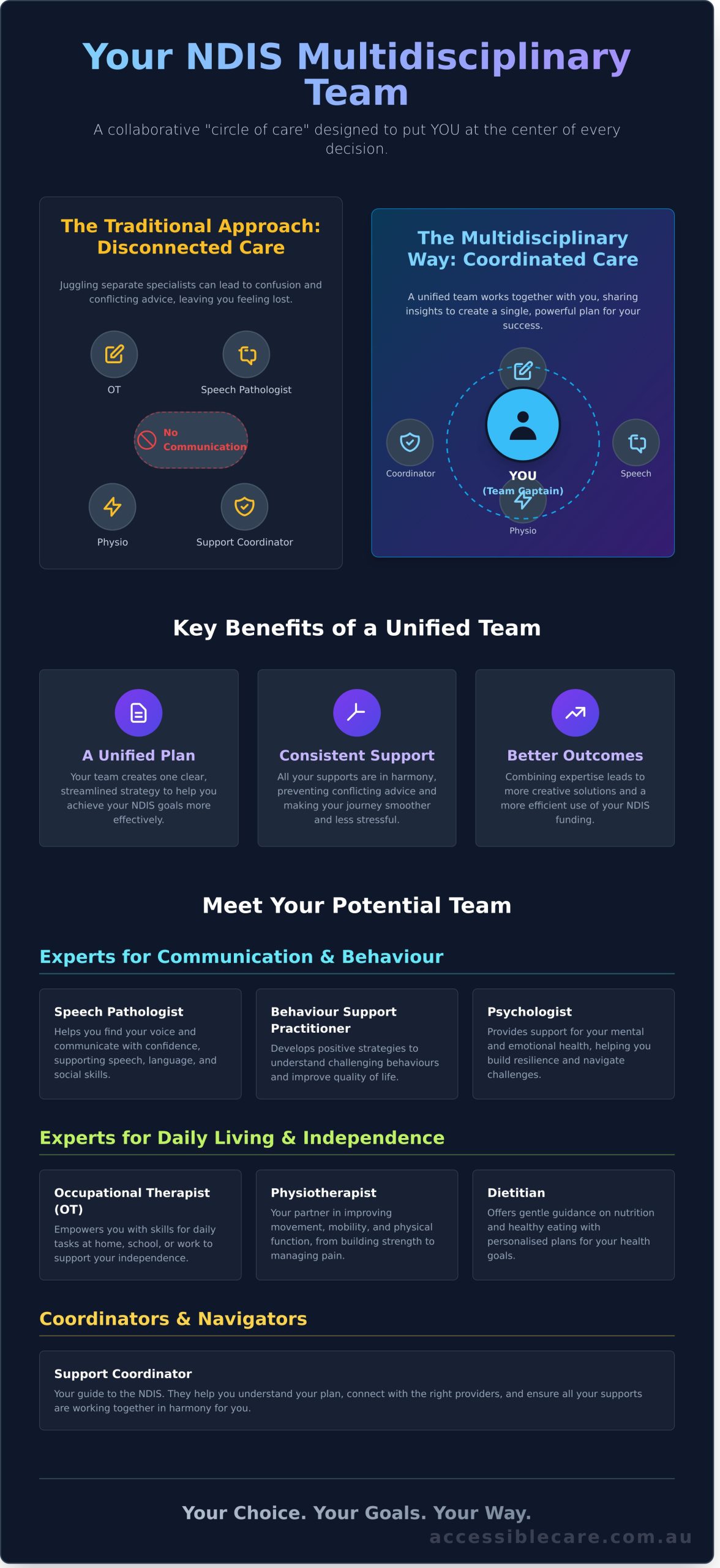
- A Unified Plan: Your team works together to create a clear, streamlined strategy to help you achieve your NDIS goals more effectively.
- Consistent Support: It ensures all your supports are in harmony, preventing conflicting advice and making your journey smoother.
- Better Outcomes: By combining their expertise, your team can often find more creative and effective solutions, leading to better results and a more efficient use of your NDIS funding.
The difference between multidisciplinary and other team models
You may also hear terms like ‘interdisciplinary’ or ‘transdisciplinary’. While there are subtle differences in how deeply the team members integrate their work, please don’t feel you need to get lost in the definitions. The core principle is always the same: collaboration for your benefit. The most important thing is that you have a team of caring professionals who talk to each other, share insights, and listen to you. This ensures your support is truly person-centred, just as it should be.
Who Is on Your Team? Meet the Allied Health Professionals
Your NDIS journey is unique, and so is the multidisciplinary team that supports you. This team isn’t a one-size-fits-all solution; it’s a group of caring professionals carefully chosen to help you achieve your specific goals. The people involved depend entirely on what you want to accomplish, whether that’s building independence, improving communication, or enhancing your wellbeing.
Remember, you don’t need every professional on this list. Your team is built around you, with you, for you. Let’s meet some of the dedicated allied health experts who could become part of your support network.
Experts for Communication and Behaviour
These professionals focus on helping you connect with others, express yourself, and manage your emotional wellbeing with dignity.
- Speech Pathologist: A caring expert who supports you with speech, language, social skills, and even challenges with eating or drinking. They help you find your voice and communicate with confidence.
- Behaviour Support Practitioner: Works with you and your family to understand why challenging behaviours occur and develops positive strategies to improve quality of life for everyone.
- Psychologist: A trusted professional who provides support for your mental and emotional health, helping you build resilience and navigate life’s challenges.
Finding the right mental health professional is key, and sometimes specialized, virtual care is the best fit. For example, a Women’s Mental Health Specialist can provide hormone-informed support tailored to unique female experiences, making expert care accessible from anywhere.
Experts for Daily Living and Independence
This group is dedicated to empowering you with the skills and support needed for greater independence in your daily life.
- Occupational Therapist (OT): Helps you develop or regain skills for tasks at home, school, or work. From cooking a meal to using a computer, an OT supports your independence.
- Physiotherapist: Your partner in improving movement, mobility, and physical function. They assist with everything from building strength to managing pain.
- Dietitian: Offers gentle guidance on nutrition and healthy eating, creating personalised plans that support your overall health goals.
Coordinators and Navigators
Think of these professionals as the ones who help bring everything together, ensuring your plan works smoothly for you.
- Support Coordinator: Your guide to the NDIS. They help you understand your plan, connect with the right providers, and ensure all your supports are working in harmony. This coordination is central to how your team works together effectively.
- Community Nurse: Provides skilled care for complex health needs right in the comfort of your own home, ensuring your health is managed with compassion and expertise.
- You and Your Family: Without a doubt, you are the most important members of the team! Your voice, choices, and goals are at the heart of every decision.
How Your Team Works Together: The Power of Coordinated Care
One of the most common worries we hear from NDIS participants is, “Will my therapists actually talk to each other?” It’s a valid concern. Juggling multiple appointments is hard enough without having to be the messenger between them. With a true multidisciplinary team, the answer is a reassuring yes. The very foundation of this approach is collaboration.
Instead of separate professionals working in isolation, your team works from a single, shared care plan. This plan is built around what matters most: your goals. This coordinated approach ensures every specialist understands the complete picture of your needs and aspirations, giving you and your family peace of mind that everyone is working towards the same outcomes.
Setting Shared Goals
The process begins with you. Your team takes the time to listen and conduct a holistic assessment to understand your unique strengths, challenges, and what you want to achieve. From there, they collaborate with you to set clear, achievable goals. This means your support is not just effective, but also meaningful.
- Example in action: A child’s goal might be school readiness. An Occupational Therapist could work on fine motor skills for writing, while a Speech Pathologist helps with communication and following instructions. They share insights to create a unified strategy, making progress faster and more consistent.
Regular Communication and Reviews
Strong, regular communication is the engine that drives a successful multidisciplinary team. Your supports are not “set and forget.” Progress is carefully tracked, and team members provide frequent updates to ensure everyone is on the same page. This happens through:
- Team Meetings (Case Conferences): Regular meetings where your therapists, support coordinator, and other professionals discuss your progress, celebrate achievements, and solve challenges together. You are always invited to be a central part of these conversations.
- Shared Reports and Calls: Ongoing communication ensures that an insight from one therapist can immediately inform the strategy of another.
Your plan is a living document, designed to be flexible. As you reach your goals or your needs change, your team reviews and adapts your plan, ensuring your support always aligns with your life and your choices.
Your Role as Team Captain: How to Get the Most from Your Care
While a team of skilled professionals is essential, it’s important to remember the most valuable member of your care team: you. You are the expert on your own life, your experiences, and your aspirations. Your NDIS journey is uniquely yours, and your multidisciplinary team is there to support your vision, not to direct it. Embracing your role as team captain empowers you to move from being a passive recipient of care to an active partner in achieving your goals.
Your voice, choices, and goals are the compass that guides every decision. Here are a few simple ways to ensure you get the most from your collaborative care.
Preparing for Team Meetings
Feeling prepared can help you communicate with confidence and clarity. Before meeting with your team, taking a few moments to gather your thoughts can make a world of difference. This ensures your time together is focused, productive, and centred on what matters most to you.
- Write down your questions. It’s easy to forget things in the moment. Keep a running list of questions or concerns as they come to you.
- Reflect on your progress. Think about what strategies are working well and what isn’t. What feels good? What challenges have you faced?
- Bring a support person. You are always welcome to bring a trusted family member, friend, or advocate to meetings for extra support and to help you voice your thoughts.
Communicating Your Needs and Preferences
Open and honest communication is the foundation of a successful partnership with your care team. Your team members are there to listen and adapt their approach to fit your unique needs. Never feel like you have to go along with a plan that doesn’t feel right.
- Share your goals openly. Be clear about what you want to achieve, both big and small. The more your team understands your vision, the better they can support you.
- Provide honest feedback. If a therapy or strategy isn’t working for you, it’s crucial to say so. This isn’t criticism; it’s valuable information that helps your team find a better way forward.
- Ask for clarification. If you hear a term or an explanation you don’t understand, please ask. There are no silly questions when it comes to your health and well-being.
Remember, a dedicated multidisciplinary team works for you. At Accessible Care, we believe in building support around your choices, because it’s your life, and it should be lived your way. Our compassionate professionals are here to listen and partner with you on your journey.
Building Your Team with Accessible Care in Melbourne & Adelaide
Understanding the power of a multidisciplinary team is the first step. At Accessible Care, we turn that concept into a compassionate, practical reality for NDIS participants across Melbourne and Adelaide. We believe you are the most important member of your own support network. That’s why we take a truly person-centred approach, building a dedicated team around your unique goals, needs, and aspirations, not the other way around.
Our goal is to provide local, accessible support that you can trust, empowering you to live life on your terms with a team that truly cares.
Our Coordinated Services
Managing multiple providers can be overwhelming. We simplify the process by offering key therapeutic and support services under one roof, creating a seamless and supportive experience. This integrated approach means your multidisciplinary team is always on the same page, working together for you.
- Collaborative Experts: Our Occupational Therapists, Speech Pathologists, and Behaviour Support Practitioners work hand-in-hand, sharing insights and strategies to support your overall wellbeing.
- Seamless Communication: We ensure regular communication between team members, so your progress in one area informs the support you receive in another.
- Reduced Stress: This saves you the time and stress of coordinating appointments and relaying information, allowing you to focus on what truly matters—your goals and your independence.
Start the Conversation Today
We are guided by a simple but powerful principle: ‘Your choice, your life, your way’. Assembling the right supports begins with a conversation where you feel heard, understood, and respected. Our friendly and compassionate team is here to listen to your story and explore how we can help build the right support system with you.
Let us help you build a supportive, expert team dedicated to empowering your independence. To learn more about our person-centred services, get in touch with us today.
Building Your Team for a Brighter Future
Navigating the NDIS can feel complex, but you don’t have to do it alone. Remember, a well-coordinated multidisciplinary team is a powerful circle of support, with different allied health professionals working together towards your unique goals. Most importantly, you are the captain of this team. Your choices, voice, and aspirations are what truly steer the direction of your care, ensuring every step taken is a step towards the life you want to live.
If you’re in Melbourne or Adelaide and ready to build a support network that truly listens, Accessible Care is here to help. As a registered NDIS provider, our compassionate and experienced therapists are dedicated to helping you assemble the right team. We believe in care that respects your dignity and empowers your independence. Talk to our friendly team about building your support network.
Your journey is unique, and your support should be too. With the right people by your side, you can confidently move towards your goals. Remember: it’s your choice, your life, your way.
Frequently Asked Questions About Multidisciplinary Teams
What is the main purpose of a multidisciplinary team?
The main purpose is to provide you with holistic, coordinated support that looks at all aspects of your wellbeing. By bringing together professionals from different fields—like an Occupational Therapist, a Speech Pathologist, and a Psychologist—the team can create a single, comprehensive plan. This collaborative approach ensures all your needs are understood and your NDIS goals are supported from every angle, leading to more effective and person-centred outcomes that respect your choices.
What are the potential disadvantages of a multidisciplinary team approach?
While the benefits are significant, challenges can sometimes arise. Coordinating schedules for meetings can be difficult for everyone involved. Occasionally, different professionals might offer conflicting advice, which can be confusing. However, a skilled Support Coordinator can help manage these issues by facilitating clear communication and ensuring all recommendations are integrated into a cohesive plan that always puts your needs and goals first, ensuring you feel heard and supported.
Who typically leads a multidisciplinary team in an NDIS context?
In the NDIS, there isn’t one single rule for who leads the team. Often, your Support Coordinator takes on this role, organising meetings and ensuring communication flows smoothly between everyone. In other cases, a “key worker”—usually the therapist you see most often—might lead. Most importantly, you and your family are at the centre of the team. Your voice, choices, and goals are what guide every decision the team makes.
How often should a multidisciplinary team meet?
The frequency of meetings depends entirely on your unique needs and goals. When first developing a support plan or during a period of significant change, the team might meet more regularly, perhaps every few months. Once a stable routine is established, meetings might be less frequent, such as annually or as needed. The schedule should always be flexible and responsive to your circumstances, ensuring the support you receive is timely and relevant to your life.
What’s the difference between a multidisciplinary and an interdisciplinary team?
The difference is in how the team members work together. In a multidisciplinary team, professionals work alongside each other on their individual goals for you, sharing information but often working separately. An interdisciplinary team is more integrated. Team members collaborate closely to create shared goals and a single, unified support plan. Both models aim to provide comprehensive care, but the interdisciplinary approach involves a higher level of teamwork and joint planning.
Can I choose who is on my multidisciplinary team?
Absolutely. The NDIS is built on the principles of choice and control, and this extends to your support team. You have the right to choose the providers and therapists you want to work with. If you feel a particular professional isn’t the right fit, you can seek another. Your Support Coordinator can help you find and connect with skilled and compassionate professionals who align with your values and are best suited to help you achieve your goals.
Does NDIS funding cover the cost of multidisciplinary team meetings?
Yes, NDIS funding can typically cover the costs of these important meetings. The time your therapists and other professionals spend in case conferences or writing collaborative reports is usually billed against your ‘Capacity Building’ (Improved Daily Living) budget. It’s considered a necessary part of providing coordinated, high-quality support. It’s always a good idea to discuss this with your providers beforehand to ensure it aligns with your plan and budget.
How does a multidisciplinary team help with a Functional Capacity Assessment?
A Functional Capacity Assessment (FCA) is much stronger when it includes input from various professionals. A multidisciplinary team provides a complete, 360-degree view of your strengths, challenges, and support needs. For example, an OT can assess daily living skills, while a Speech Pathologist reports on communication. This collaborative evidence gives the NDIS a clear and comprehensive picture, helping to ensure your plan is funded appropriately to meet all of your goals.

