


If you’re feeling overwhelmed by complex government websites and confusing jargon while trying to learn about disability support, please know you are not alone. The journey to understanding the National Disability Insurance Scheme, or NDIS, can often feel complicated and filled with uncertainty. It’s natural to feel lost, wondering if you or your loved one is eligible, where to even begin the application process, or what kind of support is truly available. This uncertainty can be a heavy weight to carry.
We’re here to lift that weight. This guide was created with care to gently cut through the confusion and replace it with clarity and hope. We promise to provide a simple, compassionate explanation of what the NDIS is and how it works to put you in control of your support. We will walk you through the essential first steps, helping you feel confident and prepared. By the end, you’ll understand how the scheme can be a powerful tool for achieving personal goals, fostering independence, and empowering you to live the life you choose.
Key Takeaways
- Understand the NDIS as a way to gain more choice and control over your life, not just as a support payment.
- Discover the main eligibility requirements in a simple checklist to see if you or a loved one may qualify for support.
- See the entire NDIS journey broken down into four simple steps, from your initial application to reviewing your plan and goals.
- Learn how NDIS funding translates into real-world support, such as therapy, nursing, and activities that help you live more independently.
What is the NDIS? A Simple Explanation of How It Supports You
Navigating the world of disability support can feel overwhelming, but at its core, the National Disability Insurance Scheme is designed with a simple, compassionate purpose: to empower you. Think of the ndis not as a welfare system, but as a dedicated support fund to help you live a full and independent life. It’s built on the fundamental principles of choice and control, giving you the power to decide what support you need and who provides it.
The entire system is managed by the National Disability Insurance Agency (NDIA), an organisation created to ensure the scheme works for you. The National Disability Insurance Scheme (NDIS) provides funding directly to eligible individuals, known as participants, based on their unique needs, goals, and aspirations. Your journey is at the heart of everything it does.
The Goal of the NDIS: Living an Ordinary Life
The ultimate goal of the NDIS is to support you in participating in your community and pursuing the things that matter to you. This isn’t just about basic care; it’s about providing the resources you need to achieve your potential. This could mean funding for supports that help you get a job, learn new skills at TAFE or university, join a local sports team, or simply connect with friends and family more easily.
Person-Centred Care: Why Your Goals Matter Most
The NDIS operates on a ‘person-centred’ approach, which simply means that you are the expert on your own life. Unlike older, ‘one-size-fits-all’ models, your NDIS plan is tailored specifically to your individual circumstances and what you want to achieve. It starts with listening to your voice and understanding your goals, ensuring the support you receive is meaningful and helps you live with dignity and respect, your way.
Who is the NDIS For? Understanding the Eligibility Criteria
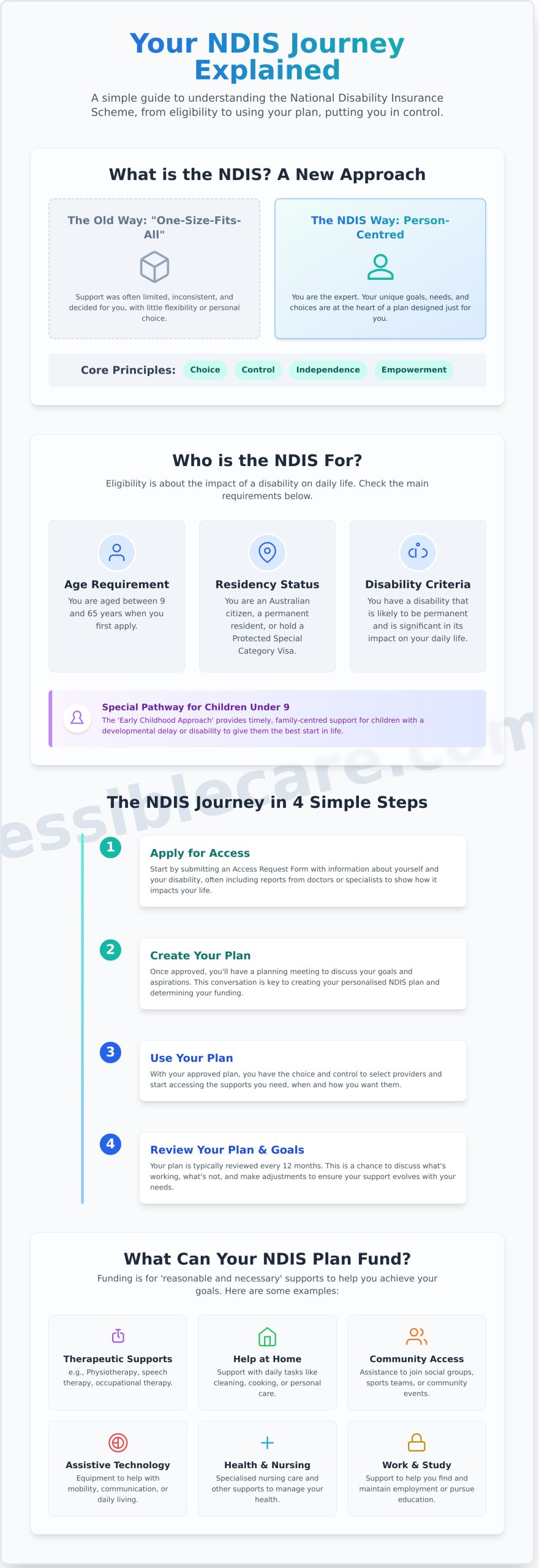
Thinking about eligibility for the NDIS can feel overwhelming, but we are here to help you understand the path forward. It’s important to remember that eligibility is not just about a specific diagnosis; it’s about the impact a disability has on your daily life. The goal is to provide the right support to help you live with more independence and choice. To make it clearer, let’s gently walk through the main requirements, which are outlined in the official NDIS eligibility criteria.
The Main Requirements at a Glance
To access support through the ndis, you generally need to meet the following requirements. Think of it as a simple checklist to get started:
- Age: You are aged between 9 and 65 years when you first apply. (There is a dedicated pathway for children under 9, which we’ll cover below).
- Residency: You are an Australian citizen, a permanent resident, or hold a Protected Special Category Visa.
- Disability: You have a disability that is likely to be permanent and is significant in its impact on your life.
What Does ‘Permanent and Significant Disability’ Mean?
These terms can sound clinical, but their meaning is rooted in compassion. ‘Permanent’ simply means your disability is lifelong. ‘Significant’ means it affects your ability to participate in everyday activities. This might involve needing support with:
- Self-care: Such as help with personal tasks like getting dressed or preparing meals.
- Mobility: Needing assistance to move around your home or community safely.
- Communication: Requiring support to express your needs or understand others.
The focus is always on your personal circumstances and the support you need to pursue your goals. Navigating this part of the process is something you don’t have to do alone; compassionate support is available to guide you.
The Early Childhood Approach for Children Under 9
For children under 9 with a developmental delay or disability, there is a special pathway called the Early Childhood Approach. This approach is designed to provide timely, family-centred support to give children the best possible start in life. It connects families with early childhood partners who understand child development and can help you access the right supports quickly, fostering growth and building capacity from a young age.
How Does the NDIS Work? Your Journey Explained in 4 Simple Steps
Starting your journey with the National Disability Insurance Scheme can feel like a big step, but it’s a path designed to support you, not overwhelm you. Think of it as a partnership built around your goals and needs. The process is a structured way to ensure you get the right support to live a more independent and fulfilling life. For a great overview, the NSW Government explains what the NDIS is and how it empowers people. Let’s walk through your journey together, one step at a time.
Step 1: Applying for the NDIS
Your journey begins with an access request. This involves providing information to the NDIA to confirm your eligibility. You will need evidence from your doctor, therapist, or other specialists. Most importantly, this is your opportunity to share your story-how your disability impacts your daily life, your relationships, and your ability to participate in the community. Be open and detailed; this helps the NDIA understand your unique support needs.
Step 2: Your First NDIS Plan and Planning Meeting
Once your access is approved, you’ll have a planning meeting. This is a conversation, not a test. A representative will chat with you about your goals and aspirations. What do you want to achieve? Perhaps it’s learning a new skill, joining a local club, or needing more help at home. Preparing your goals beforehand is key. The outcome is your first NDIS plan, a document that outlines your goals and the funding you’ll receive to achieve them.
Step 3: Using Your NDIS Funding
With your plan in place, you are in control. You have the choice and flexibility to use your funding in a way that best suits you. There are three ways to manage your funds:
- Self-managed: You manage the funding directly.
- Plan-managed: A Plan Manager pays your providers for you.
- NDIA-managed: The NDIA pays your providers directly.
You then choose the providers who will help you achieve your goals. It’s all about finding the right fit, and you have the right to engage compassionate providers like Accessible Care who listen and put your needs first. Your choice, your life, your way.
Step 4: Your Plan Review
Your NDIS plan is a living document. It’s typically reviewed every 12 months to make sure it’s still working for you. This review is a positive opportunity to discuss what’s going well and what might need adjusting. If your needs or goals change throughout the year, your plan can change with you. It’s an ongoing conversation to ensure your supports continue to empower you to live the life you choose.
What Kind of Support Can the NDIS Fund?
The NDIS is designed to give you choice and control over the support you receive. It can fund a wide range of services and items, as long as they are considered ‘reasonable and necessary’ to help you pursue your goals. In simple terms, this means the support must be directly related to your disability, help you live a more independent life, and be value for money.
Understanding how this funding is structured is the first step to making your plan work for you.
Understanding the 3 Support Budgets
Your NDIS plan is organised into three main support budgets. Each one is designed for a different purpose, giving you flexibility in how you achieve your personal goals.
- Core Supports: This budget is for the essentials of daily living. It can fund a support worker to help with personal care, assistance with household tasks, or support to get out and participate in your community.
- Capital Supports: This covers bigger-picture investments that improve your independence, such as assistive technology (like a specialised wheelchair) or modifications to your home or vehicle to make them more accessible.
- Capacity Building: This budget is focused on your future. It funds supports that help you learn new skills and become more independent, such as therapies, training, or finding a job.
Examples of ‘Reasonable and Necessary’ Supports
The supports funded by the ndis are always tailored to your individual needs. Some common examples include:
- Therapies like Occupational Therapy to help you master daily tasks or Speech Pathology to improve communication.
- A dedicated support worker to assist with personal care with dignity and respect.
- Skilled community nursing care to help you manage complex health needs at home.
- Assistive technology that empowers you to communicate or move more freely.
How to Choose and Work with NDIS Providers
An NDIS provider is the organisation or individual who delivers your funded supports. Finding the right provider is about more than just services; it’s about finding a partner who listens, understands your vision for your life, and respects your choices. You can choose from registered providers, who have met strict government quality and safety standards, or unregistered providers if your plan is self or plan-managed.
Your choice, your life, your way. Finding the right partner on your journey is key. Our caring team is ready to help you achieve your goals.
Your Partner on Your NDIS Journey
We hope this guide has helped simplify what can feel like a complex system. At its heart, the NDIS is about empowering you with the choice and control to live a fuller, more independent life. Understanding the ndis is the first step, putting you on the path to accessing the supports you need to achieve your personal goals and build a life you love.
You don’t have to navigate this journey alone. As a registered NDIS provider, Accessible Care is built on a person-centred approach, meaning your goals are always our priority. Our experienced therapists and dedicated support staff are here to listen and provide the compassionate guidance you deserve, every step of the way.
Ready to explore your options? Speak with our compassionate NDIS team in Melbourne or Adelaide today. Taking that next step is a powerful move towards the future you choose.
Frequently Asked Questions About the NDIS
What is the difference between the NDIS and the Disability Support Pension?
These two supports serve different purposes but can work together. The Disability Support Pension (DSP) is an income support payment from Centrelink, designed to help with general living costs like rent and bills. The NDIS, however, provides funding for specific, reasonable and necessary supports and services. This funding helps you achieve your goals, such as accessing therapy, getting assistive technology, or having a support worker assist you in the community.
How long does it take to get an NDIS plan after applying?
The journey to getting your first plan has a few steps. After you submit your application, the NDIA aims to decide on your eligibility within 21 days. If you are accepted into the scheme, a planning meeting will be scheduled to discuss your goals and needs. From there, your first plan is typically developed. While timelines can vary, this process is designed to be as supportive and efficient as possible for you and your family.
Can I choose my own support workers and therapists with NDIS funding?
Yes, absolutely. The NDIS is built on the principle of choice and control, empowering you to live life your way. You have the right to choose the providers, therapists, and support workers who best fit your needs and personality. This ensures your support team is one you trust and feel comfortable with, helping you to build strong, positive relationships as you work towards your personal goals. Your choice is always at the centre of your plan.
What should I do if my NDIS application is not successful?
Receiving this news can be disheartening, but please know there are clear next steps. You can contact the NDIA to ask for the reasons for their decision in writing. You then have the right to request an internal review of that decision. We recommend connecting with a Local Area Coordinator (LAC) or a disability advocacy service. They can provide compassionate guidance and support you through this process with care and respect.
Is the NDIS the same in every state of Australia?
Yes, the NDIS is a single, national scheme that operates under the same rules across all Australian states and territories. This means the eligibility requirements and the way funding is assessed are consistent, no matter where you live. While the local organisations that partner with the NDIA to deliver services may differ from region to region, the core principles and participant rights of the ndis remain the same for everyone, ensuring fair and equal access.
Do I have to pay for the NDIS?
No, you do not have to pay to access the NDIS. The scheme is funded by the Australian Government to support people with a permanent and significant disability. Once your plan is approved, the funding for all the reasonable and necessary supports included in it is provided for you. This gives you and your family peace of mind, allowing you to focus on accessing the care and services you need to thrive.
Can the NDIS help me find a job or study?
Yes, the NDIS can be a wonderful partner in helping you achieve your employment and education goals. Your plan can include funding for supports that build your skills and capacity for work or study. This might include funding for a support worker to help you travel to university, specialised job coaching, or assistive technology to use in the workplace. It’s all about providing tailored support to help you pursue your ambitions with confidence.

