


What if the most difficult moments in your day weren’t problems to be “fixed,” but messages waiting to be understood? It’s incredibly draining to feel judged by the community or lost in the maze of NDIS restrictive practice regulations. When you’re supporting someone with high-intensity needs, the weight of burnout can feel heavy; you just want a home that feels calm, safe, and supportive. Finding the right positive behaviour support melbourne shouldn’t add to your stress; it should be the partnership that finally helps you breathe easier.
We understand that behind every “challenging behaviour” is a person seeking connection, safety, or autonomy. In this guide, you’ll learn how a compassionate, evidence-based approach can reduce the need for restrictive practices and empower the people you love to lead more independent lives. We’ll look at how a clear, actionable plan can bring your whole support team together while ensuring everyone feels heard and respected. By focusing on quality of life and the latest 2026 NDIS standards, we’ll show you how to move from crisis management to a future filled with community participation and genuine peace of mind.
Key Takeaways
- Understand that challenging behaviours are often a form of communication and learn how Positive Behaviour Support focuses on quality of life rather than control.
- Discover how a Functional Behaviour Assessment (FBA) uses attentive listening to uncover the “why” behind specific actions without guesswork.
- Navigate the NDIS funding landscape to access positive behaviour support melbourne through the Capacity Building – Improved Relationships budget.
- Learn how a multidisciplinary team approach, combining PBS with nursing and therapy, creates a safer and calmer home environment for everyone.
- Move from crisis management to a clear, actionable plan that empowers independence and increases community participation for the participant.
What is Positive Behaviour Support (PBS) in Melbourne?
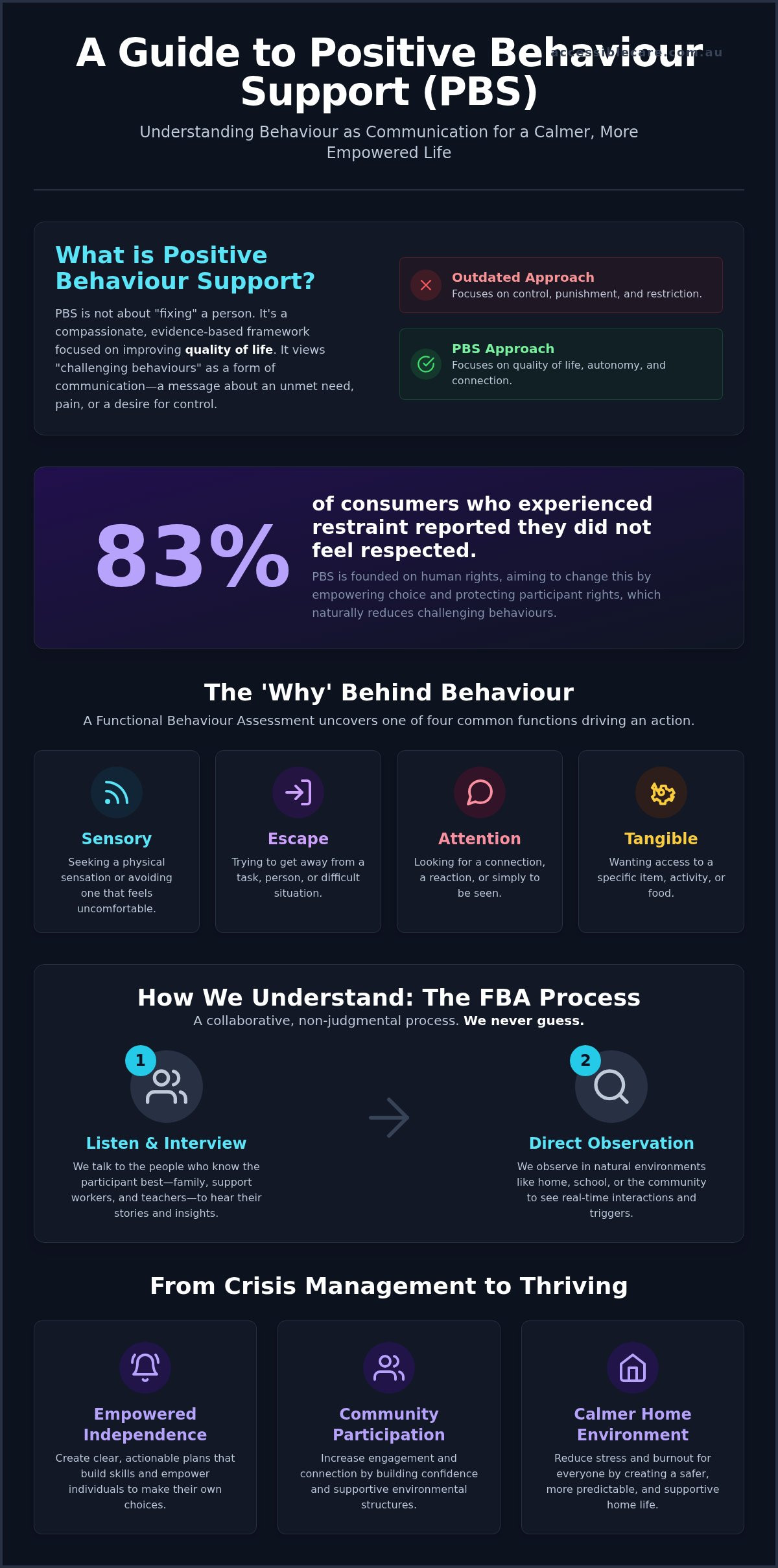
At its heart, positive behaviour support melbourne is about building a life that feels good to live. It isn’t a clinical intervention designed to “fix” a person; it’s a compassionate, evidence-based framework that focuses on improving a person’s quality of life. When we see “behaviours of concern,” we don’t see a problem to be managed. We see a message. Often, these behaviours are the only way someone has to communicate an unmet need, a feeling of pain, or a desire for control over their environment.
By using Positive behavior support, we move away from outdated, control-based methods that rely on punishment or restriction. Instead, we look at the environment and the skills a person needs to thrive. The goal is simple yet profound: we want to reduce the need for restrictive practices while increasing a person’s autonomy. In the Melbourne context, this means creating a supportive partnership where the participant’s voice is the loudest in the room. This approach ensures that every strategy is person-centred and designed to foster genuine connection and peace of mind.
The Core Philosophy: Autonomy and Rights
Human rights aren’t just a legal requirement; they’re the foundation of every support plan we create. A 2025 survey by Safer Care Victoria revealed that over 83% of consumers who had experienced restraint reported they did not feel respected. This is a heartbreaking statistic that we’re determined to change. We believe everyone in our Melbourne community deserves to make their own choices about how they live and who they spend time with. This philosophy aligns with the NDIS Quality and Safeguards Commission’s focus on protecting participant rights. When a person feels empowered to make their own decisions, the need for challenging behaviours often naturally decreases.
Who Can Benefit from PBS?
The Functional Behaviour Assessment (FBA): Understanding the “Why”
When a loved one experiences intense emotions or challenging actions, it’s natural to feel overwhelmed and exhausted. At Accessible Care, we believe in a core principle: we never guess. Guessing why a behaviour occurs often leads to strategies that don’t work, which only adds to your stress. Instead, we rely on a functional behaviour assessment (FBA). This is the heart of our positive behaviour support melbourne services. It’s a collaborative investigative process where we work closely with your family to uncover the root cause of a behaviour.
For many caregivers, the word “assessment” can feel clinical or even intimidating. We want to reassure you that this is a non-judgmental and deeply supportive experience. We aren’t here to critique your support methods or find fault. We’re here to listen attentively to your story and understand the participant’s world. By identifying the underlying needs, we can create a path toward a much calmer home environment.
Most behaviours serve one of four common functions, which act as the “why” behind the action:
- Sensory: The person is seeking a physical sensation or trying to avoid one that feels uncomfortable.
- Escape: They’re trying to get away from a task, person, or situation that feels too difficult or scary.
- Attention: The person is looking for a connection, a reaction, or simply to be seen by those around them.
- Tangible: They want access to a specific item, activity, or food.
What Happens During an Assessment?
We start by talking to the people who know the participant best. This includes interviews with family members, teachers, and support workers across Melbourne who see the person every day. We also conduct direct observations in natural environments like the home, school, or local park. This helps us see how the person interacts with their world in real-time. A functional behaviour assessment is the clinical foundation for a compassionate roadmap toward a life with more independence and less frustration.
From Data to Insight
Once we have the data, we look for triggers and “setting events.” Setting events are background factors like poor sleep, hunger, or physical pain that make a person more likely to struggle. Often, these challenges are tied directly to communication barriers. If a person can’t say what they need, they use behaviour instead. Our Speech Pathology guide explains how we support these communication needs. If you’re feeling burnt out, our team is here to provide a supportive partnership that prioritises your family’s peace of mind.
Navigating NDIS Funding for Behaviour Support in Victoria
Understanding NDIS funding can feel like trying to solve a complex puzzle while you’re already exhausted. We know the paperwork and jargon are overwhelming, especially when you’re managing high-intensity needs. In your NDIS plan, positive behaviour support melbourne isn’t found under your core supports. Instead, it lives within the Capacity Building budget, specifically under the Improved Relationships category. This dedicated funding ensures you have the resources to build a safer, calmer home environment without dipping into other essential therapy funds.
There are typically two main levels of funding for PBS. The first is “Specialist Behavioural Intervention Support,” which covers the clinical work of a practitioner. This includes the functional assessment we discussed earlier and the development of the plan itself. The second is “Behaviour Management Plan,” which focuses on training your support team and family members. This ensures everyone follows a clear, actionable plan. As of 1 July 2026, the NDIS has adjusted pricing to reflect the complex skills required for these services, allowing for more detailed billing across direct service and non-face-to-face support.
Choosing between a registered and unregistered provider is a critical decision in Victoria. While you have choices, the NDIS Quality and Safeguards Commission requires that any plan involving “regulated restrictive practices” must be overseen by a registered NDIS provider. Registered providers undergo rigorous audits to ensure they meet high safety standards. This provides an extra layer of protection and peace of mind for your family, ensuring that autonomy and rights remain at the forefront of all support.
Improved Relationships vs. Improved Daily Living
It’s common to feel confused about why different therapies sit in different buckets. While Occupational Therapy or Speech Pathology usually fall under “Improved Daily Living,” PBS stays in “Improved Relationships” because its primary goal is to enhance how a person interacts with their world. These budgets work best when they’re used together. For example, an OT might help with sensory tools while a PBS practitioner helps implement them into a daily routine. You can explore how these different parts of the system fit together in our NDIS guide.
Working with your Local Area Coordinator (LAC)
Preparing for a plan review can feel daunting, but you don’t have to face it alone. When speaking with your LAC, focus on the impact the behaviour has on daily life and community participation. Use clear examples of how current challenges limit independence. To secure funding, you’ll need evidence such as reports from therapists or incident logs. If your current plan doesn’t include behaviour support, you can request a plan reassessment based on a change of circumstances. Our team often helps families gather the necessary clinical evidence to show why this support is vital for a participant’s quality of life.
The Journey: Creating and Implementing a PBS Plan
Once the Functional Behaviour Assessment is complete, the focus shifts to creating a living, breathing document called a Behaviour Support Plan (BSP). This isn’t a static report that sits on a shelf; it’s a dynamic guide designed to grow and change as the participant develops new skills. A truly effective BSP serves as a roadmap for the entire support network, providing clear, consistent instructions for family members, teachers, and support workers. By using positive behaviour support melbourne, we ensure that every person in the participant’s life is on the same page, moving together toward a common goal of peace, safety, and independence.
We place a heavy emphasis on proactive strategies rather than just focusing on reactive ones. Proactive strategies are the heart of a compassionate plan; they’re designed to help the person feel good, safe, and empowered throughout their day. This might involve modifying the physical environment, teaching new ways to communicate, or ensuring a predictable, supportive routine. Reactive strategies are still included to maintain safety during high-intensity moments, but our ultimate aim is to make those moments rarer. We believe that when a person’s needs are met proactively and their autonomy is respected, the need for challenging behaviour naturally begins to fade.
Step-by-Step: From Referral to Results
The journey toward a calmer home involves a few clear milestones. We’ve designed our process to be methodical and supportive, ensuring you never feel lost in the paperwork.
- Step 1: We begin with an initial intake to understand your unique situation and match you with a Melbourne-based practitioner who fits your family’s dynamic.
- Step 2: We conduct the Functional Behaviour Assessment to find the “why” behind the actions, ensuring our strategies are based on evidence rather than guesswork.
- Step 3: Our team drafts the plan. If it includes regulated restrictive practices, we handle the complex process of submitting it to the NDIS Quality and Safeguards Commission for authorisation, ensuring full compliance with 2026 regulations.
- Step 4: We provide hands-on training for everyone involved. We don’t just hand you a folder; we show you how to use the strategies in the moments they matter most.
Training Your Support Network
Team coaching is the secret to a successful PBS plan. It’s not enough to have a great plan on paper; the people implementing it need to feel confident, capable, and supported. We work closely with Melbourne support workers, especially in high-intensity situations, to ensure they have the tools and emotional resilience they need to stay calm and helpful. This collaborative approach ensures that the participant feels safe and respected at all times. A successful PBS plan is one that eventually makes itself unnecessary.
If you’re ready to move from the exhaustion of crisis management to a clear, actionable plan that empowers your family, you can get started with our compassionate team today.
Accessible Care: A Multidisciplinary Approach to PBS in Melbourne
Finding a provider who truly listens is the first step toward a better quality of life. At Accessible Care, we don’t just offer services; we offer a supportive partnership built on clinical expertise and genuine compassion. Our approach to positive behaviour support melbourne is unique because we bring different experts together to look at the whole picture. By having Positive Behaviour Support, Community Nursing, and Speech Therapy under one roof, we can address the complex layers of a person’s life that a single discipline might miss. This holistic view allows us to create solutions that provide lasting comfort and peace of mind.
We believe that every individual’s perspective is the most important part of the puzzle. Our team prioritises attentive listening to understand the person’s goals, dreams, and frustrations. This collaborative ethos ensures that we aren’t just “managing” behaviours; we’re facilitating self-determination and honouring the autonomy of every participant we serve. When you work with us, you aren’t just getting a clinician; you’re gaining a trustworthy and nurturing caregiver who is dedicated to your family’s well-being.
When PBS Meets Community Nursing
For individuals with complex medical needs, “behaviours of concern” are often linked to physical discomfort or health issues that are hard to express. This is where our integrated model shines. Our community nurses work side-by-side with our PBS practitioners to identify and reduce health-related triggers. If a person is in pain or experiencing a medical complication, our nurses can provide the necessary care while our PBS team adjusts the support plan to offer extra comfort and safety. You can learn more about how we manage these intricate needs in our High Intensity Supports guide.
A Partner in Your Melbourne Community
We’re committed to supporting families across all the diverse suburbs of Melbourne. Because we offer mobile support, we come to you. We meet you in the environments where life actually happens; your home, the local park, or a community centre. This ensures that the strategies we develop together are practical and sustainable in the real world. We’re here to help you achieve your own objectives, acting as a reliable caregiver that empowers you to take control of your future. We invite you to have a low-pressure conversation with us about your needs. It’s a chance to see how a nurturing partnership can make a genuine difference. Contact Accessible Care for Compassionate Behaviour Support in Melbourne and take the first step toward a calmer, more connected life.
Embracing a Future of Connection and Calm
Choosing the right support is a deeply personal decision that can transform the harmony of your home. By moving away from control and toward understanding, you’re prioritising the dignity and autonomy of the person you love. We’ve explored how a functional assessment uncovers the “why” behind challenging moments and how the right NDIS funding provides the resources needed for a sustainable, actionable plan. A compassionate approach to positive behaviour support melbourne isn’t just about reducing incidents; it’s about building the skills and environments that allow independence to flourish.
As a Registered NDIS Provider in Melbourne, Accessible Care offers a specialised multidisciplinary team that works alongside you. Our compassionate, evidence-based approach ensures that every strategy respects the individual’s perspective and rights. You don’t have to navigate the complexities of high-intensity needs or NDIS regulations alone. We’re here to listen, support, and partner with you every step of the way. If you’re ready to find a path toward genuine peace of mind, we invite you to Begin Your Journey with Compassionate Behaviour Support in Melbourne. Better days are ahead, and we’re honoured to help you reach them.
Frequently Asked Questions
What exactly is a “behaviour of concern” under the NDIS?
A behaviour of concern is any action that might put a person or those around them at risk, or limit their ability to participate in the community. These are often viewed as a form of communication when a person’s needs aren’t being met. By using positive behaviour support melbourne, we look past the action to understand the person’s underlying feelings. This helps us create a safer environment where everyone feels respected and heard.
Does Positive Behaviour Support use restrictive practices?
The primary goal of PBS is to reduce and eventually eliminate the need for restrictive practices. We focus on proactive strategies that empower independence and respect human rights. If a restrictive practice is currently necessary for safety, it must be clearly documented in a plan and authorised by the NDIS Quality and Safeguards Commission. We work tirelessly to find gentler, more supportive alternatives that prioritise the participant’s autonomy and long-term quality of life.
How long does it take to get a Behaviour Support Plan in Melbourne?
Creating a comprehensive Behaviour Support Plan typically takes several weeks to a few months. This timeline allows for a thorough Functional Behaviour Assessment, which involves interviews and direct observations in natural settings. We don’t believe in rushing this process because your family deserves a plan that is accurate and effective. Once the assessment is complete, we draft the plan and provide the necessary training to your support team to ensure a smooth implementation.
Can PBS be delivered in schools or workplaces?
Yes, PBS is designed to be mobile and can be delivered wherever the participant needs support. Whether it’s a school in the eastern suburbs or a workplace in the CBD, our practitioners travel to natural environments. This helps us see how a person interacts with their specific surroundings and peers. By providing support in these settings, we can create practical strategies that help the participant feel confident and successful in their daily Melbourne community life.
What is the difference between a PBS practitioner and a Psychologist?
While both professionals support mental well-being, their focus areas are different. A psychologist often works on internal emotional processing and mental health conditions through talk-based therapies. In contrast, a PBS practitioner focuses on the relationship between a person and their environment. We use functional assessments to change the systems around a person and teach new communication skills. This multidisciplinary approach ensures that positive behaviour support melbourne addresses both the person’s needs and their physical surroundings.
How much does PBS cost out of my NDIS plan?
PBS is funded through the Capacity Building category of your NDIS plan, specifically under Improved Relationships. The NDIS sets national price limits for these services, which are reviewed annually every July. These funds cover the cost of assessments, plan development, and training for your support network. You won’t have to pay for these services out of your own pocket if you have the appropriate funding allocated in your plan. We can help you check your current budget.
Do I need a new assessment if we already have an old behaviour plan?
It’s usually best to conduct a fresh assessment if your current plan is more than twelve months old or if circumstances have changed. A person’s needs and environments often shift over time, and an outdated plan might not reflect their current reality. A new Functional Behaviour Assessment ensures that our strategies are based on the most recent data. This allows us to provide the most effective and compassionate support for your family’s current situation.
How do I know if a PBS practitioner is “registered” with the NDIS?
You can verify a provider’s status by checking the NDIS Quality and Safeguards Commission’s register of providers. Registered providers like Accessible Care undergo regular, rigorous audits to ensure they meet high safety and quality standards. This is especially important if your plan requires the use of regulated restrictive practices, as only registered providers can legally oversee these. Choosing a registered practitioner gives your family an extra layer of protection, peace of mind, and professional accountability.

