


What if the “challenging behaviour” your loved one displays isn’t a problem to be fixed, but a vital message waiting to be understood? For many families across Victoria, the daily reality involves feeling judged by the community and overwhelmed by the clinical jargon of the NDIS. It’s exhausting to manage high-intensity support needs while worrying about complex restrictive practice regulations. We know you want more than just a management plan; you want a home that feels like a sanctuary again. When you access professional positive behaviour support melbourne, your family can move away from crisis management and toward a future built on mutual respect and genuine connection.
This guide will show you how a compassionate, NDIS-funded approach reduces stress and empowers your loved one’s independence. You’ll learn how to replace confusing paperwork with a clear, actionable plan that every member of your support team can follow. We’ll preview how tailored strategies increase community participation and create a safer, calmer environment for everyone. Our goal is to help you find the balance between professional expertise and the heartfelt care your family deserves, ensuring that autonomy remains the loudest voice in the room.
Key Takeaways
- View “behaviours of concern” as a meaningful form of communication, shifting the focus from management to understanding and quality of life.
- Discover how a Functional Behaviour Assessment replaces guesswork with collaborative observation to identify the specific needs behind every action.
- Learn how to access NDIS funding for positive behaviour support melbourne within the Capacity Building, Improved Relationships budget category.
- See how a Behaviour Support Plan serves as a practical, living guide for your entire support team to ensure consistency and safety.
- Explore the benefits of a multidisciplinary approach that integrates PBS with nursing and speech therapy for a more holistic care experience.
What is Positive Behaviour Support (PBS) in Melbourne?
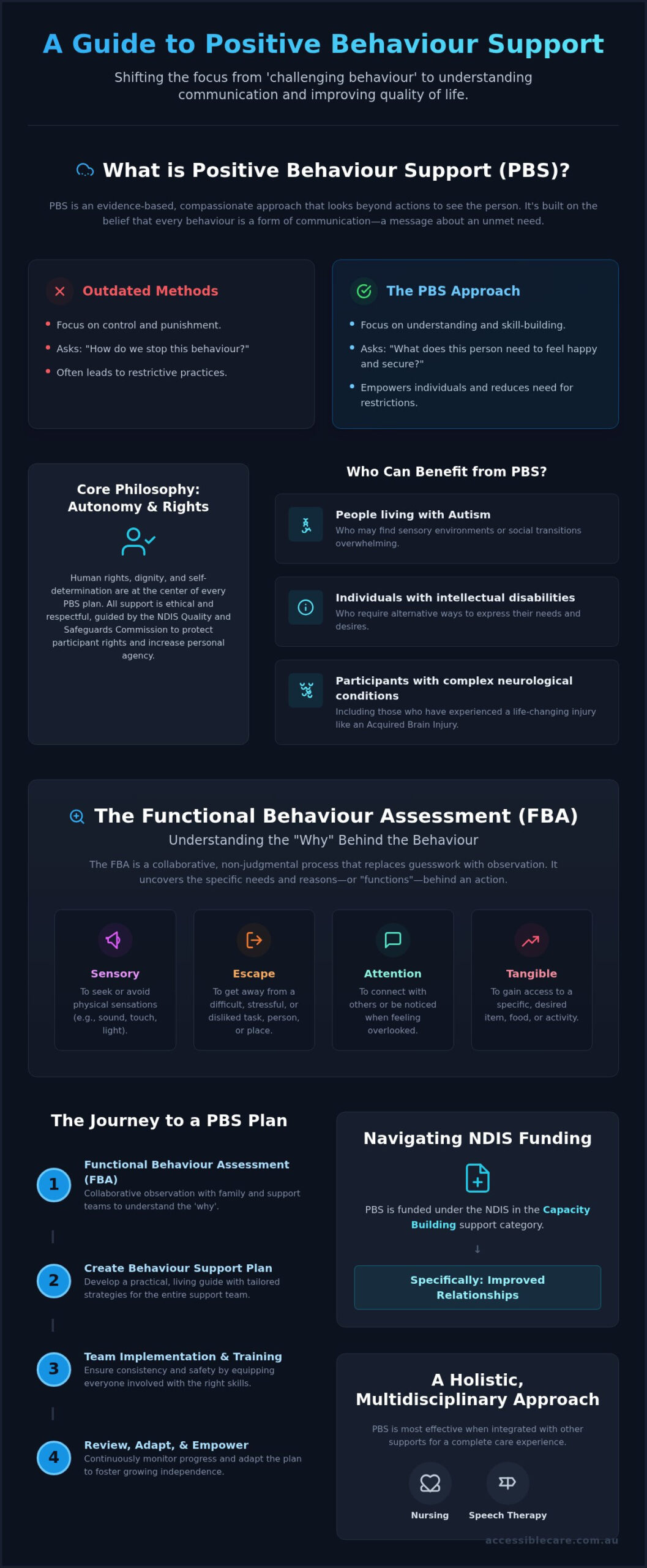
Positive Behaviour Support is much more than a clinical framework; it’s a compassionate promise to look beyond a person’s actions and see their humanity. At its heart, this approach is an evidence-based way to improve a person’s quality of life while reducing “behaviours of concern.” We believe that every action has a purpose. Often, when someone displays challenging behaviour, they’re simply trying to communicate a need that hasn’t been met yet. It might be a cry for connection, a sign of physical discomfort, or a reaction to an overwhelming environment. By choosing positive behaviour support melbourne, families move away from outdated methods that rely on control or punishment. Instead, we focus on building a supportive partnership that prioritises understanding and skill-building.
The ultimate goal of PBS is to create a life where challenging behaviours are no longer necessary. When an individual feels safe, understood, and empowered, the need for restrictive practices naturally fades away. This transition doesn’t happen overnight, but it starts with a shift in perspective. We stop asking “how do we stop this behaviour?” and start asking “what does this person need to feel happy and secure?” This person-centred focus ensures that every strategy we develop is tailored to the unique rhythm of your loved one’s life.
The Core Philosophy: Autonomy and Rights
Human rights sit at the very centre of every behaviour support plan we create. We believe that every individual in our Melbourne community deserves to live with dignity and make their own choices. This philosophy of self-determination is what drives our work. We don’t just want to manage situations; we want to empower people to lead their own lives. The NDIS Quality and Safeguards Commission plays a vital role here by setting high standards for practitioners. They ensure that all support remains ethical and focused on protecting the participant’s rights. By following the NDIS Capability Framework, we ensure that our methods are always respectful, safe, and geared toward increasing personal agency.
Who Can Benefit from PBS?
PBS is a versatile and gentle approach that supports people across all stages of life. It’s particularly effective for children and adults who navigate the world with unique neurological profiles. Those who benefit most often include:
- People living with Autism who may find sensory environments or social transitions overwhelming.
- Individuals with intellectual disabilities who require alternative ways to express their needs and desires.
- Participants living with complex neurological conditions or those who have experienced a life-changing injury.
We also provide specialised assistance for individuals with complex medical needs. If you’re supporting someone through the long-term effects of a head injury, our Acquired Brain Injury guide offers deeper insights into how tailored care can foster recovery and independence. Whether the challenges are new or long-standing, PBS provides a pathway toward a calmer, more connected life.
The Functional Behaviour Assessment (FBA): Understanding the “Why”
When a behaviour feels overwhelming, it’s natural to feel like you’ve tried everything. The Functional Behaviour Assessment (FBA) is designed to take the guesswork out of the equation. We believe that we should never guess why a behaviour occurs; instead, we take the time to truly observe and listen to the person’s unique story. This process isn’t about finding fault or placing blame. It’s a non-judgmental, supportive experience where we work alongside you to uncover the message behind the action. By focusing on positive behaviour support melbourne, we turn confusion into clarity through a shared investigative process.
There are typically four common reasons, or “functions,” why a behaviour happens:
- Sensory: The person is seeking or avoiding physical sensations, like a certain sound or feeling.
- Escape: They’re trying to get away from a task, place, or person that feels difficult or stressful.
- Attention: The behaviour is a way to connect with others or be noticed when they feel overlooked.
- Tangible: They want to access a specific item, food, or activity they enjoy.
What Happens During an Assessment?
This investigative journey is deeply collaborative. Our practitioners meet with the people who know the participant best in their Melbourne community, including family, teachers, and support workers. We also spend time in natural environments like the home, school, or local park to see how the person interacts with their world. The FBA serves as the clinical foundation for a compassionate roadmap that guides every step of your support journey. If you’re feeling burnt out by high-intensity needs, our team is here to help you find a compassionate path forward through expert guidance.
From Data to Insight
Once we gather this information, we look for triggers and “setting events.” These are the hidden factors that make a challenging moment more likely. It could be a poor night’s sleep, physical pain, or a noisy room that makes the world feel too loud. By identifying these patterns, we can change the environment to better support the individual rather than just reacting to the behaviour. We focus on the person’s specific needs and objectives to ensure the plan is as unique as they are.
Often, the biggest trigger is a communication barrier. When someone can’t say what they need, their actions have to do the talking for them. If communication is a primary concern for your loved one, you might find our Speech Pathology guide helpful for understanding how to bridge these gaps and reduce frustration.
Navigating NDIS Funding for Behaviour Support in Victoria
Understanding NDIS funding often feels like trying to solve a complex puzzle while you’re already exhausted. In Victoria, funding for positive behaviour support melbourne is found under the “Capacity Building – Improved Relationships” category. This specific budget is designed to help you build the skills and strategies needed to foster better connections and reduce stress at home. It’s not just about managing a crisis; it’s about investing in a long-term roadmap for a more peaceful life.
There are two distinct levels of funding you’ll likely see in this category. The first is Specialist Behavioural Intervention Support, which covers the expert assessment and the creation of a tailored plan. Following the 2026-27 NDIS price guide update, the national limit for this specialist support is $252.99 per hour. The second level is Behaviour Management Plan Implementation. This funding is used to train your support workers and family members on how to put the strategies into action safely and effectively. It’s also vital to work with a registered NDIS provider for these services. Only practitioners deemed suitable by the NDIS Quality and Safeguards Commission are authorised to write these plans, especially when they involve regulated restrictive practices.
Improved Relationships vs. Improved Daily Living
It’s common to wonder why PBS sits in a different budget than other therapies. While Occupational Therapy or Speech Pathology usually fall under “Improved Daily Living” to focus on functional skills, PBS is placed under “Improved Relationships.” This is because the core goal of PBS is to improve the way an individual interacts with their world and the people in it. These budgets often work together in a beautiful, holistic way. For example, an OT might help with sensory tools while a PBS practitioner focuses on emotional regulation. You can find more detail on how these categories fit into your overall plan in our NDIS guide.
Working with your Local Area Coordinator (LAC)
When you meet with your LAC for a plan review, it’s important to speak openly about “behaviours of concern.” Please don’t feel stigmatised; these behaviours are simply a sign that the current support isn’t meeting the person’s needs. To secure funding, you’ll need evidence like incident reports or letters from existing therapists. If your plan doesn’t currently include behaviour support, you can request a plan reassessment based on a change of circumstances. Be clear about how these behaviours impact safety and community participation. This clarity helps the LAC understand that PBS is a “reasonable and necessary” support for your family’s wellbeing.
The Journey: Creating and Implementing a PBS Plan
The journey toward a calmer home environment begins when the assessment insights turn into a living, breathing Behaviour Support Plan (BSP). In the context of positive behaviour support melbourne, this plan serves as a compass for the individual’s entire support network. It’s not a set of rules for the participant to follow. Instead, it’s a guide for family members, support workers, and teachers to change how they interact with and support the person. We view the BSP as an iterative document. As your loved one grows and their needs change, the plan adapts with them, ensuring that the support remains relevant and respectful.
A truly effective plan focuses heavily on proactive strategies. These are the “feel good” adjustments we make to the person’s environment and daily routine to prevent distress before it starts. While reactive strategies are included to keep everyone safe during a crisis, the heart of our work is building a life that feels like a sanctuary. When a person feels safe, heard, and empowered, the need for challenging behaviour naturally diminishes. If you’re ready to move from crisis to connection, you can start your PBS journey with our team today.
Step-by-Step: From Referral to Results
We believe in a methodical, gentle process that respects your family’s pace. The pathway usually follows these four essential steps:
- Step 1: Intake and Matching. We meet with you to understand your goals and pair you with a Melbourne-based practitioner who fits your family’s personality.
- Step 2: Conducting the FBA. We build on the collaborative investigation discussed earlier to gather the data needed for a precise plan.
- Step 3: Drafting and Submission. Our experts draft the BSP. If the plan includes regulated restrictive practices, we handle the formal submission to the NDIS Quality and Safeguards Commission.
- Step 4: Implementation and Training. We don’t just hand over a document. We stay by your side to train everyone in the support network on how to use the strategies.
Training Your Support Network
Team coaching is the secret to a successful PBS plan. A document sitting in a folder can’t change lives; people do. We spend time with your Melbourne support workers to help them feel confident and capable, even in high-intensity situations. This collaborative approach ensures that everyone is speaking the same language and providing consistent, compassionate care. Our goal is to empower your team so thoroughly that they can eventually navigate challenges without our constant intervention. A successful PBS plan is one that eventually makes itself unnecessary.
Accessible Care: A Multidisciplinary Approach to PBS in Melbourne
At Accessible Care, we believe that the most effective support happens when we listen first and act second. Our approach to positive behaviour support melbourne is built on a foundation of deep empathy and clinical excellence. We don’t just see a set of behaviours; we see a person with unique dreams, fears, and strengths. By bringing together experts in PBS, Community Nursing, and Speech Therapy, we provide a holistic support system that looks at every aspect of your loved one’s life. This multidisciplinary model means you don’t have to repeat your story to multiple different agencies. Instead, you have a single, coordinated team that’s dedicated to your family’s peace of mind and quality of life.
Our practitioners are more than just clinical experts; they’re trustworthy partners in your journey. We prioritise attentive listening as a signature promise, ensuring that the individual’s perspective is always the most important one in the room. This focus on mutual regard and connection transforms the support experience from a transactional service into a nurturing partnership. We’re here to provide comfort and professional guidance, helping you navigate the complexities of the NDIS with confidence and ease. We invite Melbourne families to have a low-pressure, gentle conversation with us to explore how our team can help restore balance to your home.
When PBS Meets Community Nursing
It’s often the case that physical health and emotional wellbeing are deeply intertwined. For individuals with complex medical needs, a “behaviour of concern” might actually be a symptom of undiagnosed pain or physical discomfort. This is where our unique collaboration shines. Our community nurses work side-by-side with our PBS practitioners to identify and address health-related triggers that might otherwise be missed. By managing these underlying physical issues, we can significantly reduce the frequency and intensity of challenging moments. If you’re managing complex care needs alongside behavioural challenges, our High Intensity Supports guide provides more detail on how we integrate medical and behavioural care for a safer home environment.
A Partner in Your Melbourne Community
We’re proud to serve families across the diverse suburbs of Melbourne with our mobile support services. Whether you’re in the heart of the city or the outer suburbs, our team comes to you. We meet you in the environments where life actually happens, from your kitchen table to the local park. At every step, we prioritise your autonomy and self-determination. We aren’t here to take control; we’re here to provide the tools you need to reclaim it. We’re committed to helping you achieve your own objectives through a plan that respects your family’s unique rhythm. Contact Accessible Care for Compassionate Behaviour Support in Melbourne to start building a brighter, calmer future today.
Embracing a Future of Connection and Calm
Choosing a path of understanding rather than control is the first step toward a more peaceful life for your family. We’ve explored how a Functional Behaviour Assessment takes the guesswork out of challenging moments by uncovering the “why” behind the actions. You’ve also seen how navigating NDIS funding doesn’t have to be a solo journey when you have a registered provider by your side. By integrating positive behaviour support melbourne with our specialised multidisciplinary team, you gain access to a holistic support system that prioritises your loved one’s autonomy and rights.
At Accessible Care, we’re dedicated to an evidence-based approach that actually listens to your unique needs. Our team of practitioners and community nurses work together to ensure that every strategy respects the individual’s perspective and fosters genuine independence. You don’t have to manage high-intensity needs alone or feel overwhelmed by the system any longer. We’re here to help you build a home environment that feels safe, predictable, and supportive for everyone involved.
Begin Your Journey with Compassionate Behaviour Support in Melbourne
We look forward to walking this path with you and helping your loved one achieve their own objectives with dignity.
Frequently Asked Questions
What exactly is a “behaviour of concern” under the NDIS?
A behaviour of concern is any action that puts the safety of the individual or others at risk, or limits their ability to participate in the community. These are often viewed as a form of communication when a person’s needs aren’t being met. By using positive behaviour support melbourne, we look for the reason behind the action. Our goal is to replace these behaviours with safer, more effective ways for the person to express themselves.
Does Positive Behaviour Support use restrictive practices?
The primary goal of PBS is to reduce and eventually eliminate the use of restrictive practices. These are interventions that limit a person’s rights or freedom of movement. We follow the strict guidelines set by the NDIS Quality and Safeguards Commission to ensure all support is ethical. Instead of control, we focus on proactive strategies that improve quality of life and make restrictive measures unnecessary over time, ensuring autonomy is always the loudest voice.
How long does it take to get a Behaviour Support Plan in Melbourne?
Creating a comprehensive plan is a methodical process that typically takes several weeks to complete. It begins with a Functional Behaviour Assessment where we observe the individual in their natural Melbourne environment. Once we understand the triggers, we draft a tailored plan for your support network. The timeline can vary depending on the complexity of the person’s needs and how quickly we can gather information from the family, support workers, and other allied health professionals.
Can PBS be delivered in schools or workplaces?
Yes, PBS is most effective when it’s delivered in the places where the person spends their time. Our mobile practitioners visit homes, schools, and workplaces across Melbourne to provide support where it’s needed most. This allows us to see how the environment impacts behaviour and helps us train teachers or colleagues. Supporting someone in their own community ensures the strategies are practical and sustainable for everyday life, fostering long-term success and independence.
What is the difference between a PBS practitioner and a Psychologist?
While both professionals support wellbeing, their focus is different. A Psychologist often works on internal emotional states through talk therapies. In contrast, a PBS practitioner looks at the external environment and the “function” of a behaviour. We analyse how systems, routines, and communication barriers impact a person’s actions. We then create a system-wide plan that the whole support team can follow to improve daily interactions and foster independence for your loved one.
How much does PBS cost out of my NDIS plan?
Funding for PBS is drawn directly from your NDIS plan under the “Capacity Building – Improved Relationships” category. The cost is determined by the NDIS Pricing Arrangements and Price Limits, which are updated annually by the NDIA. You won’t have to pay anything out of pocket if you have the appropriate funding in your plan. We recommend checking your current budget to ensure you have enough hours allocated for specialist behavioural intervention and plan implementation.
Do I need a new assessment if we already have an old behaviour plan?
It’s usually best to conduct a fresh assessment if your circumstances or environment have changed significantly. A Behaviour Support Plan is a living document that needs to grow alongside the individual. If an old plan isn’t working or was written for a different stage of life, a new assessment ensures the strategies are current. This allows us to listen to your current needs and provide the most relevant, compassionate support possible for your situation.
How do I know if a PBS practitioner is “registered” with the NDIS?
You can verify a practitioner’s status by checking the NDIS Quality and Safeguards Commission’s register of providers. Registered providers must meet rigorous safety and quality standards to deliver positive behaviour support melbourne. At Accessible Care, we’re a registered NDIS provider, which means our practitioners are deemed suitable by the Commission. This registration provides families with peace of mind that their support meets the highest national standards, ensuring your loved one is in safe hands.

