


Imagine sitting across from a loved one, your mind filled with a story you are eager to share, only to find the words coming out slurred or faint. You see the flicker of confusion on their face, and the frustration starts to rise in your chest. If you or someone you care for is living with a neurological change, you know that communication is about so much more than just sounds; it is about connection. Accessing specialized speech therapy for dysarthria is a vital step toward bridging that gap. It isn’t just about “fixing” a voice. It is about honoring your right to be heard and understood in every interaction.
We understand how isolating it feels when you can’t express your needs to medical staff or share a laugh at a family dinner. You deserve to feel confident when you speak, knowing your message is clear. This article will show you how speech pathology can transform your daily communication and provide a clear roadmap for accessing NDIS support. You’ll discover practical strategies for improving speech intelligibility and learn how to navigate the 2026-27 NDIS pricing updates to get the most from your Capacity Building budget. Let’s explore how you can find your voice again and reconnect with your community.
Key Takeaways
- Learn how neurological changes impact motor speech and why understanding the root cause is the first step toward reclaiming your voice.
- Discover how the brain can relearn speech patterns through targeted speech therapy for dysarthria, focusing on building new pathways for clearer communication.
- Gain practical tools and exercises, such as diaphragmatic breathing and articulation drills, to improve your vocal strength and clarity in daily social settings.
- Understand how to navigate the NDIS landscape, including the essential role of Functional Capacity Assessments in securing the support you need.
- Explore how personalized, community-based therapy in Melbourne and Adelaide can help you regain your autonomy and confidence in your own home.
Understanding Dysarthria and Its Impact on Your Life
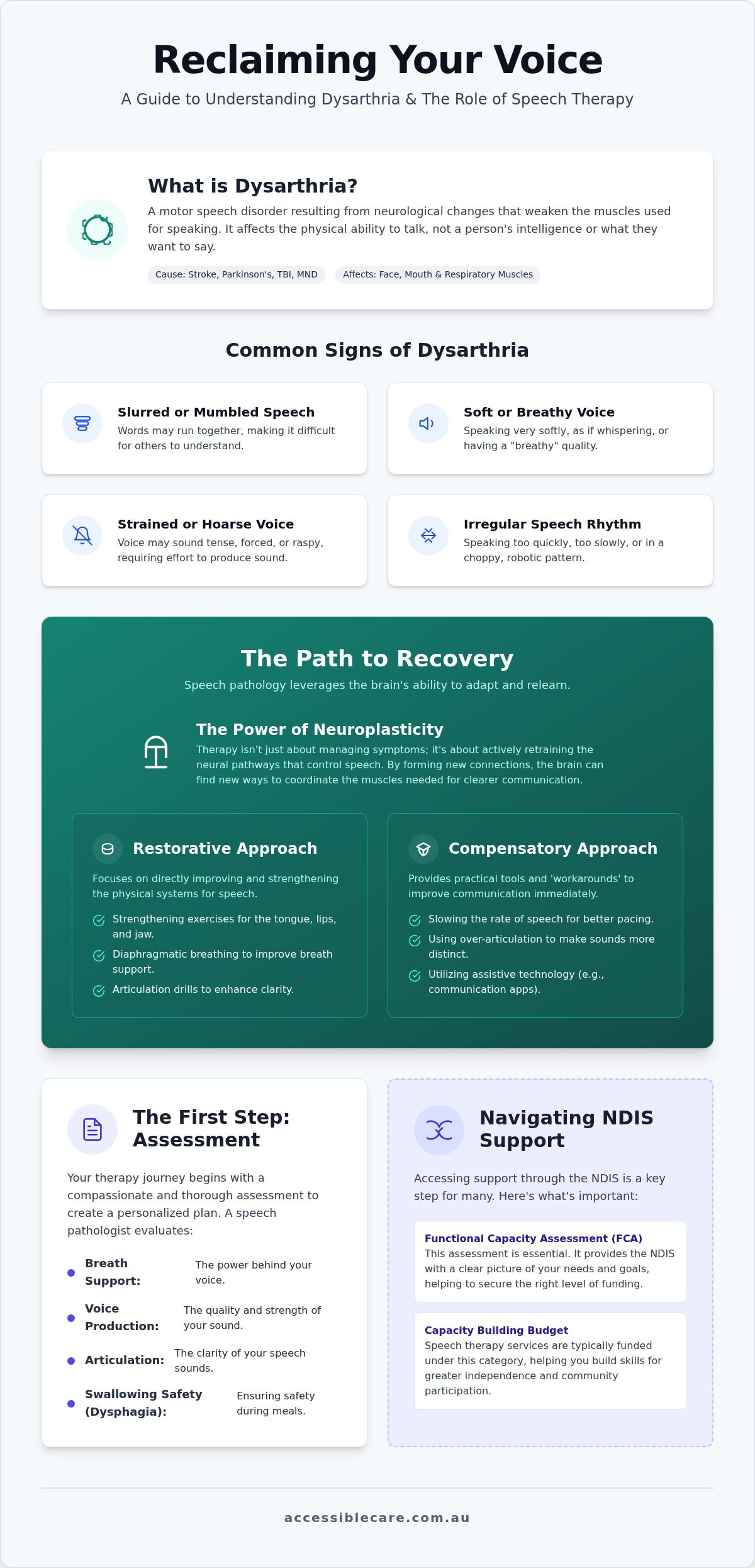
Communication is the heartbeat of our daily lives. When a neurological event like a stroke or a diagnosis of Parkinson’s occurs, it can disrupt the physical muscles we use to speak. This condition is known as dysarthria. It is a motor speech disorder that happens when the muscles in the face, mouth, or respiratory system become weak or move too slowly. For many families in Melbourne and Adelaide, Understanding Dysarthria is the first step toward reclaiming control. It isn’t just a clinical term; it’s a description of how your body is currently responding to a change in your brain.
This change can stem from various causes. Traumatic brain injuries (TBI) or progressive conditions like Motor Neurone Disease (MND) often lead to these difficulties. Regardless of the cause, the impact is deeply personal. Accessing specialized speech therapy for dysarthria focuses on your specific goals, helping you navigate these changes with dignity. Finding your voice again is vital for your independence. It allows you to make choices, share your feelings, and stay connected to the people who matter most. Your voice is your identity, and protecting it is our priority.
Recognising the Signs of Dysarthria
Identifying the signs early can help you seek the right support. You might notice your speech sounds slurred or mumbled, making it hard for others to follow. Others may comment that you are speaking very softly or that your voice sounds breathy or strained. You might also find that the rhythm of your speech has changed, feeling either too fast or unusually slow. These symptoms happen because the brain and muscles aren’t communicating as they used to. It’s a physical challenge, not a reflection of your intelligence or your story.
The Emotional Journey of Communication Changes
The transition to living with speech changes is often filled with a mix of grief and frustration. It’s exhausting when you have to repeat yourself multiple times or when well-meaning people try to finish your sentences for you. This frustration can sometimes lead to social withdrawal. You might find yourself avoiding phone calls or family gatherings because it feels too difficult to participate. Validating these feelings is a core part of the recovery process. Your family plays a huge role here. Their patience and support during the early stages of a diagnosis provide the safety you need to practice and grow. Effective speech therapy for dysarthria isn’t just about the mechanics of sound; it’s about supporting your emotional well-being as you find new ways to connect with the world.
How Speech Pathology Rebuilds Communication Skills
Your brain is remarkably resilient. Even after a neurological change, it possesses the ability to rewire itself and form new connections. This process, known as neuroplasticity, is the scientific heart of speech therapy for dysarthria. Instead of simply accepting speech changes as permanent, we work with you to retrain the neural pathways that control your vocal muscles. This journey isn’t about rushing toward a clinical finish line. It’s about a steady, supportive partnership where we help you find the most effective ways to express your thoughts and feelings.
The Assessment Process: A Gentle First Step
The first time we meet, our focus is on listening to your story and understanding your specific challenges. We look closely at how your breath support, voice production (phonation), and the clarity of your speech (articulation) are working together. Because the same muscles used for speaking are often used for eating, we also check your swallowing safety, or dysphagia, to ensure you’re staying healthy and comfortable. A speech pathology assessment is the foundation of your recovery plan. It gives us a clear picture of where you are now and helps us map out a compassionate path forward.
Restorative vs. Compensatory Approaches
Effective therapy usually involves a thoughtful balance of two main methods. Restorative approaches focus on direct improvement. These are exercises designed to strengthen the muscles of your tongue, lips, and diaphragm to make speech physically easier. On the other hand, compensatory strategies are practical “workarounds” that help you stay understood right now. This might include learning to slow your speaking rate, using over-articulation, or even utilizing assistive technology. We draw on various techniques used in speech and language therapy to ensure you can participate in the conversations that matter most to you.
Success in speech therapy for dysarthria depends on setting goals that actually mean something in your life. Do you want to be able to order your favorite coffee in a busy Melbourne cafe? Do you want to read stories to your grandchildren in Adelaide without losing your breath? We focus on these person-centric outcomes because they provide the motivation for the regular, consistent practice that neurological recovery requires. Small, daily efforts lead to significant changes over time. If you’re ready to take that first step toward clearer communication, you can explore our supportive approach at accessiblecare.com.au.
Effective Strategies and Exercises for Clearer Speech
Rebuilding your speech is a journey that requires both patience and the right set of tools. When you engage in speech therapy for dysarthria, the focus is on making communication more efficient and less tiring. We look at speech as a physical system where every part needs to work in harmony. By practicing specific techniques, you can improve how others understand you, which directly boosts your confidence in social settings. These strategies aren’t just clinical drills; they’re practical ways to help you stay connected to your community in Melbourne or Adelaide.
One of the most important elements is breath support. Think of your breath as the fuel for your voice. Many people with dysarthria tend to take shallow breaths from the upper chest, which can make speech sound faint or choppy. We teach you how to use your diaphragm to power your voice. This creates a stronger, more stable foundation for sound, allowing you to finish your sentences without feeling out of breath. Additionally, managing your speech rate by intentionally pausing between words gives your muscles time to reset and helps your listener process your message more easily.
Daily Exercises You Can Do at Home
Consistency is the key to seeing progress. Simple exercises performed daily can significantly improve motor control over time. You might practice specific lip and tongue movements to increase your range of motion and strength. For those living with Parkinson’s, we often use volume control principles that encourage you to “think loud,” helping your voice carry more naturally. Pacing strategies are also very effective. You can use visual cues or even tap your finger for each syllable to maintain a steady, intelligible rhythm during conversation.
The Role of Augmentative and Alternative Communication (AAC)
There are times when verbal speech might feel too exhausting, especially during a long day or in a noisy environment. This is where Augmentative and Alternative Communication (AAC) becomes an invaluable tool. AAC is a bridge to connection when verbal speech is fatiguing. It ranges from “low-tech” options like alphabet boards, where you point to the first letter of a word to give your listener a clue, to “high-tech” speech-generating devices. These tools don’t replace your natural voice. Instead, they act as a supportive partner, ensuring your autonomy and allowing you to express your needs and thoughts whenever you choose. Utilizing these resources as part of speech therapy for dysarthria ensures that you always have a way to be heard.
Navigating Dysarthria Support Through the NDIS
Accessing the right support through the National Disability Insurance Scheme (NDIS) is a powerful way to ensure you have the resources needed for your recovery. While the system can sometimes feel complex, it is designed to help you achieve your personal goals and maintain your independence. For those living in Melbourne and Adelaide, understanding how to align your communication needs with your funding is the key to unlocking consistent, high-quality care. We see the NDIS not as a hurdle, but as a supportive framework that honors your right to live a fulfilling life.
Within your NDIS plan, speech therapy for dysarthria is typically funded under the “Capacity Building – Improved Daily Living” budget. This category is specifically for therapies that help you build the skills needed for a more independent life. It’s important to remember that NDIS funding is about participation. When you can communicate clearly, you can engage more deeply with your family, your workplace, and your local community. This connection is at the heart of what the scheme aims to support.
Securing Speech Therapy in Your NDIS Plan
During your NDIS review or planning meeting, it is essential to advocate for the hours you need by linking your communication goals to your daily activities. For example, if your goal is to return to work or volunteer, clearly stating how clearer speech will help you achieve this is vital. Your Speech Language Pathologist (SLP) will provide evidence reports that outline your progress and justify the necessity of ongoing support. Functional Capacity Assessments also play a critical role here. These assessments provide a holistic view of how your condition affects your life, ensuring the NDIS understands the full scope of the support you require to thrive.
Multidisciplinary Care for Neurological Conditions
Neurological recovery rarely happens in a vacuum. A coordinated approach involving different specialists often leads to the most meaningful outcomes. For instance, Occupational Therapy can help you modify your physical environment or use adaptive tools that make communication easier and less physically taxing. This is especially important during Acquired Brain Injury rehabilitation, where you may be managing changes in movement, memory, and speech all at once. By working with a team that communicates with each other, you receive a seamless experience that respects your time and energy.
At Accessible Care, we pride ourselves on being a trusted partner in your NDIS journey across Victoria and South Australia. Our mobile services bring expert speech therapy for dysarthria directly to your home, removing the stress of travel and allowing you to practice in a familiar environment. If you’re ready to build a plan that prioritizes your voice and autonomy, reach out to our compassionate team to discuss how we can support your goals.
Compassionate Speech Therapy with Accessible Care
At Accessible Care, we believe your voice is a vital expression of your autonomy and self-direction. Reclaiming it after a neurological change requires more than just clinical expertise; it requires a partnership built on trust, honor, and mutual regard. Our Speech Language Pathologists (SLPs) don’t just treat symptoms. We work alongside you to rebuild your confidence and help you achieve the life goals that matter most. Whether you’re in Melbourne or Adelaide, our team is dedicated to providing supportive, person-centric care that honors your unique journey.
We understand that traveling to a clinic can be stressful, especially when you’re managing complex health needs. That’s why we bring our specialized speech therapy for dysarthria directly to you. By conducting sessions in your home or local community, we can tailor exercises to the real-world situations you face every day. This approach ensures that therapy feels relevant and accessible. It allows you to practice in the environment where you feel most comfortable and secure, making the path to recovery feel natural and steady.
Why Choose an NDIS Registered Provider?
Choosing an NDIS registered provider gives you and your family the assurance of high standards in care and safety. It means we’re committed to professional excellence and adherence to strict regulatory requirements. For participants with complex needs, our expertise in high intensity supports ensures that even the most challenging communication and swallowing issues are managed with professional competence. Registration also simplifies your journey by streamlining billing and coordination, allowing you to focus entirely on your recovery and well-being.
Your Road to Recovery Starts with a Conversation
Every successful therapy plan begins with a simple, attentive act: we listen first. We want to understand your specific life goals and what communication means for your independence. Is it ordering at a favorite cafe or sharing stories with your grandchildren? Once we understand your objectives, we develop a customized home exercise program that fits your lifestyle. We also provide ongoing support for your family and caregivers, ensuring they have the tools to be your best communication partners. Our goal is to empower you to speak with clarity, helping you achieve your own objectives through active involvement and collaboration. This is more than a service; it is a supportive partnership designed to improve your quality of life and peace of mind.
Taking Your Next Step Toward Clearer Communication
Reclaiming your voice is a journey of small, consistent steps that lead to significant change. We’ve explored how neuroplasticity allows your brain to relearn speech patterns and how practical exercises can strengthen your vocal clarity. Accessing specialized speech therapy for dysarthria is a vital part of this process, providing you with the tools to communicate with confidence in every social setting. Whether you’re mastering breath support or utilizing assistive technology, your progress is a testament to your resilience and your fundamental right to be heard.
As a Registered NDIS Provider, Accessible Care is here to support you across Melbourne and Adelaide. Our experienced SLPs offer a holistic, person-centric approach that prioritizes your unique life goals and autonomy. We bring our expertise directly to your home, ensuring your therapy is as comfortable and convenient as possible. You deserve to be understood by your family, friends, and community. Contact Accessible Care today to find a compassionate speech therapist near you. We’re ready to listen and help you find your voice again.
Frequently Asked Questions
Can speech therapy really help with chronic dysarthria?
Yes, speech therapy can be highly effective for chronic dysarthria by focusing on compensatory strategies and maintaining current function. While the initial neurological change may have happened long ago, your brain can still learn new ways to manage speech. Therapy focuses on maximizing your clarity and finding alternative ways to connect with others. It’s about honoring your current abilities while building a toolkit that supports your autonomy in daily life.
How long does it take to see results from dysarthria therapy?
Every individual’s journey is unique, so the timeline for seeing results varies based on the underlying cause and severity of the condition. Many people notice small, functional improvements in their speech clarity or breath support within a few weeks of consistent practice. Long-term progress depends on regular engagement with your exercises. We focus on celebrating every small win, as these steady gains eventually lead to greater confidence in social settings.
Does the NDIS cover speech therapy for adults with dysarthria?
Yes, the NDIS provides funding for speech therapy for adults when it is deemed reasonable and necessary to help achieve their goals. This support is typically found under the “Capacity Building – Improved Daily Living” section of your plan. By accessing speech therapy for dysarthria through your NDIS budget, you can receive regular sessions that focus on rebuilding your communication skills and enhancing your independence within the community.
What is the difference between dysarthria and aphasia?
The main difference lies in the nature of the difficulty. Dysarthria is a motor speech disorder where muscle weakness makes it hard to physically produce sounds. Aphasia, however, is a language disorder that affects the brain’s ability to process, find, or understand words. While both can follow a stroke or brain injury, they require different therapeutic approaches. Our SLPs are experienced in identifying and treating both conditions with a gentle, holistic focus.
Can dysarthria exercises be done at home without a therapist?
While daily practice at home is essential for recovery, these exercises should always be guided by a professional assessment. A speech therapist ensures that the drills you are doing are safe, especially if you also have swallowing difficulties. Once your therapist develops a customized program, you can certainly perform these exercises in your own space. This consistent, home-based practice is a key component of effective speech therapy for dysarthria.
What should I do if my loved one is frustrated with therapy?
It is completely natural to feel frustrated when communication feels like a struggle. If your loved one is feeling overwhelmed, the best approach is to offer patience and validate their feelings. We often suggest taking short breaks or shifting the focus to smaller, more achievable goals to rebuild their confidence. Openly discussing these frustrations with your therapist allows us to adjust the plan, ensuring it remains supportive and person-centric.
Is speech therapy available for people with severe neurological conditions like MND?
Yes, specialized support is absolutely available and highly beneficial for individuals living with progressive conditions like MND. In these cases, the focus of therapy often shifts toward maintaining communication for as long as possible and introducing Augmentative and Alternative Communication (AAC) tools. Our goal is to ensure you always have a way to express your needs and stay connected to your loved ones, regardless of the physical challenges you face.
How do I find a speech therapist in Melbourne or Adelaide who specializes in dysarthria?
Finding the right support in Melbourne or Adelaide starts with looking for a registered NDIS provider that specializes in neurological recovery. Accessible Care offers mobile therapy services, meaning our experienced SLPs come directly to your home. This allows us to provide care in a familiar environment where you feel most at ease. You can reach out to our team to discuss how we can partner with you on your recovery journey.

