


Could a support recommendation still feel fair if the provider may benefit from your choice? In the NDIS, even the possibility of competing interests can raise understandable questions. A clear ndis conflict of interest policy explains what must be disclosed, how a concern will be managed, and how your preferences stay central.
It’s reasonable to want confidence that advice reflects your goals, not a provider’s personal or business interests. A conflict doesn’t automatically mean anyone has acted improperly, but it should be handled openly and carefully. You deserve enough information to make an informed choice, including the option to consider alternatives.
This practical guide explains actual, potential and perceived conflicts, with examples from NDIS supports. You’ll learn what transparent disclosure and fair management can look like, which questions to ask, and how to raise a concern if something doesn’t feel right. The focus is on protecting participant choice and control while supporting respectful, trustworthy relationships.
Key Takeaways
- Spot actual, potential and perceived conflicts, including interests linked to personal relationships or organisational arrangements.
- Understand what a practical ndis conflict of interest policy can cover, from disclosure and documentation to review and escalation.
- Know how provider responsibilities differ from your right to understand the options and share your preferences.
- Use calm, direct questions to clarify what an interest is, how it could affect support and what safeguards are in place.
- Recognise signs of transparent support relationships, including clear choices and processes that respond to the participant’s goals.
Why an NDIS conflict of interest policy matters for fair support
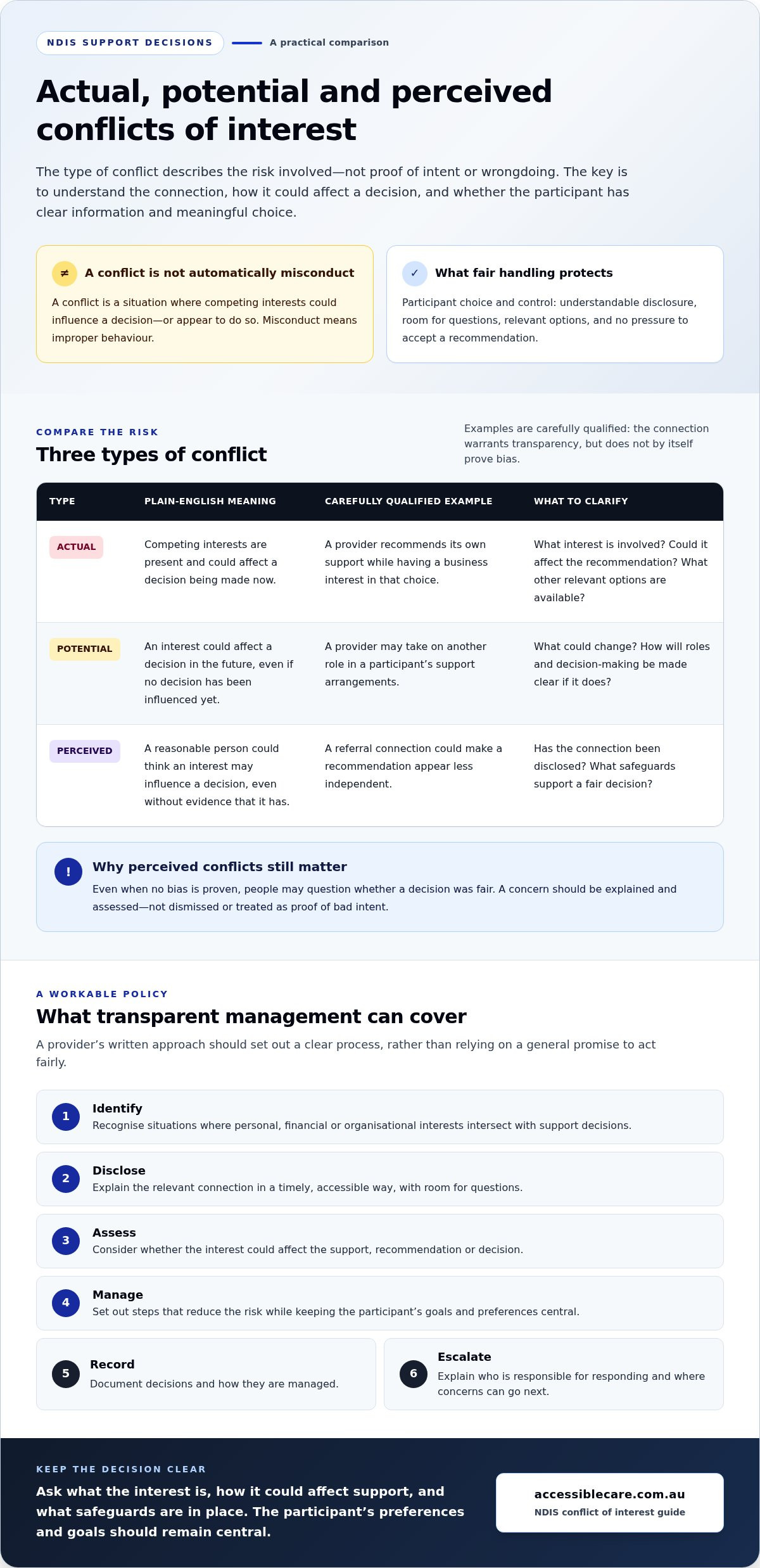
A conflict of interest is a situation to identify and manage, not automatic proof of wrongdoing. It arises when a person or organisation has competing interests that could influence a decision, or appear to do so. For example, a provider may have a financial or organisational interest in a support option they recommend. Disclosing that connection helps the participant understand the context and make an informed choice.
In plain English: a conflict is a risk that interests could affect impartial decision-making; misconduct is improper behaviour. A conflict may exist even when nobody has acted improperly. The broader concept is described in Conflict of interest. In the NDIS context, the NDIA’s position statement, released on 11 November 2024, sets expectations for registered and unregistered providers to avoid, declare and manage conflicts. The aim is to protect choice and control, not to assume bad intent.
What does an NDIS conflict of interest policy do?
An ndis conflict of interest policy is a provider’s written approach to identifying, disclosing, assessing and managing situations where interests may compete. It should explain who is responsible for responding, how decisions are recorded, and where a concern can be escalated. A useful policy gives people a clear, workable process rather than relying on a vague promise to act fairly.
That process turns a general concern into practical questions: What is the interest? Could it affect the support or recommendation? What steps will reduce the risk? Clear answers support trust, especially when a provider offers more than one kind of support or has a relationship with another organisation involved in a participant’s plan.
Why participant choice and control belong at the centre
Disclosure is useful only if the person can understand it and decide what they want to do next. Information should be shared in a timely, accessible way, with room for questions and without pressure to accept a particular support or recommendation. The participant’s preferences and goals should remain central to the conversation.
Families and supporters may help someone consider options, but their involvement should respect the participant’s own wishes and decision-making. A respectful discussion about understanding the NDIS and participant choice can help clarify what choice and control look like in practice. When interests are explained openly and safeguards are clear, people are better placed to decide whether an arrangement feels right for them.
How NDIS conflicts of interest arise and how to recognise them
Conflicts can arise wherever personal, financial or organisational interests intersect with decisions about support. An interest doesn’t prove that a recommendation is biased or that anyone has acted improperly. It signals a situation worth examining: what connection exists, whether it could shape a decision, and whether the participant has clear information and meaningful choice.
The NDIA’s position statement on conflicts of interest sets expectations for providers to avoid, declare and manage conflicts. In practice, the details matter. A referral relationship or a provider offering several kinds of support may call for transparency and safeguards, but neither automatically establishes misconduct.
Common conflict scenarios in NDIS supports
Consider a provider recommending a service delivered by its own organisation. That service may suit the participant, but relevant options should be explained and the person should not be pressured to choose it. Similarly, one organisation may hold multiple roles in a participant’s support arrangements. That overlap can make it harder to see whether advice is independent, so the roles and decision-making process should be clear.
Referral arrangements or incentives are another example to assess. A referral connection may create a financial or business interest, but its existence alone doesn’t establish that a decision was influenced. Ask whether the relationship has been disclosed, whether recommendations relate to the person’s needs, and what safeguards support a fair decision.
Actual, potential, and perceived conflicts: what is the difference?
These terms describe the kind of risk involved. They’re useful prompts for assessment, not labels that by themselves establish intent or wrongdoing.
A perceived conflict can weaken trust because people may question a decision’s fairness, even when no bias is proven. That’s why an ndis conflict of interest policy should help providers recognise and explain risks, rather than dismissing concerns or assuming bad intent. Participants seeking support shaped around their own goals can learn more about NDIS support services.
What a fair NDIS conflict of interest policy should cover
A useful ndis conflict of interest policy sets out a consistent process for recognising and responding to competing interests. It should help staff understand their responsibilities while making it easier for participants to see what’s happening and express their preferences. The steps below are a practical framework. Specific obligations can depend on current NDIS Commission guidance and applicable NDIS Practice Standards.
Disclosure, documentation, and participant communication
A disclosure should reach the people responsible for assessing and managing the interest. The participant should receive enough information to understand why the interest matters. A clear explanation describes the connection, how it might affect a decision, and what safeguards are proposed. Recording the disclosure, assessment, agreed steps and review helps keep the response consistent and accountable.
Communication should be accessible to the participant, with time and space to ask questions. A policy should guide provider actions; it shouldn’t shift responsibility for managing the conflict onto the participant. The participant remains entitled to express preferences and consider the information in a way that works for them.
Safeguards that protect choice and reduce risk
Safeguards should match the situation. Depending on the risk, they might include separating roles, involving someone independent in a decision, or explaining an alternative support pathway. A general promise to “act fairly” may not show how a particular interest will be managed. The provider should be able to explain how the chosen measure reduces the identified risk.
Review the arrangement if circumstances change, and make the escalation pathway understandable: who can receive a concern and what happens next. Refer to current NDIS Commission guidance and relevant Practice Standards when describing a step as a formal requirement. A fair process keeps provider responsibilities clear while supporting informed choice, personal preferences and the participant’s goals.
What participants and families can do when a conflict is disclosed
A disclosure should help you understand a possible risk, not take away your voice. Ask for a clear explanation, share what matters to you and take time to consider the response. The provider is responsible for explaining and managing the conflict. You remain central to decisions about your supports and preferences.
Start with the information you need to feel comfortable. You might ask:
- What interest or relationship is involved, and which support or decision could it affect?
- What options are available in my circumstances, including alternatives?
- What safeguard will manage the risk, and how will I know it’s being followed?
- When will this arrangement be reviewed, and how can I raise a concern?
You can request an explanation in a format or language you understand, or ask for time to discuss it with someone you trust. If you have a preference, state it plainly. For example: “I’d like to understand the alternatives before deciding.” After the discussion, note what was explained, what you agreed to and any next steps. This makes it easier to refer back to the conversation.
If the explanation or safeguard does not feel right
It’s okay to say that an answer hasn’t addressed your concern. Note what feels unclear and ask the provider to respond through its stated process. Be specific about what information you still need, such as how a safeguard would work in practice or when the arrangement will be reviewed. Keep a record of the response and any agreed actions.
If you need another perspective, seek independent information about relevant NDIS pathways from current official sources. The NDIS Quality and Safeguards Commission provides information about complaints, and an independent advocate may help you understand options and communicate your concerns. Check the Commission’s current guidance for up-to-date processes and contact details. No particular outcome can be guaranteed, but asking for clarity is a reasonable step.
A clear ndis conflict of interest policy should make it easier to understand who is responsible for responding and how concerns can be raised. If you’re looking for support grounded in your goals and preferences, explore participant-focused NDIS supports.
How transparent NDIS support relationships build trust
Trust grows when people can understand how support decisions are made. A transparent relationship makes relevant interests clear, explains available choices in accessible language, and matches safeguards to the situation. It also leaves room to review an arrangement if needs, roles or circumstances change. These practices help participants stay involved and keep support connected to their own goals and preferences.
A practical transparency checklist for support relationships
Use these points to reflect on whether a disclosed interest has been explained clearly:
- The interest is clear: You understand what relationship or interest exists and which decisions or supports it could affect.
- The choices are understandable: Relevant options are explained in a way that works for the participant, without pressure to choose a particular path.
- Preferences are heard: The participant’s priorities are discussed and reflected in the agreed next steps.
- Safeguards fit the risk: The provider can explain how the steps taken address the specific concern, rather than relying on a general assurance.
- There’s a way to revisit the arrangement: You know how it can be reviewed if circumstances change or questions arise.
A checklist isn’t a substitute for a provider’s current obligations under applicable NDIS requirements. It can help participants and families identify what they understand, what they’d like clarified and whether the process supports informed choice.
Finding support that respects your goals
Transparent practice matters across support work, therapy and other NDIS services. The details of each relationship may differ, but respectful support starts with listening, explaining decisions and making space for the participant’s preferences. An ndis conflict of interest policy is most useful when its processes support these everyday conversations, not just paperwork.
Accessible Care is a registered NDIS provider in Melbourne and Adelaide, offering support work and therapeutic services including speech therapy, occupational therapy, positive behaviour support and community nursing. These supports can contribute to a plan shaped around individual goals, with the participant’s voice central to decisions.
You have the right to seek clear information and make informed, self-directed choices about your supports. If you’re exploring NDIS support in Melbourne or Adelaide, learn more about Accessible Care’s services and discuss the goals that matter to you.
Move forward with clarity and confidence
A conflict of interest isn’t automatically proof of wrongdoing. What matters is whether it’s recognised, explained clearly and managed in a way that respects participant choice. A sound ndis conflict of interest policy gives providers a clear process while helping participants understand their options, ask questions and keep their goals at the centre.
If a conflict is disclosed, ask what interest exists, how it could affect support and what safeguards are in place. Clear communication and the chance to revisit decisions can help build a more respectful support relationship.
Accessible Care is a registered NDIS provider in Melbourne and Adelaide, offering support work and therapeutic services including occupational therapy, speech therapy and positive behaviour support. Explore Accessible Care’s NDIS support services and discuss how support could align with the goals that matter to you. Your choices deserve to be heard, understood and respected.
Frequently Asked Questions
What is an NDIS conflict of interest policy?
An NDIS conflict of interest policy explains how a provider identifies, discloses, assesses and manages interests that could affect decisions about supports. It should make clear who is responsible, how decisions are recorded and how concerns can be raised. The policy supports transparency and participant choice. It doesn’t mean every conflict is misconduct, or that one specific template must be used.
What counts as a conflict of interest in NDIS support?
A conflict may arise when a provider’s personal, financial or organisational interests could influence, or appear to influence, support decisions. For example, a provider might recommend a service delivered by its own organisation, or have a referral relationship with another service. These situations aren’t automatically evidence of wrongdoing. Their context, possible effect on decisions and safeguards all matter.
Do NDIS providers have to disclose conflicts of interest?
NDIA guidance expects both registered and unregistered NDIS providers to avoid, declare and manage conflicts. The NDIS Code of Conduct also emphasises integrity, honesty and transparency. A disclosure should explain the relevant interest and how it could affect support or recommendations, so the participant can understand the situation and consider their options. Check current NDIS Commission guidance for applicable requirements and processes.
Can an NDIS provider recommend its own services?
A provider may recommend a service it delivers, but any relevant interest should be made clear so the participant can make an informed decision. The recommendation should relate to the participant’s needs and goals, and the person should be able to understand relevant alternatives without pressure. Clear disclosure and appropriate safeguards help participants consider whether the option suits them.
What should I do if I think my NDIS provider has a conflict of interest?
Ask the provider what interest or relationship is involved, which decisions it could affect, and what safeguards are being used. You can also ask about alternatives, state your preferences and request an accessible explanation. Note the concern and any agreed next steps. If you’re not satisfied, use the provider’s stated process or seek independent information about advocacy and complaints through current official NDIS sources.
Does a conflict of interest mean my NDIS provider has done something wrong?
No. A conflict identifies a situation where interests could compete, or appear to compete. It doesn’t by itself prove that a provider has acted improperly or that a decision was biased. What matters is whether the situation is handled transparently and appropriately. You can ask for an explanation of the interest, its possible impact and the steps taken to manage it.
What should an NDIS conflict of interest policy include?
A practical policy should explain how conflicts are identified, disclosed, assessed, documented and managed, and how arrangements are reviewed or concerns escalated. It should clarify provider responsibilities and support clear communication with participants about relevant interests, possible effects and safeguards. The policy should also help participants understand their options and express preferences. Specific obligations may depend on current NDIS requirements and the provider’s circumstances.

