


Has an NDIS decision left you unsure whether to ask for a review, make a complaint, or request a plan reassessment? If you’re asking “what to do if you disagree with ndis decision,” the right next step depends on what was decided, when you received the decision, and whether your circumstances have changed. It’s understandable to feel unsettled, especially when a deadline is approaching or the reasons given don’t reflect your needs.
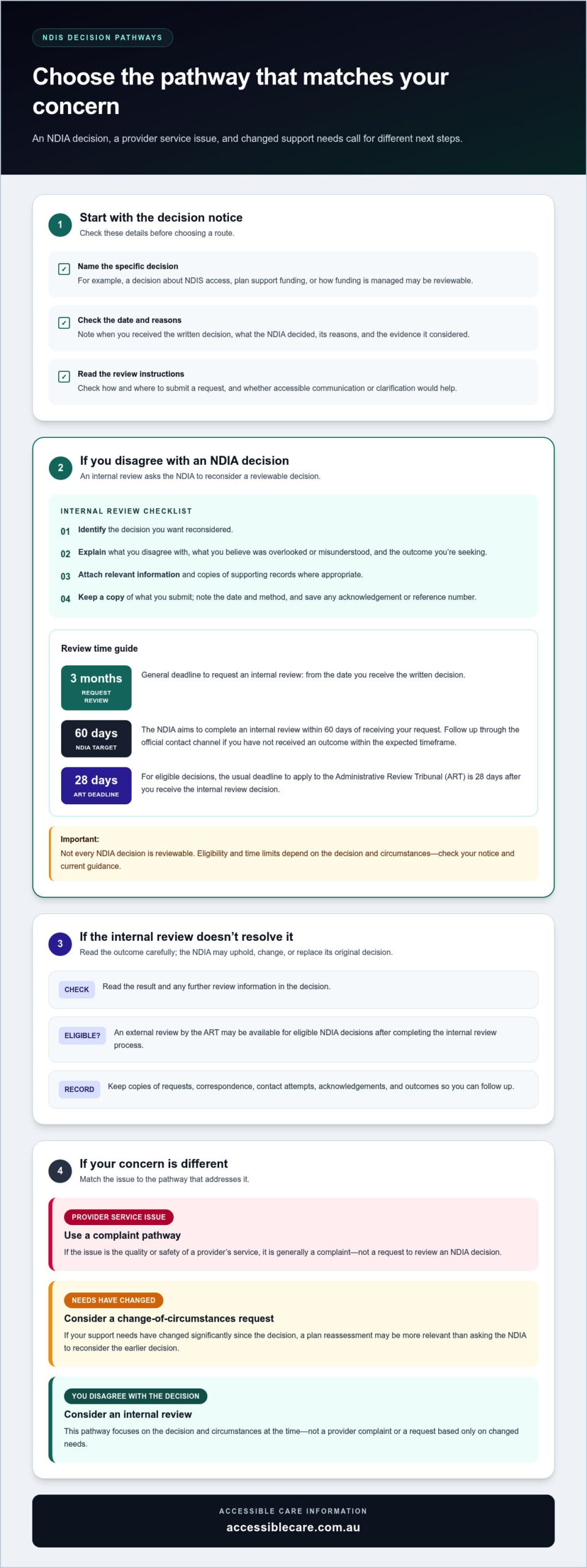
This guide explains how to identify the decision and the pathway that may apply, prepare an internal review request, and understand when an external review by the Administrative Review Tribunal (ART) may be an option. In general, you have three months from receiving the written decision to request an internal review, and 28 days after receiving the internal review decision to apply to the ART. Not every NDIA decision is reviewable, so identifying the decision type matters.
You’ll also learn how a change-of-circumstances request differs from challenging an existing decision, where to find independent support, and why a complaint about service quality follows a separate process. Start with the decision letter, the relevant date, and the information that best explains your situation.
Key Takeaways
- Start with your decision notice: note the decision date, the reasons given, and the review information included.
- Work out whether you need to challenge an NDIA decision, raise a service complaint, or request a review because your circumstances have changed.
- To decide what to do if you disagree with ndis decision, connect each reason for your disagreement to relevant records and the outcome you’re seeking.
- Keep a record of requests, contact attempts, correspondence, and outcomes so you can follow up through the right official channel.
- Family, support coordinators, disability advocates, and independent review support may help you organise information and take your next step.
Disagreeing with NDIS: Identify the Decision First
Receiving an NDIS decision that doesn’t feel right can be upsetting, particularly when it affects support you rely on. You don’t need to work out every step at once. First, identify exactly what the NDIA decided. That will help you understand which options may apply and what information to prepare.
A practical way to approach what to do if you disagree with ndis decision is to:
- Identify the specific decision you’re concerned about.
- Check the written notice for its date, reasons, and review instructions.
- Gather records that relate to the decision and your needs.
- Request the appropriate review or use another relevant pathway.
- Follow up and keep a record of your correspondence.
An internal review is a request for the NDIA to reconsider one of its decisions. It’s different from a complaint about a service provider, and it may not apply to every NDIA decision.
Which NDIS decision are you concerned about?
Name the decision as specifically as you can, rather than describing only the wider problem. For example, is it about access to the NDIS, funding for supports in a plan, or how funding is managed? These are examples of decisions that may be reviewable. The decision notice and decision type matter because they affect which options are available and the relevant time limits.
If the issue is the quality or safety of a provider’s service, that’s generally a complaint rather than a request to review an NDIA decision. If your support needs have changed significantly since the decision, a change-of-circumstances request may be more relevant. These pathways address different concerns.
What should you check in the decision notice?
Keep the notice and look for the date you received it, the decision itself, the reasons given, and any evidence the NDIA considered. Check the instructions for requesting a review, including how to submit it and where to send it. The notice may also explain how to ask questions or request accessible communication if that would help you understand or respond.
For a written NDIA decision, the general deadline to request an internal review is three months from the date you receive it. Note the date and follow the instructions in your notice. For broader background, read this guide to the NDIS and this overview of the National Disability Insurance Scheme (NDIS).
How an NDIS internal review works and what happens after it
An internal review asks the NDIA to reconsider a reviewable decision. It gives you a chance to explain what you believe was overlooked or misunderstood and provide relevant information. It concerns the decision and circumstances at the time, rather than a complaint about a provider or a request based only on needs that have changed since then.
To request a review, follow the instructions in your decision notice. Explain which decision you’re challenging, what you disagree with, and what outcome you’re seeking. Keep your reasons focused. For example, if the decision didn’t include a particular support, describe the relevant need and why you believe the information in your request supports a different outcome.
How to request an internal review
Include concise supporting information and copies of relevant documents where appropriate. Keep a copy of what you submit, note the date and method, and save any acknowledgement or reference number. These details will help if you need to follow up.
The NDIA aims to complete internal reviews within 60 days of receiving a request. If you haven’t received an outcome within the expected timeframe, follow up through the official contact channel and record when you did so. The official NDIS decision review process explains the current steps and guidance.
What if you still disagree after the internal review?
The NDIA may uphold the original decision, change it, or replace it with another decision. Read the outcome carefully: it should explain the result and any further review information. Your next options depend on the decision and the internal review outcome.
For eligible NDIA decisions, you can apply to the Administrative Review Tribunal (ART) for an external review after completing the internal review process. The usual deadline is 28 days after you receive the internal review decision. Check the instructions in your notice and current ART guidance, as eligibility and time limits depend on the circumstances. If you’re considering what to do if you disagree with ndis decision after the NDIA’s review, act promptly and seek independent guidance if you’re unsure about the next step.
If your needs have changed significantly, a change-of-circumstances plan reassessment may be more appropriate than asking the NDIA to reconsider the earlier decision. A concern about a provider’s service or conduct follows a separate complaint pathway. A support provider can be part of your broader network while you consider your options. Read about NDIS support services.
Internal review, complaint, or changed circumstances: choose the right NDIS pathway
It’s easy to assume that every concern belongs in the same form or inbox. But an NDIA decision, a problem with a provider’s service, and a change in your support needs are different issues. Choosing the right pathway helps your concern reach the organisation responsible for addressing it.
Use this comparison as a starting point. Your decision notice and the details of your situation will help you identify the appropriate next action.
| Pathway | Purpose and who handles it | May suit you if… | Next action |
|---|---|---|---|
| Internal review | The NDIA reconsiders a reviewable decision it made. | You disagree with a decision about access, funded supports, or funding management based on the circumstances considered. | Follow the review instructions in your notice and explain what you believe should be reconsidered. |
| Complaint | Raises concerns about a service or conduct. The relevant provider may handle concerns about its service; the NDIS Quality and Safeguards Commission handles complaints about the quality and safety of NDIS services. | A service was unsafe, poor quality, or otherwise concerning, rather than the NDIA’s decision itself. | Raise the concern through the appropriate complaint channel. For quality or safety concerns, contact the Commission on 1800 035 544. |
| Changed circumstances | Lets you tell the NDIA that your needs or circumstances have changed significantly and request a plan reassessment. | Your current needs have materially changed since the plan or decision was made. | Contact the NDIA about a change-of-circumstances request and provide relevant information about the change. |
When is an internal review different from a complaint?
Suppose the NDIA declined funding for a support, and you believe the decision didn’t properly account for information about your existing needs. That points to asking for an internal review, if the decision is reviewable. If a provider’s support was unsafe or didn’t meet expected standards, that’s a service complaint, not a request for the NDIA to reconsider its decision.
A complaint doesn’t automatically replace or pause a decision-review deadline. If you’re unsure what to do if you disagree with ndis decision, check the review instructions and act within the applicable time limit. You can pursue a separate complaint as well if needed.
When might changed circumstances be relevant?
A reassessment may be relevant if your needs have changed significantly, such as after a change in health or daily support requirements. This differs from saying the NDIA misunderstood the circumstances that existed when it made an earlier decision. You can request a change-of-circumstances review at any time, but it doesn’t guarantee a particular plan outcome or replace a review of an earlier decision.
Before you submit anything, identify which pathway applies and whether a decision-review deadline is still running. If your concern involves both an earlier decision and new needs, explain each issue separately.
Prepare a stronger NDIS review request with clear reasons and supporting evidence
A clear review request doesn’t need legal language. It needs to show which part of the decision you disagree with, why it matters to your circumstances, and what outcome you’re asking the NDIA to consider. If you’re working out what to do if you disagree with ndis decision, organise the relevant information before you write so your main points are easy to follow.
Use this checklist to get started:
- The decision notice: Include a copy or identify the decision and its date.
- The reasons you dispute: Note the specific reasons in the notice that you believe don’t reflect your situation.
- Relevant information: Gather records that relate directly to the disputed issue, such as an assessment, support records, or a personal statement.
- The outcome you’re seeking: State what you want the NDIA to reconsider or do differently.
Evidence is most useful when you explain how it relates to a specific need or point in the decision you’re asking the NDIA to review. A document on its own may not make that connection clear, so briefly describe what it shows and why it matters. No single report or record guarantees a particular outcome.
How to explain what you disagree with
Keep your explanation factual and direct. You might paraphrase a reason from the notice, then explain what you believe it missed. Organise your explanation into three parts: what happened or what the decision says, how it affects you, and the change you’re asking the NDIA to consider.
If dates or events help explain your circumstances, add a short timeline. For example, list when a relevant need changed, when an assessment took place, and how the issue affects daily life. You don’t need to use legal terminology or make a long argument. Clear, specific language can help the reviewer understand your perspective.
What information may help explain your circumstances?
Depending on the decision, relevant material might include an assessment or report, records of support needs, or a personal statement describing the impact on daily activities. Choose information that speaks to the point in dispute. Check that it’s accurate and as current as possible, and explain why it’s relevant rather than sending unrelated documents.
If you need an interpreter, an accessible format, or a support person to help you understand or communicate, ask about these arrangements through the channel in your notice or the relevant official contact point. You can also ask someone you trust to help organise your thoughts while keeping your priorities and preferred outcome at the centre.
Person-centred support can be part of your broader support network. Read about NDIS support services and the practical support they provide.
After an NDIS decision review: follow up, get help, and plan your next step
Once you’ve sent a request, keep a simple record so you can see what has happened and what still needs attention. Save a copy of your submission and note the date and method you sent it. Keep any acknowledgement or reference number, contact attempts, letters, emails, and review outcomes together. A brief timeline can make it easier to explain the history if you need to follow up or ask someone for help.
If the expected response is delayed, follow up through the official channel listed in your notice or correspondence. State the date you submitted the request and provide its reference number if you have one. Note the follow-up and any guidance you receive. The answer to what to do if you disagree with ndis decision may involve more than one step, so read each outcome carefully and note any further instructions or time limits.
Where can you find independent help?
A disability advocacy organisation may help you understand the process and express your views. A support coordinator or another trusted person may also help you organise information and keep track of correspondence. For complex matters, you may want to seek legal guidance. The Australian Government-funded NDIS Appeals Program offers free support from a disability advocate for people seeking ART review, and may provide access to legal services. NDIS funding can’t be used to pay for a lawyer or other representative at the ART.
Availability and eligibility for assistance vary. Use current official directories and information to find options that fit your circumstances. If you live in Victoria or South Australia, look for official state-based disability advocacy information as well as national resources.
How can support continue while a review is underway?
Check your current plan and official advice to clarify which existing supports remain active while your request is considered. Don’t assume that making a review request changes your current plan. If you have an immediate support need, write down what’s needed, why it’s urgent, and who you’ve contacted. Raise urgent concerns through the appropriate official channel. For concerns about the quality or safety of an NDIS service, contact the NDIS Quality and Safeguards Commission.
Accessible Care provides person-centred NDIS support in Melbourne and Adelaide, as part of a participant’s broader support network. Our support work and therapeutic services focus on your goals and day-to-day needs, not representation in an appeal. If you need practical support alongside the review process, you can read about our NDIS support services.
Take your next step with clarity and support
Knowing what to do if you disagree with ndis decision starts with identifying the decision and checking the instructions and deadline in your notice. Then choose the pathway that fits: an internal review for a reviewable NDIA decision, a complaint about service quality or conduct, or a reassessment request if your circumstances have significantly changed.
Keep your request clear and focused. Explain what you disagree with, connect relevant information to the issue, and state the outcome you’re seeking. Save copies of your documents and record key dates and follow-ups so you can track what happens next.
A review process can feel demanding, but you don’t have to organise every part alone. Accessible Care is a registered NDIS provider serving Melbourne and Adelaide, offering support work and therapeutic services tailored to individual needs. These supports can be part of your broader network as you work towards your goals.
Explore NDIS support with Accessible Care to find practical support alongside your next steps. Take things one step at a time. Your needs and goals deserve to be heard.
Frequently Asked Questions
Can I ask the NDIA to reconsider an NDIS decision?
Yes, you can ask the NDIA for an internal review if the decision is reviewable. Explain which decision you’re concerned about, what you believe was overlooked or misunderstood, and what outcome you’re seeking. Check the decision notice for instructions on how to submit your request. Not every NDIA decision can be reviewed, so the decision type and the information in your notice are important starting points.
How long do I have to challenge an NDIS decision?
You generally have three months from receiving the written NDIA decision to request an internal review. If you then want to apply to the Administrative Review Tribunal (ART), the usual deadline is 28 days after receiving the internal review decision. Eligibility and time limits depend on the decision, and the ART may grant an extension in some circumstances. Check your notice and current official guidance, and act promptly if a deadline is approaching.
What happens if I disagree with the NDIA’s internal review decision?
You may be able to apply for an external review by the Administrative Review Tribunal (ART), an independent body that reviews eligible NDIA decisions after an internal review. The usual application deadline is 28 days after you receive the internal review outcome. Read the outcome letter for instructions, confirm that the decision is eligible, and check current ART guidance. If you need help understanding your options, an independent disability advocate may be able to support you.
Is an NDIS complaint the same as an internal review?
No. An internal review asks the NDIA to reconsider one of its decisions. A complaint raises concerns about service quality, safety, or conduct. For example, disagreement with an NDIA decision about funded supports may call for a review, while an unsafe experience with an NDIS service may call for a complaint to the NDIS Quality and Safeguards Commission. A complaint doesn’t automatically replace or pause a decision-review deadline, so check both pathways if relevant.
Can I submit new evidence with an NDIS review request?
Yes, you can provide relevant information to explain why you believe the decision should be reconsidered. This might include an assessment, support records, or a personal statement about how your needs affect daily life. Connect each document to a specific reason in the decision or need you’re raising. Keep copies of what you submit, and remember that evidence can inform a review but doesn’t guarantee a particular outcome.
Do I need a lawyer or advocate to challenge an NDIS decision?
No, you don’t have to have a lawyer or advocate to request an internal review. You can ask a family member, friend, or support coordinator to help you organise information. Disability advocacy services may also offer assistance. The Australian Government-funded NDIS Appeals Program provides free disability advocacy support for people seeking an ART review and may provide access to legal services. NDIS funding can’t be used to pay for a lawyer or other representative at the ART.
Will my current NDIS supports stop while I challenge a decision?
Don’t assume that requesting a review automatically changes your current plan or stops existing supports. Check your plan and any official advice about which supports remain active while your request is considered. If you’re unsure, contact the NDIA through an official channel and keep a record of the guidance you receive. If you have an immediate support need, document it and raise it promptly through the appropriate official pathway.

