


Could an NDIS support item number tell you whether a support is funded for you? Not on its own. If you’re finding it hard to match catalogue descriptions and codes to your plan, this guide to ndis support item numbers explained will help you understand what a code identifies and why your plan and current NDIS rules matter too.
An item number refers to a particular support entry and may help describe how a support is delivered or claimed. But seeing a code on a quote or invoice doesn’t automatically mean the support is included in your plan or aligns with your goals. Pricing and claiming details can also change, so an older code description or price limit may not give you the full picture. Knowing what to compare can make conversations with your plan manager or support team more productive.
This guide explains how to read an item number, where to check its current description and pricing information, and what to ask when you’re considering whether a support fits your plan. You’ll be better prepared to discuss services and invoices while keeping the focus on what matters to you.
Key Takeaways
- With ndis support item numbers explained in plain language, you can understand what a code and its description identify.
- Compare the support description, unit and any applicable price limit.
- A listed item number alone doesn’t confirm that a support is funded in your individual plan.
- Check current official NDIS documents and support lists for descriptions and conditions.
- Ask practical questions about how a support will be delivered, recorded and connected to your goals.
What are NDIS support item numbers, and what do they tell you?
NDIS support item numbers identify entries in official NDIS pricing documents. Each code is linked to a support description, helping participants, providers and plan managers refer to the same type of support when discussing services, quotes or records.
The important distinction is that a support item number identifies a support entry, but it doesn’t show that the support is funded in an individual participant’s plan. A code isn’t a diagnosis, an approval or a guarantee that a claim will be paid. Whether a support can be funded depends on the participant’s plan arrangements, the relevant rules and the circumstances.
If you’re looking for ndis support item numbers explained in plain language, treat the code as a reference point, not a funding decision. For a broader introduction to the scheme, see the National Disability Insurance Scheme (NDIS) overview, then explore “What is the NDIS? A Simple and Compassionate Guide” for a participant-focused introduction.
What information does an NDIS support item number identify?
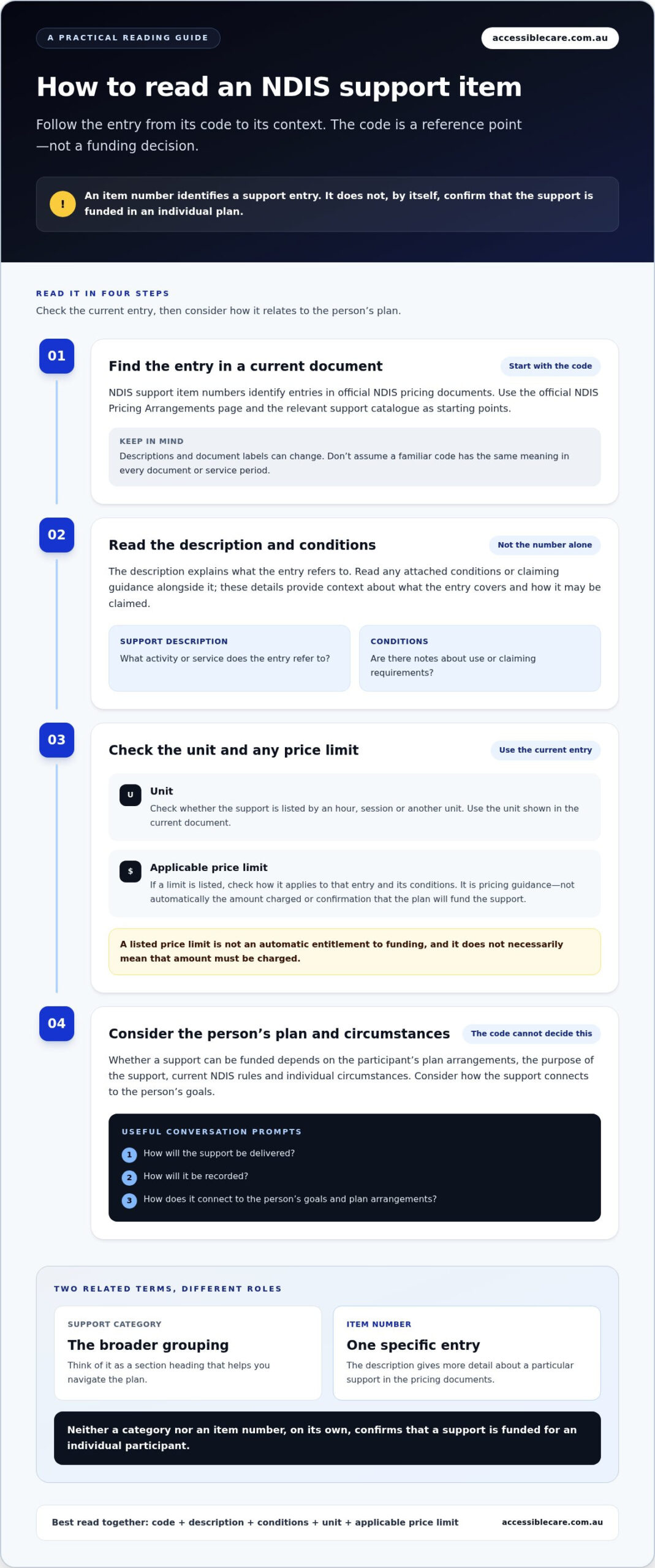
The code links to a support description in the applicable official document. Read the description and any conditions alongside the item number. They provide context about what the entry covers and may explain relevant claiming requirements. A code on its own leaves out those details, so don’t rely on the number alone when reviewing a service or record.
Descriptions and document labels can change. Check the current official source rather than assuming a familiar code has the same meaning in every document or service period.
How is an item number different from an NDIS support category?
A support category is a broader grouping. An item number identifies an individual entry within the relevant pricing documents. Think of the category as a section heading and the item as one specific entry within it. They’re related, but they don’t answer the same question.
Hypothetical example: A participant’s plan may include a broad category for daily living supports. A pricing document may list individual entries for particular types of assistance in that area. The category helps you navigate the plan, while the item description gives more detail about a specific support. Neither one, on its own, confirms that the support is funded for that participant.
Keeping these distinctions clear can make plan and service discussions more useful. Start with the support description, then consider how it relates to the person’s goals and plan arrangements.
How to read an NDIS support item number and its description
An item number is only one part of an entry. To understand what it refers to, read it with the description and any other details in the current NDIS document. Document labels and layouts can vary, so check the information shown for that specific entry.
Read the support description and any attached conditions with the item number, not separately from it. This context helps explain what the entry describes and how it may be claimed. For current documents, use the official NDIS Pricing Arrangements page and the relevant support catalogue. These are useful starting points when checking an item number on an invoice, quote or service record.
Which details should you look for beside the code?
When you find a possible match, review the details around it. The entry may include:
- Support description: What activity or service does the entry refer to?
- Unit: Is the support listed by an hour, session or another unit? Use the unit shown in the current document.
- Applicable price limit: If a limit is listed, check how it applies to that entry and its conditions. It isn’t automatically the amount charged or confirmation that a participant’s plan will fund the support.
- Conditions or claiming guidance: Look for notes explaining how the entry may be used or claimed.
Illustrative example only, not an official code or funding outcome: Imagine an entry describing a therapy session, with a unit listed as a session and a price limit shown where applicable. The description tells you what the entry relates to, the unit explains how it’s counted, and the limit provides pricing guidance under the document’s conditions. This example doesn’t identify a real item or establish that a particular person can use their plan to fund it.
Why can similar supports have different item numbers?
Entries that sound alike may differ in purpose, delivery context or claiming rules. A service delivered in one way may have a different description from a similar service delivered another way. Don’t treat a neighbouring code or familiar wording as proof of eligibility. Check the full entry and its conditions.
For a service-specific perspective, Speech Pathology: A Compassionate Guide to Communication and Swallowing Support offers context about speech therapy. To explore supports shaped around individual needs and goals, learn more about person-centred NDIS support.
Does an NDIS support item number mean the support is funded?
No. Finding an item number in an NDIS document doesn’t, by itself, confirm that a participant’s plan can fund the support. The code identifies a listed entry. Whether it fits a person’s plan depends on their plan arrangements, the purpose of the support, current NDIS rules and individual circumstances.
A listed price limit isn’t an automatic entitlement to funding, and it doesn’t necessarily mean that amount must be charged. It provides pricing guidance for the relevant support under the applicable conditions. For current descriptions and pricing information, refer to the official NDIS Pricing Arrangements. The code can help you ask informed questions, but it can’t make a plan-specific funding decision.
Can the same support item number apply differently to different people?
A code may identify the same type of support, but whether that support is appropriate under a particular plan depends on the person’s plan arrangements and the support’s purpose. Consider how the service relates to the participant’s needs and goals rather than relying on the code alone. A plan manager or support coordinator can help explain plan arrangements and where to seek clarification.
What should you check on a quote or invoice?
If an item number appears on a quote or invoice, compare its details with the service proposed or delivered. This helps you understand the claim without assuming there’s a problem. Check:
- Support description: Does the wording match the service provided or proposed?
- Unit and quantity: How is the support counted, and does the quantity make sense alongside the service record?
- Dates: Do the dates align with the service or period shown?
- Claimed amount: How does it compare with the applicable pricing information and relevant conditions?
The item number is only one part of the picture. A similar description or a price limit beside it doesn’t establish that a support is funded in a particular plan. If a claim or entry is unclear, ask your plan manager how it relates to your plan and records. Specific questions can help you have a calm, practical conversation about the service and its connection to your goals.
That distinction is central to understanding ndis support item numbers explained accurately: the code identifies an entry, while plan arrangements and individual circumstances determine whether it may fit.
How to check an NDIS support item number in current documents
A careful lookup helps you understand what an item number refers to without relying on a search snippet or an old copy of a document. Use the official NDIA source and check that the information applies to the service period you’re reviewing.
Where can you find the current support item information?
Use the NDIA’s official pricing and support-list resources as your primary reference. The NDIS pricing documents page provides current pricing information and related support documents. Search results, saved PDFs and older references may point to a previous version, so check the publication or effective date shown in the document.
The title of a current pricing document may differ from that of an older one. Use the latest official page to find the document that applies to the service period rather than assuming a familiar title or saved file is still current. Check the relevant document before relying on a code or price limit.
A practical lookup process
- Identify the support. Note the service being proposed or recorded, including how it’s described and delivered. If you have a quote or invoice, start with its wording and item number.
- Find the current official document. Go to the NDIA pricing page and open the applicable pricing document or support list. Compare its version and effective date with the service period.
- Compare the entry and its conditions. Search for the item number or relevant support description. Read the full entry, including any unit, price information and claiming guidance that applies.
This process makes ndis support item numbers explained useful in practice. The goal isn’t to memorise codes, but to check the correct entry in context.
What if an item number is unclear or seems outdated?
Don’t guess from memory, a similar description or a neighbouring code. Compare the item number and wording with the latest official document. If the entry is still unclear, note what you’re unsure about and discuss the plan-specific implications with your plan manager or support coordinator. For a broader introduction to the scheme, read What is the NDIS? A Simple and Compassionate Guide.
Checking the relevant documents can make conversations about a service and its connection to your goals clearer. To explore person-led support, learn about NDIS support shaped around your needs.
Putting NDIS support item numbers into a person-centred support conversation
Understanding an item number can help, but you don’t need to memorise codes to take part in a useful support discussion. Start with the person: what matters to them, what they’re working towards, and whether the service description makes sense in that context. The code helps identify an entry; the conversation explores how the proposed support relates to the person’s goals.
What questions can help clarify a proposed support?
Participants and nominees can ask open, practical questions to understand what’s being discussed. For example:
- What support will be delivered? Does the description explain the activity or service clearly?
- How does it connect with my goals? What outcome is the support intended to help me work towards?
- How will it be delivered? What format or setting is proposed?
- How will it appear in records? How will the service description, frequency and units be recorded on relevant documents?
For questions about how a support relates to a specific plan or how a claim should be handled, speak with the plan manager or support coordinator. The aim is to understand the information and make space for the participant’s preferences, not to assume the code settles the matter.
How can support services connect with individual goals?
Different supports may relate to different personal priorities. Someone might explore speech therapy in connection with communication, occupational therapy in relation to daily activities, or support work to help with participation in everyday life. These are broad examples, not a statement that a particular service or item number will be funded for an individual. The person’s goals and plan arrangements remain central.
Accessible Care provides therapy and disability services in Melbourne and Adelaide, with a person-centred approach that recognises each person’s needs, choices and autonomy. Clear conversations can help connect the service being discussed with what the participant wants to achieve, while making the support and its documentation easier to understand.
That’s the practical value of having ndis support item numbers explained: they can make a service conversation more specific, while the person’s goals guide it. Explore support with Accessible Care and consider what kind of assistance may align with your priorities and the way you want to live.
Use clearer information to guide your next support conversation
Understanding NDIS support item numbers can make quotes, invoices and service discussions easier to follow. The key points are straightforward: a code identifies a support entry, its description and conditions add context, and the code alone doesn’t confirm that a support is funded in an individual plan. Check current official documents, then take plan-specific questions to your plan manager or support coordinator.
Keep the conversation centred on the person. Does the described support connect with their goals? Are the service and records clear? Questions like these can help participants feel prepared and involved in decisions about their support.
Accessible Care is a registered NDIS provider serving Melbourne and Adelaide, with services including speech therapy, occupational therapy, support work and community nursing. To explore support shaped around your goals, choices and autonomy, explore person-centred NDIS support with Accessible Care.
Clear information is a helpful starting point. Your voice and what matters to you remain central.
Frequently Asked Questions
What is an NDIS support item number?
An NDIS support item number is a code linked to a described support in relevant NDIS pricing documents. It identifies an entry, while the description and any conditions provide important context. As this guide to ndis support item numbers explained shows, the code isn’t a diagnosis, funding approval or guarantee that a claim will be paid. Read it alongside current official information and the participant’s plan arrangements.
Does an NDIS support item number mean my plan will fund the support?
No. A listed item number doesn’t, by itself, confirm that your plan will fund the support. Whether it may fit depends on your plan arrangements, the purpose of the support, current NDIS rules and your circumstances. If you’re unsure how an entry relates to your plan, discuss it with your plan manager or support coordinator. They can help you understand relevant plan information, but the code alone can’t settle the question.
How do I find the current NDIS support item number?
Start with the service description, then check the latest official NDIA pricing documents and relevant support lists. Search for the description or code and read the full entry, including any unit, applicable price information and conditions. Compare the document’s version or effective date with the service period. Search snippets and saved PDFs may be out of date, so use the official source as your reference.
Can one support have more than one NDIS item number?
Similar services may appear under different item numbers when their purpose, delivery context or claiming conditions differ. Similar wording doesn’t always describe the same entry. Don’t assume a neighbouring code or familiar description applies to your situation. Compare the full entry in the current official document with the service proposed or delivered, and raise plan-specific questions with your plan manager or support coordinator.
What should I do if an item number on an invoice looks wrong?
First, compare the item number and description with the service delivered, then review the unit, quantity, dates and amount shown. Check the relevant current NDIS document rather than guessing from memory. If something is still unclear, ask your plan manager to help you understand how the invoice relates to your plan or records. Asking for clarification is practical, but it doesn’t mean an error has occurred.
Do NDIS support item numbers change?
NDIS pricing documents and support lists can be updated, so an item number, description or related guidance may change over time. Check the version and effective date of the official document that applies to the service period, especially if you’re using an older invoice reference or saved file. If a code appears differently in a newer document, compare the descriptions and conditions rather than assuming the entry is unchanged.
Is an NDIS price limit the same as the amount I will be charged?
No. A price limit is pricing guidance for a relevant support under the applicable NDIS rules and conditions. It doesn’t automatically mean that amount will be charged, and it doesn’t confirm that your plan will fund the support. Check the current official pricing information and compare it with the quote or invoice. If you need to understand how the amount relates to your plan, speak with your plan manager.
Who can help me understand an NDIS support item on my plan?
Your plan manager or support coordinator can help explain plan-specific questions and how an item may relate to your plan arrangements. The provider delivering a service can clarify the service description and how it appears in records, but an item number alone doesn’t establish funding. Accessible Care is a registered NDIS provider serving Melbourne and Adelaide, offering supports including speech therapy, occupational therapy, support work and community nursing.

