


What if the challenging behaviour you see every day isn’t a problem to be fixed, but a message waiting to be understood? It’s physically and emotionally exhausting to live on high alert, feeling like you’re walking on eggshells in your own living room. We know the weight of the guilt that comes with using restrictive measures just to keep everyone safe. You aren’t alone in wanting a home that feels like a sanctuary again, rather than a place of constant tension.
By implementing a behaviour support plan at home, you can move away from reactive crisis management and toward a lifestyle of mutual respect. This approach treats behaviour as a language, allowing you to listen to what your loved one is truly trying to say. This article will show you how to create a safer, calmer, and more empowering environment where communication replaces conflict. You’ll discover practical steps to build a peaceful routine, reduce the need for restrictive practices, and strengthen the bond with your loved one through the principles of Positive Behaviour Support.
Key Takeaways
- Learn how Positive Behaviour Support (PBS) reframes challenging behaviour as a meaningful form of communication, focusing on your loved one’s quality of life rather than just “fixing” a problem.
- Discover the “EATS” acronym to identify the underlying functions of behaviour, helping you address the root cause of challenges with compassion and clarity.
- Understand the NDIS Commission’s framework for reducing restrictive practices and how moving toward empowerment-based strategies upholds the rights and dignity of your family member.
- Gain practical, proactive tips for implementing a behaviour support plan at home, such as using predictable routines and visual schedules to create a calmer, more secure environment.
- Explore the value of a multidisciplinary approach, where PBS practitioners collaborate with Occupational Therapists and Speech Pathologists to provide holistic, person-centred support.
Understanding Positive Behaviour Support (PBS) in the Home
At its heart, Positive Behaviour Support (PBS) is a promise to look deeper. It’s a person-centred, evidence-based framework designed to improve a person’s quality of life while reducing behaviours of concern. Rather than seeing a difficult moment as a “problem” that needs fixing, PBS views behaviour as a vital form of communication. It’s often the only way someone can express an unmet need, a physical discomfort, or an emotional overload. When we change how we listen, we change how we respond.
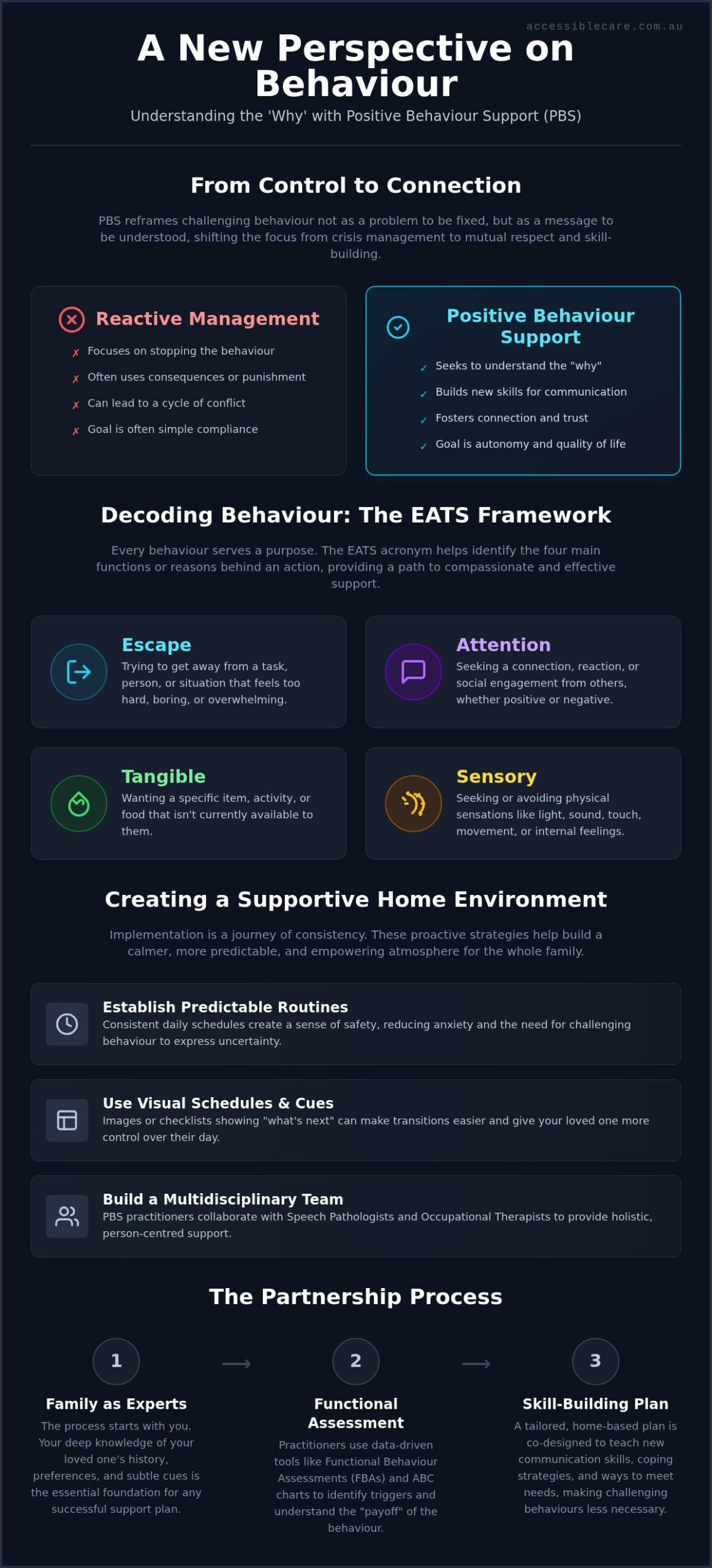
Traditional management often relies on consequences or punishment to stop a behaviour. PBS takes the opposite path. It focuses on understanding the “why” and building new skills so that the challenging behaviour is no longer necessary. The ultimate goal isn’t compliance; it’s autonomy. We want your loved one to feel empowered, self-directed, and safe in their own skin. Successfully implementing a behaviour support plan at home starts with this shift from control to connection.
Why Home-Based Support is Essential
You might have noticed that strategies developed in a clinical setting don’t always work in the living room. This is because clinics are controlled environments that lack the “ecological fit” of your daily life. A strategy needs to work for the whole family, including siblings and parents, to be sustainable. Implementing a behaviour support plan at home allows for natural observations in the place where life actually happens. It removes the stress of travel and lets practitioners see the real-world triggers and routines that shape your loved one’s day. When support fits into your natural rhythm, it’s much more likely to last.
The Role of the Family as Partners
No one knows your loved one better than you do. You’re the expert on their history, their likes, and the small signs of distress that a stranger might miss. We view our role not as directors, but as collaborators who listen to your daily realities. We know that your home isn’t a lab; it’s a place where you need to cook dinner, rest, and feel secure. Practitioners work alongside you to ensure every strategy is practical and respectful of your family’s needs. Remember, implementing a behaviour support plan at home is a journey of consistency. It isn’t an overnight fix, but a steady path toward a more peaceful household built on mutual trust.
The Foundation of PBS: Understanding the ‘Why’ Behind Behaviours
Every action tells a story. Successfully implementing a behaviour support plan at home requires us to look past the surface action to find the underlying message. When we look at someone’s choices through the lens of Positive Behaviour Support, we use the “EATS” acronym to categorize the four main functions of behaviour:
- Escape: Trying to get away from a task, person, or situation that feels too hard, boring, or uncomfortable.
- Attention: Seeking a connection, reaction, or social engagement from others.
- Tangible: Wanting a specific item, activity, or food that isn’t currently available.
- Sensory: Seeking or avoiding physical sensations like light, sound, touch, or internal feelings.
When you are managing problem behavior at home, understanding these drivers is the first step toward empathy. We reframe “behaviours of concern” as a logical response to an unmet need. If someone can’t say they’re in pain, they might shout. If they’re overwhelmed by a loud room, they might withdraw. By identifying the function, we can provide the right support.
Practitioners use a Functional Behaviour Assessment (FBA) to pinpoint these needs. This isn’t about judging your parenting or your loved one’s personality. It’s a data-driven look at what triggers the behaviour and what the “payoff” is for the individual. Sometimes, the root cause is a communication barrier. This is where speech pathology plays a vital role. By giving someone a new way to express “I need a break” or “I’m hungry”, we often see the need for challenging behaviours naturally decrease.
What to Expect During a Professional Assessment
The assessment process is a collaborative effort between your family and our team. You’ll likely be asked to keep an ABC (Antecedent-Behaviour-Consequence) chart. This helps us see what happened right before the behaviour and what happened immediately after. We’ll also spend time talking with you about your family’s daily life. This process is designed to be supportive and non-judgmental. We want to understand your challenges so we can help you with implementing a behaviour support plan at home that actually works for your lifestyle.
Defining Behaviours of Concern
Behaviours of concern can look like many things, such as physical aggression, social withdrawal, or self-harm. However, we don’t define these actions by the “type” of behaviour alone. Instead, we look at how much the behaviour limits the person’s life or impacts the safety of those around them. Behaviours of concern are actions that impact safety or community participation. Our goal is always to help the individual regain their freedom and connection to the world around them through compassionate, person-centred care.
Moving Away from Restrictive Practices Towards Empowerment
Choosing a path of empowerment means looking beyond immediate control. Restrictive practices are interventions that limit a person’s rights or freedom of movement. These include chemical restraints like medication used to influence behaviour, mechanical restraints like belts or specialized clothing, and physical restraints. They also include environmental restraints, such as locking a kitchen cupboard, and seclusion, which involves keeping someone alone in a room. While these methods might feel like the only way to maintain safety during a crisis, the NDIS Commission has a clear mandate to reduce and eventually eliminate their use. We believe that every person deserves to live without unnecessary restriction.
The psychological benefits of moving away from control are profound. When a person feels controlled, their anxiety often spikes, which can lead to more challenging moments. By choosing positive alternatives, you create a home environment built on trust rather than fear. This focus on skill-building leads to genuine independence. Successfully implementing a behaviour support plan at home means moving from a “crisis” mindset to a “growth” mindset. It empowers your loved one to handle their emotions and needs safely on their own terms, leading to long-term safety for everyone.
Restrictive vs. Positive: What is the Difference?
The core difference is whether you are stopping a behaviour or teaching a new skill. Restrictive practices are reactive; they aim to stop an action after it has already started. Positive strategies are proactive. For instance, occupational therapy can help address sensory processing needs, making the home environment more comfortable so the behaviour doesn’t happen in the first place. This shifts the focus from managing a person to supporting their environment. When you are Supporting Families with PBIS at Home, you are investing in long-term solutions rather than temporary fixes that can cause emotional distress.
The Ethical and Legal Framework in Australia
Implementing a behaviour support plan at home involves navigating specific legal requirements. Any regulated restrictive practice must be documented in a formal plan and reported to the NDIS Commission. In Victoria and South Australia, providers must also obtain specific “Authorisation” through state-based systems. These safeguards exist to uphold human rights and ensure that the least restrictive option is always used. We also honour the “Dignity of Risk.” This is the idea that everyone has the right to take risks and learn from their experiences, which is essential for personal growth. This approach respects the individual’s autonomy while keeping safety at the forefront of every decision.
Practical Strategies for a Supportive Home Environment
Creating a supportive home isn’t about becoming a clinical expert overnight. It’s about making small, intentional changes that lower the overall “temperature” of your household. We focus on proactive strategies because it’s always easier to prevent a fire than it is to put one out. When you are implementing a behaviour support plan at home, you’re building a foundation of predictability. This sense of security helps your loved one feel safe, which naturally reduces the need for challenging behaviours.
Predictable routines are the cornerstone of a calm environment. When someone knows what is happening next, their anxiety levels drop. This can be achieved through visual schedules or simple “First/Then” boards. We also look at “Environmental Modifications.” These are physical changes to your home, such as adjusting lighting, reducing background noise, or changing a room’s layout to create more space. These shifts might seem minor, but they can significantly reduce sensory overload.
Step-by-Step: Setting Up a PBS-Friendly House
- 1. Identify Triggers: Pinpoint specific noises, transitions, or times of day that seem difficult. Knowing that the vacuum cleaner or the transition to bath time is a trigger allows you to plan ahead.
- 2. Modify the Space: Create “calm zones” where your loved one can retreat. Use sensory-friendly lighting and ensure the space is free from clutter that might cause overstimulation.
- 3. Use Visual Aids: Implement pictorial schedules. Seeing a sequence of events helps a person process information better than just hearing a verbal instruction.
- 4. Model Replacement Skills: This is the heart of Functional Communication Training (FCT). If a loved one hits to get a snack, we patiently show them how to use a picture card or a simple sign to request it instead.
De-escalation: Calm Responses in the Moment
Even with the best proactive plan, difficult moments will still occur. When they do, we use “Low Arousal” techniques to help everyone regain their balance. This involves using neutral body language, moving slowly, and keeping your voice quiet and steady. It’s incredibly hard to stay calm when you feel stressed or fearful, but your calm can act as an anchor for your loved one. Always remember the “Safety First” rule; de-escalation is about ensuring safety in the moment, not about teaching a new skill or correcting a behaviour. De-escalation focuses on emotional regulation for both the supporter and the person.
If you’re feeling exhausted and need a partner to help navigate these changes, we can provide the guidance you need. Reach out to learn more about our compassionate NDIS support services and how we can support your family’s journey toward a more peaceful home.
Partnering with Accessible Care for Behaviour Support
Accessible Care isn’t just a service provider; we are a dedicated team of professionals who believe in the power of connection. Our approach is holistic, compassionate, and deeply rooted in the belief that every person deserves to be understood. We recognize that implementing a behaviour support plan at home is a significant commitment for any family. It requires patience, consistency, and the right partnership. That’s why our locally-based teams in Melbourne and Adelaide work alongside you every step of the way, ensuring the strategies we develop are practical for your unique household. For families managing more complex needs, we also specialize in integrating PBS with high intensity supports ndis. This ensures that even the most challenging situations are met with clinical expertise and a gentle, human touch.
The Multidisciplinary Advantage
One of the greatest benefits of working with Accessible Care is our multidisciplinary approach. Behaviour doesn’t happen in a vacuum; it’s often a response to how a person experiences the world. Our Occupational Therapists (OTs) play a vital role by identifying sensory processing needs that often drive distress. If a home environment is too loud or too bright, an OT can suggest modifications that create a sense of calm. At the same time, our Speech Pathologists work to give non-verbal participants a voice. When a person can express their needs clearly, the frustration that leads to challenging behaviour naturally begins to fade. By combining these different areas of expertise, we focus on autonomy and self-direction in every support plan we create.
Getting Started with Your Home Support Plan
We’ve designed our process to be as smooth and supportive as possible, moving at a pace that feels right for your family. It begins with a referral and a comprehensive assessment where we take the time to listen to your story and understand your daily challenges. From there, we move into plan development and, most importantly, implementation support. We don’t just hand you a document and leave; we stay by your side to help you bring the strategies to life. Our team also collaborates with schools, workplaces, and other support networks to ensure your loved one has a consistent experience everywhere they go. If you are ready to take the first step toward a more peaceful home life, we invite you to a gentle, no-pressure conversation about your needs. Our teams in Melbourne and Adelaide are here to help you navigate the journey of implementing a behaviour support plan at home with confidence, dignity, and care.
Embracing a Calmer Future for Your Family
Creating a home where everyone feels safe and heard is within your reach. It starts by shifting your focus from management to understanding. By reframing challenging behaviour as communication and choosing proactive strategies over restrictive ones, you are honouring your loved one’s autonomy. Small environmental changes and new communication tools can truly transform your daily routines, replacing tension with mutual respect.
Successfully implementing a behaviour support plan at home is a collaborative process. As a registered NDIS provider with specialist hubs in Melbourne and Adelaide, our experienced multidisciplinary team is here to walk this path with you. We bring together expertise in PBS, speech pathology, and occupational therapy to ensure every strategy fits your family’s unique life and values. You don’t have to carry the weight of exhaustion or guilt alone.
Begin your journey toward a calmer home; contact Accessible Care today. We are ready to listen, support, and help you build a more peaceful and empowering future together. Your family deserves a sanctuary where everyone can thrive with dignity.
Frequently Asked Questions
What exactly is an NDIS Behaviour Support Plan (BSP)?
An NDIS Behaviour Support Plan is a formal document created to improve a person’s quality of life and reduce behaviours of concern. It’s developed by a registered practitioner after a thorough Functional Behaviour Assessment. The plan includes proactive strategies to change the environment and reactive strategies to keep everyone safe. It focuses on teaching new skills so that challenging behaviour is no longer the person’s primary way to communicate unmet needs.
Who is qualified to be a Behaviour Support Practitioner?
Practitioners must be registered with the NDIS Quality and Safeguards Commission and meet the standards of the Positive Behaviour Support Capability Framework. They often hold degrees in psychology, social work, or occupational therapy. In Australia, approximately 85% of practitioners are NDIS registered. These professionals must demonstrate high levels of clinical expertise and a commitment to person centred, rights based care to ensure the safety and dignity of the people they support.
Does NDIS funding cover behaviour support at home?
Yes, the NDIS provides specific funding for these services, typically under the Capacity Building category for Improved Relationships. This funding allows a specialist practitioner to conduct assessments and develop your formal plan. Additional funding for implementing a behaviour support plan at home often comes from the Core budget. This ensures that support workers can be properly trained to follow the strategies in your loved one’s specific home environment.
How long does it typically take to see results with PBS?
Positive Behaviour Support is a steady journey rather than an overnight fix. While simple environmental changes can sometimes provide immediate relief, teaching replacement communication skills takes time and consistency. Most families notice a meaningful reduction in the frequency and intensity of challenging behaviours within three to six months. The goal is to create sustainable, long term change that improves the quality of life for the entire household through patient, daily practice.
What is the difference between PBS and ABA therapy?
Both approaches are rooted in behavioural science, but PBS has a much stronger focus on human rights and environmental fit. PBS is person centred and avoids the intensive, compliance based drills sometimes associated with traditional ABA. In Australia, PBS is the preferred framework because it prioritizes the individual’s autonomy and quality of life. It uses a multidisciplinary approach to ensure that every strategy respects the person’s dignity and supports their long term independence.
Can behaviour support help non-verbal children or adults?
Behaviour support is incredibly effective for non verbal individuals because it views every action as a form of communication. When someone cannot use words, their behaviour becomes their voice. By identifying what a person is trying to tell us, we can introduce alternative tools like pictorial schedules or communication devices. Our speech pathologists work alongside our PBS team to ensure that non verbal participants have a reliable way to express their needs clearly.
What should I do if our current plan isn’t working?
If your current strategies aren’t bringing the peace you need, it’s important to request a formal review. Behaviour support plans are living documents that must adapt to your family’s changing life. You might need to revisit the functional assessment or adjust the environmental triggers. If you’re having trouble with implementing a behaviour support plan at home, we can help you refine your approach to ensure the strategies are practical, compassionate, and effective for your reality.

