


What if the goal of therapy wasn’t to change who you are, but to change how the world works for you? For many families, the journey toward finding occupational therapy for autism melbourne feels heavy with clinical labels and the constant pressure to conform. You might feel exhausted by complex NDIS terminology or anxious about how traditional clinical settings trigger sensory overload. It’s common to feel like your home should be a sanctuary, yet you’re struggling to find the right balance for your family’s unique needs.
We believe that every individual deserves to be heard and respected. This guide explores how neuro-affirming support focuses on your strengths to build genuine independence and confidence. You’ll discover how compassionate, mobile therapy empowers you to manage sensory challenges while simplifying the NDIS process. We’ll show you how a dedicated, multidisciplinary team provides the tools for better sensory regulation and self-direction. By the end of this article, you’ll understand how to manage your NDIS plan to find a therapy partnership that truly honours your autonomy and helps you thrive.
Key Takeaways
- Learn how neuro-affirming occupational therapy shifts the focus from “fixing” to empowering individuals through autonomy and self-determination.
- Discover how specialized occupational therapy for autism melbourne helps manage sensory processing and motor skills within the comfort of your own home.
- Understand the vital role of Functional Capacity Assessments in securing NDIS funding and how home-based observations provide a clearer picture of your daily needs.
- Explore the benefits of a collaborative team approach where OT, Speech Therapy, and Positive Behaviour Support work together to provide holistic care.
- Gain practical tips for choosing a provider who aligns with your values and offers mobile services designed to reduce anxiety and sensory overload.
What is Occupational Therapy for Autism Treatment?
Imagine a life where your daily routine feels supportive rather than stressful. Occupational therapy for autism is a holistic health profession that focuses on what you can do, rather than what you can’t. In the past, therapy often looked like a clinical “treatment” designed to make autistic people act more like their neurotypical peers. Today, there is a vital shift toward empowerment and autonomy. This means your therapist works with you to build skills for school, work, and community life in a way that feels safe and respectful.
Finding the right occupational therapy for autism melbourne is a deeply personal journey. At Accessible Care, we focus on a neuro-affirming philosophy that respects your identity. We don’t see autism as something to be cured; we see it as a natural variation in the human experience. Our goal is to help you or your loved one thrive by modifying environments and building practical skills for independence. We believe that when the right supports are in place, every individual can reach their own unique potential.
The Core Philosophy of Neuro-Affirming OT
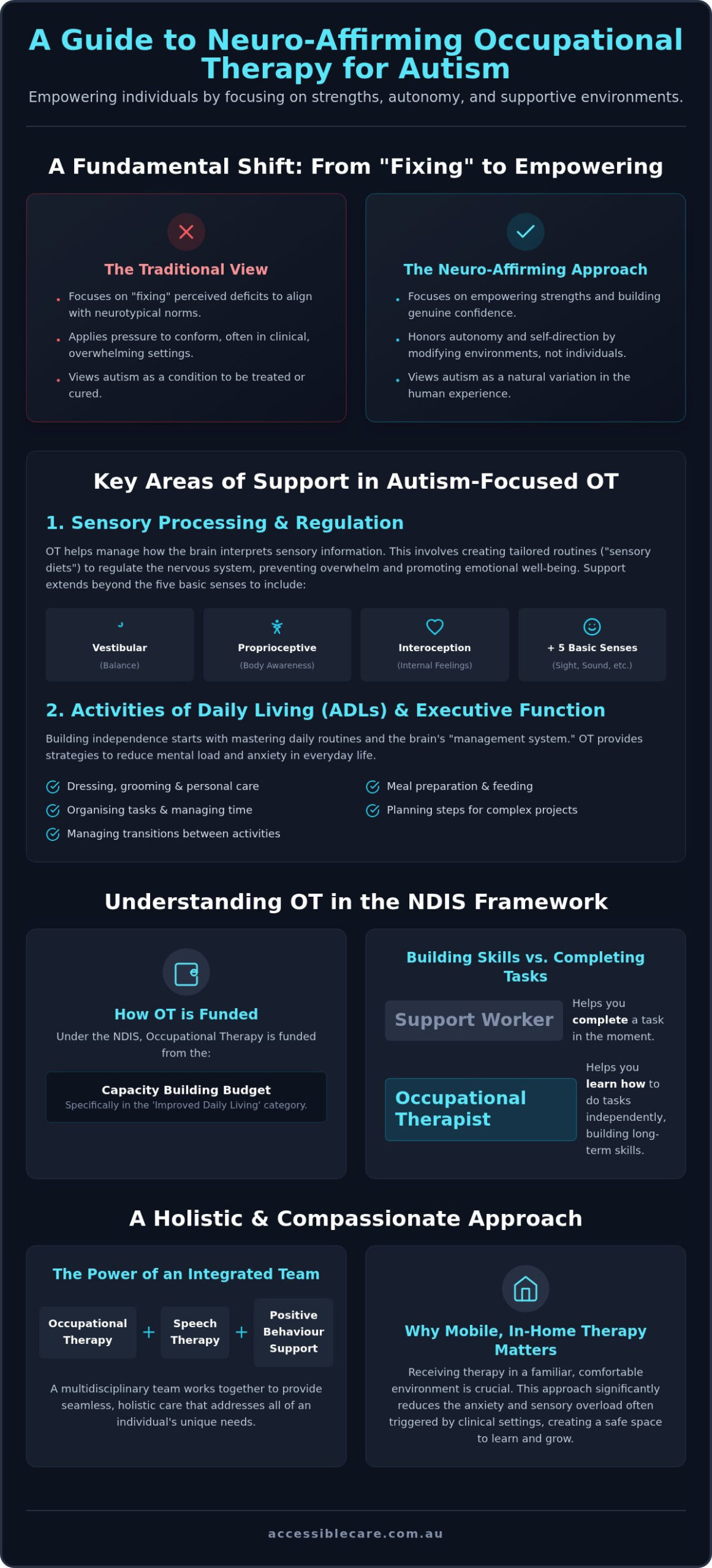
Neuro-affirming care is built on the belief that different brains are simply that; different. It’s not a deficit or a problem to be solved. This style of therapy supports individual goals rather than forcing societal norms. If a traditional classroom or office feels overwhelming, we don’t just tell you to “cope.” We look at how to change the space or your routine to make it work for you. Autonomy and self-direction are at the heart of everything we do. You are the expert on your own life, and we are here to facilitate your success.
OT in the Australian NDIS Landscape
In the NDIS system, occupational therapy for autism melbourne is generally funded under the “Capacity Building” budget. It falls specifically under the “Improved Daily Living” category. It’s important to understand that this is different from general support work. While a support worker helps you complete a task, an occupational therapist helps you learn how to do that task yourself or finds a new way to approach it.
If you’re still learning the ropes of the system, you can read our guide on What is the NDIS? to see how these supports fit together. This funding is designed to help you build the skills needed to live a more independent and fulfilling life. By focusing on capacity building, the NDIS aims to reduce the need for long-term support by increasing your own ability to manage daily activities with confidence.
Key Areas of Support in Autism-Focused OT
Effective support looks different for everyone. When looking for occupational therapy for autism melbourne, you want a team that understands how your unique brain interacts with the environment. It’s about finding comfort in your own skin and confidence in your daily actions. This approach aligns with the Victorian Government’s guide to understanding autism, which emphasises the importance of personalised, functional support. We focus on building a bridge between your current experience and your personal goals, ensuring therapy is a partnership rather than a process.
Sensory Processing and Regulation
We all experience the world through our senses, but for many autistic individuals, these signals can feel like a dull whisper or a deafening shout. Beyond the basic five senses, OTs look at three others: the vestibular (balance), proprioceptive (body awareness), and interoception (internal feelings like hunger or heart rate). We help create “sensory diets.” These aren’t about food; they’re tailored routines of activities that help regulate your nervous system throughout the day. When your body feels safe and regulated, your emotional well-being thrives. You can participate in life without being constantly overwhelmed by your surroundings.
Activities of Daily Living (ADLs) and Executive Function
Independence often starts with the small things. Developing habits for dressing, grooming, and meal preparation can significantly reduce the mental load of a day. We also work on executive functioning, which is the brain’s “management system.” This includes:
- Organising tasks and managing time effectively.
- Planning the necessary steps for complex projects or hobbies.
- Managing transitions between activities to lower daily anxiety.
If you’re curious about the broader scope of these supports, you can read our guide on What is Occupational Therapy? to see how it fosters self-reliance. Whether you’re a parent supporting a child or an adult seeking more autonomy, these strategies provide a clear path forward.
Our support also extends to motor skills and social interaction. We help you develop the physical coordination needed for school or work tasks while respecting your natural communication style. Therapy shouldn’t be about masking; it’s about finding ways to connect that feel authentic to you. Our mobile team brings these solutions directly to you, ensuring occupational therapy for autism melbourne fits naturally into your lifestyle. You might find that a little extra support makes a world of difference in your daily peace of mind; feel free to explore how our team can help you today.
Functional Capacity Assessments (FCA) for Autism
While a diagnostic assessment confirms a person is autistic, a Functional Capacity Assessment (FCA) looks at how that diagnosis impacts daily living. It’s the difference between knowing the name of a condition and understanding how it affects your ability to cook a meal, catch a bus, or manage your morning routine. For those seeking occupational therapy for autism melbourne, the FCA is often the most critical document in an NDIS journey. It provides the NDIA with a clear, professional picture of your support needs based on real-world evidence rather than clinical theory.
Our therapists prefer conducting these assessments in your home or community. Clinical environments can be stressful, often leading to “masking” or heightened anxiety that doesn’t reflect your true daily experience. By observing skills in a familiar setting, we can accurately document the sensory and cognitive challenges that might be invisible in a doctor’s office. This ensures that Occupational Therapy for autism remains focused on your authentic life and your personal goals.
Why the FCA Matters for Your NDIS Plan
An FCA provides the essential evidence required by the NDIS to justify “reasonable and necessary” support funding. Our OTs act as your advocates, translating your daily struggles and triumphs into a detailed report that highlights exactly where funding is needed most. During a mobile assessment visit, you can expect a gentle, conversational approach. We spend time listening to your story, observing how you move through your space, and identifying any environmental barriers that make life more difficult than it needs to be.
Paediatric vs. Adult OT Assessments
The focus of an assessment naturally shifts as an individual grows. For children, we look closely at developmental milestones, fine motor skills for school, and play-based interactions that foster connection. As individuals move into adulthood, occupational therapy for autism melbourne pivots toward employment, independent housing, and meaningful community participation. We understand that the transition from paediatric to adult services is a significant life event; our assessments are designed to bridge that gap, ensuring continuity of care and the preservation of autonomy at every age.
Integrating OT with Positive Behaviour Support and Speech Therapy
Managing complex care needs often requires a team of experts working in perfect harmony. A multidisciplinary approach ensures that every aspect of your life is considered, from the way you move to the way you express your needs. When you choose occupational therapy for autism melbourne through a provider that values collaboration, you gain access to a unified team. This joined-up thinking reduces the burden on families. You no longer have to act as the coordinator between different clinicians who rarely speak to one another. Instead, you experience a supportive partnership where everyone is moving toward the same goals for independence.
OT and Positive Behaviour Support (PBS)
Many actions that are labelled as “challenging behaviours” are actually an individual’s way of communicating distress or sensory overload. By integrating OT strategies with Positive Behaviour Support, we can identify the specific sensory triggers behind these moments. An occupational therapist plays a vital role in creating safe, low-arousal environments that proactively prevent distress before it starts. This partnership is especially important for those requiring NDIS High Intensity Supports, where complex needs demand a highly coordinated and empathetic response. When the environment is adjusted to meet your sensory needs, the need for “behaviours of concern” often naturally decreases.
OT and Speech Pathology Collaboration
Communication is a physical and emotional process. It requires motor control and a regulated nervous system. Our OTs work closely with speech pathologists to support the physical skills needed for clear speech or the effective use of AAC (Augmentative and Alternative Communication) devices. We believe that social-emotional regulation is the true foundation for all communication. If a person feels safe and regulated, they are far more likely to engage with the world around them. You can find more detail on this in our Speech Pathology Guide. Together, these therapies help you find your voice in a way that feels authentic and empowering.
A unified team provides more than just therapy; it provides peace of mind for the whole family. It means your therapists are sharing insights and adjusting their strategies based on your progress across all areas of life. This holistic view ensures that no part of your journey is overlooked or misunderstood. If you are ready to see how a neuro-affirming, multidisciplinary team can support your family’s unique path, contact our compassionate team today to discuss your NDIS goals.
Finding Compassionate OT Support in Melbourne and Adelaide
Choosing the right partner for your journey is about more than just checking boxes on a list of qualifications. It’s about finding a team that aligns with your values and respects your unique way of being in the world. When searching for occupational therapy for autism melbourne, look for providers who explicitly embrace neuro-affirming practices. This means they prioritise your comfort, your identity, and your personal goals over clinical “norms.” Local knowledge is also incredibly valuable. Navigating the NDIS networks in Victoria and South Australia requires an understanding of local community supports and regional variations in service delivery.
Why In-Home Therapy Works for Autistic Individuals
Traditional clinical settings can often be a source of stress rather than support. The “travel tax” is real; the energy spent navigating traffic and sitting in a sensory-heavy waiting room can leave you exhausted before the session even begins. Mobile therapy removes these barriers by bringing support to your doorstep. This allows you to practice new skills in the exact environment where they are needed, whether that’s in your kitchen, your lounge room, or your local park.
- Reduced Sensory Overload: Your home is a sanctuary where you feel safe and in command of your surroundings.
- Real-World Context: Learning to manage daily tasks is more effective when done with your own tools and in your own space.
- Family Integration: In-home visits allow carers and family members to be part of the process, ensuring everyone is on the same page.
Starting Your Journey with Accessible Care
We believe that every successful partnership begins with a simple act: listening. Our process for occupational therapy for autism melbourne and Adelaide starts with a compassionate initial consultation. We take the time to understand your history, your challenges, and what you hope to achieve. This isn’t a clinical interrogation; it’s a conversation designed to honour your autonomy and build a foundation of trust. We are currently providing these mobile services across the metropolitan regions of both Melbourne and Adelaide.
Our commitment is to be a reliable caregiver that facilitates your independence. We don’t take control; we offer the tools and strategies that help you direct your own life. If you’re ready to explore a more personalised, in-home approach to therapy, our team is here to help you navigate the complexities of the NDIS with ease and confidence. You can start this journey today by reaching out for a chat about how we can best support your unique path.
Empowering Your Journey Toward Independence
Choosing the right support is a significant step toward a more comfortable and self-directed life. We’ve explored how neuro-affirming occupational therapy for autism melbourne focuses on your strengths while modifying environments to suit your unique needs. From navigating the complexities of Functional Capacity Assessments to benefiting from a collaborative multidisciplinary team, the goal is always your autonomy. In-home therapy ensures you can build these vital skills in a space where you already feel safe, respected, and understood.
Accessible Care is a registered NDIS provider dedicated to serving individuals and families across Melbourne and Adelaide. Our specialised paediatric and adult OT services are designed to meet you exactly where you are in your journey. We believe in the power of active collaboration and attentive listening to help you reach your personal objectives with confidence. If you’re ready to partner with a team that truly honours your perspective, we’re here to help. Book a compassionate OT consultation with Accessible Care today to take the next step in your NDIS journey. You don’t have to navigate this path alone; we’re ready to support you every step of the way.
Frequently Asked Questions
Is occupational therapy only for autistic children?
Occupational therapy is for individuals at every stage of life, not just children. While paediatric support focuses on play and school, adult OT prioritises employment, independent living, and community participation. Our team supports autistic adults in Melbourne and Adelaide to navigate life transitions with confidence. We focus on building the specific skills needed for your current life stage, ensuring you have the autonomy to pursue your own goals and interests throughout adulthood.
How does the NDIS fund occupational therapy for autism?
The NDIS typically funds these supports through the Capacity Building – Improved Daily Living section of your plan. This budget is designed to help you build the skills necessary for independence in your daily life. When seeking occupational therapy for autism melbourne, your therapist will link their support directly to the goals listed in your NDIS plan. This ensures that every session is purposeful and moves you closer to achieving the outcomes that matter most to you.
What is a sensory diet in occupational therapy?
A sensory diet is a carefully designed plan of physical activities and environmental adjustments tailored to your unique sensory profile. It isn’t related to food; instead, it provides the “nutrients” your nervous system needs to stay regulated. By including specific activities throughout your day, you can manage sensory seeking or avoiding behaviours. This proactive approach helps you feel more comfortable and focused, reducing the daily stress caused by overwhelming sensory environments.
Can an OT help with autism-related meltdowns?
Yes, an occupational therapist can help by identifying the underlying sensory or environmental triggers that lead to meltdowns. We focus on proactive regulation strategies and creating low-arousal environments that help you feel safe. By understanding the “why” behind the distress, we can work together to build a toolkit of calming techniques. This approach reduces the frequency of meltdowns while respecting your emotional experience and providing practical ways to regain a sense of peace.
Do I need a GP referral for NDIS occupational therapy?
You don’t need a GP referral to access our services if you are an NDIS participant. You can contact us directly or have your support coordinator reach out on your behalf. While a GP can provide helpful background information, the NDIS system allows for self-referral to ensure you can access support quickly. We start with a compassionate consultation to discuss your needs and how occupational therapy for autism melbourne can best support your specific NDIS goals.
What happens during the first OT session for an autistic child?
The first session is a gentle introduction focused on building trust and rapport in a comfortable environment. We often use play-based observations to understand your child’s strengths, interests, and sensory preferences without the pressure of a clinical setting. It’s also a time for us to listen to your family’s story and identify the goals that are most important to you. We aim to make this initial meeting a positive, low-stress experience for everyone involved.
How long does autism support with an OT usually last?
The duration of support is entirely dependent on your individual goals and the progress you make over time. Some people seek short-term assistance for a specific challenge, while others benefit from longer-term support during major life transitions. Your NDIS plan is reviewed regularly, allowing us to adjust the frequency and type of therapy as your needs evolve. We are here to provide consistent, reliable care for as long as it helps you thrive and maintain independence.
Can OT help an autistic adult find or keep a job?
Occupational therapy is highly effective for autistic adults looking to enter the workforce or maintain their current employment. We can help by assessing your workplace for sensory challenges and recommending simple modifications to your environment. We also focus on building executive functioning skills, such as time management and organisation, which are vital for professional success. Our goal is to help you find a work-life balance that respects your energy levels and honours your professional autonomy.

