


What if a support request becomes clearer when you connect it to the difference it could make in everyday life? The ndis reasonable and necessary criteria can be difficult to apply when you’re trying to explain personal needs in formal terms. A clear link between disability-related needs, personal goals and relevant evidence can help make a request easier to understand, although it can’t guarantee a funding decision.
This guide explains the criteria in plain English and explores what information can help describe a requested support. You’ll learn how to connect a support with the impairment that makes you eligible for the NDIS, your goals and your daily life, so you can feel more prepared for conversations with professionals and people you trust.
As of October 2026, seven criteria apply. Since 27 August 2026, a requested support must also connect directly to the impairment that makes someone eligible. From 1 February 2027, an eighth criterion will address whether another scheme or government service should fund the support. We explain these changes and give examples involving therapy and support, without suggesting that any outcome is certain.
Key Takeaways
- Understand how the ndis reasonable and necessary criteria inform funding decisions, and why a useful support isn’t automatically funded.
- Learn how to connect a support request with disability-related needs, personal goals and everyday participation.
- See how personal examples and professional information can help explain a requested support.
- Use a simple sequence to organise information, while recognising that the NDIA makes the funding decision.
- Explore how participant-led therapy and support can relate to goals, independence and daily life.
What do the NDIS reasonable and necessary criteria mean?
The wording may sound formal, but the questions behind it are practical: does a support relate to a person’s disability, help them work towards their goals and meet the NDIS rules that apply to their circumstances? The ndis reasonable and necessary criteria are the framework the National Disability Insurance Agency (NDIA) uses when deciding whether a requested support can be funded in an NDIS plan. They help distinguish a support that may be useful from one that meets the scheme’s funding requirements.
The NDIS is Australia’s national scheme for supporting people with disability. The National Disability Insurance Scheme (NDIS) overview provides broader context about the scheme’s purpose and structure. Current NDIA guidance explains how funding rules are applied. Decisions are individual: the same type of support may be considered differently depending on a person’s disability-related needs, goals, circumstances and the rules in force at the time.
As of October 2026, the framework includes seven reasonable and necessary criteria. Since 27 August 2026, a requested support must also connect directly to the impairment that makes a person eligible for the NDIS. A further criterion about whether another scheme or government service should fund a support is due to apply from 1 February 2027. As changes are introduced progressively, check current NDIA information for the rules relevant to your situation.
This section explains the framework in general terms. It isn’t legal advice, and no explanation or provider recommendation can guarantee a funding outcome. For a broader introduction to the scheme and how it works, see our simple guide to the NDIS.
Who applies the criteria, and when?
The NDIA makes relevant NDIS funding decisions, including decisions about supports requested for a plan. Participants and their supporters may encounter the criteria during planning conversations or when discussing a plan change. These conversations are an opportunity to explain how support needs affect daily life and relate to the request. The NDIA makes the funding decision under the applicable rules.
Why the criteria matter to participants and supporters
The criteria give participants, families and supporters a shared way to consider whether a requested support belongs in an NDIS plan. They can help you explain the support’s purpose, how it relates to disability-related needs and what difference it may make. They can also help identify where more information would make the request clearer.
Uncertainty about funding can feel stressful, especially when a support seems important to everyday wellbeing or independence. A professional may recommend a service based on an assessment of someone’s needs. That recommendation can help explain the request, but it doesn’t determine how the NDIA applies the criteria.
A provider can recommend a support; only the NDIA can decide whether it meets the funding requirements for an NDIS plan. Keeping that distinction in mind can help you use professional advice constructively as you prepare for a funding discussion.
How the NDIS reasonable and necessary criteria are applied
The NDIA considers whether a requested support meets the applicable requirements in the context of the participant’s circumstances. The ndis reasonable and necessary criteria aren’t a points system where one strong piece of evidence or one positive answer guarantees funding. The request is considered as a whole, alongside current legislation, guidance and applicable support lists.
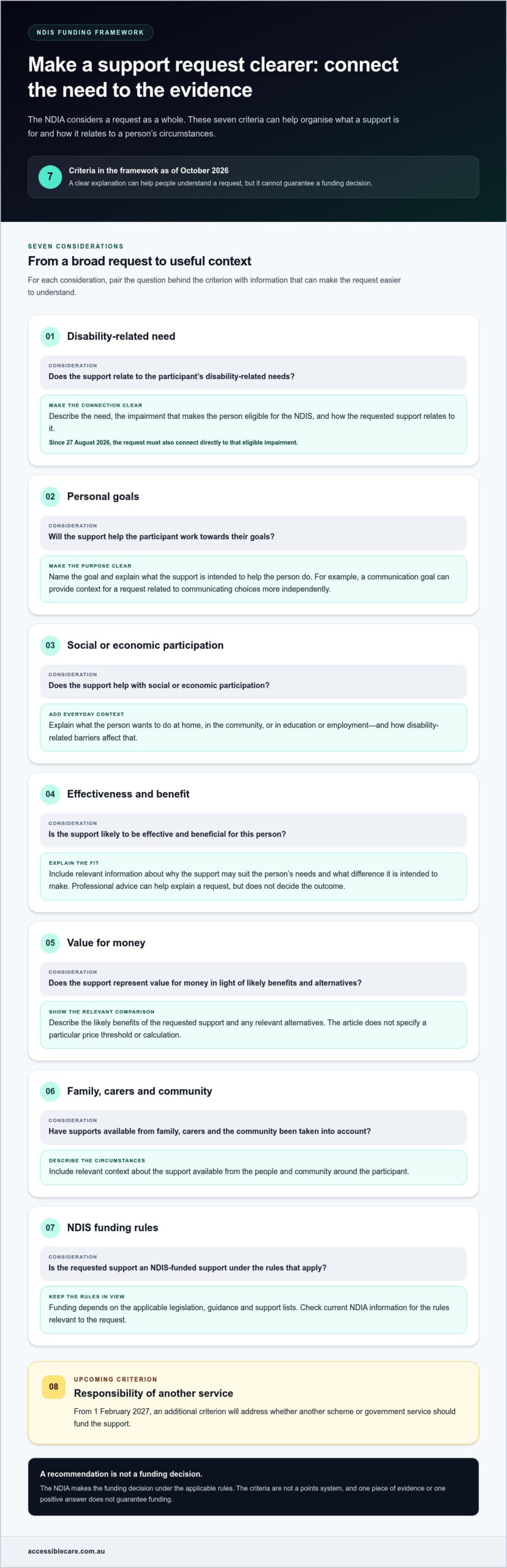
In plain English, the considerations include whether the support:
- relates to the participant’s disability-related needs and, since 27 August 2026, connects directly to the impairment that makes them eligible for the NDIS;
- helps the participant work towards their goals;
- supports their social or economic participation;
- is likely to be effective and beneficial for that person;
- represents value for money in light of its likely benefits and alternatives;
- takes account of support available from family, carers and the community; and
- is an NDIS-funded support under the rules that apply to the request.
These are plain-English summaries, not a substitute for the legal wording. The NDIA’s official NDIS guidelines on reasonable and necessary supports explain the framework. From 1 February 2027, an additional criterion will address whether another scheme or government service is more appropriately responsible for funding a support.
How a support can relate to disability and personal goals
A request is easier to understand when it explains the connection between a person’s disability-related needs and the support being sought. A goal gives the request a practical purpose. For example, if someone’s goal is to communicate their choices more independently, information about their communication needs can help explain why a particular support is being requested. The goal doesn’t prove that the support is eligible for funding, but it shows what the support is intended to help the person achieve.
Participation matters, too. Explain what the person wants to do at home, in their community, or in education or employment, and how disability-related barriers affect that. Specific context is more informative than naming a service alone.
How effectiveness, value, and informal supports fit in
Effectiveness and benefit are considered in the person’s circumstances. Relevant information may explain why the support is suitable for their needs and what outcomes it is intended to support. Value for money isn’t simply a matter of choosing the cheapest option. The decision considers the support’s likely benefits and costs in context, including whether another approach could achieve similar outcomes.
Informal supports, such as help from family, friends or community, may also be considered. This doesn’t mean relatives are automatically expected to provide every type or level of care. The person’s circumstances matter, including what support is available and sustainable. For children, the rules about parental support are changing from 1 February 2027, so check current NDIA guidance for the relevant date.
The NDIA considers how a support relates to disability, goals, participation, likely benefit, value, informal supports and applicable funding rules, rather than relying on one factor alone. If you’re exploring how allied health or support work may relate to a person’s goals, Accessible Care’s NDIS services can support conversations about independence and daily life.
Common misunderstandings about NDIS reasonable and necessary decisions
It’s natural to hope that a clear diagnosis or a professional recommendation will settle a funding request. Both can be important, but neither automatically means a support will be funded. The NDIA considers the request against the rules that apply and the person’s circumstances, including how the support relates to their disability-related needs and goals.
A support may be helpful, valued or recommended and still need to meet the relevant NDIS requirements before it can be included in a plan. That distinction isn’t a judgement about whether someone’s needs matter. It reflects the difference between identifying a possible support and deciding whether the NDIS can fund it under the current framework.
Does a diagnosis or therapist recommendation guarantee funding?
A diagnosis can help explain a person’s disability and provide context for their support needs. On its own, though, it doesn’t explain why every requested support is needed or show that each funding criterion is met. A therapist’s recommendation can add useful professional insight, but it remains information for the NDIA to consider.
Clear, person-centred detail can make that information more useful. Rather than relying on a diagnostic label alone, explain what the person finds difficult in everyday situations, what support is being recommended and what it is intended to help them do. Keep the explanation specific to the person, not just the name of a service.
Does reasonable and necessary mean the same thing for everyone?
No. Two people may request the same type of support but have different goals, functional needs, living arrangements, informal supports and evidence. Those differences can affect how a request is considered. A general example can explain a criterion, but it can’t predict how the NDIA will decide an individual case.
The same support can have a different funding case for each person because its purpose, disability-related connection and likely benefit depend on individual circumstances. Describe the person’s own situation rather than assuming that a decision made for someone else will apply in the same way.
Rules and guidance can also change. The legal framework includes the National Disability Insurance Scheme Act 2013 and related NDIS Rules. Current NDIA information can help you understand which requirements apply when a request is considered, particularly during periods of legislative change.
If a request isn’t funded as hoped, it can be disappointing. Take time to understand the reasons given and which information or criteria were relevant. A decision is based on the material considered and the rules in force, not simply on whether a professional believes a support could be beneficial. Understanding that distinction can help participants and supporters have a clearer conversation about next steps.
How to prepare information for an NDIS support request
Preparation can make a support request easier to understand, even though it can’t determine the outcome. The NDIA makes the funding decision. Your role is to bring together clear information about the person’s goals, disability-related needs and the support being requested. A thoughtful account can also help professionals understand what matters most to the participant.
Describe the need and the outcome in everyday terms
Begin with the person’s priorities. Describe what they want to do and what gets in the way, using examples from daily life rather than relying only on broad labels. For example, a person may want to prepare a meal more independently but need support with steps that are difficult because of disability-related needs. Keep the focus on the participant’s preferences and the outcome they hope to work towards.
An occupational therapy assessment may help describe how a person manages everyday activities and what support needs arise. Our guide to occupational therapy explains how this kind of assessment can relate to daily life and independence.
Use this sequence to organise your information:
- 1. Start with a goal. Record what the person wants to achieve, in their own words where possible.
- 2. Describe the everyday impact. Note the activity, communication or participation barriers connected with their disability-related needs. A brief, specific example can make the impact easier to understand.
- 3. Explain the requested support. State what support is being sought and how it may help the person work towards the goal. Don’t present an intended outcome as guaranteed.
- 4. Add the participant’s perspective. Include their preferences, experience and priorities. If someone supports them to communicate, make clear which views belong to the participant.
- 5. Gather relevant professional information. Reports or observations from therapists and other professionals can add context about the person’s needs, the proposed support and its purpose. Use information that relates directly to the request.
- 6. Check the current rules. Review NDIA guidance and applicable support lists before relying on older information, as legislation, guidance and lists may change. If published information is unclear, seek clarification through appropriate NDIS channels.
Bring together relevant information and review current guidance
Professional observations can complement, but not replace, the person’s account. Organise documents around the goals or needs they help explain, and leave out unrelated detail that could make the request harder to follow. Before sharing information, check that it reflects the person’s current circumstances and clearly connects the evidence to the support being requested.
These steps help prepare an explanation; they don’t guarantee that the NDIA will fund the support. To discuss participant-led support that reflects a person’s goals and daily life, explore NDIS support with Accessible Care.
How Accessible Care can support goals connected to NDIS criteria
Understanding the criteria is one part of the process. The next is exploring what support may help a person work towards their own goals in everyday life. Accessible Care is a registered NDIS provider serving Melbourne and Adelaide, offering allied health and support services that can be considered in light of each participant’s needs and preferences.
A therapist or other professional can help describe a person’s needs and the purpose of an intervention. This information may contribute to a funding request, but it doesn’t determine whether the NDIA will fund a support. The ndis reasonable and necessary criteria are applied by the NDIA to the person’s circumstances and the rules that apply.
Connecting therapy and daily support with individual goals
Occupational therapy may focus on activities that matter to the person, such as managing aspects of a daily routine or building independence in everyday tasks. Speech therapy may relate to communication and participation, including expressing choices or taking part in conversations. The right focus depends on the individual. Our speech pathology guide to communication and swallowing support offers more context about this area of therapy.
Helpful conversations start with listening. A participant’s goals, communication preferences and experience can guide an assessment and help professionals understand the support being considered. Where appropriate, allied health observations can add detail about daily activities, communication or barriers to participation. Together, this information can clarify the intended purpose of support without overstating what it may achieve.
Taking a supportive next step with Accessible Care
Each person’s priorities are different. A useful discussion can begin with what the participant wants to do, what feels difficult and what kind of assistance they would like to explore. This keeps the person’s voice central and makes the conversation practical, whether the focus is therapy, support work, community nursing or another relevant service.
Accessible Care provides occupational therapy for adults and children, speech therapy, positive behaviour support, community nursing and support work in Melbourne and Adelaide. The aim is to understand the person’s circumstances and support needs, then consider how services may relate to their goals and independence.
If you’d like to talk through support needs and possible service options, start a conversation with Accessible Care. The discussion can help clarify what matters to the participant and what support may be appropriate. Any NDIS funding decision remains with the NDIA.
Take your next step with confidence
A funding conversation doesn’t have to begin with perfect wording. Start with what matters to the participant and what they hope could change in daily life. That priority can guide a clearer discussion with trusted professionals and supporters, even when the eventual decision is uncertain.
The ndis reasonable and necessary criteria provide a framework for considering a request, not a promise of funding. Keep the person’s voice at the centre, ask questions when something is unclear and use current NDIA information as you consider what to do next. Each thoughtful step can make it easier to express needs and choices with confidence.
If you’d like support exploring options that reflect a participant’s goals, talk with Accessible Care about support that fits your goals. Start a conversation with Accessible Care about the participant’s priorities and support needs.
Frequently Asked Questions
What does reasonable and necessary mean in the NDIS?
It means the NDIA assesses whether a requested support meets the funding requirements for an NDIS plan in the participant’s circumstances. The decision considers factors such as disability-related need, goals, participation, likely benefit, value for money and informal supports. It doesn’t mean the NDIS will cover every helpful expense. Everyday living costs, for example, aren’t automatically NDIS supports simply because a participant has a disability.
Is a diagnosis enough to meet the NDIS reasonable and necessary criteria?
No. A diagnosis can help explain a person’s disability, but it doesn’t by itself show why a particular support is needed or how it relates to their goals and daily life. For example, a diagnosis may not explain which communication tasks are difficult or what support could help. The ndis reasonable and necessary criteria apply to the specific request and the person’s situation, not just a diagnostic label.
Can a therapist recommend a support and guarantee NDIS funding?
No. A therapist can assess needs and recommend support, but only the NDIA makes the relevant funding decision. A useful report may explain the assessment findings, the proposed support, how it relates to the person’s disability and goals, and the outcomes it aims to support. It should describe professional observations accurately, without presenting possible progress as certain or implying that a recommendation guarantees approval.
How do I show that a support is related to my disability?
Describe the connection between the disability-related impairment and the specific activity where support is needed. For example, explain what makes preparing a meal, communicating a choice or joining a community activity difficult, and how the requested support could help address that barrier. If available, combine your own account with relevant professional observations. Keep the explanation focused on your experience rather than assuming the connection is obvious from a diagnosis.
What happens if my requested support is not included in my NDIS plan?
First, read the plan or decision information carefully to understand what was included and the reasons provided. If those reasons aren’t clear, contact the NDIA through its official channels and ask what information informed the decision. You can also ask about review options and any relevant time limits, as these depend on the decision. Keep copies of correspondence and note dates so you can follow up in an organised way.
Do the NDIS reasonable and necessary criteria change in 2026?
Yes. From 27 August 2026, a requested support must connect directly to the impairment that makes a person eligible for the NDIS. The existing seven criteria continue to apply. Another criterion, about whether a different scheme or government service should fund a support, is due to begin on 1 February 2027. Some rules are being introduced progressively, so check current NDIA guidance for the date relevant to your request.
Can family members help explain an NDIS support request?
Yes. Family members can share practical examples of what they observe in daily life, such as when a person needs assistance with routines or communication. Where possible, include the participant’s own preferences and perspective, too. Informal support is considered in funding decisions, but that doesn’t mean family must provide every type of care. From 1 February 2027, rules will specify how parental support is considered for children, so check current guidance.

