


What if the first step isn’t choosing a therapy or proving a diagnosis, but talking through your child’s strengths, support needs and what matters to your family? The ndis early childhood approach is a family-centred pathway, not a single therapy or a one-size-fits-all plan.
It’s understandable to feel unsure about whether your child may be eligible, who to speak with first, or how an Early Childhood Partner works alongside therapy providers. You don’t need to have every answer before exploring support. A useful first conversation can start with what you notice about your child’s development and daily life.
This guide explains how the pathway works, who may be involved and what information can help you discuss your child’s needs and strengths. You’ll also learn how the NDIS and the phased introduction of Thriving Kids may shape support options, and where paediatric occupational therapy or speech therapy can fit into a broader journey. The aim is to help you feel informed and prepared, without pressure to make decisions before you’re ready.
Key Takeaways
- The ndis early childhood approach centres on your child’s strengths, everyday participation and family priorities, rather than on one therapy alone.
- An Early Childhood Partner can help your family understand possible next steps, connect with supports and explore whether an NDIS application may be appropriate.
- Age thresholds and support pathways differ. Understanding the current criteria can help you explore options without assuming a developmental concern automatically means NDIS eligibility.
- Before a conversation, note your child’s strengths, routines and support needs, with examples from home, childcare or community life.
- Occupational therapy and speech therapy may support individual goals, such as everyday activities, communication and independence.
What is the NDIS Early Childhood Approach and who is it for?
The NDIS Early Childhood Approach is a family-centred pathway that helps young children with developmental delay or disability and their families explore support for the child’s development and participation. It isn’t one therapy or a guarantee of an NDIS plan. Depending on the child’s needs and circumstances, the pathway may include practical guidance, connections to community supports or help exploring NDIS access.
The approach recognises that families know their child well. Conversations can consider what a child enjoys, what’s becoming difficult and what the family hopes to support. A child’s strengths and priorities matter alongside the areas where they may need help.
What does the Early Childhood Approach aim to do?
Support is shaped around the child’s development and family context, rather than a standard program applied to every child. Everyday routines can help clarify needs and priorities. For example, a family might discuss how their child communicates during play, joins in at childcare, manages mealtimes or takes part in getting dressed.
These details can help families and professionals identify meaningful goals. What matters most may change as a child grows or circumstances shift, so progress is individual. The aim is to explore useful support, not to promise a particular outcome.
How is the approach different from a therapy appointment?
A therapy appointment usually focuses on specific goals with a qualified therapist. The Early Childhood Approach is broader: it can help a family understand possible pathways and connect with supports that fit the child’s needs. The precise steps depend on the child and the rules in place at the time.
For instance, paediatric occupational therapy may work on daily living skills and participation in everyday activities. Speech therapy may focus on communication goals. Either may be one part of a wider support journey, not the whole approach. Families seeking the broader funding context can also read What is the NDIS?
Early childhood support and NDIS participant access are related, but they aren’t the same thing. Under current guidance, the Early Childhood Approach is for children younger than 9 with disability, or younger than 6 with developmental delay. Being able to explore early childhood support doesn’t automatically mean a child meets the criteria for an NDIS plan. Families can start by discussing concerns and priorities, even if they’re unsure which pathway may fit.
How does the NDIS Early Childhood Approach work, step by step?
The ndis early childhood approach is a guided pathway, not a rigid sequence that looks the same for every family. An Early Childhood Partner delivers the approach on behalf of the NDIA. They’re a first point of contact for information, connections to community supports and, where a child’s needs may be significant, help exploring an NDIS application. The current pathway is outlined in the NDIS Early Childhood Approach guidance.
A practical first step is to contact the Early Childhood Partner for your area and describe what you’re noticing. You don’t need to have every answer ready. The conversation can help clarify possible next steps, which depend on your child’s circumstances and the rules in place.
What happens when a family first seeks guidance?
To make the conversation useful, share both concerns and strengths. You might describe how your child communicates, plays, manages daily routines or joins in at childcare and in the community. A diagnosis isn’t a prerequisite for raising developmental concerns in an initial conversation. The Partner can help explain what information or pathway may be relevant.
How do families and practitioners shape next steps together?
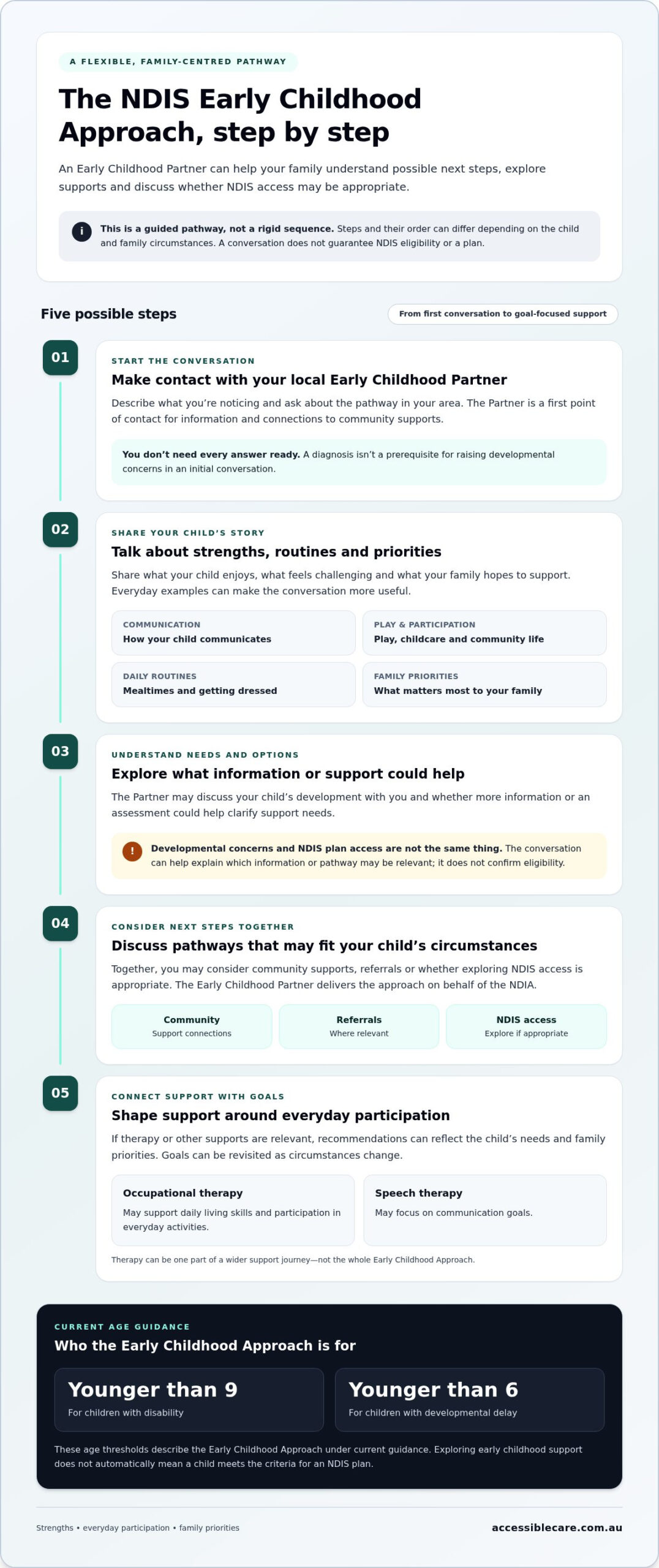
The journey may include several parts, in a different order depending on the child:
- Make contact. Speak with the local Early Childhood Partner to discuss your concerns and ask about the pathway in your area.
- Share your child’s story. Talk about strengths, everyday routines, what feels challenging and what your family hopes to support.
- Explore needs and options. The Partner may discuss your child’s development with you and whether more information or an assessment could help clarify support needs.
- Agree on possible next steps. Together, you may consider community supports, referrals or whether exploring NDIS access is appropriate. A discussion doesn’t guarantee NDIS eligibility or a plan.
- Connect support with goals. If therapy or other supports are relevant, recommendations can reflect the child’s needs and family priorities. Goals may be revisited as circumstances change.
Families in Melbourne or Adelaide can explore paediatric occupational therapy and speech therapy support as part of a broader support journey. Therapy goals can be tailored to a child’s everyday participation and communication.
Who may be eligible, and what support can the Early Childhood Approach involve?
Developmental concerns, support through the Early Childhood Approach and eligibility for an NDIS plan are connected, but they’re not interchangeable. A family can seek guidance about a child’s development without that conversation confirming NDIS access. Under current guidance, the approach is for children younger than 9 with disability, or younger than 6 with developmental delay. NDIS access is a separate decision based on the applicable criteria and information about the child’s situation.
These age pathways and supports are changing. From October 2026, the phased rollout of Thriving Kids is introducing community-based support for children aged 8 and under with developmental delay and/or autism who have low to moderate support needs. The rollout is expected to be fully operational by 1 January 2028. Children with permanent and significant disability or high support needs will continue to be eligible for the NDIS under the current guidance. Families can read the current NDIS Early Childhood Approach guidance for details as the transition progresses.
Do children need a diagnosis or an NDIS plan to seek early guidance?
For an initial conversation: a diagnosis isn’t required to raise developmental concerns about a child younger than 6. Families can talk with an Early Childhood Partner about what they’re noticing and ask what options may fit. The conversation doesn’t determine eligibility or guarantee a particular service.
For NDIS access: a family needs to explore the formal access criteria, which are distinct from seeking guidance. A diagnosis alone doesn’t automatically mean a child will receive an NDIS plan, and the information needed depends on the child’s circumstances and the criteria that apply. If you’re unsure, describe your child’s needs to the Partner and ask what pathway or evidence may be relevant.
What kinds of support might be relevant to a child’s goals?
Support depends on the child’s goals and may involve community connections, developmental supports or therapy. These examples don’t mean a particular service will be funded automatically.
| Possible support | How it may relate to a child’s goals |
|---|---|
| Early Childhood Partner guidance | Discuss needs and strengths, understand possible pathways, and connect with relevant community supports. |
| Paediatric occupational therapy | Work towards goals involving daily living skills and participation in everyday activities. |
| Speech therapy, also called speech pathology | Support individual communication goals in meaningful daily contexts. |
These supports can be considered as parts of an individualised journey, not a fixed package. Exploring paediatric occupational therapy or speech pathology can help families understand how a therapy focus may relate to a child’s everyday priorities.
How can families prepare for an Early Childhood Approach conversation?
You don’t need to create a formal report before speaking with an Early Childhood Partner. A few brief notes can help you explain what your child enjoys, what feels challenging and what your family would like support with. The ndis early childhood approach is centred on your child and family, so your everyday observations are valuable.
What information can help explain a child’s everyday experience?
Think about specific moments rather than trying to summarise everything. For example, note when your child is most comfortable joining an activity, what makes a routine harder or how they show they want help. If relevant, include observations about communication, play, self-care and taking part at home, childcare or in the community.
Keep notes brief and relevant. You can share examples from other settings if they help explain your child’s experience, while respecting other people’s privacy. There isn’t one document list or assessment that every family must prepare. If you already have relevant reports or notes, ask whether they’d be useful, but don’t let paperwork become a barrier to starting a conversation.
- Strengths and interests: What does your child enjoy or do confidently?
- Everyday routines: Which activities feel comfortable, and where might support help?
- Your observations: What have you noticed at home, childcare or in the community?
- Family priorities: What would you most like your child to be able to do or take part in?
A simple preparation checklist: note your child’s strengths, one or two everyday examples, what your family hopes to support and any questions you’d like answered.
How can families keep goals centred on their child?
Describe what you’d like to see in daily life, in your own words. A goal might be for your child to feel more comfortable during a routine, communicate their choices or join an activity that matters to them. These priorities can guide discussion without technical language or a fixed plan from the outset.
You can ask for unfamiliar terms to be explained plainly, what role each person may have, which options are being considered and how you’ll talk about progress. It’s okay to take time to think about recommendations. Progress can look different for each child, and goals may shift as needs and family priorities change.
Occupational therapy can relate to everyday activities and participation. For a simple explanation, explore What is occupational therapy? If you’d like to discuss paediatric therapy aligned with your child’s goals, explore therapy support for your child.
How can therapy support fit into the NDIS Early Childhood Approach?
Therapy can be one part of a child’s broader support journey, not the whole Early Childhood Approach. The focus is on what matters to the child and family in everyday life. Depending on the child’s circumstances, goals and applicable NDIS arrangements, therapy may be considered alongside other supports. A therapy service isn’t automatically funded because a family is exploring the approach or has a particular concern.
Start with the goal, not the name of a therapy. What would help your child take part in a valued activity, communicate a choice or manage an everyday routine? Sharing these priorities can make conversations with practitioners more relevant and grounded in your child’s life.
When might paediatric occupational therapy be relevant?
Paediatric occupational therapy may support goals related to daily living skills, routines, play and participation. A family might want to discuss how their child takes part in getting dressed, mealtimes, play or activities at childcare. These examples are starting points for a conversation, not a checklist of milestones every child must meet.
Goals should reflect the child’s strengths, needs and family priorities. One approach won’t suit every child, and a goal may change as the child’s routines or circumstances change. Practitioners like Michelle McMillan emphasise personalized therapy strategies that support children and families as their needs evolve. The emphasis is on practical skills and participation that are meaningful to that child.
When might speech therapy be relevant?
Speech therapy may be relevant when a family wants to support a child’s communication. Goals could relate to expressing needs, sharing choices, understanding others or joining in conversations and play. Communication looks different for every child, so the family’s observations can help shape a useful discussion.
It may help to describe what you notice in daily life: how your child lets you know what they want, which situations feel easier and when communication becomes more difficult. These details can connect therapy goals with real experiences at home, childcare or in the community.
Funding and service choices depend on the child’s individual circumstances and the NDIS arrangements that apply. If you’re considering therapy, connect the discussion to your child’s goals and priorities. Families in Melbourne and Adelaide can explore support with Accessible Care, including paediatric occupational therapy and speech therapy.
Take the next step at your family’s pace
The ndis early childhood approach is a pathway to explore your child’s needs and possible supports, not a promise of a particular service or outcome. Your observations about their strengths, routines and priorities can guide a conversation with an Early Childhood Partner. NDIS access has separate criteria, but families can seek initial guidance about developmental concerns without having every answer in advance.
Therapy may also fit into a broader, individualised support journey. Paediatric occupational therapy can relate to daily activities and participation, while speech therapy can focus on meaningful communication goals. The right support depends on your child’s and family’s circumstances.
Accessible Care is a registered NDIS provider serving Melbourne and Adelaide, with paediatric occupational therapy and speech therapy among its services. Explore therapy support with Accessible Care to discuss how therapy may align with your child’s goals.
You can take things one conversation at a time. Your family’s priorities matter, and it’s okay to ask questions, consider the options and choose your next step when you feel ready.
Frequently Asked Questions
What is the NDIS Early Childhood Approach?
The ndis early childhood approach is a family-centred pathway for young children with developmental delay or disability and their families. An Early Childhood Partner can help families understand options, connect with community supports and explore NDIS access when appropriate. It isn’t a single therapy program or an automatic guarantee of an NDIS plan. The pathway considers the child’s strengths, needs, participation and family priorities.
Who is eligible for the NDIS Early Childhood Approach?
Current guidance covers children younger than 9 with disability, or younger than 6 with developmental delay. Accessing guidance through the approach and meeting the criteria for an NDIS plan are separate matters. From October 2026, Thriving Kids is being phased in for children aged 8 and under with developmental delay and/or autism who have low to moderate support needs. The transition is ongoing, so families should consider current guidance for their circumstances.
Does a child need a diagnosis to access the Early Childhood Approach?
A diagnosis isn’t needed to raise developmental concerns with an Early Childhood Partner for a child younger than 6. The Partner can discuss what the family has noticed and explain possible next steps. Formal NDIS access is separate and depends on the applicable criteria and information about the child’s circumstances. A diagnosis alone doesn’t guarantee a plan, and families can ask what evidence or pathway may be relevant.
How do families access the NDIS Early Childhood Approach?
Families can contact the Early Childhood Partner responsible for their area and describe their child’s strengths, support needs and everyday experiences. The Partner is the local organisation delivering the approach on behalf of the NDIA. They can provide information, help connect families with community supports and, where the child’s needs may be significant, explain how to explore an NDIS application. The exact steps depend on the child’s circumstances and current rules.
What supports can children receive through the Early Childhood Approach?
Support may include guidance from an Early Childhood Partner, connections with community services, or help exploring therapy and other developmental supports. The right options depend on the child’s goals and circumstances. Paediatric occupational therapy may relate to daily activities and participation, while speech therapy may support communication goals. These are examples, not automatic entitlements: NDIS funding depends on eligibility, the child’s plan and the arrangements that apply.
Can families choose occupational therapy or speech therapy for their child?
Families can discuss occupational therapy or speech therapy as possible supports and consider whether either relates to their child’s goals. How a service is accessed or funded depends on the child’s circumstances and applicable NDIS arrangements, including their plan. Occupational therapy may address daily living skills and participation; speech therapy may focus on communication. A discussion with the Early Childhood Partner or relevant practitioner can help clarify possible next steps.
What should I prepare before speaking with an Early Childhood Partner?
You don’t need to prepare a formal report. A few notes can help you describe your child’s strengths, interests, routines and support needs. Consider brief examples from home, childcare or community settings, such as how your child communicates, plays, manages self-care or joins activities. You can also write down your family’s priorities and questions. Share information that’s relevant, and ask for plain-language explanations if anything is unclear.
Is the NDIS Early Childhood Approach the same as early intervention therapy?
No. The Early Childhood Approach is a broader pathway that helps families understand support options and may connect them with community services or an NDIS application pathway. Early intervention therapy is one possible support within a child’s wider journey. For example, occupational therapy or speech therapy may work towards individual goals. The approach doesn’t require every child to have therapy, and a particular service or funding outcome isn’t guaranteed.

