


What if a behaviour that feels alarming is also communicating an unmet need? If you’re searching for the ndis behaviour of concern definition, it’s understandable to want clarity while worrying that a label could unfairly define someone you care about. In the NDIS context, the term describes behaviour that may cause harm to the person or others, or affect their quality of life. It identifies a concern about the behaviour, not the person.
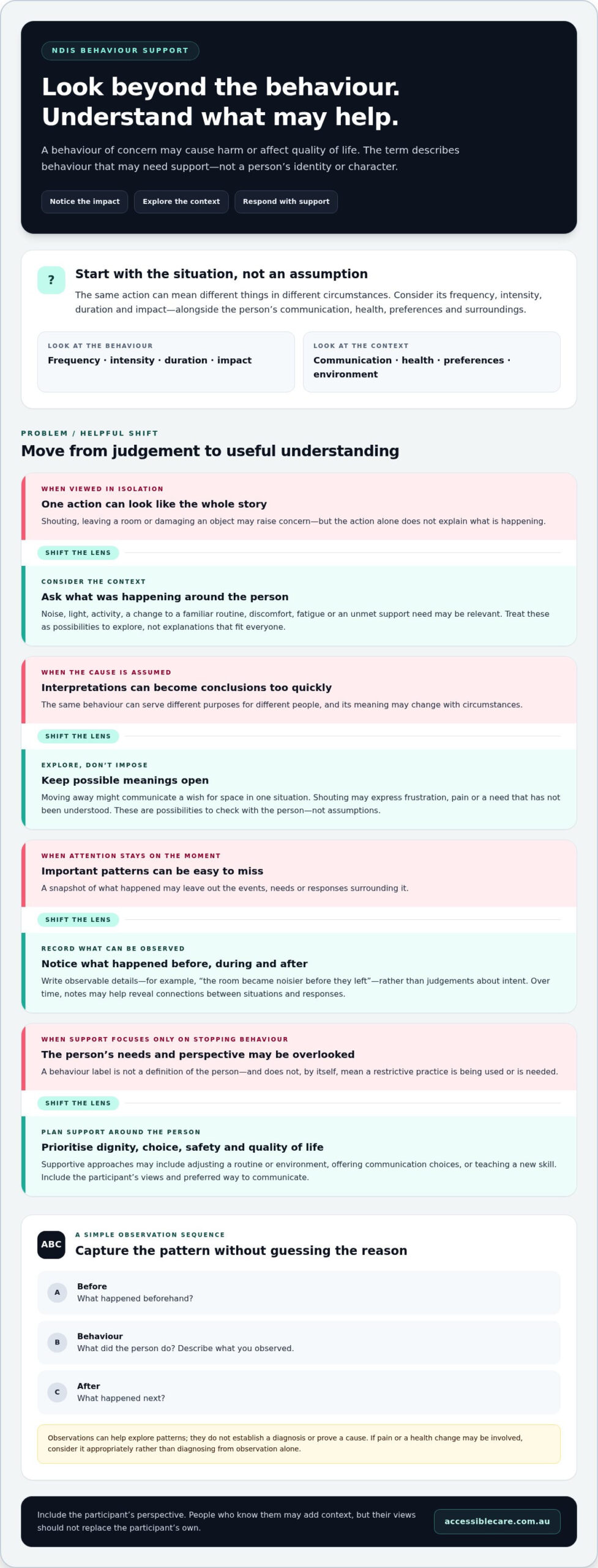
It can be hard to tell whether an action fits the term, especially when its meaning depends on the situation. Consider its frequency, intensity, duration and impact, as well as communication needs, distress, health, surroundings and what happened beforehand. Looking at context can shift the question from “How do we stop this?” to “What might this person need, and what support could help?”
This article explains the term in plain language, explores why behaviours of concern may occur, and outlines how person-centred positive behaviour support can respond. It also explains how behaviour support plans fit into the picture and why restrictive practices require careful safeguards. The aim is understanding without blame, and support that respects each person’s dignity, choices and goals.
Key Takeaways
- The ndis behaviour of concern definition describes behaviour that may need support, not a person’s identity or character.
- Look for patterns and record what you observe, including what happened before and after, without assuming the cause.
- A behaviour label alone doesn’t mean a restrictive practice is being used or is needed. Supportive strategies and restrictive practices are different.
- Positive behaviour support works collaboratively with the participant and people important to them, guided by the person’s choices and goals.
What does behaviour of concern mean in the NDIS?
In the NDIS context, a behaviour of concern is an action that may cause harm to the person or someone else, or affect the person’s quality of life, and needs to be understood in context. The term describes behaviour that may call for support, not a person’s identity or character. The phrase ndis behaviour of concern definition is about what is happening and what may help, rather than placing blame.
Whether a behaviour raises concern depends on more than what it looks like. Consider its impact, how often it occurs, how intense or long-lasting it is, and the circumstances around it. An action may be concerning in one setting but not another. The person’s communication, health, preferences, relationships and environment can all help explain what is happening.
How is behaviour of concern different from challenging behaviour?
Terminology varies between services and guidance. “Challenging behaviour” is used more broadly in some settings, as described in this overview of challenging behaviour. In NDIS behaviour support, “behaviours of concern” is preferred because it focuses on the behaviour’s impact and the support that may be needed, rather than implying that the person is the problem.
Use person-first language, such as “a person who displays behaviour of concern”, rather than defining someone by a behaviour. Include the person’s perspective, too. Ask what feels safe, difficult or helpful, using their preferred way to communicate. Their views can reveal details that others might miss.
What kinds of behaviour may prompt concern?
Examples might include shouting, moving away from a situation, damaging objects, or actions that could cause injury to the person or someone else. These examples are prompts for understanding, not a checklist or diagnosis. A person’s disability alone doesn’t explain why an action happens.
The same action can have different meanings. Leaving a room might be a way to find quiet, communicate discomfort or respond to an overwhelming situation. Shouting may express frustration, pain or a need that hasn’t been understood. These are possibilities to explore, not assumptions. Notice what happens before and after, and listen to the person wherever possible. Understanding the individual circumstances helps guide a respectful response.
Why might a behaviour of concern happen?
Behaviour can be one way a person communicates a need, preference, discomfort or distress, especially when it’s difficult to express something in words. It can also be a response to what’s happening around them. This doesn’t mean every behaviour has a clear message or a single cause. The ndis behaviour of concern definition is a starting point for asking what the person may need, not a reason to assume why an action occurs.
The same behaviour can serve different purposes for different people, and its meaning can change with the person’s circumstances. Moving away might communicate a wish for space in one situation, but relate to another need in a different one. Treat interpretations as possibilities to explore with the person, not conclusions to impose.
What can influence behaviour in a particular situation?
Small details in the environment and daily routine can matter. Consider whether the person had a reliable way to communicate, whether noise, light or activity felt overwhelming, or whether a change to a familiar routine affected them. These are prompts for gentle investigation, not explanations that apply to everyone.
Discomfort, a change in health, fatigue or an unmet support need may also be relevant. If pain or a health change is possible, it should be considered appropriately rather than diagnosed through observation alone. Look at the whole situation, including what the person was doing, who was present and whether their preferences or support needs were understood.
How does understanding the behaviour’s function help?
Careful observation can reveal patterns that are easy to miss in the moment. Note what happened beforehand, what the person did, and what followed. Record observable details, such as “the room became noisier before they left”, rather than judgements about intent. Over time, these notes may help the person and their supporters see whether particular situations or responses are connected.
Include the participant in this process in ways that respect how they communicate and make choices. People who know them well may offer useful context, but their views shouldn’t replace the participant’s own perspective. Notice strengths, interests and what helps the person feel comfortable, as well as any safety concerns. Understanding the purpose of behaviour can guide support that responds to the person’s needs and supports quality of life.
The NDIS behaviour support guidelines explain the scheme’s approach to behaviour support. Participants and families seeking collaborative, individualised support can explore positive behaviour support with Accessible Care in Melbourne or Adelaide.
Does behaviour of concern automatically mean restrictive practices?
No. A behaviour label alone doesn’t mean a restrictive practice is being used or is needed. The behaviour and the response to it are separate things. A person’s actions may raise concern, while the support response should focus on understanding their needs and protecting their dignity, choice and safety.
Proactive support might include adjusting a routine, changing the environment, offering communication choices or teaching a new skill. A restrictive practice, by contrast, limits a person’s rights or freedom of movement. The NDIS Quality and Safeguards Commission regulates five types: seclusion, chemical, mechanical, physical and environmental restraint. Whether a particular action falls within a regulated category depends on its purpose and circumstances.
What is the difference between support and restriction?
The distinction isn’t simply whether an action is intended to help. Consider what it does: does it support the person to participate and make choices, or does it restrict their movement, access or freedom? The table offers a broad comparison, not a substitute for assessing a specific situation.
| Proactive support | Restrictive practice |
|---|---|
| Adapts communication, routines or surroundings to meet individual needs. | Limits a person’s movement, access or freedom in a way covered by regulated categories. |
| Builds safety, choice, participation and quality of life. | Can limit a person’s rights and is subject to NDIS safeguards. |
| Seeks to understand what works for the person and prevent distress. | Must not be treated as a routine behaviour-support strategy. |
For example, offering a quieter space or a different way to communicate is different from preventing someone from leaving a room. The details matter, so don’t rely on a label or a quick comparison to decide how a specific action is classified.
How do rights and safeguards shape behaviour support?
Behaviour support should respect the participant’s dignity, autonomy and involvement in decisions. The person’s communication preferences and choices matter, as does finding approaches that are as least restrictive as possible while addressing safety. Restrictive practices can affect a person’s rights, so they shouldn’t be assumed necessary just because behaviour causes concern.
Specific safeguards depend on the practice and the applicable NDIS requirements. For current information about regulated restrictive practices, behaviour support plans and provider responsibilities, consult guidance from the NDIS Quality and Safeguards Commission. This section is general information, not legal advice. Understanding the difference can help participants and families ask clearer questions about what support is being used, why, and how it respects the person.
What can participants and families do when behaviour raises concern?
A calm, curious response can help everyone move from worry to a clearer understanding of what’s happening. Start with what you can observe, listen to the participant, consider the circumstances and discuss what support might help. The aim isn’t to assign blame or reach a quick conclusion. It’s to make space for the person’s perspective and identify practical next steps.
- Notice patterns: consider whether particular situations, changes or support arrangements coincide with the behaviour.
- Listen to the person: use their preferred communication method and respect their choices.
- Record what you observe: write down what happened before, during and after, without guessing at motives.
- Discuss support: share relevant observations with the participant and appropriate people involved in their support.
What information can help make sense of a pattern?
Keep notes factual and private. For example, write “the room became louder, then Sam covered their ears and left” rather than “Sam was difficult”. Include relevant details about communication, preferences, surroundings and changes to routine or support. Share information only with people who are appropriately involved. These observations can help discussions focus on context instead of judgement.
If the behaviour is new or coincides with a change in health, pain or wellbeing, seek advice from an appropriate health professional. Don’t try to diagnose the cause from behaviour alone. If there’s an immediate threat to life or safety, call 000 and follow emergency guidance.
How can a behaviour support practitioner contribute?
A behaviour support practitioner can work with the participant to understand their circumstances, strengths and goals, and involve relevant supporters with the person’s agreement. Where appropriate, an individualised behaviour support plan can guide consistent responses. It should support the participant’s needs and choices, rather than reduce them to a label or promise a particular outcome.
If you’re learning about the NDIS more broadly, the Australian Government’s plain-language NDIS guide explains the scheme. To understand behaviour and discuss individualised positive behaviour support, explore positive behaviour support with Accessible Care in Melbourne or Adelaide.
How can positive behaviour support help under the NDIS?
Positive behaviour support (PBS) starts with the person, not a goal of simply stopping a behaviour. It aims to understand what may be influencing behaviour and support the person’s quality of life. The NDIS approach recognises that strategies need to fit the individual and their circumstances. In practice, this means listening, observing and working together to identify helpful ways forward.
The ndis behaviour of concern definition can help describe why support may be needed, but it doesn’t tell you what approach will suit a person. PBS brings the focus back to their communication, preferences, strengths and everyday goals. The participant, their chosen supporters and a behaviour support practitioner can contribute to understanding what’s happening and shaping strategies. The person’s involvement should reflect their communication style and choices.
What should person-centred behaviour support aim to achieve?
Useful goals are guided by what matters to the participant. They might include communicating needs more effectively, feeling safer in daily settings, taking part in preferred activities or having greater choice in routines. Strategies could involve adapting the environment, making communication more accessible or building skills that help the person express preferences and respond to difficult situations.
There’s no single approach that suits everyone. Strategies should be individualised and reviewed as the person’s needs, goals or circumstances change. Progress isn’t simply the absence of a behaviour. It also means understanding its context and supporting safety, participation, connection and the person’s own priorities.
Where can NDIS behaviour support fit within broader care?
Behaviour support may sit alongside other supports when they relate to the participant’s goals. For example, speech therapy may contribute to communication goals, occupational therapy may support participation in everyday activities, and psychology providers such as allaccesspsychology.com.au can assist with broader mental health needs alongside support work. The right combination depends on the person. Collaboration can help supporters respond consistently while respecting the participant’s choices.
Accessible Care provides positive behaviour support in Melbourne and Adelaide. As a registered NDIS provider, it takes a person-centred approach focused on understanding individual needs and supporting meaningful goals, not promising to eliminate behaviour. To explore a more collaborative approach, learn about Accessible Care’s positive behaviour support.
Take a person-centred next step
Understanding the ndis behaviour of concern definition can help shift the focus from blame to curiosity. A behaviour may need support, but it doesn’t define a person or automatically mean restrictive practices are involved. Context matters: listening to the participant and noticing what happens around the behaviour can help identify support that respects their needs, choices and goals.
Positive behaviour support is a collaborative way to build understanding and support quality of life. The approach should be individualised, not based on a promise to eliminate behaviour. Accessible Care is a registered NDIS provider offering positive behaviour support in Melbourne and Adelaide.
If you’re ready to explore support that begins with listening and works towards meaningful goals, explore positive behaviour support with Accessible Care.
Frequently Asked Questions
What is the NDIS definition of behaviour of concern?
In the NDIS context, a behaviour of concern is behaviour that may cause harm to the person or others, or affect the person’s quality of life. The ndis behaviour of concern definition describes a concern about what is happening, not who someone is. Context matters, including the behaviour’s impact, frequency, intensity and duration, as well as the person’s individual circumstances and support needs.
What are examples of behaviours of concern?
Examples can include actions such as shouting, damaging objects, moving away from a situation or behaviour that could cause injury. These examples aren’t a diagnostic checklist. The same action may have different meanings depending on the person and situation. Consider what happened before and after, how the person communicates, and whether their environment or support needs played a part. Don’t assume disability alone explains the behaviour.
Is behaviour of concern the same as challenging behaviour?
The terms can overlap, and language varies between services and guidance. “Challenging behaviour” is used in some settings, while NDIS behaviour support commonly uses “behaviours of concern” to focus on the impact and possible need for support. Neither term should define a person. Use respectful, person-first language, and include the individual’s views and preferred ways of communicating when discussing what a behaviour may mean.
Does behaviour of concern automatically mean restrictive practices are used?
No. A behaviour label alone doesn’t mean a restrictive practice is being used or is needed. Supportive approaches may adapt communication, routines or surroundings to help a person feel safe and participate. Restrictive practices involve restricting a person’s freedom or access in ways covered by NDIS rules. Their use is subject to safeguards, and current requirements depend on the practice and circumstances. Check NDIS Commission guidance for regulatory details.
Can behaviour of concern be a form of communication?
Yes, behaviour can sometimes communicate a need, preference, discomfort or distress, particularly when a person has difficulty expressing something in words. But it’s important not to assume a single meaning. The same behaviour may have different functions for different people, or change with circumstances. Listening to the person, observing context and considering their preferred communication methods can help supporters explore what might be happening respectfully.
Who can help assess behaviour of concern under the NDIS?
An NDIS behaviour support practitioner can work with the participant and relevant supporters to understand behaviour and develop individualised support where appropriate. The participant’s perspective, communication preferences, strengths and goals should guide this work. If behaviour is new or may relate to pain, health or wellbeing, an appropriate health professional can help assess those concerns. Assessment should explore context rather than presume a cause based on disability.
What is the difference between positive behaviour support and restrictive practices?
Positive behaviour support is a person-centred approach that seeks to understand behaviour and improve quality of life through individualised strategies. These may support communication, safety, choice and participation. Restrictive practices, in contrast, limit a person’s movement, access or freedom and are regulated under the NDIS. They aren’t routine behaviour-support strategies. A behaviour support plan, when required, should focus on the person’s needs and applicable safeguards.

