


What if reading or writing difficulties are connected to language skills that speech therapy can support? Spoken and written language are closely linked, so challenges with understanding words, organising ideas or following sentences may affect literacy too. Speech therapy for literacy support can explore these connections while keeping a person’s strengths, communication needs and goals at the centre.
It’s understandable to wonder whether speech therapy, literacy intervention or tutoring is the right kind of help. Each has a different focus, and speech therapy isn’t a substitute for every form of reading or writing support. A speech language pathologist can assess relevant communication, cognitive and language skills, then discuss goals that fit the person’s needs.
This article explains how spoken language can relate to reading and writing, what an assessment and personalised support may involve, and how speech therapy differs from tutoring or literacy intervention. You’ll also find practical questions to help guide next steps. The aim is to make the options clearer and support decisions shaped around the person.
Key Takeaways
- Notice which reading or writing tasks feel difficult, and identify what the person would most like to work towards.
- An assessment can explore relevant skills, strengths, communication preferences and access needs before goals are agreed.
- Speech pathology, structured literacy teaching and tutoring have different focuses, even though their roles may sometimes overlap.
- Connect agreed goals with meaningful everyday activities, keeping practice manageable and guided by the person’s preferences.
- Speech therapy for literacy support can explore how communication, cognitive and language skills relate to an individual’s goals.
How can speech therapy support literacy? Start with the language connection
Reading and writing difficulties can have different causes, and they don’t define a person’s intelligence, effort or potential. For some people, aspects of spoken language can make written language harder to understand or use. Speech therapy for literacy support explores those connections without assuming that every literacy challenge needs the same response.
Speech pathologists work with communication and language, skills that can be relevant to literacy. Reading and writing involve making sense of sounds, words and sentences, as well as expressing ideas. Speech-language pathology has a broad scope of practice that includes literacy-related needs.
Literacy-focused speech therapy supports communication and language skills that may relate to a person’s reading and writing goals, guided by individual assessment. It isn’t, by itself, a dyslexia diagnosis or a promise of a particular result. Assessment helps identify which skills are relevant and how they connect with the person’s priorities.
Which language skills can connect with reading and writing?
One relevant skill is phonological awareness: noticing and working with the sounds in spoken words. For example, a person might practise hearing that “cat” has three sounds or noticing how changing the first sound changes the word. This is different from simply pronouncing sounds clearly. It involves thinking about how sounds make up spoken words.
Other language skills can support understanding and expressing written ideas:
- Vocabulary: Knowing what words mean can help a reader understand a sentence or explain an idea in writing.
- Sentence structure: Understanding how words fit together can help someone follow longer sentences and organise their own.
- Comprehension: Connecting details, remembering information and working out meaning can support understanding of a text.
Speech sounds can also be linked with letters and written words. How that connection is explored depends on the person’s assessment, learning history and goals. No single approach suits everyone.
Who might consider speech therapy for literacy support?
Children or adults may consider an assessment if reading, writing or understanding language remains difficult and they want to explore whether communication skills are part of the picture. The aim isn’t to label someone based on one challenge. It’s to understand their strengths and needs and consider useful next steps.
Literacy needs can also arise or change after an acquired neurological condition. Changes in communication or cognition may affect how a person reads a message, understands written information or records their thoughts. A speech pathologist can consider these skills as part of a broader assessment of communication, cognitive and language needs.
Support should respect what matters to the person. That may include preferred ways to communicate, energy levels, access needs and everyday reading or writing tasks they want to manage. Their strengths and choices belong in the conversation from the start.
What happens in an assessment for speech therapy and literacy support?
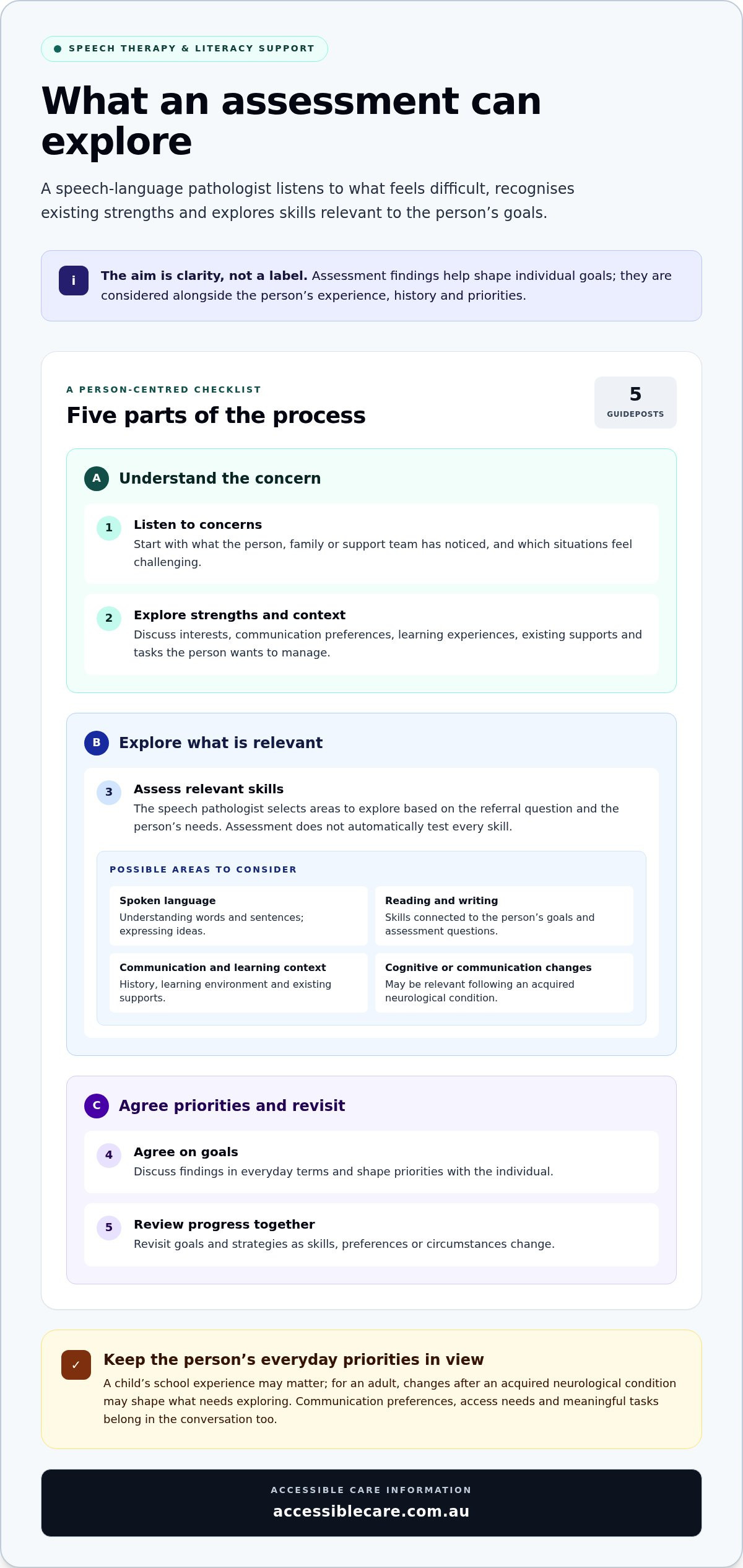
An assessment should make next steps clearer, not reduce a person to a score or label. A speech language pathologist listens to what’s difficult, recognises what the person already does well and explores relevant communication, language and cognitive skills. The focus is on understanding the person’s experience and priorities, including how reading or writing challenges show up in everyday life.
Assessment findings guide individual goals, not a one-size-fits-all programme. The scope depends on the person’s history, communication, learning context and access needs. A child’s experience at school may be relevant; for an adult, changes following an acquired neurological condition may shape what needs exploring. The American Speech-Language-Hearing Association (ASHA) also provides information about speech-language pathology and its connection to literacy.
- Listen to concerns. Start with what the person, family or support team has noticed and which situations feel challenging.
- Explore strengths and context. Discuss interests, communication preferences, learning experiences, existing supports and tasks the person wants to manage.
- Assess relevant skills. The speech pathologist selects areas to explore based on the referral question and the person’s needs.
- Agree on goals. Discuss findings in everyday terms and shape priorities with the individual.
- Review progress together. Revisit goals and strategies as skills, preferences or circumstances change.
What might a speech language pathologist explore?
Depending on the questions being asked, assessment may consider spoken language, such as understanding words and sentences or expressing ideas, alongside relevant reading and writing skills. Communication history, the learning environment and existing supports help put those observations in context. If cognitive or communication changes followed a neurological condition, these may also inform the assessment. The aim is to explore what matters, not to test every skill automatically.
One result shouldn’t be treated as the whole story. A score or task can offer useful information, but it needs to be considered alongside the person’s history, everyday experiences and access needs. The speech pathologist can explain what findings suggest, what they don’t establish on their own and where further discussion may help.
How are assessment findings turned into goals?
A broad concern can become a practical goal the person can recognise in daily life. For example, “reading is hard” might lead to a goal around understanding written instructions for a familiar activity. “I can’t get my ideas down” could prompt a discussion about ways to organise and share thoughts in writing. The person’s priorities help determine which goals are meaningful and how progress will be reviewed.
Goals can change. A strategy may need adjusting if the task changes, access needs become clearer or the person’s priorities shift. If you’re exploring speech therapy for literacy support related to communication, language or cognitive needs, Accessible Care’s experienced speech language pathologists provide holistic assessment and therapy. Learn more about Accessible Care speech therapy support and consider what goals you’d like to discuss.
Speech therapy, literacy intervention, or tutoring: what is the difference?
These forms of support can all relate to reading and writing, but they usually start with different questions. Is the person’s main need linked to communication or language skills? Do they need explicit teaching of literacy skills? Or would guided practice with learning content be most useful? Understanding the focus can help make support more relevant, without assuming that one option must replace another.
| Type of support | Usual purpose | Potential focus |
|---|---|---|
| Speech pathology | Explore communication, language or cognitive needs that may affect literacy and everyday participation. | Skills identified through individual assessment, with goals shaped around the person’s priorities. |
| Structured literacy teaching | Provide planned, explicit instruction in reading and writing skills. | Teaching and practice organised around literacy learning needs and an educational approach. |
| Tutoring | Support learning through explanation, practice or help with particular content. | For example, working through a school subject, revising material or practising set tasks. |
The boundaries can overlap. A literacy task may involve language skills as well as learning content, and a person may benefit from more than one kind of support. The roles, assessment processes and goals are still different. Diagnosis and decisions about an appropriate teaching approach depend on the person’s circumstances and assessment by suitably qualified professionals.
What does speech pathology contribute to literacy support?
A speech pathologist considers whether communication, language or cognitive skills are relevant to the person’s literacy goals. For instance, if someone finds written information hard to follow, assessment may explore how they understand language and what could make the task more accessible. Goals can then focus on functional participation, with progress reviewed in relation to what matters to the person. This is the individualised focus of speech therapy for literacy support, not a preset literacy programme.
At Accessible Care, experienced speech language pathologists provide holistic assessment and therapy for communication, cognitive and language skills, including for people with acquired neurological disorders. They listen to the person and explore how their needs relate to everyday life, rather than assuming one standard pathway.
When might tutoring or education-based support also matter?
Tutoring may be useful when the immediate goal is to practise or better understand particular learning content. Education-based literacy teaching focuses on teaching reading or writing skills through an instructional approach. A speech pathologist may address related communication needs, while an educator focuses on teaching and practice. With the person’s agreement, these perspectives can complement each other when their goals and roles are clear.
Think about the task the person wants to manage and what seems to get in the way. That can help clarify whether the next conversation should focus on communication skills, literacy instruction, learning content or a combination shaped around the person.
How can literacy support become useful in everyday life?
Literacy goals matter most when they connect with something the person wants to do. That might mean reading a message from a friend, understanding a form, following written instructions or enjoying a favourite book, recipe or online article. Choose tasks that feel relevant to the person, rather than adding homework to an already busy day.
Agreed strategies can be practised in brief, manageable moments. A family member or support person might read a short passage together, pause to let the person work something out or help them write a note for a real purpose. Activities should match the goals set with the speech pathologist. Adjust practice for energy, communication preferences and access needs, and let the person choose what they’re ready to try.
What can practice look like at home or in the community?
Start with material the person has chosen. It could be a favourite story, a familiar menu, a text message or information about an activity they enjoy. If a goal involves understanding written directions, practise with relevant instructions and offer the agreed level of support. For writing goals, a shopping list or message can provide a meaningful reason to share ideas in writing.
Encouragement doesn’t mean correcting every mistake. Give the person time, offer a supportive prompt if it fits the agreed strategy, and notice effort as well as successful participation. They might ask for clarification, choose a useful way to communicate or complete more of a task independently. These moments count, even if the person still needs support with some skills.
Choice matters. Ask whether the activity feels useful and whether the person wants to continue, change it or take a break. A routine that respects their preferences is more likely to feel manageable than one built around pressure or repeated correction.
How can progress be reviewed without adding pressure?
Progress can include changes in relevant skills, but it can also show up in daily participation. For example, the person may begin a familiar reading task with less prompting, explain which part of a form is confusing or share an idea in writing using a preferred method. These examples connect therapy goals with what the person values.
Reviewing support should include the person’s own view. Ask what feels easier, what remains tiring or difficult, and whether the current goal still matters. Progress can vary with energy, context and the task itself. A speech pathologist can use this feedback alongside assessment information to review strategies and adjust goals together. The purpose of speech therapy for literacy support is to make support responsive to the person, not to push through a fixed routine.
If you’re considering communication or language goals connected with everyday literacy, explore speech therapy support with Accessible Care.
Taking the next step with personalised speech therapy support
Exploring support doesn’t mean committing to a particular programme or outcome. A manageable first step is to identify what the person wants to do, discuss whether an assessment could clarify relevant communication needs, and decide together which goals feel worthwhile. Review support as the person’s priorities or circumstances change.
- Identify priorities. Think about the reading, writing or language situations the person would most like to make easier.
- Discuss assessment. Share what you’ve noticed and explore which communication, language or cognitive skills may be relevant.
- Agree and review goals. Choose goals with the person, then revisit whether the support remains useful and meaningful.
At Accessible Care, experienced speech language pathologists provide holistic assessments and therapy focused on communication, cognitive and language skills. For people with acquired neurological disorders, these areas may be relevant to changes in everyday communication and literacy. Accessible Care is a registered NDIS provider serving Melbourne and Adelaide, with support shaped around the individual rather than a fixed pathway.
What can families and individuals prepare before starting?
Preparation is optional. If it helps, make a few notes about everyday situations where reading, writing or understanding language feels difficult. For example, describe a written instruction that’s hard to follow or a task where it’s easier to share ideas aloud than on paper. Existing reports may provide useful background, but there’s no need to create a perfect summary.
It can also help to share the person’s communication preferences, access needs and goals. They may prefer extra time to respond, information in a particular format or support from someone they trust. Include them in the conversation in ways that work for them. This isn’t a test, and the person doesn’t need to prove that they deserve support.
How does NDIS context relate to therapy goals?
For someone using the NDIS, it’s helpful to consider how a therapy goal relates to their disability-related needs and the goals in their individual plan. Literacy support isn’t automatically funded just because reading or writing is difficult. Whether a particular support can be funded depends on the person’s circumstances and current NDIS guidance. Check the relevant information for that person before making assumptions about eligibility or plan coverage.
Most of all, the person’s voice should guide the process. They can help decide what to work on, what support feels comfortable and when a goal needs to change. If you’d like to explore whether speech therapy may fit communication, cognitive or language goals, explore speech therapy with Accessible Care.
Let the person’s priorities lead the next step
Literacy goals don’t need to begin with a perfect plan. They can start with one question: what would the person like to feel more confident doing? The answer can guide a conversation about whether communication, language or cognitive needs are part of the challenge and what support might be useful.
Choosing speech therapy for literacy support means exploring these connections in a person-centred way, not expecting the person to fit a preset pathway. Their interests, preferences and pace matter throughout. A useful next step can be as simple as sharing what they hope to work towards and taking time to understand the options.
Accessible Care’s speech language pathologists listen to individual concerns and provide holistic assessment and therapy tailored to communication, cognitive and language needs. Explore personalised speech therapy support with Accessible Care.
Every meaningful goal can begin with a conversation that respects the person’s voice and potential.
Frequently Asked Questions
Can speech therapy help with reading and writing?
Speech therapy may support reading and writing when communication or language skills are relevant to the person’s needs and goals. For example, a speech pathologist might explore what makes a public transport timetable difficult to understand and discuss strategies that suit the individual. Speech therapy for literacy support isn’t the same for everyone, and no particular reading or writing result can be guaranteed. A helpful starting point is a conversation about what the person wants to do.
Is speech therapy the same as literacy tutoring?
No. Speech pathology focuses on communication, language or cognitive needs identified through assessment, while tutoring commonly centres on instruction, practice or learning content. A learner might receive help understanding the language involved in a task while also benefiting from teaching focused on the task itself. These forms of support can complement each other when useful, but neither automatically replaces the other. The right mix depends on the person’s needs, preferences and goals.
Can speech therapy support someone with dyslexia?
It may support some communication or language needs that are relevant for a person with dyslexia, but people’s strengths and support needs differ. A speech language pathologist can assess relevant skills within their professional scope. Speech therapy shouldn’t be treated as a dyslexia diagnosis or as covering every aspect of dyslexia. A person-centred discussion can clarify their priorities and, where helpful, how therapy goals may sit alongside learning supports.
How does phonological awareness relate to literacy?
Phonological awareness means noticing and working with sound patterns in spoken language, such as recognising rhymes or hearing the parts in a spoken word. This can be relevant as someone learns how speech sounds connect with written words. Literacy also involves other skills, including understanding vocabulary and making meaning from text. Difficulty with one sound-based task doesn’t explain every reading or spelling challenge, and one activity cannot be expected to resolve them all.
Can adults receive speech therapy for literacy support?
Yes. Adults can seek assessment for communication, language, cognitive or literacy-related concerns, including changes after a neurological condition. The person’s goals may relate to daily participation, such as understanding a work-related notice or writing a message to explain a preference. An adult’s experiences and priorities may differ from a child’s, so assessment and support should reflect their history, access needs and preferred ways to communicate.
Does the NDIS fund speech therapy for literacy support?
NDIS funding for speech therapy for literacy support isn’t automatic. Whether a support may be funded depends on the individual’s circumstances, plan goals and current NDIS rules. Consider how the requested support relates to the person’s disability-related needs, then check current guidance from the National Disability Insurance Agency (NDIA) before making funding decisions. Avoid assuming that a particular literacy service or activity will be covered.
How long does speech therapy for literacy support take?
There’s no standard timeframe. The duration of speech therapy for literacy support depends on the person’s assessment, goals, circumstances and response to support. Reviews can consider specific skills as well as practical changes, such as taking part in a task with a different level of assistance. Progress may vary, so the person and speech pathologist can discuss what’s useful, whether priorities have shifted and whether goals need adjustment.

