


What if everyday support could help you do more for yourself, rather than take over? That’s the purpose behind ndis assistance with daily life: support with everyday routines that can help build confidence and independence. It’s understandable to wonder which activities may be covered, how funding works and whether support will reflect your choices.
This guide explains the category in plain English. You’ll learn what everyday tasks assistance might involve, how support relates to your individual NDIS plan and why funding depends on your goals and support needs. A category name alone doesn’t mean every task will be funded, so it’s important to understand how your plan applies.
Depending on your plan, support may include help with personal care, household tasks or meal preparation, while respecting what you want to do for yourself. Support work can also help you practise routines and build everyday skills. By the end, you’ll have a clearer picture of what to consider and how to prepare for a practical conversation about support.
Key Takeaways
- Understand what ndis assistance with daily life may involve and why support depends on your individual plan and circumstances.
- See how assistance can fit around existing routines instead of assuming everyone follows the same schedule.
- Learn why a support-category label alone doesn’t mean every requested activity will be funded.
- Prepare for a support conversation by noting a daily challenge, its impact and the personal goal you want to work towards.
- Explore how Accessible Care’s support work in Melbourne and Adelaide can centre your choices and everyday goals.
What is NDIS Assistance with Daily Life?
NDIS language can feel unfamiliar when you’re trying to connect a support-category name with the practical help someone needs. In plain terms, ndis assistance with daily life refers to support with everyday activities when it suits the participant’s circumstances and is funded in their individual plan. It sits within Australia’s National Disability Insurance Scheme (NDIS), but a category name alone doesn’t determine what a person can access.
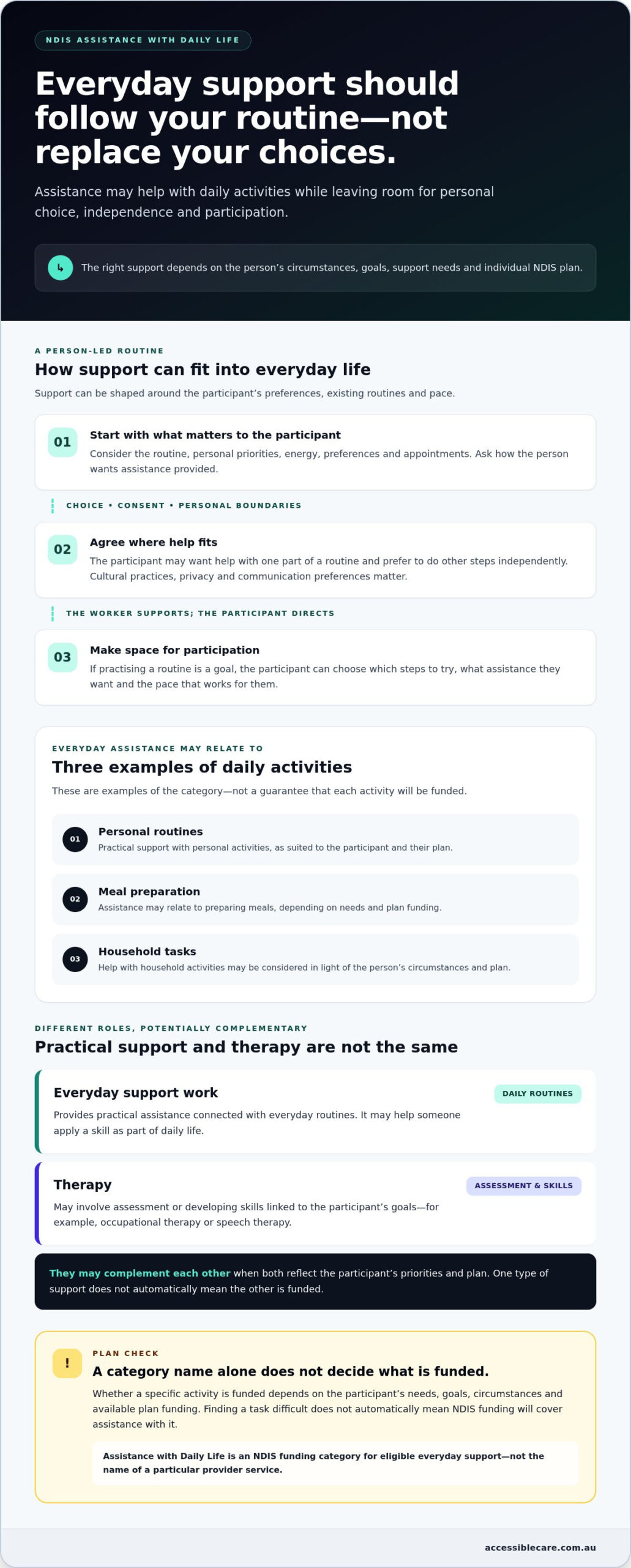
Assistance with Daily Life is an NDIS funding category for eligible everyday support, not the name of a particular provider service. The support is considered in light of a person’s needs, goals and plan. It may help someone take part in daily routines with more choice and involvement, rather than having tasks automatically done for them. What that looks like will differ from person to person, and no particular outcome is guaranteed.
What kinds of everyday activities might assistance involve?
Depending on a participant’s needs and plan funding, everyday assistance might relate to personal routines, meal preparation or household tasks. These examples explain the category, but they don’t mean every activity will be funded. The key question is how a specific support relates to the person’s circumstances and the funding in their plan.
Support can be shaped around the participant’s preferences. One person might want help with part of a routine while doing other steps independently; another may have different priorities. The participant’s choices matter, and their plan determines which supports can be funded. Finding a daily task difficult doesn’t automatically mean NDIS funding will cover assistance with it.
How is daily life assistance different from therapy?
Support work provides practical assistance connected with everyday routines. Therapy, such as occupational therapy or speech therapy, may involve assessment or developing skills linked to a participant’s goals. The services have different purposes, although support and therapy may complement each other when they align with the person’s plan and goals.
For example, a therapist may work with someone on a skill or strategy, while practical support may help them apply it in everyday life. The right mix depends on the individual. Therapy doesn’t automatically mean related support work is funded, or vice versa. Both should reflect the participant’s priorities and plan.
Understanding the wider scheme can make its support language easier to interpret. For more background on how the NDIS works, see this guide to the NDIS. From there, consider which daily routines matter to you and how your plan relates to the support you’re seeking.
How NDIS daily life assistance can fit into everyday routines
Good support should fit around the person, not require them to follow a rigid timetable. A daily routine may depend on energy, preferences, appointments and what matters to the participant. With ndis assistance with daily life, agreed support can be planned around existing routines, within the participant’s plan and funding.
That flexibility starts with listening. A participant may prefer to do some things independently, want help at a particular point in a routine or need information communicated in a specific way. Cultural practices, privacy, consent and personal boundaries matter, too. A support worker should respect the participant’s choices and ask how they want assistance provided, rather than assume one approach suits everyone.
What does person-led support look like at home?
Person-led support means making decisions together. A support worker can offer choices, agree on what assistance looks like and leave space for the participant to take part. The aim isn’t to take over a task simply because it may be quicker. It’s to respect the person’s preferences, abilities and pace. Since routines and goals differ, assistance should be shaped around the individual.
When routines are led by the participant, support can protect dignity while making room for choice and self-direction.
Can assistance help build everyday skills?
There’s a difference between completing a task for someone and supporting them to participate. The right approach depends on the person and the support they need at that time. If building confidence with a routine is one of their goals, a support worker may encourage involvement in the parts the participant wants to practise, while respecting their choices about what help they need.
For example, a participant might want to practise a familiar morning routine at their own pace. They could choose which steps to do themselves and where they’d like assistance. The routine, level of support and funding depend on the person’s circumstances and plan, and this example doesn’t guarantee a particular service or outcome.
Support work and therapy have different roles. A therapist may focus on assessment or developing skills, while everyday support may provide an opportunity to use a skill within a routine. These approaches may complement each other when they reflect the participant’s goals. For more detail on therapy’s role, explore this guide to occupational therapy.
The NDIS describes Core Supports as funding for everyday needs, including Assistance with Daily Life. Read the NDIS Core Supports guidance for more on how this budget category works. If you’re considering person-centred support work, learn about Accessible Care’s approach to support.
What determines whether daily life support suits your NDIS plan?
Whether ndis assistance with daily life suits your plan depends on your circumstances, goals, support needs, available funding and current NDIS rules. The category name helps describe a type of support, but it doesn’t confirm that every requested activity will be funded. Consider how the support relates to your needs and what your plan says.
To explain your support needs, describe what’s difficult, how it affects everyday life and what you’d like to work towards. For example, you might want support to take part in a routine more independently or participate in activities that matter to you. Clear examples help explain your priorities, but particular wording doesn’t guarantee funding or plan approval.
How do plan goals relate to everyday assistance?
Goals describe the direction you want your support to take. They might relate to building independence, maintaining routines or participating more in daily life. Connect a goal to your own experience by explaining the challenge and what meaningful support could look like. Keep the focus on your circumstances and preferences. The NDIA considers your plan and applicable rules, so a goal alone doesn’t establish that a specific support will be funded.
Funding categories can sound similar, but the purpose of a support helps distinguish them. This comparison is a plain-language guide, not a substitute for your plan or current NDIA guidance.
| Support type | Typical focus | What to keep in mind |
|---|---|---|
| Everyday assistance | Practical support connected with daily living and routines | Relevance and funding depend on the participant’s plan and circumstances. |
| Therapy | Assessment or developing skills in line with therapy goals | It has a different purpose from practical support work, though the two may complement each other. |
| Higher-intensity support | More specialised support for complex needs | It’s distinct from general daily assistance and depends on the person’s requirements and plan. |
When might daily assistance differ from complex support?
Some participants have support needs that are more specialised or clinically complex than general help with everyday routines. Higher-intensity support is a distinct area, and the appropriate assistance depends on the participant’s needs and plan. If this distinction is relevant to your situation, this guide to NDIS high-intensity supports explores the topic separately.
NDIS terminology and funding guidance can change. For decisions about your own supports, refer to current NDIA information and the details in your plan. This helps you compare the support you’re seeking with the funding and conditions that apply to you, rather than relying on a category label alone.
How to prepare for a conversation about daily life assistance
It can be hard to explain support needs in a short conversation. A few notes can help you describe what matters without needing to know every NDIS term. For ndis assistance with daily life, focus on the person’s experience: what feels difficult, how it affects everyday life and what they’d like to work towards.
Try this simple sequence:
- Name a daily challenge. Describe a routine or activity that takes extra effort or is difficult to manage.
- Explain its impact. Note what happens, when support may be useful and how the challenge affects participation or choice.
- Connect it to a personal goal. Describe what the participant hopes to do, practise or take part in, in their own words wherever possible.
What information can help explain your support needs?
Specific examples make a conversation clearer. Rather than relying only on a broad phrase such as “needs help at home,” describe which part of a routine is challenging, whether it takes extra effort and what kind of assistance the participant prefers. Note what they can do independently, too. This keeps the discussion centred on their abilities and choices, not just their support needs.
Families and supporters can help organise thoughts, but the participant’s perspective should remain central wherever possible. Record preferred routines, communication needs, cultural considerations and what independence means to the person. If they communicate in a particular way or need extra time to express a preference, include that in your notes to help make the conversation respectful and accessible.
How can goals remain realistic and personal?
A meaningful goal starts with what the participant values, not a routine chosen for convenience. It might be taking part in a familiar activity with more confidence or having a greater say in how a daily routine unfolds. Keep goals personal and practical. A goal can guide discussion, but it doesn’t guarantee that a particular support will be funded or approved.
Before a conversation, save or discuss this checklist with the participant or their support network:
- A daily challenge and its impact
- When assistance may be useful, and what the person prefers to do independently
- Preferred routines, communication needs and important cultural considerations
- A personal goal, described in the participant’s own terms
- Questions about the plan and funding to compare with current NDIA guidance
Plan details and funding rules affect which supports are available, so use current NDIA information alongside the participant’s plan. Preparation helps make the conversation focused, but it can’t determine the NDIA’s funding decision. If you’re considering person-centred support work, explore support work with Accessible Care.
How Accessible Care approaches NDIS Assistance with Daily Life
Understanding how the category works is one part of the picture. The other is finding support that respects the person behind the plan. Accessible Care is a registered NDIS provider serving Melbourne and Adelaide, and support work is one of its core services. Its approach is collaborative and centred on each participant’s goals and choices.
For someone considering ndis assistance with daily life, respectful support starts with understanding what the participant wants from their everyday routines. Support work provides practical assistance while keeping the participant involved in decisions about how support fits. The aim is not to impose a standard routine, but to keep the participant’s perspective at the centre.
What can a supportive working relationship feel like?
A supportive working relationship makes space for listening, clear communication and mutual respect. The participant’s preferences guide discussions about the support they’re seeking, with their dignity and choices at the centre. Goals can shape the conversation without assuming that everyone wants the same routine or type of assistance.
Collaboration matters. The participant can share what independence means to them and what they’d like support to help make possible. Family members or other supporters may contribute where appropriate, while keeping the participant’s own views in focus. This person-centred approach helps keep support responsive to individual priorities.
How can support work and occupational therapy relate?
Support work and occupational therapy are separate services with different roles. Support work provides practical assistance, while occupational therapy may focus on daily living skills and independence. Depending on the participant’s goals and plan, these supports may sit alongside one another, each contributing in a different way. Their relevance and funding depend on individual circumstances and the plan.
Accessible Care offers occupational therapy for adults and children to support daily living skills and independence. A participant can discuss their priorities with a support team and consider which type of support aligns with their goals. The conversation starts with the person: what matters to them, what choices they want to make and how they’d like to be involved.
As you explore options, keep your plan and funding in view. The support category doesn’t automatically mean every requested activity is funded, and services should be considered in relation to the participant’s circumstances and goals. A clear conversation about those priorities can bring practical details into focus without losing sight of choice and self-direction.
If you’re in Melbourne or Adelaide, Accessible Care provides support work and occupational therapy. Use your individual goals to guide a conversation about the support that matters to you.
Take the next step at your own pace
Thinking about ndis assistance with daily life can start a clearer conversation about the support that feels right. You don’t need to have every detail worked out first. Begin with the participant’s priorities, make space for their choices and use their plan to guide questions about funding.
Support should be discussed as a partnership. The participant’s views, communication preferences and idea of independence can help shape the discussion. If you’re supporting a family member, listening together can help keep their voice at the centre.
Accessible Care’s support work and occupational therapy can relate to different everyday goals, depending on the participant’s needs and plan. Explore the available information and consider which questions you’d like to raise about your circumstances.
Explore Accessible Care’s NDIS support services and take the next step when you feel ready. Your goals can guide the conversation.
Frequently Asked Questions
What does NDIS Assistance with Daily Life cover?
NDIS Assistance with Daily Life may fund support with everyday activities when it relates to the participant’s disability and is included in their plan. For example, someone might need help with parts of a daily routine or a household activity. The exact support depends on the person’s circumstances and plan, so a task isn’t automatically covered just because it sounds like daily assistance.
Is Assistance with Daily Life the same as support work?
No. Assistance with Daily Life is an NDIS support category, while support work is a service that may provide practical assistance. The terms are related, but they aren’t interchangeable: a provider’s service doesn’t confirm that a participant has funding for it. Compare the service with the participant’s plan and current NDIS guidance that applies to their funding.
Can NDIS daily life assistance help me become more independent?
It may support your participation in daily routines in a way that reflects what you want to do for yourself. For instance, you could discuss where you’d like to take the lead and where assistance is useful, then agree on an approach that respects your preferences. Support can be tailored to your goals, but it can’t guarantee a particular level of progress or independence.
Who decides whether daily life support is funded by the NDIS?
The NDIA makes decisions about a participant’s NDIS plan and funded supports. A support worker or provider can discuss services, but they can’t approve NDIS funding. If you’re unsure whether an item in your plan applies, review the plan wording and current NDIA information. Keep any questions focused on the particular support and the participant’s circumstances.
Can a family member provide NDIS assistance with daily life?
A family member can offer support, but NDIS funding to pay a relative isn’t automatic. Whether a family member can be paid depends on the participant’s situation and applicable NDIS rules. Review current NDIA guidance or discuss the question with the participant’s NDIS contact before making arrangements. This helps distinguish informal family support from a paid support arrangement and clarify what may be appropriate for the plan.
What should I do if my daily support needs change?
Write down what has changed, when you noticed it and how it affects your daily life. Then review your plan and contact the NDIA or your NDIS contact to ask what process applies to your circumstances. Needs can shift over time, so seek guidance before changing funded supports or assuming your existing plan will cover a different type or amount of assistance.
Is NDIS Assistance with Daily Life available in Melbourne and Adelaide?
Accessible Care serves participants in Melbourne and Adelaide, and support work is among its services. Whether a particular daily living support can be funded depends on the participant’s needs and plan. In either city, explore Accessible Care’s NDIS support information and consider how support work or occupational therapy may relate to your goals.

