


What if your child’s first therapy session isn’t a test they need to pass, but a chance to get to know the therapist? It’s understandable to worry they might feel nervous or wonder whether you’ll say the right thing. Preparing your child for their first therapy session doesn’t mean having all the answers. It means helping them understand what to expect while letting them take things at their own pace.
The first appointment is often a shared starting point. The therapist may ask about your child’s strengths, everyday experiences and goals, while making time to build a connection. Depending on whether your child is seeing an occupational therapist or speech pathologist, the conversation and activities may differ. Your child might be involved throughout, or you may have time to talk with the therapist too.
This guide explains how to talk about therapy in an age-appropriate way, prepare useful information and practical supports, and approach the first session without adding pressure. It can be a gradual, collaborative beginning shaped around your child’s needs.
Key Takeaways
- Preparing your child for their first therapy session can start with a calm, age-appropriate explanation and time to hear their questions.
- Expect the appointment to unfold flexibly, with the therapist learning about your child before discussing possible next steps.
- Your child doesn’t need to talk, cooperate, or show progress for the session to be worthwhile.
- Make it easier to share useful context by noting your child’s strengths, interests, routines, communication preferences and current goals.
- Paediatric occupational therapy and speech therapy support different areas of development, with care shaped around your child and family priorities.
Preparing Your Child for Their First Therapy Session: Start with Reassurance
A first appointment can bring uncertainty for both a child and their caregiver. You might wonder what the therapist will ask, how your child will respond, or whether you need to prepare them in a particular way. Think of the session as a chance to meet, share what matters to your family and begin understanding your child’s needs together.
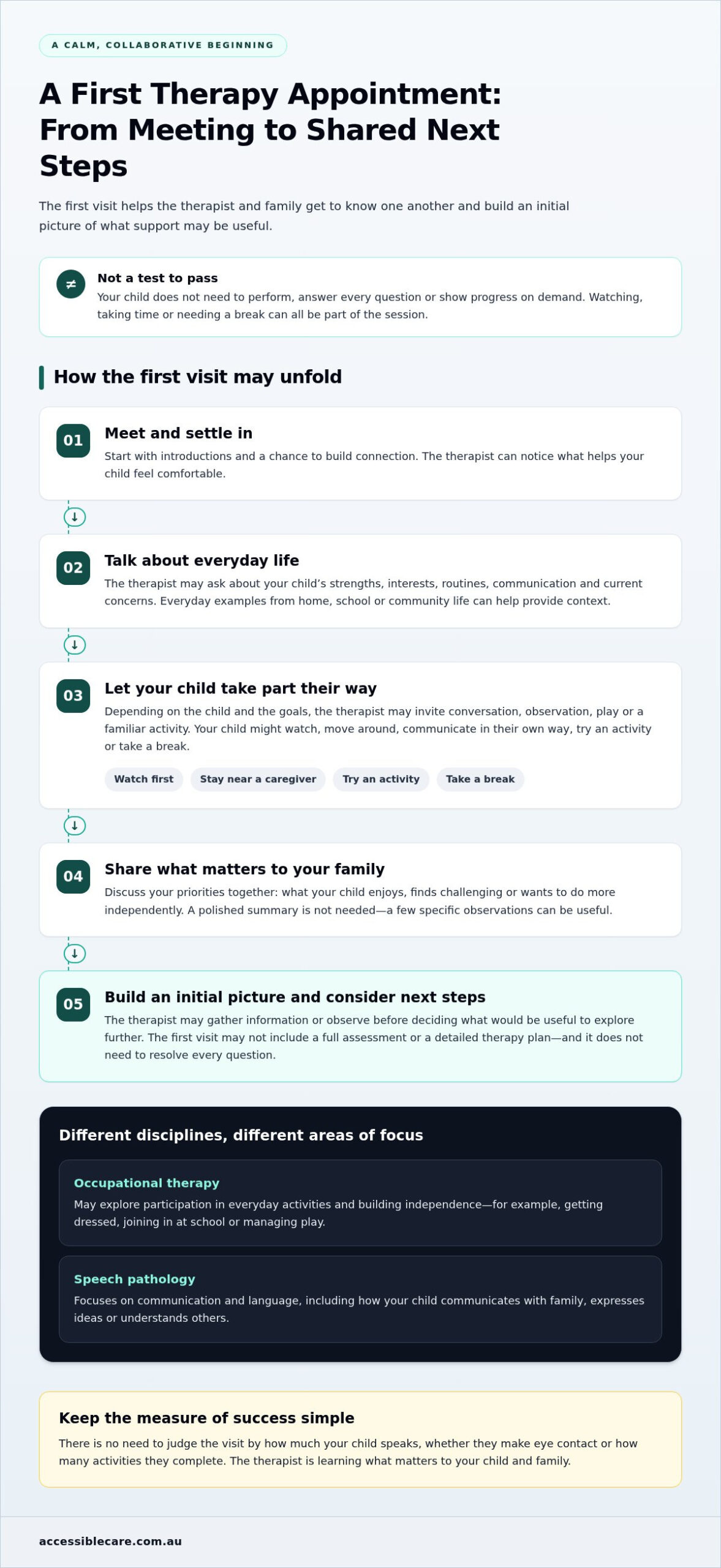
A first therapy session is a supported starting point, not a test. Your child doesn’t need to perform, answer every question or show what they can do on demand. The therapist is there to listen, notice what helps your child feel comfortable and learn about your family’s priorities.
Preparing your child for their first therapy session is easier when you describe the support they’re going to receive without promising exactly what will happen. Activities depend on your child’s goals, age, preferences and communication. The therapist may begin with conversation, observation, play or an activity that feels familiar and appropriate.
What paediatric therapy can look like
Occupational therapy and speech pathology have different areas of focus. Occupational therapy may explore how a child takes part in everyday activities and builds independence. This could mean discussing routines such as getting dressed, joining in at school or managing play. Speech pathology focuses on communication and language. A speech pathologist may ask how your child communicates with family, expresses ideas or understands others. The aim is to understand your child’s needs, not to assume every child will follow the same plan.
Depending on your child and the goals being discussed, a session might involve talking together, observing how your child approaches an activity or using play to support engagement. Some children are ready to join in quickly; others prefer to watch or stay close to their caregiver at first. Child psychology considers how children’s development shapes the ways they think, feel and communicate. A child-centred approach makes room for those individual differences.
Make space for your child’s feelings
Your child might feel excited, quiet, unsure or reluctant. Each response is understandable, and none means the session has gone wrong. Listen without rushing to correct their feelings. You could say, “It’s okay to feel unsure. We’ll meet the therapist together, and you can take your time.”
Choose simple, truthful words that fit your child’s age and communication style. For a younger child, you might explain, “We’re going to meet someone who will learn what helps you and your family.” An older child may appreciate a more direct explanation of why the appointment is happening and what they hope to work on. If your child communicates without speech or needs extra time to respond, keep the explanation brief and allow time for them to take it in.
Reassure your child that you can share your perspective and support them during the appointment. You don’t need to script their answers or persuade them to feel excited. A calm, honest conversation gives your child room to arrive as they are.
What May Happen During a Child’s First Therapy Appointment
A first appointment gives the therapist and family time to get to know one another and understand what support may be useful. The order can vary. You might begin with introductions, followed by a conversation about your child’s everyday experiences. The therapist may then invite your child to engage in a way that suits them, before you discuss priorities and possible next steps together.
Some of the appointment may involve gathering information rather than completing a full assessment or agreeing on a detailed therapy plan. The therapist may ask questions or observe how your child approaches an activity before deciding what would be useful to explore further. The first visit helps build an initial picture; it doesn’t need to resolve every question.
Children can take part in different ways. They might watch, move around, communicate with words or another method, try an activity or take a break. A child who needs time to become comfortable is still part of the session. There’s no need to measure success by how much they speak, whether they make eye contact or how many activities they complete.
How the therapist and caregiver can work together
Your knowledge of your child can help the therapist understand what matters in daily life. Share observations about routines, strengths, interests, communication and any concerns you’d like to discuss. Specific examples are especially useful: perhaps getting ready for school is difficult, or your child communicates more easily during a familiar game.
Where relevant, describe what you notice at school or in community settings too. You don’t need a polished summary. A few everyday examples can give the therapist useful context. The Society of Clinical Child and Adolescent Psychology provides a professional perspective on clinical child and adolescent psychology. A paediatric allied health appointment has a different focus, shaped by the therapy discipline and your child’s needs.
Discuss goals together. The therapist can listen to your family’s priorities and learn what your child enjoys, finds challenging or wants to do more independently. This keeps the conversation connected to meaningful participation in everyday life, rather than a checklist that treats every child the same.
Why there is no single perfect first-session response
A child’s comfort and participation can shift with their energy, familiarity with the setting, communication style and what is happening around them. They might be curious at first and quieter later, or prefer to watch before joining in. These responses can offer the therapist context, but they aren’t a score of how well the appointment has gone.
A child can begin therapy without performing, speaking or settling immediately. Preparing your child for their first therapy session also means allowing room for the visit to unfold at their pace. If your family is exploring paediatric occupational therapy or speech therapy in Melbourne or Adelaide, you can learn about therapy support with Accessible Care.
First Therapy Worries: What Parents Don’t Need to Perfect
A quiet, hesitant or unsettled child hasn’t failed their first therapy session. They don’t need to arrive ready to talk, follow every instruction or demonstrate a skill. The appointment can still be useful if your child watches from beside you, needs time to warm up or communicates in a way that isn’t immediately familiar to the therapist.
It’s also natural to hope the first visit will answer every question. It may not. The therapist might need time to understand your child’s experiences and hear your family’s perspective before suggesting a practical next step. An initial appointment can build understanding, identify areas to explore and help shape goals. A quick conclusion or visible change isn’t the measure of whether it was worthwhile.
Useful preparation means offering support and helpful context, not trying to make your child behave a certain way. There’s no need to rehearse answers, insist they participate or promise that therapy will be fun. A more realistic message is: “We’re going to meet someone who wants to understand what helps you. I’ll be there to support you.”
If your child feels anxious, reluctant, or overwhelmed
Start by recognising the feeling rather than arguing it away. “You’re not sure about going. I hear you,” can be more reassuring than insisting there’s nothing to worry about. Avoid presenting the appointment as guaranteed fun. Instead, share simple details you know, such as where you’re going, who you’ll meet and whether you’ll be there with them. For children dealing with performance worries or broader situational stress, resources from Balanced Minds Psychology & Wellness illustrate how evidence-based psychological support can help young people navigate feelings of overwhelm.
If you are unsure what to say or share
You don’t need a complete history or a perfect explanation. Begin with what you’ve seen in everyday life: a routine that feels difficult, an activity your child enjoys or a moment when communication seems easier. Describe what happened and what helped, rather than feeling you need to apply a label or explain the cause.
- “Getting ready to leave home can take a long time.”
- “My child shares more when we talk during a familiar activity.”
- “They enjoy doing things independently, but find this part of the routine frustrating.”
Family questions are useful, too. You might want to understand what the therapist hopes to learn, how your child can take part at their own pace or what a manageable next step could look like. Write down a few priorities if that helps, but treat them as prompts, not a script you must follow.
Preparing your child for their first therapy session doesn’t depend on getting every detail right. Arrive with what you know, be open about what you’re still working out and let the conversation develop with the therapist. The aim is a clearer shared understanding, one step at a time.
A Simple Checklist for Preparing Your Child for Therapy
A little planning can make the appointment easier to approach, without turning it into a performance your child has to get right. Use this sequence as a flexible guide. Adjust it to suit your child’s age, communication style, routines and support needs.
- Explain: Give a short, honest description of who your child will meet and why you’re going.
- Listen: Invite questions and notice what your child says, shows or needs time to process.
- Prepare: Jot down useful observations, strengths, priorities and communication preferences.
- Plan: Think through travel, timing, comfort items and how to make transitions manageable.
- Reflect: After the visit, offer a calm moment to reconnect without expecting a full debrief.
What to tell your child before the appointment
Keep your explanation clear and truthful. For example: “We’re going to meet a therapist who wants to learn what helps you with things that matter to you.” Add details you know, such as where you’re going, how you’ll get there and whether you’ll stay with them. Avoid guessing about activities or promising how the visit will feel.
Make space for questions, but don’t press your child to talk about their feelings straight away. You can return to the conversation later or offer another way to share, such as drawing, pointing or choosing between simple options. A brief reminder close to the appointment may help, especially if your child benefits from knowing what comes next.
What caregivers can prepare and bring
Write down a few things you’d like the therapist to understand. Include your child’s strengths and interests, important routines, current goals and specific concerns. Concrete examples are often easier to discuss than broad descriptions. Note what was happening, what your child did and what seemed to help.
- Relevant appointment information or details requested for the visit
- Examples from home, school or community routines that relate to your concerns
- Communication supports your child uses, such as a device, pictures or extra response time
- A familiar comfort item, if it helps your child feel more settled
Plan the practical details around your child. Allow time for travel and arrival, consider whether the appointment timing fits their energy and routine, and think about what might make the transition into the setting easier. If you can, keep the next part of the day flexible so your child has time to reset afterwards.
Save this reminder: Explain, listen, prepare, plan, then give your child time to reflect in their own way. Preparing your child for their first therapy session doesn’t require a perfect script or a packed folder. A few relevant notes and a thoughtful plan can help you share what matters. To explore paediatric therapy support shaped around your child and family, connect with Accessible Care.
How Accessible Care Can Support Your Child’s Therapy Journey
Choosing a starting point for support can feel like another big decision after preparing your child for their first therapy session. Accessible Care offers paediatric occupational therapy and speech therapy, with support shaped around each child’s needs and family priorities. The focus is on understanding what matters in everyday life and working collaboratively towards meaningful goals.
These therapies have distinct areas of focus. Occupational therapy can support a child’s participation in everyday activities and growing independence. Speech therapy focuses on communication and language. To learn more about these approaches, explore our occupational therapy guide and speech pathology guide.
Accessible Care is a registered NDIS provider. This describes the provider’s registration, not whether a particular child is eligible for NDIS funding or whether a specific service will be covered. Families looking for general scheme information can read our NDIS guide.
Finding the right starting point for your family
Think about what you’d most like support with. Is your child finding everyday activities or participation challenging? Occupational therapy may be a relevant area to explore. Are you wondering about communication or language? Speech therapy may be a useful starting point. You don’t need to settle on a fixed answer before beginning. These questions can open a conversation about your child’s strengths, needs and goals.
Sharing examples from your child’s routines can make that conversation specific. You might describe what they enjoy doing, where they’d like more independence or when communication feels easier. From there, you can discuss priorities together, keeping both your child’s experience and your family’s perspective in view.
Keeping the child at the centre
Children have their own preferences, ways of communicating and pace for getting comfortable. Their responses can help guide how support is shaped. Caregivers bring valuable insight about daily life, while making space for the child’s choices and participation wherever possible. The aim is a collaborative relationship, not a one-size-fits-all plan or pressure to progress on a set timetable.
Accessible Care provides services in Melbourne and Adelaide. If you’re considering paediatric occupational therapy or speech therapy, you can take a low-pressure next step by exploring Accessible Care’s support and learning more about options for your family.
Let the First Step Lead to the Next
Your child’s first appointment doesn’t need to settle every question. It can create a starting point for noticing what helps, what matters to your family and what you’d like to explore together. As you continue preparing your child for their first therapy session, remember that your observations and your child’s preferences can guide the conversation, even if neither of you has everything figured out yet.
Support should make room for your child to participate in their own way and for you to share what you know about everyday life. A thoughtful next step might be learning more about the kind of therapy that aligns with your family’s priorities, then deciding whether you’re ready to explore it further. Because supporting a child through new care pathways can also place emotional demands on parents, practical guidance from relationship therapist Tracy Kimberg can help couples stay connected and maintain healthy communication at home.
Accessible Care is a registered NDIS provider offering paediatric occupational therapy and speech therapy, with experienced Speech Language Pathologists supporting families in Melbourne and Adelaide. Explore how Accessible Care can support your family and take the next step when it feels right. You can move forward at your own pace, with your child’s needs at the centre.
Frequently Asked Questions
What if my child refuses to participate in their first therapy session?
A refusal or reluctance doesn’t mean the appointment has failed. Let the therapist know what you’re seeing, such as your child turning away, staying close to you or asking to leave. Rather than repeating prompts, pause and give them room to adjust. The therapist can use what they observe and what you share to consider a gentler way to connect, even if your child doesn’t join an activity that day.
Can I stay with my child during their first therapy appointment?
Caregiver involvement can vary with your child’s needs, the therapy goals and how the appointment is organised. Your presence may offer reassurance and help you share details the therapist can’t see in one visit. You can discuss whether staying nearby, joining an activity or stepping back gradually feels right. There’s no single arrangement every family must follow. Your child’s comfort and growing autonomy can both guide the conversation.
How long does a child’s first therapy session take?
Appointment length varies, so use the details provided for your child’s visit rather than guessing or promising a finish time. If your child finds transitions hard, describe the parts you know, such as travelling there, meeting the therapist and what happens afterwards. You might also plan a familiar, low-key activity after the visit. Knowing the appointment structure can help you set expectations without locking your child into an uncertain timeline.
Does my child need a diagnosis before starting therapy?
A diagnosis isn’t the only way a family can recognise that a child may benefit from support, but requirements can differ between therapy access and funding pathways. NDIS eligibility and funded supports are determined through the relevant NDIS processes, not simply by attending a therapy appointment. If you’re unsure how the scheme works, read this guide to the NDIS for broader context.
What if my child does not speak during the first session?
Your child can still share information without speaking. They might gesture, use a communication device, point to a choice or communicate through their actions. Tell the therapist what you notice at home, including how your child signals yes, no, interest or discomfort. Preparing your child for their first therapy session doesn’t mean rehearsing answers. Instead, help the therapist understand the communication approaches your child already uses and allow interaction to develop without pressure.
Can my child have occupational therapy and speech pathology at the same time?
A child may have goals that relate to both occupational therapy and speech pathology, since the services focus on different areas. Whether support happens at the same time or separately depends on the child’s needs, family priorities and arrangements. For example, a family may want to discuss how participation in daily activities and communication goals fit together. Keeping the purpose of each service clear can help ensure support feels relevant rather than adding appointments without a shared reason.
Is everything my child does in therapy shared with parents?
Ask the therapist to explain how they communicate with caregivers and what privacy arrangements apply to your child’s service. The approach may depend on your child’s age, the information involved and the setting. You can discuss what updates would help you support your child between appointments, while also respecting their privacy and growing independence. Clear expectations at the start can help everyone understand how information is handled and how caregivers are involved.

