


What if recovery after a brain injury isn’t only about finding the right words, but also about feeling heard, joining conversations and reconnecting with everyday life? Difficulty expressing thoughts, understanding others or keeping track of a conversation can be frustrating and isolating. Speech therapy for brain injury recovery can support communication and participation, with goals based on what matters to each person.
Progress takes time and looks different for everyone. Therapy may focus on language, speech clarity and the thinking skills that support communication, such as attention, memory and problem-solving. A speech pathologist can assess a person’s strengths and challenges, then develop practical strategies for situations that matter to them, from talking with family to taking part in the community.
This article explains communication changes that may follow a brain injury, what assessment and therapy can involve, and how to support communication in daily life. Accessible Care’s experienced Speech Language Pathologists provide holistic assessments and therapy focused on communication, cognitive and language skills in Melbourne and Adelaide.
Key Takeaways
- Communication changes after brain injury vary, so therapy goals should reflect the person’s strengths, needs and everyday priorities.
- Speech therapy for brain injury recovery may address language, speech clarity, thinking skills and communication in real-life situations.
- Structured practice and functional communication strategies can work together to support meaningful participation.
- Agree on one communication goal, practise in a calm moment and give the person time to respond.
- Accessible Care’s experienced Speech Language Pathologists provide holistic assessments and therapy focused on communication, cognitive and language skills.
How brain injury can change communication, and where speech therapy fits
Communication can change in different ways after a brain injury. One person may know what they want to say but struggle to find the words; another may speak clearly but find it hard to follow a fast-moving conversation. Some people experience several changes, while others notice a specific difficulty. Each person’s experience deserves individual attention. Communication challenges don’t define their ability, preferences or personality.
An acquired brain injury (ABI) is damage to the brain that occurs after birth. Speech therapy after brain injury supports communication, language and related thinking skills. A speech pathologist considers how these skills affect daily life and what the person wants to communicate, rather than assuming everyone needs the same help. Traumatic brain injury is one type of ABI; a general overview is available in this article on Traumatic Brain Injury (TBI).
Which communication changes can follow a brain injury?
Changes may involve different parts of communication. These three terms describe some common areas, but they aren’t a checklist that everyone will match:
- Aphasia is a language difficulty. It can affect expressing thoughts, understanding what others say, or using reading and writing. A person might understand a familiar topic but find it difficult to name an object or write a message.
- Dysarthria affects the movement or coordination involved in speech. Words may sound less clear, or speaking may take more effort. The person may know exactly what they want to say, even when listeners need extra time to understand them.
- Cognitive-communication changes affect how thinking skills support communication. Attention, memory and processing may make it harder to keep up with a conversation, organise a response or remember what was just discussed.
These differences matter because communication difficulty isn’t always about speaking clearly. Someone who speaks fluently might still lose track when several people are talking, while someone who understands clearly may need support to find a particular word. Identifying the nature of the challenge helps shape relevant, personal goals.
Why communication is about more than speaking clearly
Communication helps people make choices, maintain relationships and direct their own routines. It can mean following a conversation at home, explaining a need during an appointment, asking for more time or sharing an opinion with family. If these moments become harder, a person may participate less or feel that others are speaking on their behalf. Misunderstandings can also affect confidence and connection.
Speech therapy for brain injury recovery can focus on the communication skills that matter in these situations. One person may want to express choices more easily; another may need strategies to follow a group conversation. Their strengths, preferred ways of communicating and everyday priorities all belong in the plan. The aim isn’t simply to change how someone sounds. It’s to support communication that helps them take part in life on their terms.
How speech therapy supports communication and thinking after brain injury
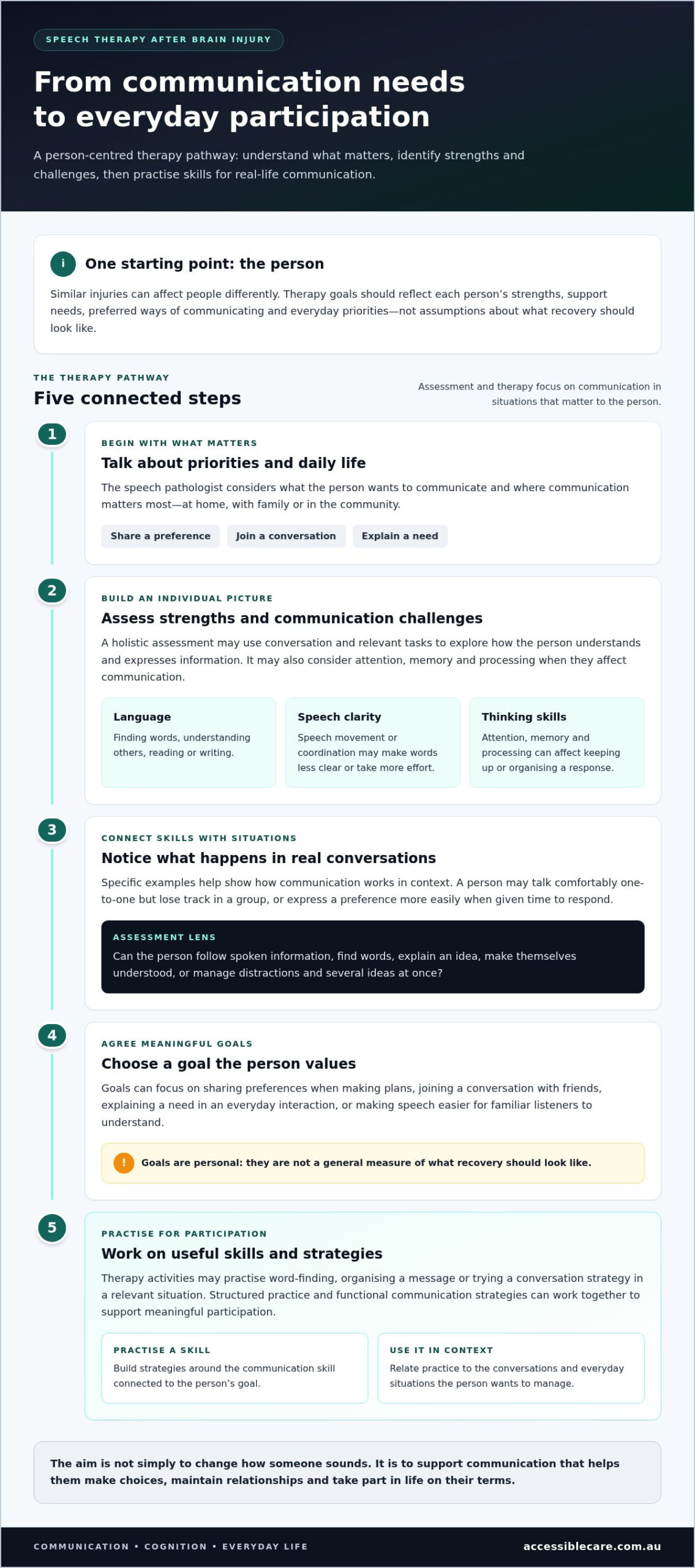
A useful therapy plan starts with the person, not just a diagnosis. Two people with similar injuries may have different communication strengths, routines and priorities. A speech pathologist can use a holistic assessment to understand what feels easy, what takes effort and where communication matters most. The person’s input then helps shape meaningful goals.
An assessment is more than a test of correct answers. It may include conversation and relevant tasks to show how someone understands and expresses information. The speech pathologist may also explore attention, memory and processing if these affect communication. With the person’s input, they can consider how communication needs show up at home, with family or in the community.
What might a speech pathologist assess?
The focus depends on the person. An assessment may explore whether they can follow spoken information, find words, explain an idea or make themselves understood. It may also look at how they manage a conversation with distractions or several ideas to keep in mind. The aim is to understand practical effects, not to assume every skill is affected.
Specific examples help make an assessment relevant. Perhaps someone can talk comfortably one-to-one but loses track in a group, or can express a preference more easily when given time to respond. These details connect observed communication skills with situations the person wants to manage.
How therapy goals connect to everyday communication
Once strengths and support needs are clearer, goals can be specific and useful. A person might want to share preferences when making plans, join a conversation with friends or explain a need during an everyday interaction. Another goal could focus on making speech easier for familiar listeners to understand. Each goal should reflect what the person values, rather than a general idea of what recovery should look like.
Therapy activities can practise the skills and strategies that support those goals. Depending on the assessment, this might involve working on word-finding, organising a message or trying a conversation strategy in a relevant situation. A communication aid or other support may also be considered if it suits the person’s needs and preferences. These options can support communication without defining the person or replacing their choices.
Progress is individual. It may show up in small, meaningful changes, such as needing less support to express a choice or feeling more confident in a familiar conversation. The pace and type of change can vary, so goals may be reviewed as needs, routines or priorities shift. Speech therapy for brain injury recovery is most useful when the plan stays connected to everyday life.
Accessible Care’s experienced Speech Language Pathologists provide holistic assessments and speech therapy focused on communication, cognitive and language skills after acquired neurological disorders. For people in Melbourne and Adelaide, Accessible Care speech therapy offers support shaped around individual needs and goals.
Speech therapy approaches after brain injury: matching support to the person
Speech therapy isn’t limited to practising clearer speech. Depending on a person’s goals, it may support word-finding, understanding, organising thoughts, following conversation or communicating preferences. The right approach depends on the skill they want to work on and where it matters. Different approaches can complement one another.
Structured practice and functional communication
Structured practice gives someone a focused way to work on a particular skill. If finding words is difficult, for example, a speech pathologist might use a targeted activity to practise naming or describing. If organising information is the challenge, an exercise might involve arranging ideas before sharing them. These tasks offer a clear setting for practice, but they’re only one part of therapy.
Functional communication practice brings skills into meaningful situations. A person might practise how to enter a conversation, ask for clarification or explain a preference in a familiar context. A speech pathologist may also explore conversation strategies or communication supports that fit the person’s needs and preferences. The plan can combine approaches and adapt as priorities change. Speech therapy for brain injury recovery should connect practice to the person’s own goals, not follow a fixed script.
Speech pathology alongside other rehabilitation supports
Speech pathologists focus on communication, language and related cognitive skills, such as the attention or memory needed to take part in a conversation. Occupational therapists have a distinct focus on participation and daily living. For example, an occupational therapist may work with someone on managing everyday activities, while speech therapy may address communication during those activities. Their perspectives can complement each other when support is coordinated around what the person wants to do.
For a closer look at the occupational therapy role, explore this guide to occupational therapy and independence.
Consider progress against the person’s goals and everyday participation, not only performance in a structured task. If the goal is to share a preference, useful signs might include expressing that choice in a relevant situation or needing less help to communicate it. A speech pathologist can review what’s working with the person and adjust the approach. Change may be gradual, uneven or different across skills, so there’s no single measure or timeline that suits everyone.
Practical ways to support brain injury communication between sessions
Everyday conversations can offer useful opportunities to practise without turning home life into another therapy session. Agreeing on a small goal together helps keep the person in control. They might want to share an opinion during dinner or ask for help with a familiar task. Use this simple sequence and adapt it to what feels comfortable:
- Agree on a goal. Ask what the person would like to practise, and respect it if they’d rather not practise at that moment.
- Choose a calm moment. Pick a familiar routine when there’s time to communicate without rushing.
- Practise naturally. Use the person’s preferred way to communicate, whether that’s speaking, writing, gestures or another agreed support.
- Reflect together. Notice what helped, what felt difficult and whether the person would like to try anything differently next time.
Keep the focus on connection, not performance. Practice between sessions should support goals developed with a speech pathologist, not replace professional guidance or become a test.
Communication-partner strategies that respect autonomy
Communication partners can make it easier for someone to take part by creating space for their message. Try having one person speak at a time, using clear, unhurried language and allowing time for a response. A pause can help; avoid finishing sentences unless the person wants that support.
Offer choices where useful and check understanding gently. For example, ask, “Would you like tea or water?” rather than putting several questions together. If something isn’t clear, give the person another way to explain or show what they mean. The aim is to understand, not to quiz them. Support them to express their own preferences rather than speaking over them or assuming what they want.
Making practice manageable in everyday routines
Choose a meaningful routine, such as planning an outing or preparing a meal, instead of adding a new task to an already tiring day. Keep practice brief and pause if attention or energy changes. Fatigue can make communication feel harder, so a shorter interaction, a quieter setting or a break may be more supportive than pushing through.
Notice which conditions make conversation easier. Is it simpler in a quiet room, with one topic at a time or earlier in the day? Share these observations with the person’s speech pathologist so strategies can be adapted to real routines. For broader context about life after injury, the acquired brain injury support and recovery guide explores support and recovery more widely.
Speech therapy for brain injury recovery works best when practice respects the person’s pace, choices and communication style. If you’re looking for speech therapy support, explore Accessible Care’s speech therapy for people with acquired neurological disorders in Melbourne and Adelaide.
Speech therapy for brain injury recovery with Accessible Care
Finding support after an acquired brain injury can feel like another task in an already demanding time. Accessible Care’s experienced Speech Language Pathologists provide speech therapy focused on communication, cognitive and language skills for people with acquired neurological disorders. Holistic assessments help build an understanding of the person’s communication needs and priorities, so support can be shaped around what matters in everyday life.
Accessible Care is a registered NDIS provider serving Melbourne and Adelaide. Whether someone is working towards communicating choices more easily, sharing information with others or taking part in everyday activities, their goals and preferences can guide the support they receive.
A person-led starting point for speech therapy
A helpful starting point is listening. The person’s priorities, preferred ways of communicating and daily routines help show what support may be useful. A holistic assessment can explore communication and related cognitive and language skills in context, then help identify goals connected to the person’s life. That could include communicating more comfortably at home or participating in familiar activities.
Family members or other communication partners may share useful observations if the person wants them involved. Their role is to support the person’s voice, not speak on their behalf. Respecting consent, privacy and communication preferences keeps the process centred on the individual and helps ensure their choices remain part of planning and review.
Finding local support in Melbourne and Adelaide
For individuals and families in Melbourne and Adelaide, Accessible Care provides speech therapy for people with acquired neurological disorders. The service focuses on building communication, cognitive and language skills through assessment-led support. To understand more about speech pathology and the types of communication support it can involve, read this guide to speech pathology and communication support.
Some people explore speech therapy through the NDIS. Accessible Care is a registered NDIS provider, but funding for a particular support depends on individual circumstances and current plan rules. Funding should not be assumed; a person’s plan and goals are relevant to understanding their options.
A next step can begin with considering which communication goals matter most and what the person would like support to help them do. That gives the conversation a practical focus: their needs, preferences and everyday priorities.
Explore Accessible Care to learn about speech therapy support.
Take the next step at your own pace
Communication goals don’t need to be big to matter. A small step towards expressing a preference, taking part in a conversation or feeling understood can make everyday interactions more manageable. The person’s priorities can guide what comes next, and it’s fine for those priorities to change over time.
Speech therapy for brain injury recovery can support communication that builds connection and self-direction. If you’re exploring support for yourself or someone close to you, consider what would make the greatest difference in daily life. That question can help shape a first conversation about individual needs and goals.
Explore speech therapy support with Accessible Care and take a considered next step. You don’t need to have everything figured out before you begin. A meaningful goal can give therapy a practical place to start.
Frequently Asked Questions
Can speech therapy help months or years after a brain injury?
Yes. People may seek speech therapy for brain injury recovery months or years after an injury; there isn’t a universal cut-off for discussing communication needs. Goals can shift as routines and responsibilities change, such as returning to study or managing appointments. A qualified speech pathologist can help explore current priorities. New or worsening symptoms should be assessed by a medical professional promptly, rather than treated as a routine communication change.
Can speech therapy help if someone has very limited speech after a brain injury?
Yes. Communication support isn’t limited to spoken words. A speech pathologist can explore how the person currently communicates and what they want to express, then discuss options that may suit their strengths and preferences. These could include gestures, writing, pictures or other supports, depending on the individual. The person’s choices should guide the approach. Their needs should be assessed before selecting a method or setting expectations about outcomes.
How often should someone have speech therapy after a brain injury?
There’s no single session schedule that suits everyone. Frequency can depend on the person’s goals, assessment findings, circumstances and energy, as well as how therapy fits alongside daily routines and other commitments. More sessions don’t automatically mean faster progress. The person and their speech pathologist can review whether the plan remains manageable and useful, then adjust it as needs or priorities change. It’s reasonable to discuss what feels sustainable.
Does speech therapy after brain injury help with memory and concentration?
It may address cognitive-communication needs when attention, memory or processing affects everyday communication. For example, a person might work on strategies for keeping track of key points during a discussion or organising what they want to say. This isn’t a promise to restore memory or treat every cognitive difficulty. An assessment helps clarify whether a communication goal is relevant to situations the person wants to manage.
Can family members support speech therapy practice at home?
Yes. Family members or other communication partners can support everyday practice if the person wants them involved. They might help set up a calm conversation or note situations the person found easy or challenging to discuss with the speech pathologist. Agree on a simple way to signal when a pause is needed. Follow strategies developed with the person and their speech pathologist, without pressuring or correcting them.
Can NDIS funding cover speech therapy after a brain injury?
It may, but funding depends on the person’s circumstances, their plan and current NDIS rules. Don’t assume a particular support will be funded or that eligibility is automatic. Review the latest NDIS information and consider how the person’s goals and supports are described in their plan. If the plan or funding arrangements are unclear, the person can use current NDIS guidance to understand their situation.
Is speech therapy only for people with traumatic brain injury?
No. Brain injuries and acquired neurological conditions can have different causes, and speech pathology may support communication or related cognitive-language needs in some situations. That doesn’t mean everyone with a brain injury needs speech therapy. An individual assessment can help clarify whether there are communication goals the person wants support with and whether speech pathology is relevant to those needs and everyday priorities.

