


What if an NDIS goal doesn’t need to sound formal to be meaningful? If you’re searching “how to set goals for ndis plan,” start with what matters in your everyday life, not with what you think the NDIA expects. Your priorities are personal, and it’s understandable if putting them into a plan feels daunting.
A goal can describe something you’d like to do, learn or take part in. It helps explain what matters to you, but it doesn’t promise that a particular support or funding will be approved. The connection between a goal and possible supports is a conversation, not a guarantee.
This practical 2026 guide will help you turn your hopes into clear, personal goals and prepare for a planning conversation. You’ll learn how to choose priorities, describe them in your own words and explain the support needs behind them. We’ll also cover how services such as occupational therapy or speech therapy can fit into a discussion about a goal, while keeping funding decisions separate from the goal itself.
Key Takeaways
- Start with everyday priorities, such as routines, relationships, communication or community activities, then choose what matters most to you.
- When considering how to set goals for ndis plan, describe the change you hope to experience rather than naming a specific service as your goal.
- Use personal examples to make broad hopes clearer, while remembering that a goal doesn’t guarantee a particular support or funding outcome.
- Prepare for a planning conversation by writing down your goals, current barriers, everyday examples and questions.
- Revisit your priorities as life changes, and reflect on what progress means to you.
How NDIS plan goals work, and what they can and cannot do
NDIS goals can start with ordinary, personal priorities: getting through a morning routine with more confidence, joining an activity you enjoy, or communicating more comfortably. You don’t need polished wording. A goal describes an outcome or direction that matters to you and helps explain the life you want to work towards.
Goals guide conversations about your priorities and support needs. They aren’t a shopping list of services, and including one in your plan doesn’t guarantee that a particular support or amount of funding will be approved. For background on the scheme’s purpose and structure, see the National Disability Insurance Scheme (NDIS) overview. Your goals should start with your own circumstances and what you value.
What makes an NDIS plan goal personal?
A personal goal reflects your preferences, strengths, daily life and circumstances. It might focus on managing an everyday task, taking part in a community activity, communicating with people around you, or building independence. It doesn’t need to sound clinical. “I want to feel more confident catching the bus to visit my sister” describes a meaningful direction in your own words.
If you’re thinking about how to set goals for ndis plan, begin with what you want to change or continue doing. The goal should feel like yours, not like a professional’s description of what you ought to achieve. A family member or practitioner can help you find the words, while your priorities stay at the centre.
Do NDIS goals decide what funding you receive?
Goals and funding are connected, but they aren’t the same thing. A goal tells the planning conversation what matters to you. A funding decision considers whether proposed supports meet the NDIS’s current requirements, including the reasonable and necessary criteria. NDIA guidance and individual circumstances matter, so a goal alone can’t promise that a particular support will be funded.
A personal goal describes the change you want. A funding decision determines separately what assistance the NDIS will pay for.
For example, you might want to prepare meals more independently. That’s the outcome you care about. Occupational therapy may be relevant to daily living skills, but including it in a goal doesn’t guarantee funding for it. At planning, explain the support needs behind your goal and how they relate to current NDIS criteria.
Even if a particular support isn’t funded, your goal can still guide the conversation. It explains what matters and why, keeping attention on the change you hope to make rather than on one service alone. That distinction can help you discuss your priorities clearly while leaving funding decisions to the relevant planning process.
How to find NDIS goals that reflect what matters to you
You don’t have to begin with a polished sentence. Think about the parts of life you value, what you’d like to do more often and which changes would make a difference. A trusted person can help you reflect or write down ideas, if you want. Your voice and priorities come first.
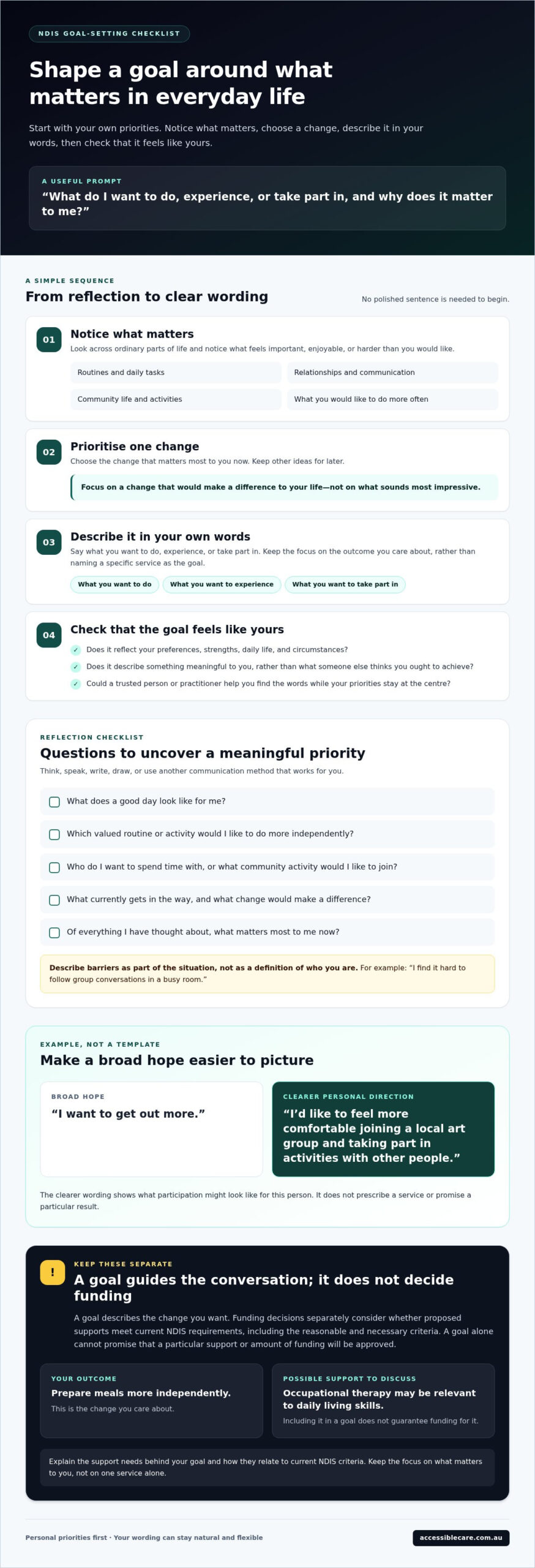
Use this sequence to shape your thinking:
- Notice: Think about your routines, relationships, communication and community life. What feels important or enjoyable? What feels harder than you’d like?
- Prioritise: Choose one change that matters most to you now. Keep other ideas for later.
- Describe: Put the change into your own words, focusing on what you want to do, experience or take part in.
- Check: Ask yourself whether the goal feels personally meaningful, rather than chosen to sound impressive or professional.
A useful prompt is: “What do I want to do, experience, or take part in, and why does it matter to me?” The NDIA’s How to set goals for your NDIS plan guidance also encourages participants to focus on what’s important to them. Use it as a starting point, then make the reflection your own.
Questions that help uncover meaningful priorities
Take time to think, speak, write, draw or use another communication method that works for you. Consider these questions:
- What does a good day look like for me?
- Which valued routine or activity would I like to do more independently?
- Who do I want to spend time with, or what community activity would I like to join?
- What currently gets in the way, and what change would make a difference?
- Of everything I’ve thought about, what matters most to me now?
Describe barriers as part of the situation, not as a definition of who you are. For example, “I find it hard to follow group conversations in a busy room” explains a challenge without reducing your identity to it.
Turning a broad hope into a clear goal
A broad hope is a useful starting point. Add the everyday outcome you want to make it easier to discuss, while keeping the wording natural and flexible.
Example, not a template: “I want to get out more” could become “I’d like to feel more comfortable joining a local art group and taking part in activities with other people.” The clearer version explains what participation might look like for this person. It doesn’t prescribe a service or promise a particular result.
You can make a goal specific without forcing it into a SMART format or using clinical language. A useful approach to how to set goals for ndis plan is to choose words that explain your hopes and still sound like you. If you’d like support exploring daily-life priorities, learn about Accessible Care’s NDIS support services.
How to make NDIS goals clear without promising a funding outcome
A clear goal describes the change you want in your life, not a particular service you expect to receive. This keeps planning conversations focused: explain what matters, then discuss possible ways to work towards it. The examples below are starting points, not scripts. Let your circumstances and preferences guide the wording.
| Broad wording | Clearer personal outcome | Questions to discuss at planning |
|---|---|---|
| “I want my mornings to be easier.” | “I’d like to manage more of my morning routine with greater confidence.” | Which parts of the routine are difficult? What would doing more independently look like for me? |
| “I want to get out more.” | “I’d like to take part in a local activity that interests me and feel comfortable being there.” | What activity would I choose? What makes joining in difficult at present? |
| “I want help with talking.” | “I’d like to express my needs more easily in conversations that matter to me.” | Where or with whom do I want communication to feel easier? What would help me notice progress? |
Examples of broad goals and clearer personal outcomes
These revisions add context without dictating how to achieve the outcome. For example, “I want to do things at home” could become “I’d like to prepare a simple meal that I choose, with more confidence.” The useful detail is the person’s desired experience and choice, not a prescribed method. Keep the wording flexible as your priorities or circumstances change.
As you consider how to set goals for ndis plan, check whether each clearer version still sounds like you. Would you describe the outcome this way to someone who knows you? If it feels too formal, simplify it. The NDIA’s Understanding NDIS Goals guidance explains the role goals play in a plan and can provide useful context as you choose your wording.
Goals, supports, and funding are different things
A goal describes what you want to do or experience. Supports are possible ways to work towards that outcome, and funding is considered separately through the NDIS planning process. Occupational therapy and speech therapy can relate to some people’s goals, depending on their individual circumstances, but mentioning a therapy doesn’t mean it will be funded. Current NDIA criteria and guidance apply, so don’t treat an example as a funding decision.
Clear wording can improve communication, but it can’t guarantee plan funding. At planning, explain why the outcome matters, what gets in the way and what types of support you’d like to discuss. This keeps the conversation centred on your needs rather than assuming one service is the only answer. Learn about person-centred NDIS support.
How to prepare your NDIS goals for a plan meeting
Preparing a few notes can help you explain what matters without memorising a script. Focus on the goal, why it matters to you and what you hope will change. If you’re working out how to set goals for ndis plan, think of preparation as a way to make your priorities easier to share, not a test you need to pass.
Before the meeting, write down:
- Your written goals: Keep them in your own words, even if they’re still a work in progress.
- Everyday examples: Note a recent situation that helps explain what the goal means to you.
- Current barriers: Describe what makes the activity or change difficult now, without judging yourself.
- Why it matters: Explain what you value about this priority and what a positive change might look like.
- Questions: Note anything you want to understand, including how a goal is recorded and how proposed supports relate to it.
If you’d value a supportive conversation to clarify daily-life priorities, explore person-centred NDIS support with Accessible Care.
What examples can help explain a goal?
Choose ordinary moments that show the difference between what’s happening now and what you’d like to change. For example, you might find it hard to follow a conversation in a noisy group and want to share your thoughts more comfortably during a community activity. Keep details relevant and protect your privacy. You don’t need to share personal information that isn’t needed to explain your goal.
If you have assessment information or reports that help explain your support needs, you can refer to them in the conversation. They may add useful context, but one particular report isn’t required to talk about your priorities. You can also bring a short written example or ask someone you trust to help you remember the details.
How to communicate your goals in the meeting
Lead the conversation at a pace that works for you. Ask for time to think, have a question repeated or use a communication aid if that helps you express yourself. A trusted supporter can come with you if you choose, but they should support your voice, not replace it. You might say, “This matters because…” or “A change I hope to see is…” to explain the personal meaning behind each goal.
Useful questions include: “How will this goal be recorded?” and “How do the supports we’re discussing relate to this priority?” They can help you understand the conversation without assuming a goal guarantees funding. For wider context on how the scheme works, see this guide to understanding the NDIS. Your preparation doesn’t need to be perfect. It should help the planning conversation reflect what matters to you.
Revisiting NDIS Goals and Finding Support to Reach Them
Your goals don’t have to stay fixed. A new interest, a change in daily life or a priority that no longer feels relevant can all be reasons to reflect. Revisiting a goal isn’t a sign you’ve failed. It helps ensure your priorities still reflect the life you want.
Ask yourself:
- What feels most important to me now?
- Has anything changed in my routines, relationships or circumstances?
- Does this goal still feel like mine?
- What does progress mean to me, even if the change is gradual or looks different from what I first expected?
Changing your personal priorities is different from making a formal change to an NDIS plan. If you’re considering a formal plan request or reassessment, use current NDIA guidance to understand the relevant steps. You can reflect on, refine or discuss what matters to you without assuming that a wording change will automatically change your plan or funding.
When might a goal need to change?
Revisit a goal if your circumstances have changed, a new opportunity matters more, or the goal no longer reflects what you want. Perhaps an activity you once hoped to try isn’t a priority now, or you’ve realised a different part of daily life deserves attention. Keep what still feels meaningful and adjust what doesn’t. Changing direction isn’t failure.
How Accessible Care can support person-led priorities
Talking through a goal with a practitioner can help you describe what matters and explore ways to work towards it. Accessible Care offers occupational therapy focused on daily living skills and independence, as well as speech therapy to support communication, cognitive and language skills. Support work can also relate to a person’s stated goals and everyday priorities. These supports can be considered in context, but they don’t promise a particular outcome or NDIS funding.
Your choices stay central. Start with what you want to do or change, then consider whether a support could relate to that outcome. If you’re unsure where to begin, bring one goal and explain why it matters, what progress would mean to you and what support you’d like to explore. This keeps the discussion grounded in your life, rather than in a service alone.
As you consider how to set goals for ndis plan, remember that goals can grow with you. Notice what has changed, name what matters now and choose a direction that feels personal. If you’d like to discuss your priorities with a supportive team, talk with Accessible Care about NDIS support.
Take the Next Step at Your Own Pace
You don’t need every goal perfectly worded before moving forward. Choose one priority that matters to you, jot down why it’s important and consider what change you’d like to work towards. That starting point can help shape your next conversation and keep your choices at the centre.
If you’re still thinking about how to set goals for ndis plan, a supportive conversation can help you put your priorities into words. Accessible Care is a registered NDIS provider serving Melbourne and Adelaide. Its services include occupational therapy for children and adults, as well as support from experienced speech language pathologists. These services can relate to personal goals, but neither a goal nor a service guarantees a particular funding decision.
Explore support in a way that feels comfortable for you. Explore person-centred NDIS support with Accessible Care and take the next step when you’re ready. Your goals belong to you, and you can shape them in your own words, at your own pace.
Frequently Asked Questions
What should I include in my NDIS plan goals?
Include the outcome you want, why it matters and the part of life it relates to. You might want to manage a particular task at home, join an activity or communicate a preference more easily. If you’re learning how to set goals for ndis plan, describe the outcome in a sentence you’d naturally use, then add an everyday example to give it context.
Can I change my goals in an NDIS plan?
Your priorities can change, and you can reflect on or discuss updated goals. A personal change in priorities doesn’t automatically change an approved plan or its funding. If you need a formal plan change or reassessment, consult current NDIA guidance about the process for your circumstances. First, write down what has changed, why the existing goal no longer fits and what you want to focus on instead.
Do NDIS goals need to be written in SMART format?
No particular SMART format is needed to express what matters to you. Specific, measurable wording can help explain an outcome, but it shouldn’t make a goal feel artificial or difficult to maintain. For instance, “I want to feel more confident making choices about my weekly activities” may be more meaningful than adding a deadline or measurement that doesn’t suit your situation. Choose wording you can understand and explain.
Will the NDIS fund every support related to my goals?
No. A goal doesn’t guarantee funding for every support that might relate to it. Funding decisions are considered separately under current NDIS rules and in light of your circumstances. If a support isn’t funded, you can still discuss the outcome that matters and whether other ways of working towards it are available to you. For information about a particular funding decision, refer to current NDIA guidance or contact the NDIA directly.
How many goals should I have in my NDIS plan?
There isn’t one ideal number for everyone. Focus on priorities you can explain and that reflect what matters in your life, rather than adding goals to meet a target. You could group connected aims under a broader outcome, such as taking part in activities you choose, and add examples to explain what that means to you. Check the current plan format or NDIA guidance if you’re unsure how to record them.
Who can help me set goals for my NDIS plan?
You can work through ideas independently or invite someone you trust, such as a family member, friend, nominee or practitioner, to help you find the words. You decide who is involved and what you share. A practitioner may help connect everyday priorities with possible supports, but they don’t decide what the NDIS will fund. If someone is helping, ask them to leave space for you to speak or communicate in your own way.
What happens if my circumstances change after my NDIS plan is approved?
Start by noting what has changed and how it affects your support needs or current goals. For example, a change in living arrangements might affect how you manage everyday tasks. Contact the NDIA or consult its current guidance to understand whether you should discuss the change or request a formal plan action. Keep relevant information together, but don’t assume a changed circumstance automatically alters your plan or funding.

