


A diagnosis alone may not explain why a child needs speech therapy support at school. A useful speech therapy for school funding report connects communication needs to learning, participation and safety, then sets clear, functional goals. For children under 6 in Australia without a diagnosis, evidence may need to show delays in at least 2 areas for 12 months or more.
Families often understand the challenges their child faces but aren’t sure how to describe them in a funding application. The report should turn those day-to-day experiences into specific evidence of need and explain how speech therapy goals relate to school life. This guide covers access barriers, the information to gather from teachers and carers, and ways to prepare a report and goals that clearly show the support being requested.
Key Takeaways
- Map the access pathway that applies to your child’s age and circumstances before planning a funding application.
- Build the report around everyday communication needs, with practical examples from home and school.
- Match your application to the relevant funding program, as school-based support can differ across Australia.
- Allow time to gather assessment results and teacher or carer feedback before requesting a report.
Barriers to accessing speech therapy funding
Funding can depend on a child’s age, evidence of disability and application pathway. Because school and NDIS funding follow separate processes, it can be difficult to know which support to seek first.
- Identify the relevant age pathway. The NDIS Early Childhood Approach supports children under 9 in Australia. For children under 6 without a diagnosis, evidence may need to show delays in at least 2 areas for 12 months or more. It may also need to show that at least 2 allied health services are required. From age 7, NDIS eligibility considers whether a significant and permanent disability affects participation in daily life. These criteria can make early intervention harder to access when a child’s needs are still being assessed.
- Show how communication needs affect daily life. A language difficulty can affect classroom instructions, friendships, expressing needs or staying safe. A speech pathology report should connect assessment findings with specific examples. For instance, explain when a student struggles to follow a spoken instruction, and what support helps them take part. Evidence from teachers or carers can show how needs appear across settings, rather than relying on a diagnosis alone.
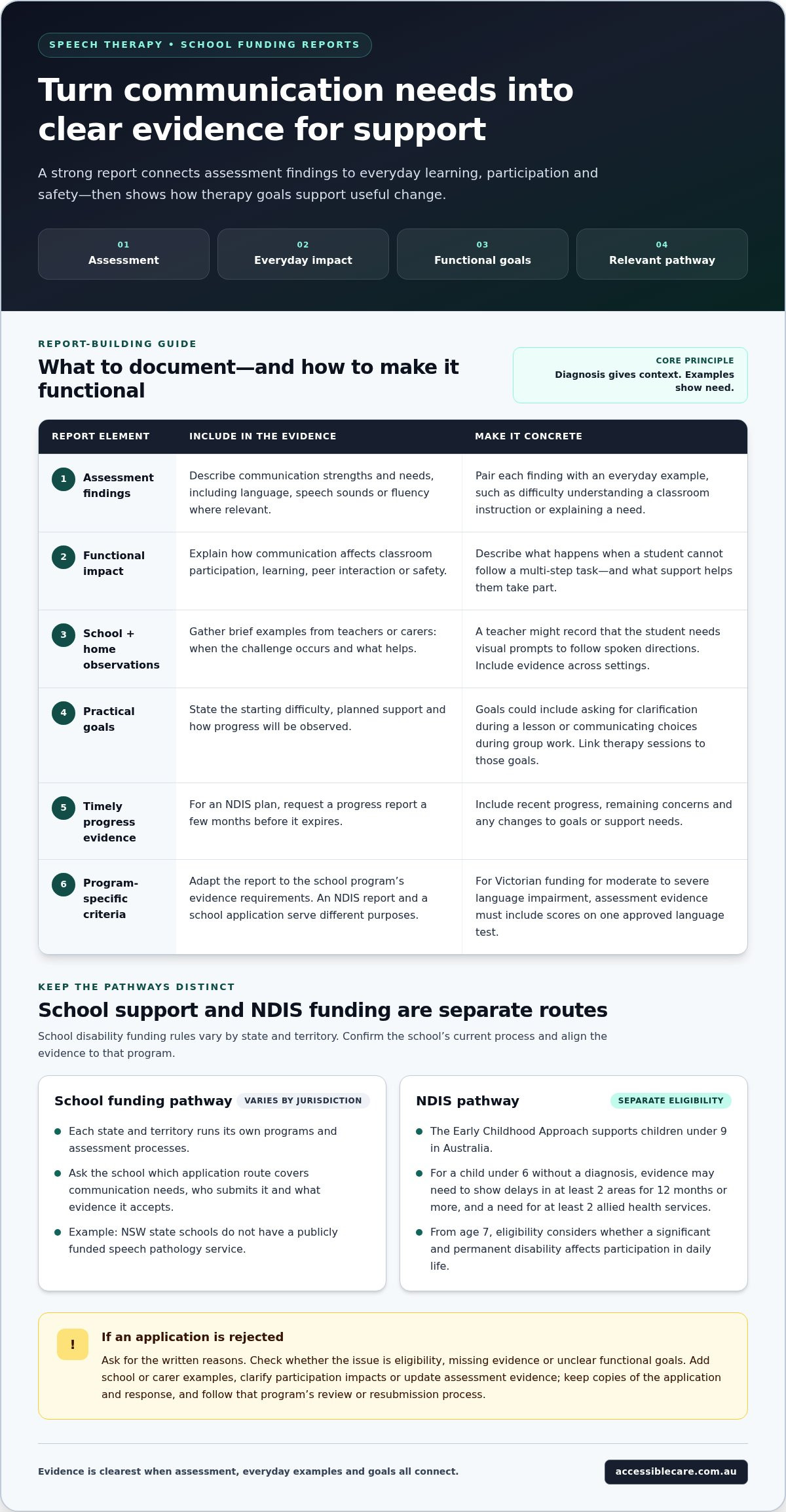
- Separate school support from NDIS funding. State and territory school disability funding rules differ because each jurisdiction runs its own programs and assessment processes. For example, NSW state schools do not have a publicly funded speech pathology service. Check which school pathway applies, then align the application with its evidence requirements. NDIS funding is a separate route, with its own eligibility criteria and evidence about disability-related support needs.
- Respond constructively if an application is rejected. Ask for the written reasons and identify whether the concern relates to eligibility, missing evidence or unclear functional goals. Then work through each point: add school or carer examples, clarify the impact on participation, or update assessment evidence. Keep copies of the original application and response. Follow the review or resubmission process for that specific program, and make the report clearly connect therapy sessions with the child’s everyday progress.
Preparing reports and goals for funding applications
Yes. An NDIS speech pathology report can support a school funding application in Australia, particularly when it explains how communication needs affect learning and participation. Adapt the evidence to the school program’s criteria: an NDIS report and a school application serve different purposes. A speech therapy for school funding report should make that connection clear.
- Start with the assessment question. Ask the speech pathologist to describe the child’s communication strengths and needs, including language, speech sounds or fluency where relevant. Connect each assessment finding to an everyday example, such as difficulty understanding a classroom instruction or explaining a need. For Victorian funding for moderate to severe language impairment, assessment evidence must include scores on one approved language test.
- Describe functional impact, not diagnosis alone. Explain how communication affects classroom participation, learning, peer interaction or safety. For example, note what happens when a student cannot follow a multi-step task, and what support enables them to take part. The diagnosis provides context; specific evidence shows why intervention and funded support may be needed.
- Gather observations from school and home. Invite teachers or carers to document concerns with brief examples, including when challenges occur and what helps. A teacher might record that a student needs visual prompts to follow spoken directions. Add these observations alongside assessment results so the application reflects the child’s needs across settings.
- Write goals that describe a useful change. Set goals around practical participation, such as asking for clarification during a lesson or communicating choices during group work. State the starting difficulty, the support planned and how progress will be observed. Link requested therapy sessions to these goals, rather than listing sessions without explaining their purpose. Use the speech therapy for school funding report to show how each goal supports participation.
- Prepare the report before a plan ends. Ask for an NDIS progress report a few months before the child’s plan expires. Include recent progress, remaining concerns and any changes to goals or support needs. For early childhood intervention, explain how communication needs affect everyday routines, and organise evidence around the criteria used in the application.
If you need help turning assessment findings into practical goals, speech therapy support can be part of that process.
Which Australian school funding programs cover speech therapy or communication needs?
- Start with your state or territory’s school pathway. School disability funding programs differ across Australia, so identify the program used by your child’s school before preparing documents. Ask the school which current application route covers communication needs, who submits it, and what evidence it accepts. This helps distinguish school support from an individual therapy funding request.
- Use Victorian examples as historical context. In 2018, Victoria’s State Support Services Funding program offered speech therapy funding to students from Prep to Year 4 for a maximum of three years. Treat this as a past program example, not evidence of current availability. For a present application, confirm the relevant Victorian school process and its current criteria.
- Separate school-sector funding from individual NDIS funding. The Australian Government Schools Funding Report covers financial assistance paid to the schools sector and relevant decisions under section 127 of the Australian Education Act 2013. It covers the 2024 funding year. This report concerns school-sector funding, not an individual child’s application for speech therapy sessions.
- Match the evidence to the funding purpose. For school support, describe how communication affects access to lessons, classroom participation or interaction with peers. For example, show how difficulty understanding spoken instructions affects a student’s ability to begin a task. For NDIS funding, explain the disability-related functional impact and connect requested therapy with everyday goals.
- Ask the school to identify the next application step. Find out whether the school applies on the student’s behalf, what supporting documents it needs, and when decisions are considered. Then organise the speech pathology report, assessment information and relevant teacher observations for that pathway. Keep a copy of each document and note which evidence supports each stated need.
How long does it take to get a speech therapy report for a school funding application?
There’s no single turnaround time for every Australian funding report. Timing depends on the assessment required, the records available and how quickly school observations can be gathered. Start early so there’s time to prepare the report for the application process.
- Ask what the report needs to cover. Start by identifying the funding program and its evidence requirements. A school application may need examples of classroom impact, while an NDIS progress report should explain disability-related support needs and progress towards goals. Clear requirements help the speech pathologist plan the assessment and documentation without unnecessary revisions.
- Allow for assessment requirements. An existing assessment may provide useful evidence, but a speech pathologist may need further information to describe current communication needs. The assessment approach depends on the child’s age, language profile and the questions the report must answer. In Victoria, evidence for moderate to severe language impairment funding must include scores on one approved language test.
- Gather school and carer observations promptly. Teacher or carer feedback can add practical examples to the report. Ask them to describe a specific situation, such as difficulty following spoken instructions or joining group activities. Share those observations with the speech pathologist early, so the report can connect assessment findings with the child’s experience at school.
- Plan around the funding deadline. For an NDIS plan review, ask for a progress report a few months before the plan expires. This allows time to summarise progress, update goals and organise supporting documents. For school applications, work backwards from the school’s submission date and account for any steps needed to collect assessment results or staff feedback.
- Reduce avoidable back-and-forth. Provide the child’s current goals, relevant school examples and the application’s requirements together. Check that the report explains the functional impact and links recommended support to practical outcomes. If you need support with a child’s communication assessment and goals, explore speech therapy support.
Accessible Care: NDIS Support Services
Accessible Care provides NDIS support services and speech therapy to help people with communication needs and everyday participation. When preparing a funding application, speech therapy can clarify communication strengths, support needs and practical goals. The report should reflect the person’s circumstances and the evidence required for the relevant pathway.
If communication needs affect other areas of daily life, occupational therapy or positive behaviour support may also be relevant. The right support depends on the person’s goals and the challenges they want to address. Accessible Care’s team can listen to your priorities and work with you on a person-centred approach.
Contact Accessible Care to discuss speech therapy and support for your funding goals.
Make the next step work for your child
A speech therapy for school funding report can do more than support an application. Use it to keep the student’s priorities central to planning, with communication goals tied to daily learning and participation. As needs or classroom demands change, those priorities can guide conversations about useful next steps.
Before moving forward, write down the main communication challenges you want the report to address and the changes that would matter most to your child. This gives you a clear starting point for a conversation with a speech pathologist and helps keep the process focused on your child’s voice, strengths and goals.
For support with your next steps, contact Accessible Care. Every funding journey is different, and a thoughtful plan can help you move forward with greater clarity and confidence.
Frequently Asked Questions
What does a speech therapy report for school funding in Australia include?
A report typically describes the student’s communication profile, assessment findings and how their needs affect school participation. It can also explain the settings where communication is easier or more challenging. For example, a child may speak confidently with familiar people but struggle to answer questions in a busy classroom. Include the child’s communication strengths and languages used to give the school a fuller picture.
Who can write a speech pathology report for school funding in Australia?
A speech pathologist can prepare the clinical report using assessment findings and relevant observations. Teachers and carers can contribute examples as supporting information, but their notes are not a clinical assessment. For instance, a teacher might describe how a student responds during group work. Tell the speech pathologist the school funding purpose so the report addresses the application’s key questions.
What evidence must a speech pathology report include to support school funding?
Evidence should show how communication needs affect the student’s access to learning and participation. Useful material may include assessment findings, specific examples from school, and details of strategies already tried and their effect. In Victoria, funding evidence for moderate to severe language impairment must include scores on one approved language test. Keep supporting examples clear and directly linked to the student’s communication needs.
How are speech therapy needs assessed for Australian school funding applications?
Assessment can combine formal language testing with information about how a student communicates in everyday settings. The appropriate test depends on the child’s age and the communication questions being assessed. For example, the PLS-5 is listed for children from birth to 7 years 11 months, while the CELF-5 A&NZ is listed for people aged 5 years 0 months to 21 years 11 months. Test results inform the picture of need; they don’t alone establish funding eligibility.
How do parents request school funding for a child with speech and language needs in Australia?
Start by telling the child’s school about their communication needs and asking which funding application process applies. Clarify who prepares and submits the application, which supporting documents are needed, and how your family can contribute information. Share relevant reports and practical examples with the school. Keep copies of what you provide and note the submission details so you can follow up through the school’s process.

