


A complaint should not disappear into a queue. The NDIS complaints process has separate completion targets for complaints and reportable incidents: the NDIS Commission aims to complete 50% of complaints and 75% of reportable incidents within 90 business days.
It’s understandable to want clear answers about what happens after you raise a concern, especially when someone’s safety, support or privacy is involved. The timeframe is only part of the picture: how the matter is prioritised and whether it falls within the Commission’s role also affect what happens next.
This guide explains the difference between complaints and reportable incidents, how timeframes and priorities work, which issues the Commission can address, and what to expect about privacy. You’ll get a clearer picture of the process and the options available when a concern needs attention.
Key Takeaways
- Learn how complaint and incident timelines differ, and what to do when a concern needs urgent attention.
- Understand the factors that can affect priority and how to follow the progress of a report.
- Identify the kinds of concerns the Commission can address and when an issue may fall outside its role.
- Explore what privacy considerations may arise when reporting, and how NDIS supports can help with related needs.
Complaint and incident timeframes
Timeframes depend on whether you complain to a provider or the NDIS Quality and Safeguards Commission. Providers commonly aim to acknowledge formal complaints within 2 business days and resolve them within 21 days. Some internal reviews take up to 30 days. These are reported service aims, not guaranteed deadlines.
The Commission aims to complete 50% of complaints within 90 business days. Its target for reportable incidents is 75% within 90 business days. These separate targets help explain why a complaint and an incident report may follow different paths. Urgent safety concerns should be raised without waiting for either timeframe.
How do you complain about an NDIS provider or support worker? Start by raising the concern with the provider and asking for its complaints process. If the response is inadequate, or you want the Commission involved, contact the NDIS Quality and Safeguards Commission on 1800 035 544.
What information and evidence should an NDIS complaint include? Give the names of the people involved, dates, locations and a clear account of what happened. Add relevant messages, letters, records or witness details, and explain what outcome would address your concern. You can still make a complaint without every detail.
If the provider has given no meaningful update after 3 weeks, consider escalating the concern to the Commission. Keep a copy of your complaint and note when you contacted the provider. These details make it easier to explain what has happened and what response you’re seeking.
What support, advocacy and interpreter services can help with a complaint? A trusted person or advocate can help organise information, communicate your concerns or take part in discussions. If you need an interpreter or communication support, ask the Commission’s Contact Centre about available assistance.
Act immediately if safety is at risk. According to the NDIS Quality and Safeguards Commission, call triple zero (000) if a person with disability’s life might be at risk, or there’s an emergency involving possible critical harm or serious injury.
Complaint prioritisation
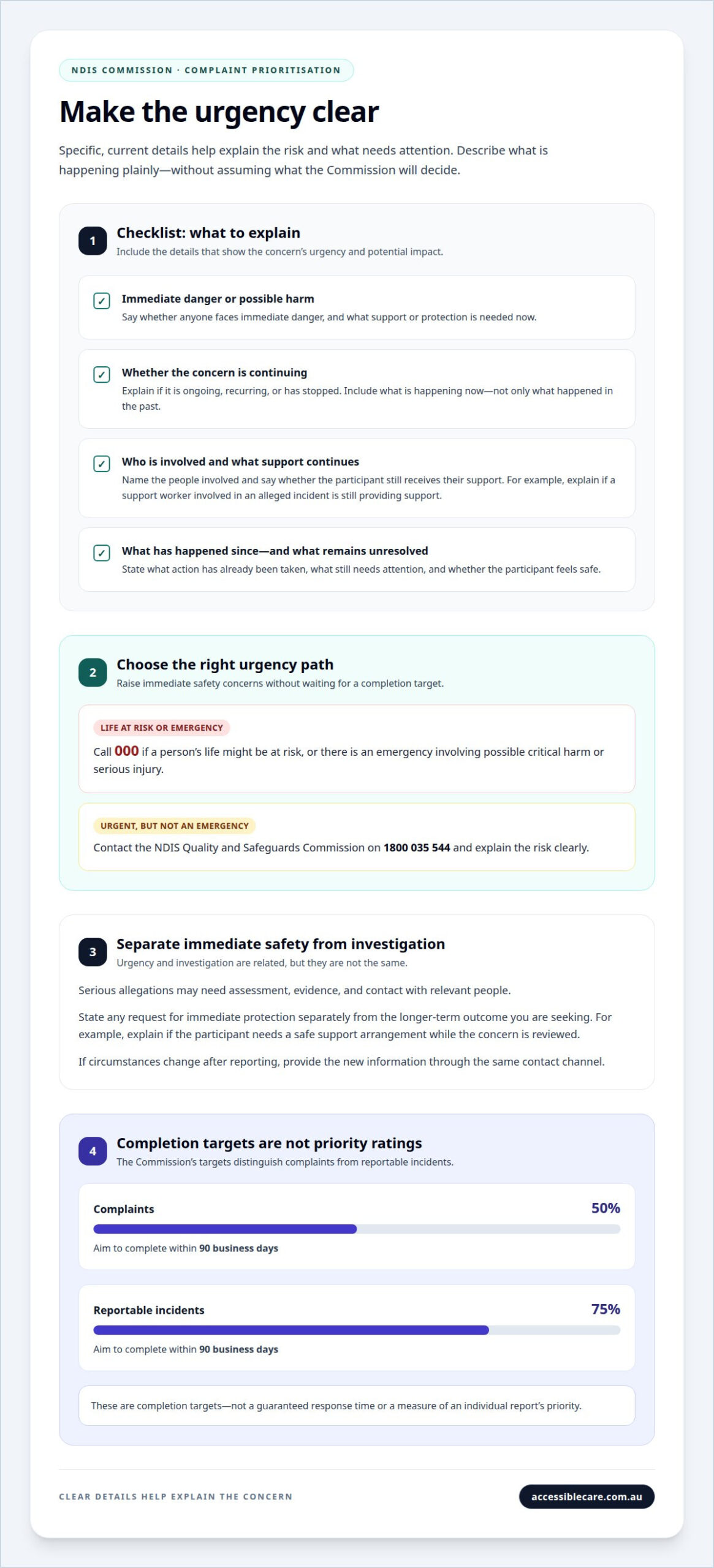
Priority depends on the concern’s urgency and potential impact. A report about ongoing harm needs clear details about what’s happening now. A past disagreement about a service may require a different response. Explain whether the risk is ongoing, who may be affected and what support is needed immediately. This helps distinguish urgent safety concerns from issues that need investigation or follow-up.
When reporting to the NDIS Quality and Safeguards Commission, describe the situation plainly. Include specific details that help explain its urgency:
- Whether someone faces immediate danger or possible harm.
- Whether the concern is continuing, recurring, or has stopped.
- Who is involved, and whether the person still receives their support.
- What action has already been taken, and what remains unresolved.
For example, explain whether a support worker is still involved after an alleged incident. State what happened, when it occurred and whether the participant feels safe. Avoid assumptions about what the Commission will decide. Specific details make the concern easier to understand.
How do you report an immediate risk, abuse, neglect, or fraud involving an NDIS participant? If someone’s life may be at risk, call triple zero (000). For an urgent concern that isn’t an emergency, contact the NDIS Quality and Safeguards Commission on 1800 035 544 and explain the risk clearly.
Urgency and investigation are related, but they aren’t the same. A serious allegation may need assessment, evidence and contact with relevant people. State any request for immediate protection separately from the longer-term outcome you’re seeking. For instance, say whether the participant needs a safe support arrangement while the concern is reviewed.
The Commission’s completion targets distinguish complaints from reportable incidents: it aims to complete 50% of complaints and 75% of reportable incidents within 90 business days. Those targets describe completion, not an individual report’s priority or a guaranteed response time. If circumstances change after reporting, provide the new information through the same contact channel.
Issues the Commission can and cannot address
The NDIS Quality and Safeguards Commission deals with concerns about NDIS providers and the supports they deliver. This can include worries about safety, quality, respectful treatment, or how a provider responds to a participant’s needs. For example, explain if a worker ignored agreed support instructions or a provider failed to address a safety concern.
Provider conduct matters too. The NDIS Code of Conduct applies to providers and workers, and became mandatory for all providers on 1 July 2019. Concerns may involve disrespectful treatment, unsafe support, or a worker’s conduct. Describe what happened and how it affected the participant, rather than relying only on labels such as “poor service.”
The Commission may not be the right place for every NDIS-related disagreement. A concern solely about plan funding, eligibility or a plan decision differs from a complaint about provider conduct. For example, if the issue is the amount of funding in a plan, identify it as a plan-decision concern. If a provider’s actions are also part of the problem, explain both issues clearly.
Separate the issue into the decision or service involved:
- For provider conduct or support quality, describe the provider’s actions and impact.
- For a plan decision, identify the decision and the outcome you’re seeking.
- For a concern involving both, explain each part separately.
This distinction helps the Commission understand what you want reviewed and prevents a service concern from being mistaken for a funding dispute. Include the provider’s name, the support involved and any steps already taken. If you’re unsure how your concern fits, describe what happened plainly and ask the Commission which parts it can consider.
A complaint can raise more than one issue. For instance, a participant may question both a provider’s conduct and whether the support delivered matched their plan. State each concern, give relevant examples and explain what response or change would address it. Clear details help the Commission assess the provider-related concern without confusing it with a separate plan decision.
Privacy when reporting
Sharing details about a participant can feel sensitive. Before contacting the NDIS Quality and Safeguards Commission, decide what information is essential. A report should explain the concern clearly without including unrelated personal details. For example, describe the support incident rather than sharing a full personal history.
Be clear about whose information you’re providing. If the concern involves a participant, explain your connection and whether they know about the report. If you’re reporting on someone else’s behalf, clarify what they’ve agreed to share. Don’t assume every detail can remain undisclosed during follow-up.
Before submitting a report, ask the Commission how it will handle your identity and the information you provide. If you’re concerned about being identified, say so at the outset. Ask what options are available and what information may need to be shared to assess the concern. Don’t assume a report can be investigated without identifying details.
Share information through the Commission’s reporting channel, and keep a copy of what you submit. A simple record can help you track which details you included and when you reported them. Store the copy securely, especially if it contains names, contact details or sensitive information about a participant.
To prepare, separate facts from your interpretation. Include relevant dates, the provider or worker involved, and the specific support in question. Leave out unrelated medical, financial or family details. For example, explain that a scheduled support visit didn’t happen rather than attaching records unrelated to that visit.
- State whether the participant knows about the report.
- Include only details relevant to the concern.
- Ask the Commission about identity and information handling.
- Keep your report and related correspondence in a secure place.
If you need help discussing support needs or communicating your preferences, explore support options that can help you take part in decisions.
More than 10,000 NDIS participants and families raised concerns in the 2022–23 reporting period. That context reinforces the value of sharing only relevant information and making your privacy concerns clear when reporting.
Accessible Care: NDIS Support Services
Accessible Care can support you with ongoing disability-related needs after you’ve raised a concern. If you need practical assistance or therapeutic support, its NDIS Support Services may help you work towards your goals and maintain daily routines.
Depending on your needs, support may include Speech Therapy, Occupational Therapy or Positive Behaviour Support. These services focus on areas such as communication, everyday activities and behaviour-related support. You remain central to decisions about your goals and the support that suits you.
For ongoing support that aligns with your needs, contact Accessible Care or visit accessiblecare.com.au.
Keep your next steps centred on your goals
Raising a concern can be one step towards improving how support works for you. As you decide what comes next, write down the changes that matter in daily life and keep your preferences central to conversations about support. Understanding the NDIS complaints process can help you make informed choices as you continue working towards your goals.
Accessible Care offers NDIS Support Services, Speech Therapy and Occupational Therapy. These supports may help if you’re looking for assistance with daily activities, communication or ongoing NDIS support. The focus is on your needs and the outcomes you want to work towards, while keeping decisions in your hands.
If you’d like to explore support that fits your goals, contact Accessible Care about NDIS support. You can take the next step at your own pace, with your priorities guiding the way.
Frequently Asked Questions
What types of NDIS complaints can the NDIS Quality and Safeguards Commission handle?
The Commission can consider concerns about an NDIS provider’s services, conduct or support quality. For example, you might report that a provider didn’t follow agreed communication needs or that a worker treated a participant disrespectfully. Explain the provider’s role and the specific support involved. Concerns solely about a plan decision, such as funding allocation, differ from complaints about provider conduct.
How long does the NDIS complaints process take?
There’s no single completion time for every matter. Providers commonly aim to acknowledge a formal complaint within 2 business days and resolve it within 21 days, while some internal reviews take up to 30 days. The Commission aims to complete 50% of complaints and 75% of reportable incidents within 90 business days. These are targets, not a set finish date for each case.
Can I make an anonymous or confidential NDIS complaint?
Before reporting, tell the NDIS Quality and Safeguards Commission if you’re worried about your identity being shared. Ask how it handles identifying details and what information may be shared to assess the matter. An anonymous report doesn’t identify its source; a confidential report involves sharing your identity with limits on disclosure. Explain any safety concerns and ask about the options that apply to your report.

