


Speech support can be considered when communication concerns emerge, rather than waiting for a particular birthday. Signs your toddler might need speech therapy include using fewer words than expected, struggling to combine words, or finding it hard to understand what others say. Children generally say their first words between 10 and 14 months, and by age two, toddlers should use more than 50 words and combine words into simple sentences.
It’s understandable to wonder whether your toddler is simply taking their time. Children develop at different paces, but ongoing difficulty communicating or following instructions is worth paying attention to. You don’t have to work out the cause on your own.
This guide explains when toddlers may benefit from speech therapy and which communication patterns could point to a need for support. You’ll learn what to notice about understanding instructions, stuttering, vocabulary and sentence use, so you can take a clearer, calmer next step if you have concerns.
Key Takeaways
- Speech therapy can begin when communication concerns arise; an assessment helps identify your toddler’s strengths and support needs.
- Notice whether your child has difficulty understanding instructions with two or more steps, especially in familiar routines.
- Repeated sounds, syllables or words may be signs of stuttering; the pattern and its impact can help guide next steps.
- Look at the whole picture, including how your toddler understands, expresses ideas and communicates with others.
1. When Should Your Toddler Start Speech Therapy?
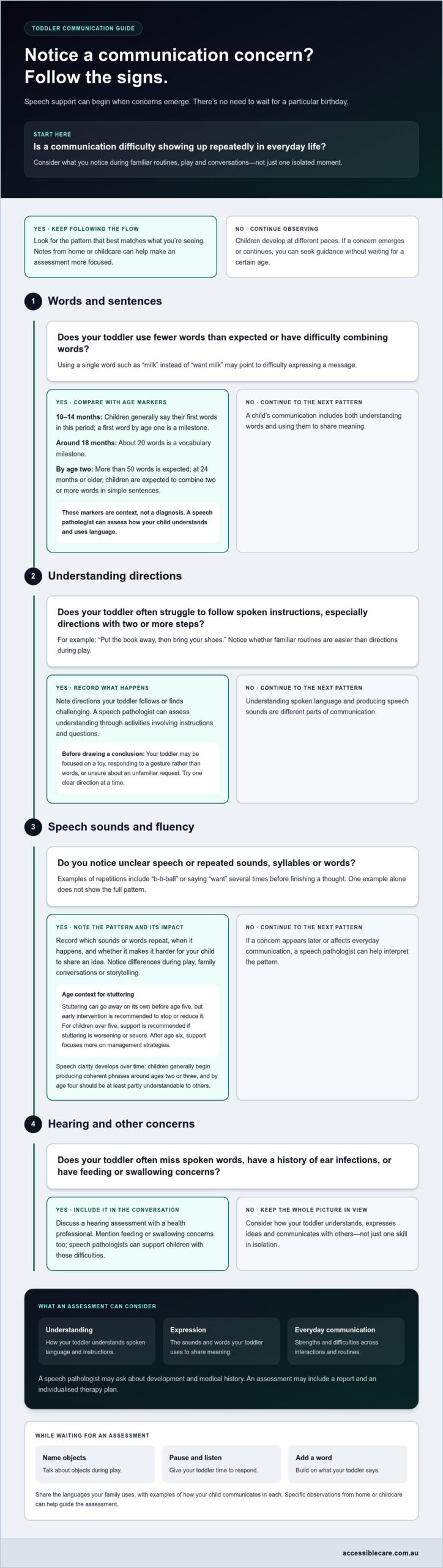
Speech therapy can begin when communication concerns emerge; there’s no need to wait for a particular birthday. Possible signs your toddler might need speech therapy include limited words, difficulty combining words, or trouble understanding everyday language. Children generally say first words between 10 and 14 months, and a first word by age one is a milestone. Around 18 months, about 20 words is a vocabulary milestone; by age two, toddlers should use more than 50 words.
Speech and language are connected but distinct. Speech is how a child produces sounds and words; language involves understanding and using words to share meaning. If you notice signs your toddler might need speech therapy, a speech pathologist can assess both areas. They may ask about your child’s development and medical history, listen to the sounds and words your toddler uses, and identify communication strengths and difficulties. The assessment may include a report outlining the findings and an individualised therapy plan.
Using only one-word sentences, such as “milk” instead of “want milk,” may point to expressive language difficulty. Trouble understanding spoken directions may involve receptive language. At 24 months or older, children are expected to combine two or more words in simple sentences. At 36 months, look at how your child communicates and forms phrases; a speech pathologist can help interpret concerns. These patterns can be signs your toddler might need speech therapy, especially when they affect everyday interactions.
Hearing concerns can affect communication. If your toddler often misses spoken words or has a history of ear infections, discuss a hearing assessment with a health professional. They can guide the next step for your child.
While waiting for an assessment, name objects during play, pause to give your toddler time to respond, and add a word to what they say. Share which languages your family uses, with examples of how your child communicates in each. A speech pathologist can consider this context during the assessment.
2. Difficulty understanding simple instructions
A toddler who often struggles with spoken directions may have difficulty understanding language. Notice whether they follow instructions with two or more steps, such as “put the book away, then bring your shoes”. If they manage familiar routines but find spoken directions difficult during play, note both examples. A speech pathologist can assess understanding through activities involving instructions and questions.
Consider what is happening before assuming your toddler hasn’t understood a direction. They may be focused on a toy, responding to a gesture rather than words, or unsure about an unfamiliar request. Try giving one clear direction at a time and notice how your toddler responds. Repeated difficulty following simple instructions across everyday situations can be one of the signs your toddler might need speech therapy.
Understanding language and producing speech sounds are different parts of communication. A child may understand “bring the ball” but have trouble saying “ball” clearly. Another may pronounce familiar words clearly yet struggle to follow spoken instructions. These patterns can be signs your toddler might need speech therapy, particularly if they make it harder to express needs or join in play.
Speech clarity develops over time. Children generally begin producing coherent phrases around ages two or three, and by age four they should be at least partly understandable to others. These milestones don’t specify which sounds every toddler should pronounce. A speech pathologist can assess your child’s speech and how it affects communication.
Keep brief notes about directions your toddler follows or finds challenging, along with examples of words that are hard to understand. Mention feeding or swallowing concerns too, as speech pathologists can support children with these difficulties. Specific observations from home or childcare can help make an assessment more focused on your child.
3. Stuttering and fluency disorders
Listen for repeated sounds, syllables or words when your toddler talks. For example, they may say “b-b-ball” or repeat “want” several times before finishing a thought. These patterns can be signs of stuttering, which affects the flow of speech. One example doesn’t show the full pattern, so notice whether repetitions occur across different conversations and situations.
Disfluency describes interruptions in speech, such as repeating a word or restarting a sentence. Stuttering involves repeated sounds, syllables or words, and may make it harder for a child to share an idea. Keep a brief record of what you hear, including the repeated words and the situations where it happens. These concrete examples can help a speech pathologist discuss your child’s communication and ability to express themselves.
Stuttering can go away on its own before a child turns five. But that possibility doesn’t mean families need to ignore concerns: early intervention is recommended to stop or reduce stuttering. A speech pathologist can listen to your child’s words and sounds, learn about their communication, and consider how the pattern affects everyday interactions. You can also note whether your toddler speaks differently during play, family conversations or storytelling.
For children over five, speech-language pathologist support is recommended if stuttering is worsening; support is also recommended for children with severe stutters. After age six, support focuses more on management strategies. These age markers can help families understand when to seek guidance, but the pattern itself matters too. Note when the stutter began, which repetitions you notice and whether your child has trouble communicating. Speech pathologists can also support swallowing difficulties, though these are separate from fluency concerns. Clear examples help keep the conversation focused on your child’s needs, not just a label.
4. Signs a child may benefit from speech pathology
Look beyond how many words your child says. Notice whether they use words to request, share attention, answer or take turns. A toddler who points but rarely uses words to communicate, or struggles to make their needs understood, may benefit from an assessment. Note examples from play, meals and family routines so a speech pathologist can see where the difficulty arises.
By age four, children should be at least partly understandable to others. If familiar people regularly struggle to understand your child, or your child avoids speaking because some words are hard to say, note the words and sounds involved. Children born with a cleft lip or palate can have difficulty making some sounds or speaking clearly, even after the condition has been corrected. A speech pathologist can assess the sounds your child uses and how they affect everyday communication.
Notice how your child responds during social exchanges, too. Not responding to their name can be associated with hearing or receptive language issues, as well as autism spectrum disorder. It doesn’t identify the cause on its own. Note when it happens, such as during play or in a quiet room, and share those observations during an assessment.
Some children speak in certain settings but not others. Selective mutism may involve not speaking in particular situations, using a low whisper, or relying on gestures and other non-verbal cues. If your child communicates differently at home, childcare or family visits, describe the situations rather than labelling the behaviour. If your child has had ear infections and your family has communication concerns, an assessment can also help.
Bring a short list of examples and your questions to a speech pathology assessment. If you’re ready to discuss communication concerns, explore speech therapy support as a next step.
Accessible Care: NDIS Support Services
Accessible Care offers NDIS support services and speech therapy for families seeking help with a child’s communication. If your toddler has difficulty expressing needs, understanding others or being understood, a speech pathologist can assess their strengths and communication needs, then shape support around them.
Families may also consider occupational therapy or positive behaviour support when these services relate to their child’s broader support needs. The next step depends on the concerns you’ve noticed and the goals that matter to your family. Sharing everyday examples, such as difficulty following instructions or using words, can help start a focused conversation about support.
To discuss support for your family, contact Accessible Care or visit accessiblecare.com.au.
Choose a supportive next step for your family
Recognising signs your toddler might need speech therapy isn’t about comparing them with other children. It’s about understanding what helps your child communicate, participate and feel heard in everyday life. Your observations and your toddler’s own ways of connecting can help shape a conversation around meaningful goals.
Take the next step at a pace that feels manageable. Think about what you’d most like your child to do, such as making a request, joining play or expressing a preference. Clear goals can help keep future support focused on your child and your family’s priorities.
Accessible Care offers NDIS Support Services, Speech Therapy and Occupational Therapy. If you’d like to explore support for your family, contact Accessible Care today. Each thoughtful step can help you better understand your child’s communication and support their growing confidence.
Frequently Asked Questions
At What Age Should Speech Therapy be Started for Your Toddler?
Speech therapy can start when communication concerns become noticeable; there’s no need to wait for a particular birthday. Children generally say their first words between 10 and 14 months, and by age two toddlers should use more than 50 words. These milestones offer context, while an assessment considers your child’s communication and development together.
When should a toddler combine words into short sentences?
Toddlers aged 24 months or older are expected to combine two or more words in simple sentences, such as “more juice” or “Daddy go”. Coherent phrases commonly begin around ages two or three. Notice whether your child combines words spontaneously during play and daily routines, rather than only repeating a phrase after someone else.
What is the difference between a speech delay and a language delay?
A speech difficulty affects how a child produces sounds or words, while a language difficulty affects how they understand or use words to communicate. For example, a toddler might understand “get your shoes” but be hard to understand when speaking. Another child might pronounce words clearly but struggle to understand questions or express an idea.
When should Australian parents seek a speech pathologist for a toddler?
Seek support from a speech pathologist when communication concerns persist or affect everyday interactions, such as asking for help, joining play or understanding familiar directions. Keep brief notes about what happens at home and childcare, including examples of words your toddler uses and understands. These details can help focus the conversation on your child’s strengths and support needs.
How can parents get a toddler’s speech assessed in Australia through a GP, child health nurse or speech pathologist?
Parents can discuss concerns with a GP or child health nurse, or contact a speech pathologist directly. In Australia, a child doesn’t need a GP referral to see a speech pathologist. Before an appointment, note your child’s communication across routines, the languages used at home, and any relevant developmental or medical history. This context can help guide the assessment.
How many words should a toddler say at 12, 18, 24 and 36 months?
By 12 months, a first word is a milestone; around 18 months, about 20 words; and by 24 months, more than 50 words. At 36 months, consider how your child communicates and forms phrases rather than a specific word-count milestone.

