


You choose who supports you: the NDIS says participants can choose their provider. The NDIS service booking process has also changed as PACE rolls out. In PACE plans, “my provider” records replace service bookings, but they do not reserve funding for a provider.
It’s understandable to want clarity before support begins, especially about who manages your funding and how a provider claims for their work. This article explains what service bookings did, how they related to consent and claims, and how they differ from service agreements. It also covers how funding management affects the process, what a plan manager does, and what to understand in an agreement before support starts. This can help you make informed choices while keeping your goals and control at the centre.
Key Takeaways
- You choose which provider to work with; understand how consent and funding arrangements shape a booking.
- Learn what changes when you move to a new provider and why cancellation terms matter.
- See how bookings related to claims, and how the process differs for PACE plans.
- Understand how a service booking differs from a service agreement before support begins.
Can a provider create an NDIS service booking without my consent?
A provider can’t choose itself on your behalf. According to the NDIS, participants choose which provider they work with. A proposed booking should reflect the support you want and the funding available for it. Ask the provider to explain what support the booking covers, its duration and how it relates to your plan before you agree to proceed.
If you’re changing providers, review your current service agreement before ending support. It should explain cancellation conditions, notice periods and how changes are managed. Give your current provider clear notice in line with the agreement, and ask for written confirmation of the date the arrangement ends. This helps clarify which provider can claim for support already delivered and when a new arrangement can begin.
Under the earlier system, service bookings applied to NDIA-managed funding. The NDIS is phasing them out as PACE rolls out, with “my provider” records used instead in PACE plans. These records do not reserve funding for a provider. If you have an older booking, discuss ending or changing it with the provider and confirm what happens to any remaining commitment. Your service agreement and funding-management arrangement help determine the practical steps.
Before agreeing to support, ask for the rates in writing and how travel is charged. Check that rates align with current NDIS pricing arrangements and applicable price limits. Your service agreement should also explain cancellation terms, responsibilities and how changes will be handled. For example, it can clarify the notice required and any applicable cancellation conditions if a visit is cancelled. If a rate, travel charge or cancellation term is unclear, ask for a plain-language explanation before deciding.
Ending a booking does not erase claims for support already provided. Keep a record of your notice and the provider’s response, including the date support ends. If a proposed booking does not reflect your choice, raise the concern and request a change. You can choose a different provider if the support is unsuitable or you have concerns about its quality. In situations where disputes arise over contracts or service expectations, engaging professional dispute resolution from Conflict Manager can assist families and organisations in reaching a fair outcome.
How bookings were created and checked when claiming
Under the earlier system, a service booking linked NDIA-managed funding to a registered provider and set aside funding for support. The booking details and claims therefore needed to match the support delivered. PACE is changing this arrangement.
Provider Consent for Bookings
A service booking connected funding with a provider selected by the participant for a particular support. The NDIS says participants choose their providers, so a booking should reflect that choice, not a provider’s independent decision. This mattered because the booking associated a provider’s support with the funding. Before support began, the participant and provider needed a shared understanding of the support and arrangement. A plan manager did not choose the provider or approve supports on the NDIA’s behalf.
Creating and Synchronising Bookings
In the earlier process, the booking set aside funding for an NDIS-registered provider’s planned support. Its details needed to correspond with the support being claimed, so changes to the arrangement could affect the funding recorded against it. The NDIA began rolling out its PACE computer system in late October 2023. PACE plans use “my provider” records instead of service bookings, and those records don’t reserve a participant’s funds. This shift changes how providers are recorded, rather than giving them control over a participant’s funding.
Booking Approval and Activation Time
There isn’t one approval or activation timeframe that applies to every booking. A booking being recorded and a claim being paid are separate points in the process. Claims from providers recorded as a participant’s “my providers” are generally paid within 2 to 3 business days. For NDIS supports delivered from 1 December 2026, claims must be made within 90 days after the support. Older NDIA guidance advised providers to claim within 90 days of a service booking ending. These are claim timeframes, not booking approval times.
For help understanding how NDIS supports relate to your plan, explore NDIS Support Services.
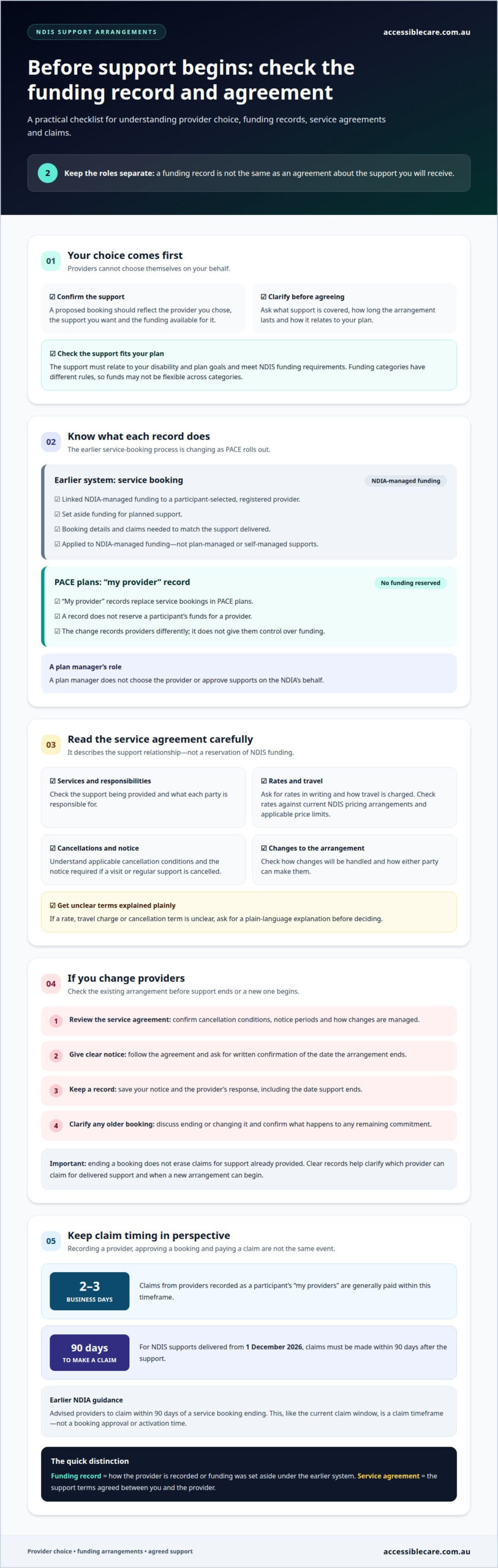
Service bookings compared with service agreements
An NDIS service booking and a service agreement have different purposes: one relates to funding, while the other records agreed support arrangements. Participants choose their provider and agree on the support before considering how to manage the funding.
Booking and Agreement Differences
A service booking was an administrative record that set aside NDIA-managed funding for a registered provider’s support. A service agreement records the support and working arrangement agreed between a participant and provider. The distinction matters because a booking alone does not explain what support the participant expects or how it will be delivered. The agreement can set out services, rates, cancellation terms, responsibilities and how changes will be managed.
Choosing Providers and Agreeing on Services
The NDIS says participants choose which provider they work with. Before agreeing on support, discuss what you need and the terms with the provider. The support must relate to your disability and plan goals, and meet NDIS funding requirements. Funding categories have different rules, so funds may not be flexible across categories.
Ask the provider to explain the support in plain language and give you the rates in writing. The agreement can clarify travel charges, cancellation conditions, notice periods and how either party can make changes. For example, if you need to stop regular support, the agreement should explain the notice required and any applicable cancellation terms. These details help you understand your commitments before services start.
Funding management also affects the arrangement. Older service bookings applied only to NDIA-managed funding, not plan-managed or self-managed supports. In PACE plans, “my provider” records replace service bookings and do not reserve funding for a provider. A service agreement remains useful for describing the support relationship, but it does not set aside NDIS funds. Keep these roles distinct when discussing a new provider or changing services.
What NDIS service bookings are and how they work
An NDIS service booking was a record linking funding to a registered provider and agreed support. Under the earlier system, it set aside funding for that provider. Understanding the NDIS service booking process starts with recognising that a booking did not replace the participant’s choice or explain every detail of how support would be delivered.
Bookings applied only to NDIA-managed funding, not plan-managed or self-managed supports. The NDIS says participants choose their provider. For plan-managed supports, participants can generally use registered or unregistered providers when the support meets NDIS requirements and can be paid from the relevant funding. For example, individuals and teams exploring specialised guidance might look into Neuro-Sparks training solutions for tailored neurodiversity support and training.
Funding rules also shaped what a booking could cover. The NDIS is designed to fund reasonable and necessary supports related to a participant’s disability and plan goals. Plans may include stated supports, meaning funding amounts intended for a particular purpose. Core, Capacity Building and Capital supports have different rules, and funding is not always flexible between categories.
The NDIA lists 21 support categories across four budgets. That structure matters because a support’s category affects which funding may be used. If you’re unsure whether a proposed support can be claimed, clarify its funding before services begin. For plan-managed supports, providers usually invoice the plan manager directly. The plan manager doesn’t choose the provider or approve supports for the NDIA.
PACE changes the recordkeeping model. The NDIA began rolling out its PACE computer system in late October 2023. PACE plans use “my provider” records instead of service bookings. These records identify a provider but don’t reserve the participant’s funds. The key distinction in the NDIS service booking process is that a provider record isn’t proof that a support is funded or that budget has been set aside.
For support that fits your plan and goals, talk through your NDIS support needs.
Accessible Care: NDIS Support Services
Accessible Care can help you explore NDIS Support Services for disability support connected to your goals and plan. Clear discussions about the support, funding and service agreement can help you understand the arrangement before services begin.
Depending on your needs, support may include Speech Therapy, Occupational Therapy or Positive Behaviour Support. Each service addresses different needs, so start with the support that reflects what matters to you. Discuss your goals and the help you’re looking for, then consider how it fits your NDIS plan.
If you’re ready to talk through your support needs or have questions about getting started, contact Accessible Care.
Make your next support decision with confidence
Understanding the NDIS service booking process can help you move from plan details to a support arrangement that reflects your priorities. Before taking the next step, consider what you want support to make possible in daily life. This gives you a clearer starting point for discussing the type of support you need and how it fits your goals.
Accessible Care offers NDIS Support Services, including Speech Therapy and Occupational Therapy. These supports may suit you if you’re looking for assistance that aligns with your needs and plan. Discuss what matters to you and explore a suitable next step while keeping your choice and control in view.
If you’d like to talk about your support needs, contact Accessible Care. Every support journey starts with your goals, and you can take the next step at your own pace.
Frequently Asked Questions
Do I need an NDIS service booking if I am plan-managed or self-managed?
No. Under the earlier arrangement, service bookings applied to NDIA-managed funding, not plan-managed or self-managed supports. For plan-managed supports, providers usually invoice the plan manager directly. If you’re self-managed, a booking is not the way to set aside funds. Your plan’s funding arrangements determine how supports are paid, so consider the relevant budget before starting new support.
What are the components of a Service Booking Record?
A Service Booking Record linked a participant’s NDIA-managed funding with a registered provider and the support they planned to deliver. Its key details connected the provider, support and funding allocation. It was not the same as a service agreement, which explains practical terms such as rates and cancellations. Treat the record as a funding arrangement, not a complete description of the provider relationship.
What happens to remaining funds when an NDIS service booking ends?
Funding not used for support is not paid to a former provider just because a booking ends. Under the older system, a booking set aside funding for that provider’s support; ending it removes that booking arrangement. Your plan’s funding remains subject to its budget and category rules. For example, funds in one support category may not be available for another category.
What is an NDIS service booking and when is one needed?
An NDIS service booking was a record that set aside funding for a registered NDIS provider to deliver agreed support. Under the earlier system, it applied to NDIA-managed funding, not plan-managed or self-managed supports. The NDIA is phasing bookings out as PACE rolls out. In a PACE plan, a “my provider” record replaces the booking but does not reserve funding.
How do participants create an NDIS service booking in the myplace portal?
The myplace portal relates to the earlier service-booking arrangement, which applied to NDIA-managed funding. The NDIS is phasing out bookings as PACE rolls out, so the process depends on which system your plan uses. PACE plans use “my provider” records instead. Before relying on a portal record, identify whether your plan uses the earlier booking model or PACE, as the record’s function differs.
What information is required to set up an NDIS service booking?
The booking needed to connect the participant’s funding with the registered provider and the support delivered. The support also had to fit the participant’s NDIS funding arrangements. For a clear service arrangement, discuss the support, rates, cancellation terms, responsibilities and how changes will be handled. For example, agree how travel charges work before regular visits begin, then record the practical terms in the service agreement.

