


Your voice doesn’t have to fit a single gender template. Speech therapy for transgender voice training is a non-surgical, individualised approach that can help you explore vocal qualities in line with your gender identity and personal goals. It can address more than pitch, including resonance, intonation, volume and vocal comfort.
It’s understandable to want your voice to feel more like your own and to wonder what therapy involves. A speech-language pathologist listens to what matters to you, assesses how you currently use your voice and works with you on goals that feel comfortable and meaningful.
This article explains how gender-affirming voice therapy works, the role of a speech-language pathologist and the vocal features a plan may address. You’ll also learn how your goals and everyday communication needs can shape therapy, helping you consider what professional support could look like.
Key Takeaways
- Gender-affirming voice therapy is a non-surgical way to explore vocal changes that feel aligned with your identity and preferences.
- A personalised plan can address more than pitch, including resonance, inflection, articulation and vocal comfort.
- A speech-language pathologist can assess how you use your voice and support you in working towards your communication goals.
- Your priorities across everyday settings help shape therapy, so the focus can stay on the voice and communication that matter to you.
What Is Gender Affirming Voice Therapy?
Gender-affirming voice therapy is non-surgical support for exploring vocal qualities that better reflect a person’s identity and preferences. A speech pathologist can work on voice and communication goals, including how speaking feels in everyday situations.
Exercises, Breath Control, and Voice Health
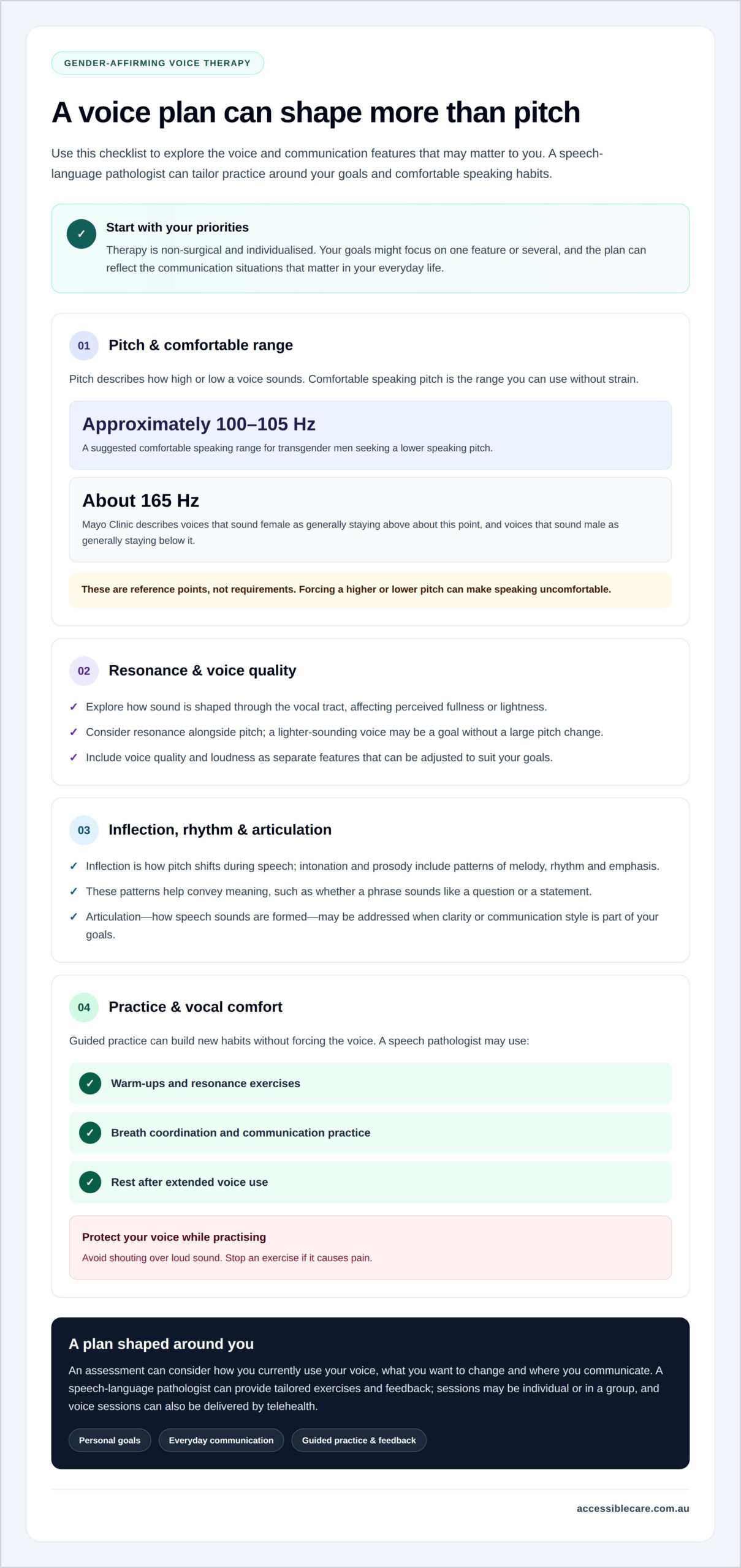
Vocal exercises and breath control help you practise voice changes while supporting comfortable, sustainable speaking. A speech pathologist may use warm-ups, resonance exercises and breath coordination to develop new habits without forcing the voice. Rest matters too: pause after extended use, avoid shouting over loud sound and stop an exercise if it causes pain. These steps help protect vocal health as you practise.
In Australia, the cost depends on the assessment, session format and funding pathway; a case-specific price is provided after a quote request. Access to a speech pathologist with gender-affirming voice experience can depend on local service arrangements, while the assessment should centre your voice and communication goals. Telehealth can also be used for voice sessions, allowing a pathologist to listen and provide feedback remotely.
Therapy, Surgery, and Self-Guided Training
Speech therapy uses guided practice and feedback; surgery changes physical aspects of the voice, while self-guided training does not provide a clinician’s direct feedback. Therapy can address pitch, resonance, inflection and vocal comfort together. By contrast, Mayo Clinic describes voice surgery as mainly changing pitch and reports that feminising surgery can reduce low-pitched voice ability and loudness. Some voice feminisation surgery results are permanent, so the options have different implications.
Access to therapy can vary by state or territory, service setting and funding arrangements, but therapy goals are personal rather than determined by location. An assessment can identify which communication features matter most and shape professional support around your priorities. This helps distinguish a goal such as lighter resonance from one focused on pitch or vocal expression.
Resonance, pitch, inflection and articulation
Gender-affirming voice work can explore several aspects of speaking, not just pitch. Together, these features can shape how a voice is heard and how it feels to use.
Pitch and Comfortable Speaking Range
Pitch is how high or low a voice sounds, while comfortable speaking pitch is a range a person can use without strain. The distinction matters because forcing a lower or higher pitch can make speaking uncomfortable. For transgender men seeking a lower speaking pitch, a comfortable range of approximately 100 to 105 Hz is suggested rather than straining lower. Mayo Clinic describes voices that sound female as generally staying above about 165 Hz, and voices that sound male as generally staying below 165 Hz. These are reference points, not requirements for personal expression.
Resonance and Voice Quality
Resonance describes how sound is shaped as it travels through the vocal tract, affecting a voice’s perceived fullness or lightness. A pathologist may help you explore resonance alongside pitch, as these features can influence gender perception together. For example, you may prefer a lighter-sounding voice without aiming for a large pitch change. Voice quality and loudness also affect how communication comes across, so therapy can consider them as separate, adjustable features.
Inflection, Intonation, and Prosody
Inflection is how pitch shifts during speech; intonation and prosody describe broader patterns of melody, rhythm and emphasis. These patterns help communicate meaning, such as whether a phrase sounds like a question or a statement. Therapy can explore how they align with your gender identity and preferred expression. Articulation, or how speech sounds are formed, may also be addressed when clarity or a particular communication style is part of your goals.
Hormone effects on voice depend on the hormones used and individual factors, including when treatment begins relative to natal puberty. A speech pathologist can consider the voice’s current qualities and desired changes together, rather than treating one pitch target as the whole goal. If you’re considering professional speech therapy support, a conversation about your priorities can help identify which voice and communication aspects matter most.
Speech-language pathologists’ roles in gender-affirming voice care
A speech-language pathologist supports voice and communication goals through assessment, tailored exercises and feedback. Support can include spoken and non-verbal communication, depending on what you want to address.
Goals and Types of Voice Care
Gender-affirming voice care supports you to explore communication that feels more aligned with your gender and preferences. You may want to work on one feature, such as loudness, or several features together. Sessions may be individual or in a group. A pathologist can use interview information and listening to identify relevant areas, rather than assuming everyone wants the same changes.
Therapy may include voice exercises and communication practice, with goals shaped around everyday situations. For example, you may want to feel more at ease speaking at work, while someone else may prioritise social conversation. A pathologist may also discuss articulation, speech rate and word choice. The focus is on helping you communicate in ways that feel comfortable and self-directed.
Voice and Gender Perception
Listeners may perceive gender through a combination of voice and communication features, not pitch alone. Loudness, voice quality, articulation, speech rate and word choice can all contribute. Formant frequencies, which relate to resonance, can influence perception alongside fundamental frequency, the rate of vocal fold vibration. This helps explain why a single pitch target cannot represent everyone’s affirming voice goals.
Communication also includes non-verbal expression. A pathologist may explore gestures, facial expression, posture and eye contact when they relate to your goals. For example, you may want feedback on how posture affects your comfort while speaking. The aim isn’t to prescribe one correct way to communicate, but to support choices that reflect your identity.
Intake forms and interviews can establish the name and pronouns you use, along with your priorities across home, school, work and social settings. This context helps the pathologist plan affirming voice therapy and select relevant exercises. The eighth version of the Standards of Care for the Health of Transgender and Gender Diverse People identifies areas where speech-language pathologists with relevant expertise may work, including voice, communication and non-verbal expression.
Individualised voice goals and therapy plans
An individualised plan starts with an assessment of your current voice, communication needs and preferred outcomes. The pathologist asks how you like to use your voice and where you want changes, such as at home, work, school or social events. This makes the plan relevant to your daily life, rather than based on a single idea of how a gender-diverse person should sound.
You can describe goals in practical terms: speaking comfortably in meetings, exploring a different vocal quality or feeling more at ease on the phone. The pathologist considers these priorities alongside your current speaking patterns and vocal health. Goals can be specific and change over time. For example, you might begin with comfort during conversation, then focus on expression in group settings. Your preferences guide which communication features receive attention.
Hormone therapy can inform the assessment. Masculinising hormone therapy may help some transgender men and others develop a deeper voice, while feminising hormone therapy with anti-androgens and oestrogen does not change the voice. Hormone effects vary with treatment and individual factors, including when treatment begins relative to natal puberty. Sharing relevant treatment context helps the pathologist understand your voice goals, not define them for you.
The therapy plan can be reviewed as your needs evolve. A pathologist may use feedback on voice tasks or everyday communication to discuss what feels comfortable and what needs adjustment. For instance, a goal that works in a quiet appointment may feel different during a busy workday. Tracking these situations connects session activities with practical communication while keeping progress aligned with your priorities.
You don’t need to arrive with a technical description of your voice. Examples of situations that feel affirming, uncomfortable or tiring can help the pathologist understand what matters. A patient, client or support person can contribute context where appropriate, while the individual remains central to decisions. To discuss goals for speech therapy support, share the communication changes you want to explore and the situations where they matter most.
Accessible Care: Speech Therapy
Accessible Care offers Speech Therapy for people seeking support with communication and personal voice goals. If you’re considering professional guidance to explore vocal changes, speech therapy offers space to discuss what matters to you and how communication feels in everyday situations.
You can share the voice qualities you want to explore, such as resonance, pitch or speaking comfort, and the settings where they matter most. This gives therapy a person-centred starting point. If you also receive NDIS Support Services, your broader support needs may be relevant to planning your care.
When you’re ready to discuss speech therapy and your voice goals, contact Accessible Care.
Take the Next Step Towards Your Voice Goals
Your voice goals can be a starting point, not a fixed destination. As your needs or circumstances change, revisit what feels comfortable and meaningful, then shape support around the communication you want in daily life. Speech therapy for transgender voice training can offer a professional space to explore those goals at your own pace.
Accessible Care offers Speech Therapy, alongside NDIS Support Services and Occupational Therapy. If you’re ready to talk about the voice and communication goals that matter to you, contact Accessible Care. You can begin by sharing what you hope to explore and which everyday situations you’d like support with. Your priorities can guide the conversation and help set a clear direction for next steps.
There’s no single way a voice needs to sound. Your goals are yours to define, and you can take the next step when you feel ready.
Frequently Asked Questions
What does transgender voice training with a speech pathologist involve?
Therapy involves an assessment, a discussion of your communication priorities and guided practice tailored to your goals. In speech therapy for transgender voice training, a pathologist may listen to connected speech, such as a phone conversation or workplace introduction, and offer feedback on the features you want to explore. Sessions can also help identify which situations feel comfortable and where communication still feels effortful.
What qualifications and experience should I look for in an Australian voice therapist?
Look for an Australian speech pathologist with specific experience in gender-affirming voice and communication care. Their practice should respect your name, pronouns and self-defined goals, rather than assume one particular voice is the right outcome. You can ask how they assess communication needs, adapt sessions to different goals and respond if exercises cause discomfort. Relevant experience matters because the work involves more than changing pitch.
Does Medicare, private health insurance, or the NDIS cover gender-affirming voice therapy in Australia?
Coverage isn’t automatic, and Medicare, private health insurance and NDIS funding follow different eligibility and funding pathways. Whether support can be claimed depends on your circumstances, the purpose of therapy and the relevant plan or policy terms. If you’re an NDIS participant, consider whether the support relates to your approved goals and funding. Don’t assume one funding source will cover every session or therapy purpose.
What are the steps and typical timeline for voice feminisation or masculinisation therapy?
Therapy commonly starts with an assessment and discussion of the changes you want, followed by a personalised plan, guided sessions and progress reviews. The timeline varies with your goals, starting voice patterns, practice between appointments and how comfortably techniques fit into daily communication. For example, working on one feature may follow a different path from combining several features across work and social settings.
What exercises and techniques are used in gender-affirming voice therapy?
A pathologist may use direct pitch work, resonance practice, vowel modification, formant shifting and semi-occluded vocal tract exercises. The techniques selected depend on your goals and how your voice responds during practice. For instance, you may work on resonance to explore a fuller sound, or focus on intonation or clearer articulation. The clinician guides the exercises and adjusts them based on your feedback.
What are the risks of vocal strain or injury, and how can voice training be done safely?
Overworking or forcing your voice can cause discomfort and fatigue. A safer approach includes professional guidance, warming up before practice, taking voice breaks after extended use and avoiding shouting or talking over loud noise. Stop if an exercise hurts rather than pushing through it. A pathologist can help adjust techniques and address tension in areas such as the jaw, tongue, shoulders, neck or laryngeal area.

