


What if your daily support felt less like a checklist of chores and more like a partnership built on genuine mutual regard? It’s deeply frustrating to feel like a task to be completed rather than a person with unique goals and preferences. You might be struggling with inconsistent support workers or feeling overwhelmed by the complexity of NDIS funding categories in 2026. We understand that your home is your sanctuary, and the people who enter it should treat it with the honor and respect you deserve.
Finding the right compassionate in-home care adelaide doesn’t have to be a source of stress. This guide is designed to help you navigate your options with confidence and peace of mind. We’ll show you how person-centred support can empower your independence, ensuring you remain the director of your own life while receiving the high-quality assistance you need to thrive and remain safe at home.
By the end of this article, you’ll understand how to seamlessly integrate daily support with vital services like occupational therapy and speech pathology. We’ll also break down the latest NDIS updates to ensure your funding works effectively for your specific needs, helping you achieve a life of comfort, connection, and self-determination.
Key Takeaways
- Learn how compassionate in-home care adelaide combines professional expertise with heart-centered empathy to respect your autonomy.
- Understand the distinctions between NDIS funding and the Support at Home program to choose the most effective path for your situation.
- Discover how a multidisciplinary team of therapists and support workers can work together to help you achieve your personal goals.
- Find out how to verify provider credentials and identify specific gaps in your current support for better quality outcomes.
- Explore the “autonomy-first” model that prioritizes your voice and choices in every aspect of your daily care.
What Does Compassionate In-Home Care Mean in Adelaide?
Compassionate care is often misunderstood as simply being “nice” while performing daily duties. In reality, compassionate in-home care adelaide is a sophisticated blend of clinical expertise and genuine human empathy. It’s about recognizing that every person has a history, a voice, and a vision for their future. Many families in South Australia are moving away from traditional, rigid service models. They’re seeking support that prioritizes the person over the process. This shift isn’t just a trend; it’s a necessary evolution in how we honor the lives of those living with disability.
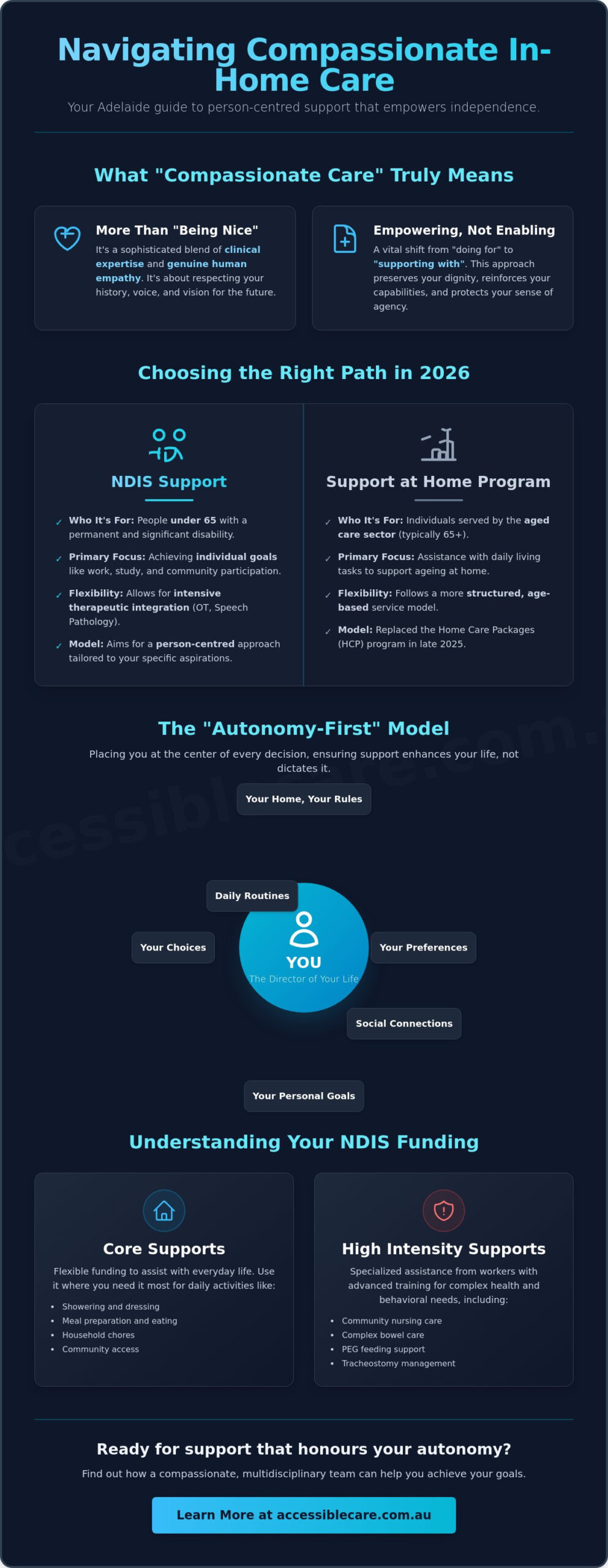
Active listening sits at the heart of this approach. It’s the difference between a caregiver who walks in with a preset agenda and one who asks, “How can I best support you today?” Within the framework of the National Disability Insurance Scheme (NDIS), this dialogue ensures that care remains dynamic and responsive. There is also a vital distinction between “doing for” and “supporting with.” When a caregiver does everything for a client, they unintentionally strip away that person’s sense of agency. By supporting someone to complete tasks themselves, we preserve their dignity and reinforce their capabilities.
The Human Element: Beyond the Service Agreement
A service agreement is just a piece of paper. The real magic happens when a support worker and a client truly “click.” We believe in matching team members based on shared interests, temperaments, and values. If you’re a lifelong footy fan or a classical music enthusiast, having someone who shares those passions makes every visit more meaningful. Trust is the foundation of long-term disability support. When a client feels emotionally safe, they’re more likely to engage with their therapeutic goals. This sense of security often accelerates progress in areas like speech or mobility, as the stress of “being managed” melts away.
Autonomy and Self-Determination at Home
Your home is the one place where you should always feel in control. In-home care is designed to protect that right. Unlike institutional settings, receiving support in a familiar environment allows you to maintain your routines and social connections. This familiarity is directly linked to better mental well-being and lower anxiety levels. Autonomy is the cornerstone of modern NDIS support, ensuring that every individual remains the primary author of their own life story. By focusing on self-direction, compassionate in-home care adelaide helps you live a life that is not just supported, but truly your own.
NDIS Support vs. Aged Care: Choosing the Right Path in 2026
Many people believe that professional help at home is exclusively for the elderly. This misconception can prevent younger individuals and families from accessing the life-changing benefits of compassionate in-home care adelaide. While the Support at Home program (which replaced Home Care Packages in late 2025) serves those in the aged care sector, the NDIS is specifically designed for people under 65 living with permanent and significant disabilities. According to the official NDIS website, the scheme focuses on providing the support needed to achieve individual goals and participate in the community.
NDIS funding often allows for a more intensive level of therapeutic integration than standard aged care models. Compassionate care looks different depending on the person’s stage of life. For a young child, it involves nurturing development through play and communication. For an adult, it focuses on protecting their right to work, study, and socialise. By choosing compassionate in-home care adelaide, you ensure that the support matches the person’s age and aspirations rather than a generic age-based template.
Understanding NDIS Funding for In-Home Care
Under the “Core Supports” category, your plan can cover help with daily activities like showering, dressing, or meal preparation. This funding is flexible, allowing you to use it where it’s needed most. For those with more complex medical or behavioral requirements, high intensity supports ndis provide specialized assistance from workers with advanced training. This ensures that even the most intricate needs, such as community nursing or complex bowel care, are met with professionalism and heart. It’s about building a team that understands your unique health profile.
When to Transition to Professional In-Home Support
Family caregivers often carry a heavy burden. It’s okay to ask for help. Signs that you might need professional backing include persistent fatigue, feeling overwhelmed by medical tasks, or a lack of time for your own well-being. An occupational therapy assessment is a great starting point for this transition. An OT can review your home environment to suggest modifications that improve safety and ease the physical strain on everyone involved. Professional support work doesn’t replace family love; it provides the foundation that allows family relationships to flourish without the stress of constant “care fatigue.”
If you’re feeling unsure about your funding options or how to start, you can explore our support services to see how we can help you find the right balance for your home.
The Pillars of Integrated Disability Support
Support is most effective when it isn’t fragmented. When therapy goals and daily care exist in separate silos, progress often stalls. The most effective compassionate in-home care adelaide operates as a unified team, where every person involved in your care is moving in the same direction. This holistic approach ensures that the exercises you do with your therapist don’t end when the session is over. Instead, they’re woven into the fabric of your daily life by support workers who understand your long-term objectives.
Consistency is the heartbeat of a successful support plan. It’s difficult to build trust or maintain a routine when you’re constantly meeting new faces. Reliable scheduling allows you to feel secure in your own home, knowing exactly who is coming and when. This stability is a core part of the NDIS home and living supports framework. It prioritizes your comfort and ensures that compassionate in-home care adelaide remains both professional and deeply personal. When your team is consistent, they notice the small changes that others might miss, allowing for early intervention and better health outcomes.
Therapeutic Support Work
Support workers are the hands and feet of your therapeutic team. While an Occupational Therapist might prescribe a specific routine to improve your mobility, it’s your daily carer who helps you practice those movements safely during your morning routine. This same integration applies to communication. If you’re working with speech pathology, your support worker can encourage the use of communication aids or swallowing techniques during meal times. They’re not just providing assistance; they’re active partners in your skill-building journey. This collaborative model also extends to positive behaviour support, where carers use gentle, proven strategies to help manage stress and promote a calm home environment.
Clinical Care and Community Nursing
For individuals with complex medical requirements, community nursing provides a vital safety net. Managing health needs like wound care, medication administration, or catheter management requires a high level of clinical expertise. Our nurses provide this care with the utmost dignity and privacy, ensuring you feel respected in your most vulnerable moments. This professional oversight is often the key to preventing unnecessary hospital readmissions. It’s especially critical for those recovering from an acquired brain injury, where medical stability and cognitive support must go hand-in-hand. By combining clinical precision with a nurturing touch, we help you manage complex health conditions without losing the comfort of your own home.
Steps to Finding Quality Care in Adelaide
Finding the right provider is a deeply personal journey. It’s not just about ticking boxes on a service list; it’s about finding people who truly see you. Start by looking at your daily life and identifying where the gaps currently exist. Do you need more help with morning routines, or are you looking for someone to help you engage more with your local community? Once you’ve defined your goals, ensure any potential provider is registered with the NDIS Quality and Safeguards Commission. This registration is your assurance that the organization meets strict national standards for safety and quality. It provides a level of protection and accountability that is vital when inviting someone into your home.
Transparency is the bedrock of a healthy partnership. When you review a service agreement, look for clear language regarding fees and cancellation policies. You should never feel confused about how your funding is being used. We also recommend requesting a meet-and-greet before any services begin. This isn’t a formal interview; it’s a chance to see if there’s a genuine personality match. You deserve to feel comfortable and respected in your own sanctuary. Choosing compassionate in-home care adelaide means finding a team that honors your space and your story.
Navigating the Adelaide NDIS Landscape
Adelaide has a unique community feel, from the bustling northern suburbs to the quiet coastal areas in the south. Local knowledge is incredibly valuable for social support and community access. A provider who understands the layout of our city can better help you find local cafes, parks, or community groups that align with your interests. Whether you’re located in the eastern suburbs or the western beachside areas, your support should feel connected to your neighborhood. Working with a local support coordinator can help you bridge the gap between your NDIS plan and the compassionate in-home care adelaide that best fits your lifestyle.
Questions to Ask Potential Providers
Don’t hesitate to ask the tough questions. You’re the director of your care, and a good provider will welcome your curiosity. You might start by asking how they handle staff consistency, as having a familiar face is often the key to building trust. If you have complex medical needs, ask about their experience with clinical care. For instance, what is your specific approach to ndis high intensity supports? You should also confirm if they’re willing to collaborate with your existing therapists. A truly integrated plan means your support workers and your OTs or speech pathologists are all on the same page.
If you’re ready to find a team that prioritizes your autonomy and well-being, you can reach out to our compassionate team to start a conversation about your needs today.
Why Adelaide Families Choose Accessible Care
Accessible Care isn’t just a service provider; we’re a dedicated partner in your journey toward a more independent life. Our approach to compassionate in-home care adelaide is built on the belief that you are the expert in your own life. We follow an “autonomy-first” model, ensuring that every decision, from meal times to community outings, is led by your preferences. This commitment to self-determination is what sets us apart in the South Australian community. We don’t just provide care; we facilitate the life you choose to lead.
We understand that navigating the ndis can feel complex and sometimes overwhelming. That’s why we’ve assembled a multidisciplinary team that includes Speech Language Pathologists (SLPs), Occupational Therapists (OTs), and Community Nurses. This integration allows us to offer a seamless experience where clinical expertise meets daily support work. You don’t have to manage multiple agencies or explain your story over and over. Instead, you have a unified team focused on your empowerment and the achievement of your specific, individual objectives.
A Partner in Your Independence
Families across Adelaide often tell us that our “attentive listening” promise makes all the difference. We don’t just hear your requests; we listen to the aspirations behind them. This empathetic approach is why so many veterans and NDIS participants in South Australia trust us to enter their homes. Whether we’re supporting someone with a new disability or assisting a long-term participant, our goal remains the same: to provide comfort, peace of mind, and a higher quality of life. We believe that by honoring your voice, we help you build the confidence to lead your own way. We’re here to listen, to learn, and to support.
Get Started with a Reassuring Conversation
Taking the first step toward professional support should feel like a relief, not a burden. We begin every partnership with a reassuring conversation to understand your needs and desires. Our process is designed to be calm, methodical, and entirely focused on you. Here is what you can expect when you reach out to our Adelaide-based team:
- Book a Holistic Assessment: We’ll sit down with you to review your NDIS plan and identify the best support mix for your lifestyle.
- First Home Visit: We’ll visit you in your own environment to ensure we match you with support staff who fit your personality and interests.
- A Tailored Plan: We create a customized support schedule that integrates your therapy goals with your daily routines.
If you’re ready to explore how compassionate in-home care adelaide can empower your future, our local team is here to help. We invite you to contact us for a no-pressure discussion about your goals and how we can help you achieve them with dignity and respect.
Empowering Your Future at Home
Choosing a support partner is about more than just managing daily tasks; it’s about reclaiming your time and energy to focus on what matters most to you. We’ve explored how the right support model prioritizes your autonomy while ensuring your clinical needs are met with precision. By integrating therapy goals from OTs and SLPs directly into your daily routine, you can achieve progress that feels natural and sustainable. It’s about building a life that reflects your choices and aspirations in a place where you feel most secure.
Accessible Care is a Registered NDIS Provider with a dedicated, multidisciplinary team of SLPs and OTs ready to support your unique journey. With local teams based in Adelaide and Melbourne, we’re here to help you navigate the 2026 NDIS landscape with confidence and peace of mind. If you’re ready to experience compassionate in-home care adelaide that honors your voice and your sanctuary, we’re ready to listen. You can Book a Compassionate In-Home Care Consultation in Adelaide to begin your journey toward a more empowered and independent life.
You don’t have to navigate this path alone. We’re here to provide the steady, nurturing support you deserve as you reach for your goals and embrace your future.
Frequently Asked Questions
What is the difference between home care and in-home support under the NDIS?
The primary difference lies in the funding source and the specific focus of the care. Home care often refers to services provided through the aged care system for seniors. In-home support under the NDIS is specifically for people with permanent and significant disabilities. This model focuses on building independence and achieving personal goals rather than just providing basic maintenance or domestic assistance.
How much does in-home care in Adelaide cost per hour in 2026?
Hourly rates for support services are governed by the NDIS Support Catalogue, which is usually updated every July. For 2026, standard weekday rates for one-to-one support fall within the price limits set by the NDIA. These rates vary for evenings, weekends, and public holidays. It’s best to check the most recent NDIS price guide for the exact figures that apply to your specific support categories.
Can I choose my own support workers with Accessible Care?
Yes, you have full control over who provides your support and enters your private sanctuary. We believe that a strong personality match is essential for building trust and emotional safety. We encourage meet-and-greets so you can ensure your compassionate in-home care adelaide is delivered by someone you truly connect with. This autonomy ensures that your support feels like a genuine partnership.
Does NDIS cover community nursing for high-intensity needs?
Yes, the NDIS funds community nursing for participants who have complex health requirements that need professional clinical oversight. This can include tasks like complex wound management, medication administration, or respiratory support. These services are designed to manage your health safely at home. By providing high-quality clinical care, community nursing helps prevent unnecessary hospital visits and maintains your overall well-being in a familiar environment.
How do I change my NDIS provider to Accessible Care in Adelaide?
Changing providers is a simple process that begins with checking the notice period in your current service agreement. Once you’ve informed your current provider of your intent to leave, you can contact our team to begin your transition. We’ll help you set up a new agreement and ensure there are no gaps in your care. Our goal is to make the move feel easy and stress-free.
What qualifications do your in-home support workers hold?
Our support workers hold relevant industry qualifications, such as a Certificate III or IV in Individual Support or Disability. Every team member must also pass the mandatory NDIS Worker Screening Check and hold current First Aid and CPR certifications. For complex cases, we provide additional specialized training. We select staff who demonstrate both professional competence and a deeply nurturing, empathetic personality to ensure high standards of delivery.
Can in-home care help someone with an acquired brain injury (ABI)?
Yes, in-home support is vital for individuals with an acquired brain injury, focusing on cognitive rehabilitation and daily routines. Compassionate in-home care adelaide provides a stable, low-stress environment that is ideal for practicing skills prescribed by therapists. Our workers can assist with memory aids, social participation, and physical exercises. This consistent support helps participants regain their independence and improve their quality of life after an injury.
Is in-home therapy (OT/Speech) available in all Adelaide suburbs?
Yes, our multidisciplinary team of therapists travels to homes across all Adelaide suburbs, including the North, South, East, and West. We believe that therapy is most effective when it happens in the environment where you actually live and use your skills. Whether you need occupational therapy to modify your home or speech pathology for communication support, our professionals come to you to ensure your care is accessible.

