


What if a community nursing continence assessment could start with a conversation, not an examination? Talking about bladder or bowel concerns can feel private, and it’s natural to want to know what may happen before you begin. An assessment may explore symptoms, health history, daily routines and goals. A physical examination isn’t always needed, and you can discuss your preferences and privacy with the health professional involved.
This guide explains what questions and observations may be part of an assessment, how preparation can help, and what to ask when comparing community nursing support. You’ll also find prompts for discussing NDIS funding, nursing scope and possible next steps. Accessible Care is a registered NDIS provider offering community nursing in clients’ homes in Melbourne and Adelaide. Contact the team to ask whether continence assessments are available, what the nursing service can cover and whether it operates in your location. The right support should connect clinical needs with your priorities, dignity and everyday life.
Key Takeaways
- A community nursing continence assessment can be shaped around your concerns, health history and goals, with the scope guided by your needs and consent.
- Questions about privacy, communication preferences and appointment steps can help you feel more prepared and in control.
- Compare support options by checking clinical scope, relevant nursing experience, location, appointment format and follow-up arrangements.
- Agreed recommendations may help shape respectful everyday support that fits a person’s routines and preferences.
- Accessible Care offers community nursing in Melbourne and Adelaide. Contact the team to confirm whether continence assessment is available and what the service can include.
What is a community nursing continence assessment, and when might it help?
Bladder or bowel concerns can feel difficult to raise, but they deserve respectful attention, not assumptions or blame. A community nursing continence assessment is a focused conversation and clinical review of a person’s continence concerns, needs and goals. It may help clarify what support could be useful, while keeping the person’s preferences and consent central.
An assessment is a review at a particular point in time. Ongoing nursing support is care provided over time, if appropriate and agreed. The assessment’s scope depends on the person’s health history and needs, the clinician’s role and qualifications, and what the person consents to discuss or do. Not every assessment involves the same questions or procedures.
Continence concerns can arise in different contexts, and an assessment isn’t a substitute for medical diagnosis. For general background, see Urinary incontinence. A qualified practitioner can answer questions about individual symptoms and whether further clinical review may be needed.
What concerns can a continence assessment explore?
The conversation may cover bladder or bowel patterns, daily routines and the concerns the person chooses to share. A nurse may ask about relevant health history and existing supports to understand how continence affects everyday life. The person can ask why a question is relevant, request a pause or choose not to answer. Clinical questions about possible causes or treatment should be directed to a qualified practitioner.
Who may consider community nursing support?
Someone might explore support if continence needs affect comfort, daily routines, participation or how assistance is organised. This may include a person with disability or complex needs, though continence concerns aren’t universal. Community nursing can be a way to discuss individual needs, but check whether a provider offers the assessment you’re seeking and what its nursing scope includes.
If you’re considering support through the NDIS, the person’s goals, support needs and plan are relevant to the discussion. Funding and eligibility depend on individual circumstances, so don’t assume a particular assessment or service will be covered. For a general introduction to the scheme, read this NDIS guide.
Accessible Care provides community nursing in clients’ homes and supports people with complex medical and disability needs in Melbourne and Adelaide. Contact the team to ask whether it can discuss your continence needs, whether an assessment is available and what next steps may be suitable.
What happens during a community nursing continence assessment?
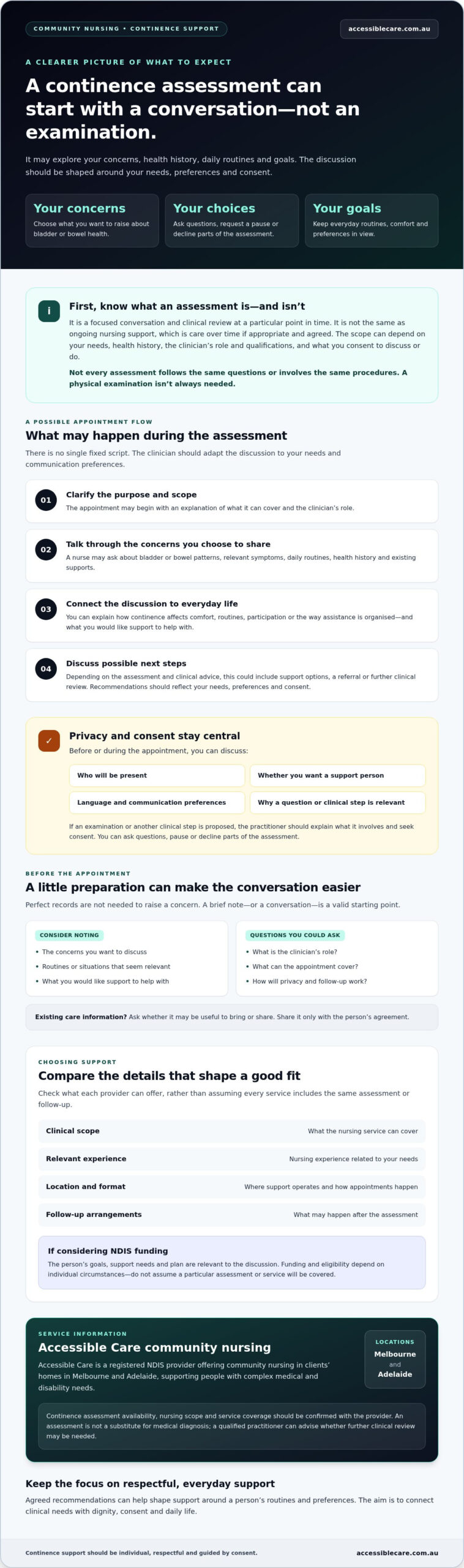
There isn’t one fixed script. A community nursing continence assessment should be adapted to the person’s needs, communication preferences and the clinician’s role. The appointment may begin with an explanation of its purpose and scope, followed by a conversation about the concerns the person wants to raise. The clinician may ask about relevant symptoms, patterns and routines, then discuss possible next steps based on what’s shared.
Privacy and consent matter throughout. The person can ask who will be present, request a support person, or discuss their preferred language and communication needs before the appointment. If an examination or another clinical step is proposed, the practitioner should explain what it involves and seek consent. The person can ask questions, pause or decline parts of the assessment.
How to prepare for the appointment
A little preparation may make it easier to talk, but perfect records aren’t needed to ask for help. Consider noting the concerns you want to discuss, any routines or situations that seem relevant, and what you’d like support to help with. For example, you could write down questions about the clinician’s role, privacy or what the appointment can cover.
If there’s existing care information that may be useful, ask whether to bring or share it. Only share information with the person’s agreement. A brief note or conversation is a valid starting point; don’t let missing details stop you from raising a concern.
What may be discussed and agreed afterward
Before the appointment ends, ask what the clinician has understood and what may happen next. Depending on the assessment and clinical advice, this could include discussing support options, a referral or further clinical review. Recommendations won’t be identical for everyone, and they should reflect the person’s needs, preferences and consent.
Clarify how follow-up will work. Ask who will receive any notes or recommendations, whether information will be shared with existing supports, and who to contact with questions. Agreeing these details can help the person stay involved and understand what happens after the conversation.
Accessible Care provides community nursing in clients’ homes. If you’re considering community nursing support, contact the team to check whether continence assessment is available, what it may involve and what follow-up can be discussed.
How to compare continence assessment and community nursing options
Providers may differ in what they assess, who delivers the service and whether support is available in your area. Don’t assume every nurse or community nursing provider offers the same continence assessment. Compare clinical scope, relevant nursing experience, location, appointment format and follow-up arrangements before deciding what may suit the person.
Information and helpline services can be useful for general questions, but they aren’t the same as an individual clinical assessment in someone’s home. Clarify what type of support you’re contacting and whether it can address the person’s specific needs. A community nursing continence assessment should be within the clinician’s scope, and the provider should explain what the appointment can and can’t cover.
| What to compare | Questions to ask |
|---|---|
| Clinical scope and experience | Is continence assessment available? Which clinicians provide it, and what relevant experience do they have? |
| Location and format | Does the service cover the person’s location? Is an in-home appointment possible, or are other formats available? |
| Access and follow-up | Is a referral needed? What happens after an enquiry, and how are urgent concerns directed? |
| Privacy and communication | How is consent handled? How can the person’s privacy, preferred language and communication needs be supported? |
Questions to ask a nursing provider
Use the first conversation to check practical details as well as clinical fit. Ask what information to prepare, who will be involved and how personal information is handled. If the provider can’t offer the assessment requested, ask whether it can explain other appropriate pathways. Clear answers help you understand the service without assuming it will meet every need.
How to check fit for disability-related support
For a person with disability or complex support needs, consider whether recommendations can connect with existing care. Ask how the provider might coordinate with the person’s clinicians, family or support team, and share information only with the person’s consent. Discuss how agreed recommendations could reflect everyday routines, communication needs and the person’s chosen goals.
Accessible Care provides community nursing in clients’ homes and supports people with complex medical and disability needs in Melbourne and Adelaide. Contact the team to ask about current assessment scope and location coverage. If complex support needs are relevant, the NDIS high-intensity supports guide offers further context.
How to turn assessment recommendations into respectful everyday support
An assessment is most useful when any agreed recommendations make sense in the person’s everyday life. With the person’s consent and in line with clinical advice, recommendations might inform how supporters communicate, organise assistance or adapt routines. They aren’t instructions to apply automatically. The person should have a say in what feels comfortable, practical and consistent with their goals.
Keep the person’s preferences at the centre
Start by asking what comfort, privacy and independence mean to the person. One person may want help to be offered discreetly; another may prefer to manage parts of their routine independently. Accessibility, preferred language, communication style and daily activities can all shape how agreed support is put into practice.
Involve family members or other supporters only when the person agrees and their involvement is appropriate. Continence needs aren’t a personal failing or an inconvenience. Use respectful language, listen without judgement and allow the person to change their preferences as their circumstances shift.
Coordinate support and review next steps
Before an appointment or care discussion ends, clarify what happens next. It may help to agree:
- Who will follow up and how the person can get in touch with questions.
- What information may be shared, with whom, and only with the person’s agreement.
- When the agreed support approach should be reviewed, especially if needs or routines change.
Ask the nurse which concerns can be discussed within their role and which may need review by another health professional. Changes in health or support needs can be a reason to seek appropriate clinical advice. A community nursing continence assessment doesn’t replace medical care, and a provider should clarify the limits of its scope.
If the person is an NDIS participant, confirm funding questions against their current plan and individual circumstances. Ask which support category may apply and whether the proposed support aligns with the plan. Don’t assume that an assessment, recommendation or ongoing service will be funded.
Accessible Care provides community nursing in clients’ homes and supports people with complex medical and disability needs. Ask Accessible Care about its community nursing scope, including whether it can discuss your needs and what next steps may be available in your location.
Choosing community nursing continence support in Melbourne or Adelaide
Accessible Care offers community nursing in Melbourne and Adelaide, including support for people with complex medical and disability needs. Contact the team to ask whether continence assessments are available. Before deciding what support may suit you, use this sequence to clarify the service and keep the person’s choices at the centre.
- Describe the need. Share the concern or support goal you feel comfortable discussing. You don’t need to provide every personal detail at the first enquiry.
- Confirm the scope. Ask whether a community nursing continence assessment is available and which clinician would be involved. Check what the appointment can cover and where the service boundaries lie.
- Check location and access. Confirm that support is available in the person’s part of Melbourne or Adelaide. Ask about referral steps, appointment options and any eligibility considerations.
- Discuss consent and preferences. Explain any privacy, communication or accessibility needs, and ask how existing care relationships can be respected.
- Agree on next steps. Before deciding, clarify what information is needed, who will follow up and what alternatives may be appropriate if the requested service isn’t available.
What to confirm with Accessible Care
Ask directly whether continence assessment is currently available in the relevant city. If it is, clarify the clinician’s role, relevant experience, assessment scope and any referral requirements. If it isn’t, ask what community nursing support may still be relevant or whether another pathway should be considered. Availability and suitability depend on the person’s needs and the provider’s current service scope.
You can also explain what matters to the person, such as maintaining privacy during care or coordinating with clinicians and supporters they already know. Information should be shared with others only with the person’s agreement. Ask how their goals and preferences can guide any discussion, and whether there are limits to what the nursing team can provide.
Taking a comfortable first step
An enquiry doesn’t commit you to an assessment or service. The person or their supporter can share only what they feel ready to discuss, then ask questions before deciding whether to proceed. It’s reasonable to request clear information about the clinician’s role, service options and next steps before making a choice.
If you’re in Melbourne or Adelaide, contact Accessible Care to ask whether its community nursing may suit your needs and to confirm current continence assessment availability and scope. A conversation can help clarify the options without assuming a particular service is available or right for everyone.
Take the next step at your own pace
A continence assessment can help clarify concerns and possible support, but the conversation should respect the person’s privacy, consent and goals. Preparing a few questions can make it easier to understand what an appointment may involve. Before choosing a provider, check its clinical scope, who may be involved and how follow-up will work.
Accessible Care is a registered NDIS provider offering community nursing in clients’ homes in Melbourne and Adelaide, including support for people with complex medical and disability needs. Contact the team to ask whether continence assessments are available, what the nursing service can cover and which next steps may suit your circumstances. A community nursing continence assessment may be one pathway to discuss individual needs, but the right option depends on the person’s circumstances.
Talk with Accessible Care about community nursing support and ask what may be available in your area. You can begin with the questions you feel ready to ask, then decide what feels right for you.
Frequently Asked Questions
What is a community nursing continence assessment?
A community nursing continence assessment is a conversation and clinical review of a person’s bladder or bowel concerns, health history, routines and support goals. A qualified clinician adapts the scope to the person’s needs, their role and the person’s consent. The appointment may help clarify possible next steps, but it doesn’t automatically include a physical examination or ongoing nursing care. Ask the provider what its assessment covers.
What happens during a continence assessment at home?
A home assessment may begin with the clinician explaining their role and asking what concerns the person wants to discuss. They may ask about symptoms, daily patterns, relevant health history and existing supports. The clinician should consider privacy, consent and communication preferences. The person can ask questions, request a pause or decline parts. Any recommendations or further clinical review depend on the individual assessment.
Who can request a continence assessment through community nursing?
A person can often contact a community nursing provider directly, and a family member, support coordinator or health professional may also enquire or refer. A GP referral isn’t always required, but each provider sets its own access process, so check first. The person’s agreement matters, particularly when someone else is making contact or sharing personal information on their behalf.
Does the NDIS cover continence assessment or products?
NDIS continence assessments are generally funded under Capacity Building – Improved Daily Living, while disability-related continence products may be funded under Core Supports, in the Consumables category. Funding depends on the participant’s circumstances and plan, so confirm the relevant support with the NDIA or a suitable adviser before making arrangements. NDIS funding for continence aids and the Continence Aids Payment Scheme can’t be received simultaneously.
How do I prepare for a continence nurse appointment?
Write down the concerns you want to raise, any relevant routines, and questions about privacy, the clinician’s role or next steps. Existing care information may be helpful, but share it only with the person’s agreement. You don’t need a complete diary or perfect records to start a conversation. If the person has language, communication or accessibility preferences, mention these when arranging the appointment.
Can a community nurse provide continence support at home?
Some community nursing services may provide continence-related support at home, but the available care depends on the clinician’s qualifications, provider scope and the person’s needs. Ask whether the service includes an individual assessment, ongoing support or another type of nursing care. Accessible Care provides community nursing in clients’ homes in Melbourne and Adelaide. Contact the team to ask whether a dedicated continence assessment is available.
How do I choose a continence assessment provider?
Ask whether the provider currently offers continence assessments, which clinicians conduct them and what their clinical scope includes. Check location coverage, referral steps, appointment format and follow-up arrangements. Also ask how the provider respects consent, privacy and communication needs, and whether recommendations can work alongside existing supports. Compare clear answers rather than assuming every community nursing provider offers the same service.

